


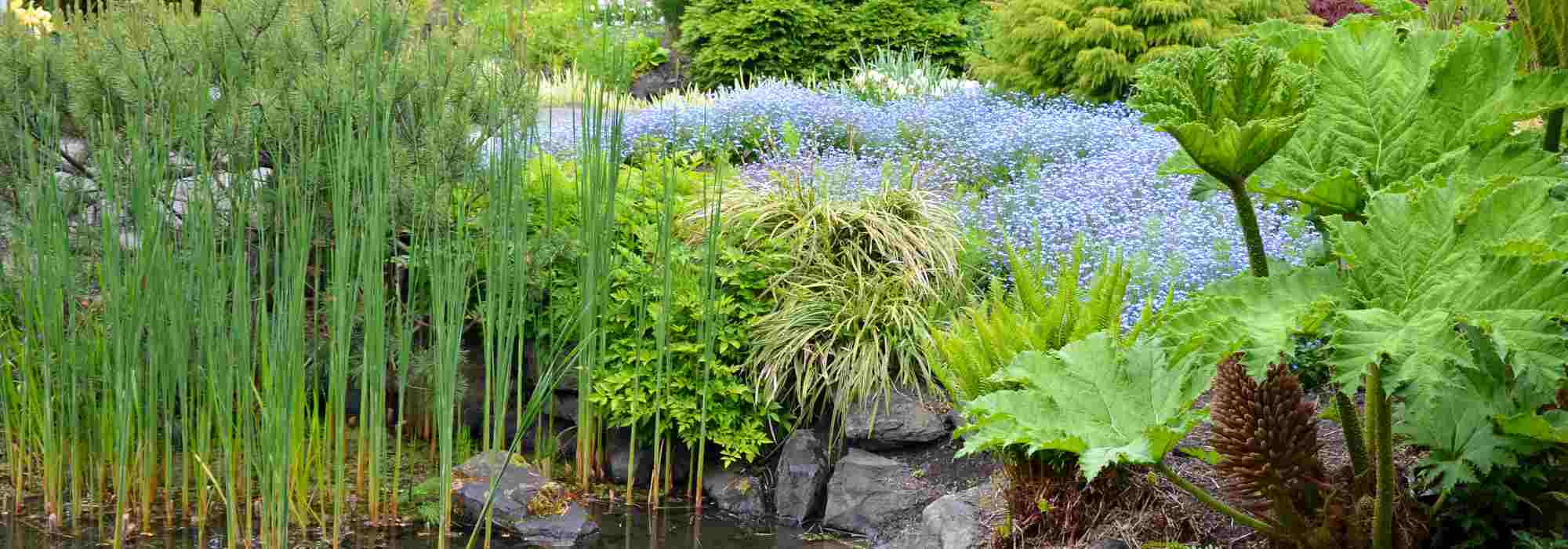
How do I choose plants that suit my garden?
Taking into account its characteristics: climate, soil, light and style
Contents
Plants that brighten a garden are not chosen at random. They must be suited to its characteristics, which vary from region to region, such as soil or climate, but also to location-related criteria such as its exposure and its environment. They must also be in keeping with the overall style and the effects sought in the garden. From this initial selection dictated by unforeseeable constraints, you will refine the plant range with your own tastes. Here are the right questions to ask yourself when you must decide on a tree, a bush, a perennial or any other plant to install in your garden.

Plants suited to my climate
Let’s start by talking about climate, one of the most tangible elements. Books on plants, online resources and nurseries clearly indicate whether a plant is frost-tender (negative temperatures, or even low positive temperatures, or prolonged frosts that will kill it) or ‘hardy’, i.e., able to withstand cold and negative temperatures, or semi-hardy when it sits halfway and tolerates some coolness.
Plants, whether perennials, shrubs or trees, all have a tolerance to cold (and to heat!), often stemming from their distant origins. Make sure to choose plants suited to the minimum and maximum temperatures of your region. We can always protect the parts above ground and the root system of the plants by various means, but common sense dictates that you plant in a garden a specimen that matches the characteristics of its climate, including rainfall and humidity, which are also very important for plants that require a lot of water, as well as the duration of sunshine.
In this climate context, how could we not talk to you about climate change and how it impacts our gardens? The decades ahead will require us to adapt our plants to it more and more. Find all our advice on our dedicated page: the garden facing climate change. We discuss, among other things, the impacts on gardening and the plants to favour now in each major region.
My tip : observe the plants in neighbouring gardens, visit a local nursery; you will find plants suited to your climate!
→ Also read: How to understand a plant’s hardiness data? ; Climate change: rethinking our gardens to adapt, and Climate zones and USDA zones in France. At Promesse de Fleurs, we classify shrubs by climate type to help you.
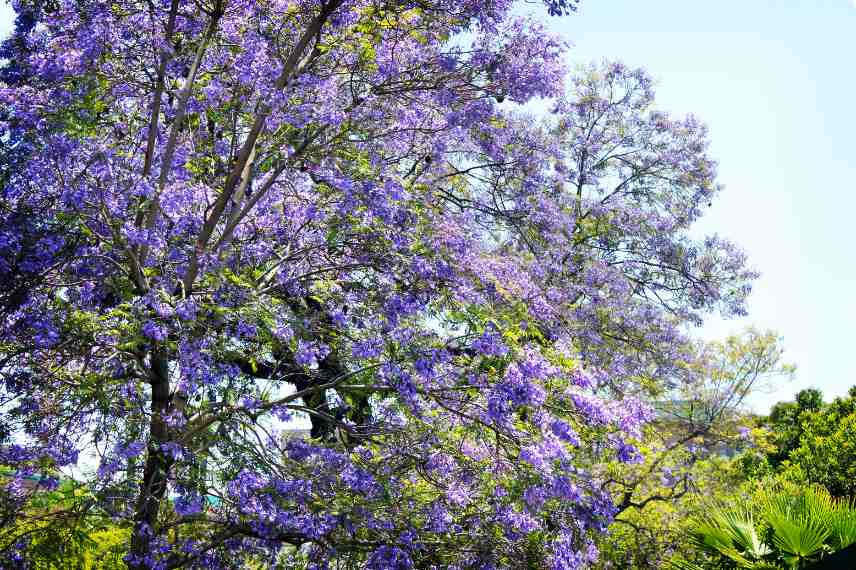
A jacaranda, striking with its blue habit, can still only be envisaged in southern regions and along the Mediterranean coast, due to the higher risk of late frosts elsewhere.
Plants suited to my soil
This cannot be emphasised enough: The soil is one of the most important elements to consider when choosing plants for your garden. It is the essential foundation for plants, from which they draw nutrients, organic matter and microorganisms, and it also supports gas and water exchange. Two key concepts to consider are soil pH and soil moisture or drought.
- Soil pH or potential hydrogen tells us about the degree of acidity or alkalinity of the soil, expressed on a scale from 0 to 14. A pH below 7 indicates acidic soil, while a pH above 7 indicates alkaline soil; a pH of 7 is neutral. Plants do not all grow in the same soils, and a striking example is ericaceous plants, which, as their name suggests, grow in soils with an acidic bias. For example, Daphne and Kalmia prefer acidic soil (pH below 6), while lavender thrives in alkaline soil (pH above 7). It is therefore essential, before choosing plants, to know the pH of your soil. If your soil analysis reveals acidic soil, you will need to select only plants suited to that pH, or risk them quickly developing develop chlorosis quickly. Olivier shares you with home tips for analysing your soil yourself.
→ Read: Gardening in calcareous soil, gardening in acidic soil ; 10 perennials to grow in acidic soil, 10 perennial plants for calcareous soil ; Soil life decoded: understanding its essential role in the garden, and our Bushes by soil type page.
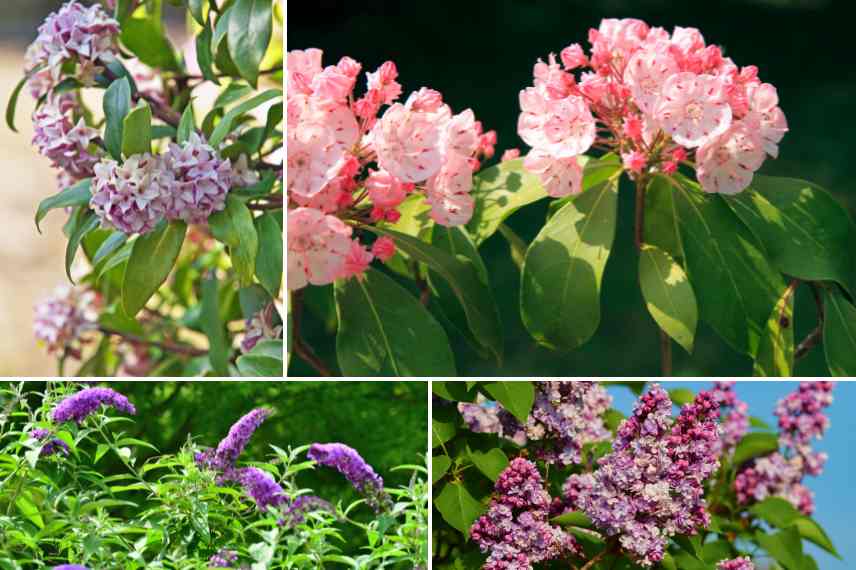
Daphne and Kalmia are ericaceous plants that prefer acidic soils, while Buddleja and lilac prefer alkaline soils
- Moist, cool or dry soil? Not all plants have the same water needs, and soils do not all have the same moisture level due to their texture (sandy, loamy or clayey). The soil’s ability to retain water is as important as its level of alkalinity or acidity. Plants that favour moist soils, such as marsh irises and astilbes, will only thrive in cool, moist soils. By contrast, plants suited to dry, well-drained soils (often calcareous and shallow), such as yarrow, agaves and yuccas, will be more drought-tolerant and will require less water during hot spells. There is also dry shade in gardens, notably at the base of trees, which requires plants well suited to cope with it.
→ Read: Gardening in heavy, wet soil, gardening in dry shade, and our advice page on gardening in dry soil.
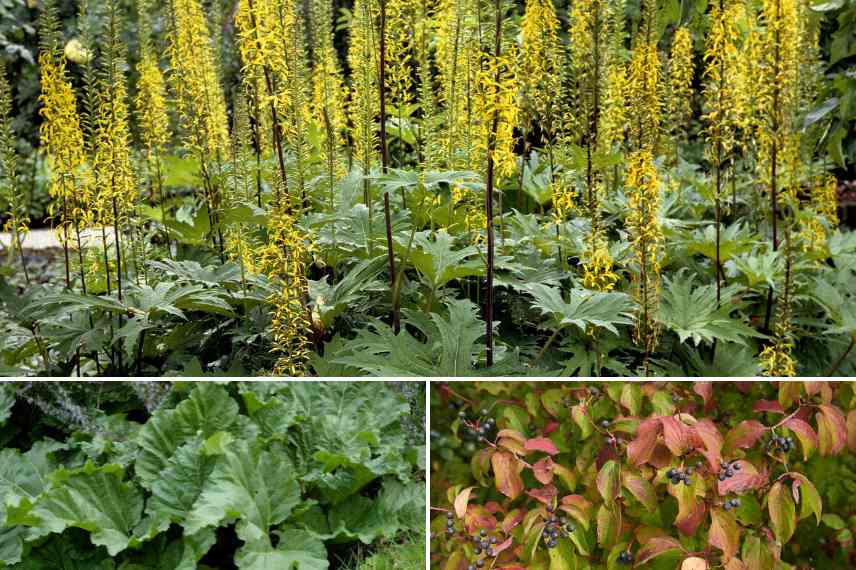
Ligularias, rhubarb and cornelian cherries require cool, moist soil
Plants suited to the site: understanding exposure
Plants each have very varied light requirements, and the exposure, the sunlight they will or will not receive, are major factors in their development. Thus, we generally divide plants into two broad categories: ‘shade-loving plants’ and ‘sun-loving plants’. Between the two, that is, for a semi-shaded situation receiving 4 to 5 hours of direct sun per day, they are described as part‑shade plants (learn more in our piece on the light in the garden: exposure, sunlight, shading and brightness).
Some plants will therefore need full sun exposure to provide generous flowering or to thrive: these are often plants with linear or reduced foliage, blue-tinged or silvery, such as the gauras for perennials, the eucalyptus among trees or the junipers among the conifers. You will also find plants with fleshy foliage, which store water in their tissues, such as agaves, yuccas and other sedums.
Conversely, shade plants often feature broader or glossy foliage, such as the hostas or hydrangeas. They are perfect for shaded areas, cool borders beneath trees or near buildings. Shade gardens will therefore draw from the wide range of plants, somewhat less flowering but with delicate and handsome foliage, and sunny gardens will benefit from a very wide palette of plants from many continents.
→ To read: 6 tips from a landscape gardener for creating a shade garden; How to design a north-facing garden?; How to design a west-facing garden?, How to design an east-facing garden?, How to design a south-facing garden. and our section on the shade garden.
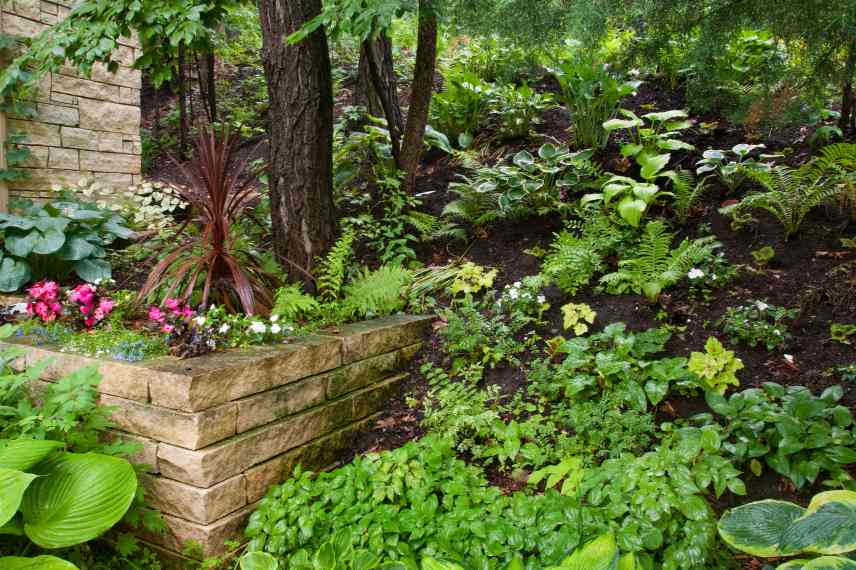
In shade, you’ll have somewhat less flowering and plenty of ornamental foliage.
Read also
Nothing grows in my garden. Why?Plants adapted to the environment
The environment is another factor to consider, as it significantly influences the plants that can be grown in geographical or geological circumstances, such as flood-prone areas, urbanised zones subject to higher pollution, gardens exposed to wind and sea spray, etc.
A flood-prone garden will have to cope with plants that can tolerate high groundwater rise in winter, such as willows, Eupatorium and many others. A garden exposed to sea spray must incorporate plants that tolerate both wind and salt-laden air, such as the tamarisk or Atriplex halimus, while a garden under pine trees combines low undershrubs and plants suited to acidic or sandy soils.
Sloping gardens, with a steep gradient, require choosing plants that thrive on slopes, and garrique gardens, on exposed rock and arid calcareous limestone, will incorporate a range of hardy plants that withstand both heat and cold.
Finally, urban gardens are planned with plants that stand up well to ambient pollution, which can be high in large urban areas, with for example bushes such as privets or Skimmia.
→ To read: 5 tips for designing a garden in a windy climate ; designing a garden in a garigue area and what landscaping ideas can enhance a sloping site?
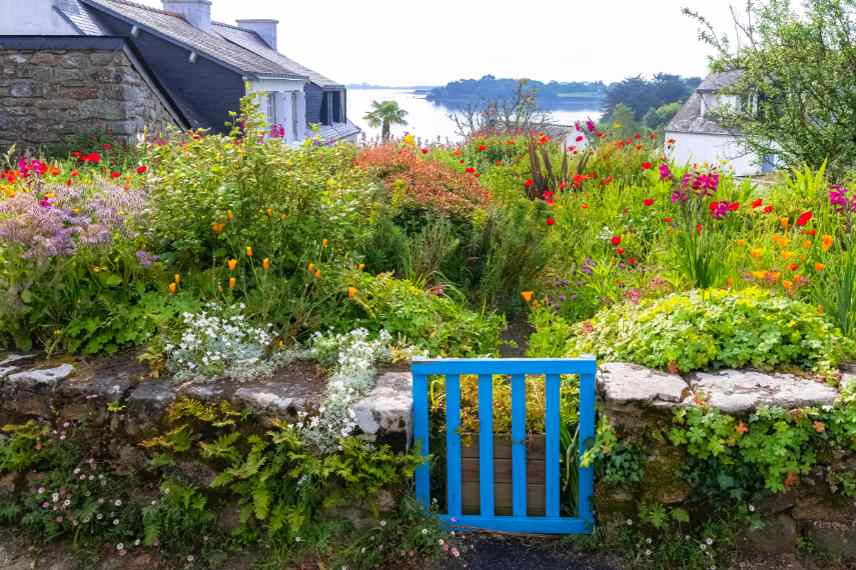
By the sea, we also adapt plants to cope with stronger winds and sea spray.
Plants suited to the garden style.
Enfin, et ce critère n’est pas à négliger, il est raisonnable aussi de choisir pour son jardin des plantes qui vont s’accorder au style que l’on définit par goût personnel et/ou en accord avec la bâtisse. We can always plant, as fashion dictates, olive trees in the Île-de-France region and surround them with other plants that do not reflect this southern note in a garden, but better to set a coherent line for the garden’s spirit and the plant families from the outset: the garden will gain enormously. Here are a few examples for the most common garden types:
- Small urban garden: you’ll make greater use of grimpantes (climbing plants) and adapt with compact plants; read our tips in Designing a small garden, Designing a city garden and Gardening in a block of flats.
- Large garden: free-form shapes in bushes (unpruned) are preferred, and we allow broad and generous plants. We give you plenty of ideas in Designing a large garden and Which trees to choose for a park.
- Exotic garden: you can envisage it as a jungle garden, a dry exotic garden in southern regions, a classic exotic garden, a Madeira-inspired garden or a garden with South African accents!
- Japanese-style garden: Japanese maples, bamboo and azaleas are ideal plants for creating a zen atmosphere. Here, ericaceous plants are highlighted, as are the cloud-pruned shrubs. We tell you more in Create a Japanese or Zen garden and in 7 planting ideas for Japanese gardens.
- Contemporary garden: these are the graphic and upright plants that will be favoured, including some grasses. Learn more about suitable plants in our piece How to create a contemporary garden?.
- Montane garden: opt for hardy plants such as gentians, edelweiss and rhododendrons. These plants are suited to high-altitude conditions.
- Naturalistic garden: it places emphasis on wildflowers, flexible plants, and perennials and grasses, to be found in our advice sheet Designing a naturalistic garden.
- English garden: it makes extensive use of roses, climbing plants and perennials such as Delphiniums or poppies;
- Southern garden that can be expressed as a Mediterranean garden and its 10 iconic plants, a garrigue garden up to a Californian-style garden.
- Drought garden: we prioritise all drought-resistant plants, the plants of the scree garden, perennials of the rock garden;
- Coastal garden: plants must withstand salty sea spray and strong winds. Tamaris, sea thrift and everlasting flowers are suitable choices.
- Sans oublier le holiday home garden pour lequel on choisit les plantes qui fleurissent quand on y est ! (10 perennial plants flowering in late spring, 5 bushes flowering in early summer, etc.)
- Finally, the monochrome garden, where you’ll opt for a dominant colour, white, the blue, the pink, the yellow… by selecting your favourite plants.
→ Read also: Creating a mountain garden and our garden inspiration Escape to Île aux Moines.
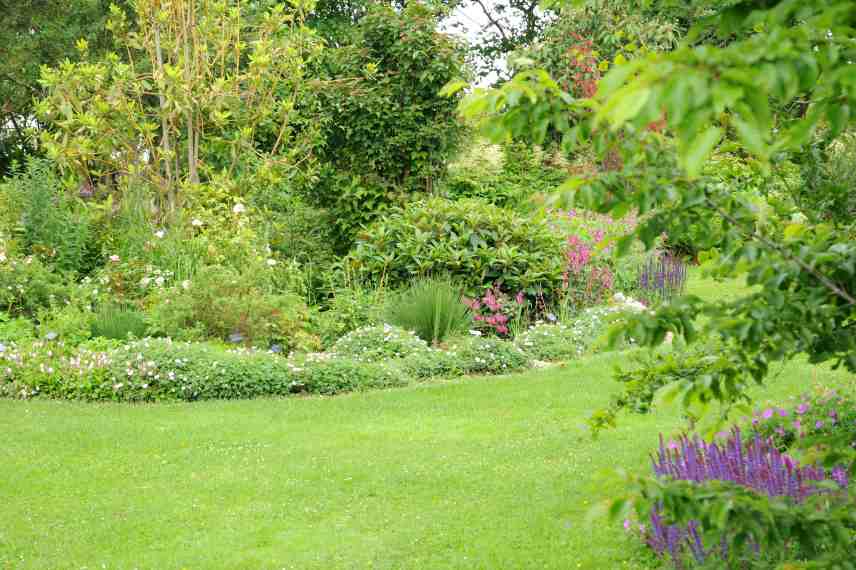
An English-style garden
Further reading...
At Promesse de Fleurs, to help you choose the plants best suited to your garden, we provide free access to our Plantfit tool. It allows you to take stock of your garden by creating the various zones and beds, and to receive personalised recommendations based on all the elements we’ve covered: soil analysis, sun exposure and the environment, but also choices in terms of colour and the sizes of the young plants.
- Subscribe!
- Contents
Comments