


How to grow Ginkgo biloba in a pot?
Growing successfully on a terrace, balcony or in a small garden
Contents
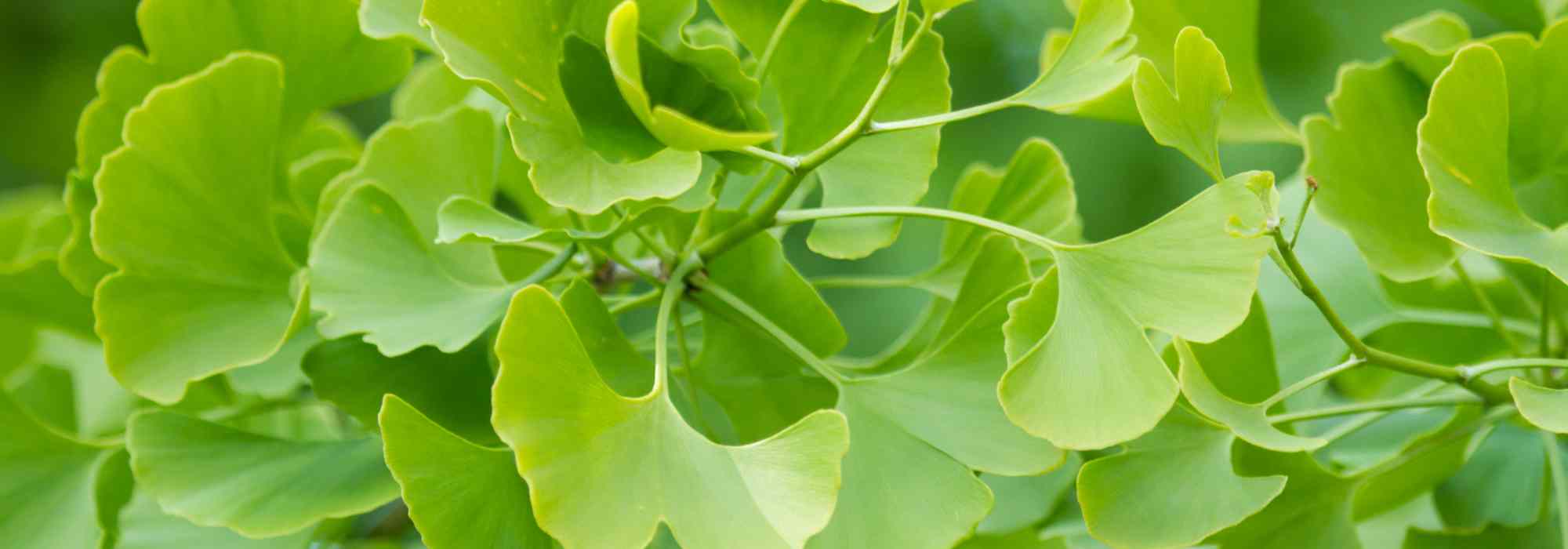
Ginkgo biloba is a majestic tree, which is recognisable by its remarkable fan-shaped foliage, taking on golden hues in autumn. With an exceptionally long lifespan, it is renowned for its hardiness.
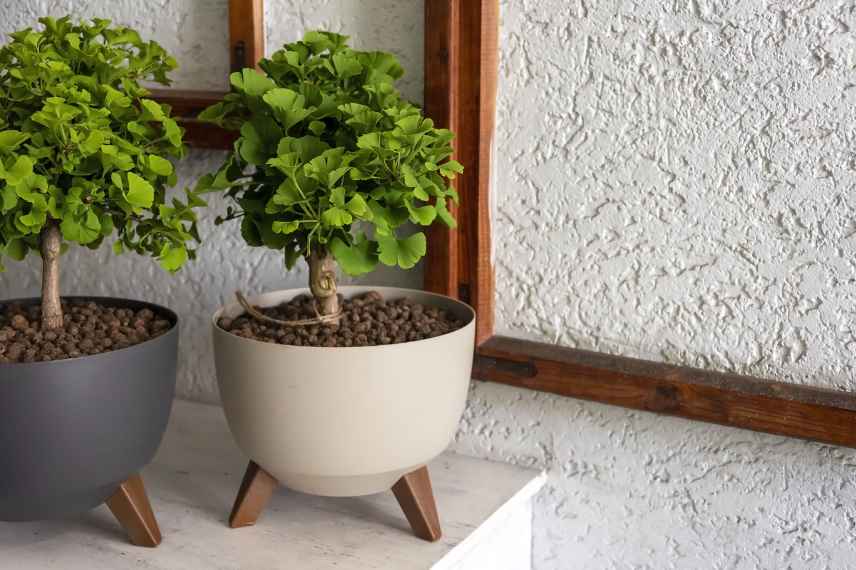
Although the largest specimens can reach up to 40 metres tall, did you know there are also dwarf varieties? They are therefore very well suited to container growing, to brighten terraces, balconies, patios and small gardens. They are also used in the art of bonsai.
So discover our tips here for successfully growing a Ginkgo in a pot, from planting to care.

Which varieties of Ginkgo biloba should I choose for growing in pots?
For pot culture, it is essential to select small-sized Ginkgo biloba of modest size. With limited space, only the smallest varieties will be able to grow without difficulty. This tree also benefits from relatively slow growth during its early years, which is advantageous for container cultivation.
We recommend choosing cultivars that measure a maximum of 2.50 metres.
Among the smallest Ginkgos, firstly we mention ‘Chris Dwarf’, a dwarf cultivar that reaches only 60 cm in height with a spread of 80 cm. Its dense foliage is smaller and more undulate than that of the type species.
Not much larger, the variety ‘Troll’ barely exceeds 1 metre across in all directions and has a well-compact globose habit.
Another dwarf Ginkgo biloba: the cultivar ‘Baldi’, which has a rather spreading silhouette and will measure about 1.50 metres across.
With its weeping and fastigiate (vertical) habit, reaching 2 metres in height with only 60 cm across, ‘Mutant Weeper’ is clearly hard to miss. Its foliage forms a dense, upright mass with a somewhat unruly appearance, which will broaden over time. A real curiosity!
And if you have a little more space, opt for ‘Mariken’ or ‘Globus’, which do not exceed 2.50 metres in all directions.
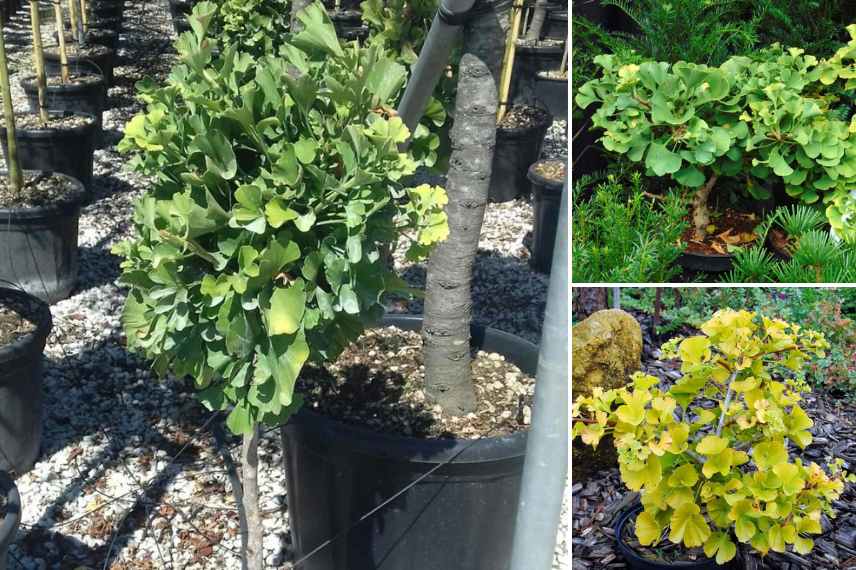
Ginkgo biloba ‘Chris Dwarf’, ‘Troll’ and ‘Mariken’
When is the best time to plant Ginkgo biloba in a pot?
The planting of Ginkgo biloba in a pot is preferably carried out in spring, between February and April depending on the region, once the last risk of frost has passed.
If you live in a region with mild winters, you can plant in autumn.
Potting up Ginkgo biloba in a pot
The container
Choose a container that will be about twice the volume of the root ball. It is essential to select a pot or tub with drainage holes. Ginkgo does not tolerate standing water at all.
In terms of material, terracotta allows better aeration of the substrate, since it is porous. However, water evaporates more quickly, so more regular watering will be necessary. Plastic containers are economical and retain moisture better, but are regarded as less aesthetically pleasing. The choice is yours.
The substrate
Ginkgo grows in ordinary soils, even calcareous or stony ones. However, it requires a well-drained substrate, in which water does not stagnate.
For planting, opt for a special potting compost for planters and pots or make your own mix with:
- 2/3 of horticultural potting compost of good quality or garden soil if it isn’t too heavy / clayey ;
- 1/3 of river sand or drainage elements (clay balls, perlite, gravel…) ;
- 1 to 2 handfuls of mature household compost or well-rotted manure.
Planting
About an hour before planting, we recommend immersing the root ball of your Ginkgo biloba in a container of room-temperature water to rehydrate it thoroughly.
- Install a drainage layer about 3–5 cm thick at the bottom of the container. Use gravel, terracotta shards or clay balls.
- Add the substrate until it fills about 1/3 of the container’s height.
- Carefully unpot your Ginkgo, ensuring you keep the root ball, and place it in the centre of its new container. Top up with substrate until the root ball is well covered.
- Firm gently with your fingers all around the base to drive out air pockets.
- Water generously.
- Install an organic mulch (straw, hay, dead leaves, RCW or plant husks), which will limit evaporation of the watering.
The planting steps are the same if you wish to grow your Ginkgo as a bonsai, but you will then need to follow proper pruning techniques to reduce root volume. Also adapt the substrate, which must be perfectly drained.
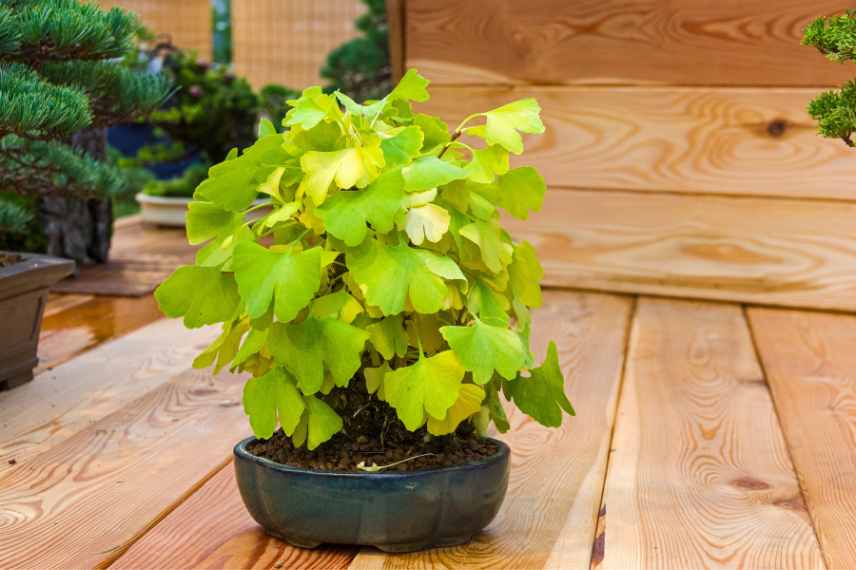
Grown as a bonsai, the pot and substrate will be adjusted
Exposure
The Ginkgo biloba prefers sunny exposures, possibly lightly shaded in hot regions of southern France.
Note that it is a tree that resists pollution well, making it an ideal candidate for urban gardens.
Ginkgo biloba care in a pot
Watering
The Ginkgo prefers moist soil that never fully dries out. So ensure regular watering, especially since water will evaporate more quickly in a container of limited size. Gently check the top few centimetres of soil with your fingers. If they are dry, it’s time to water.
If you have a saucer under the pot, remember to empty it after about twenty minutes.
Fertilisation
Fertilising is not strictly necessary for the Ginkgo. If desired, you can add a handful of well-decomposed household compost at the start of spring, to be gently incorporated by surface soil raking.
If you don’t have any, there are fertilisers for trees and shrubs that stimulate root growth and leaf development. They are generally in solid form (sticks, granules…) for long-lasting action. Simply incorporate them into the substrate following the indicated dosages.
Pruning
Ginkgo is not a tree that particularly loves pruning. So simply cut away any damaged or poorly positioned branches, in order to maintain a harmonious shape. Carry out pruning in late winter, during the plant’s dormancy. Use cutting tools that are well sharpened and previously disinfected with 70% alcohol.
Diseases and pests
This is one of the great strengths of this tree: the Ginkgo biloba has no real enemies. It is not susceptible to diseases or parasites and has an impressive lifespan. Some specimens are believed to be over 3,000 years old.
Overwintering
The Ginkgo is a very hardy tree, able to withstand temperatures below -25°C. It can therefore spend the winter outdoors in all our regions. In the first years, if winters are particularly harsh, it would be preferable to move it to a location sheltered from cold winds, since cold resistance is always poorer when grown in a container.
- Subscribe!
- Contents
Comments