


How to grow tickseed in a pot?
All our tips on planting and caring for this sun-loving perennial, grown in pots or planters
Contents
If you love yellow flowers, you’ll surely know Coreopsis, which has made that colour its signature! Coreopsis, also called tickseed, is essentially a perennial plant, sometimes an annual, which charms with its sunny, luminous flowers, usually yellow, but sometimes red, pink or bi-coloured. Originating from meadows in North America, it is renowned for its ease of cultivation, its prolific flowering and its ability to attract pollinators. For many months it brightens even the smallest perennial border or a rock garden with these vibrant colours. If you don’t have a garden, or if you want to brighten a balcony or a terrace, growing Coreopsis in pots is an ideal option.
Discover how to successfully grow Coreopsis in pots, from planting to overwintering, including day-to-day care.

Which tickseed varieties are best for growing in pots?
Not all Coreopsis varieties are suitable for pot culture. Accordingly, the tallest species and varieties, which can still reach up to 1.80 m, are not recommended for growing in pots or window boxes. It is best to select small-sized varieties with a compact habit, perennial or annual. Some breeders have, in fact, developed varieties specifically destined for pot culture.
We present you with a selection of the best Coreopsis to grow in pots
Perennial Coreopsis for growing in pots
- Coreopsis lanceolata : these Coreopsis have yellow flowers and light green, lanceolate foliage. This species is distinguished by a bushy, compact habit, with an average height of 25 to 30 cm. Our recommended varieties: ‘Baby Gold’ with bright yellow flowers, marked with burgundy at the base of the petals, or ‘Sternlater’ with golden-yellow flowers, with a brown eye.
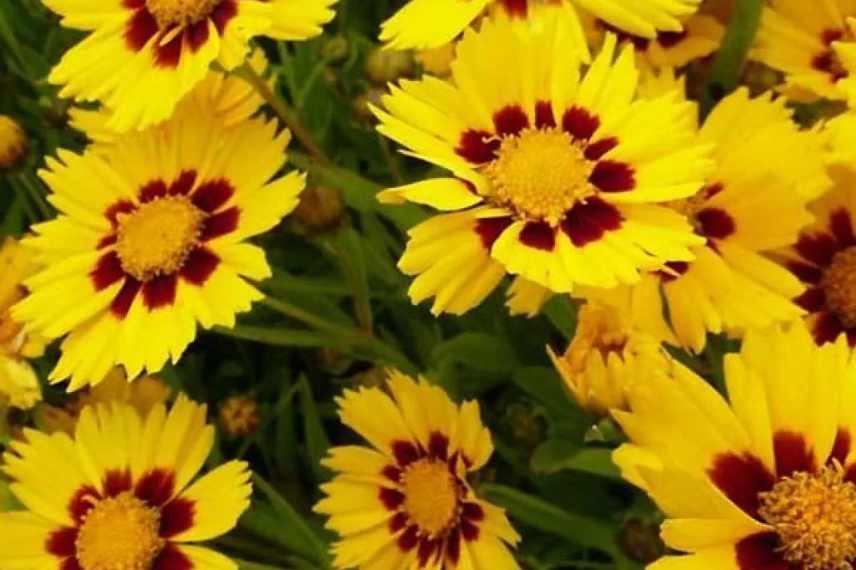
The Coreopsis ‘Baby Gold’
- Coreopsis verticillata : these verticillata Coreopsis form compact, very dense clumps. The stems are highly branched and the foliage is finely divided. They are stunning in flowering containers. There are a multitude of varieties, never taller than 40 to 50 cm with a corresponding spread, which allow a wide colour palette. Our recommended varieties: ‘Zagreb’ is a safe bet with its golden-yellow heads, ‘Moonbeam’ offers star-shaped flowers in pale lemon-yellow to buttery yellow, ‘Ladybird’ stands out for its bright red flowers with yellow tips, and ‘Route 66’, a new variety with yellow flowers, randomly splashed with purple.
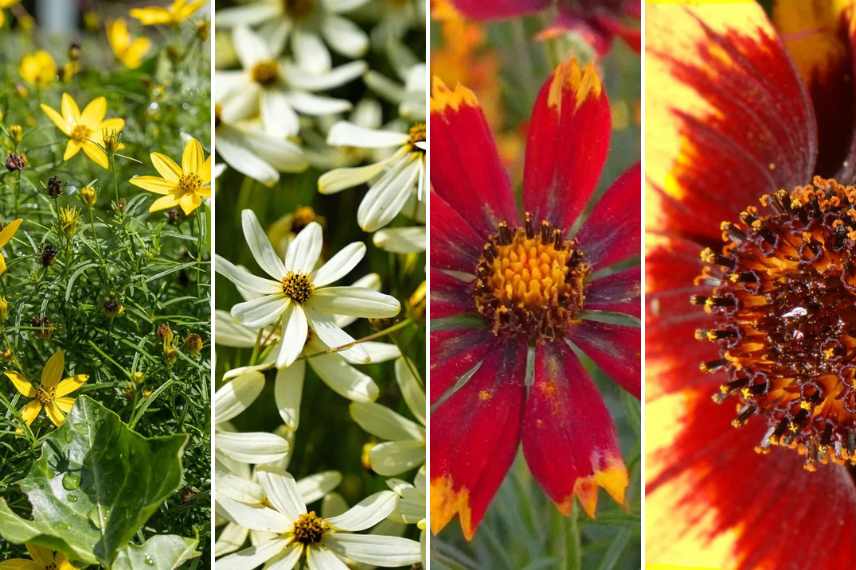
The varieties ‘Zagreb’, ‘Moonbeam’, ‘Ladybird’ and ‘Route 66’
- Coreopsis grandiflora : the Solar® collection is particularly well suited to pot planting, as these hybrid Coreopsis form bushy clumps, 40 cm tall and 30 cm wide. This series is also noted for its abundant flowering, disease resistance and ease of cultivation. ‘Solar® Moon’ offers flowers in pastel yellow with a red centre, ‘Solar® Fancy’ produces cherry-red flowers with yellow edges, and ‘Solar® Jewel’ with bright yellow flowers maculated with red. One could also mention ‘Early Sunrise’, an astonishing variety with its enormous flowers of a vivid yellow surrounding a honey-brown eye.
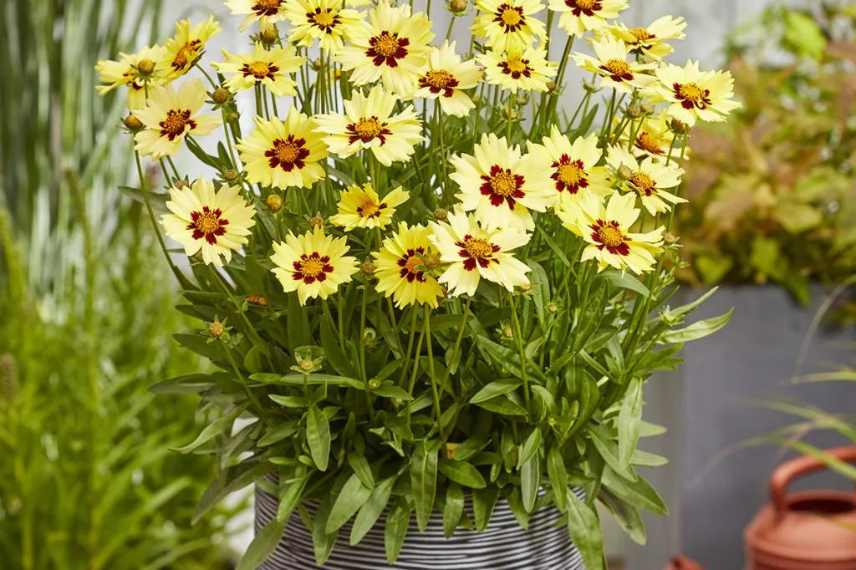
‘Solar® Moon’, one of the representatives of the Coreopsis Solar® series
Annual Coreopsis suitable for pots and window boxes
Annual varieties belong to the species Coreopsis tinctoria, or dyer’s tickseed. They can reach from 30 cm to 1 m in height. The shorter ones are therefore suitable for pots and window boxes, while the taller ones are perfect as cut flowers. The variety ‘Corusco Cream-Red’ is particularly well suited to pots thanks to its dense habit and compact size, as it does not exceed 20 cm in height. It also offers splendid cream-white flowers with a handsome burgundy-red centre.
Read also
Coreopsis : to sow, to plant, to growWhen should you plant Coreopsis in a pot?
Coreopsis perennials are sold in pots and can be planted directly in a pot, while annual Coreopsis are sold as seeds and sown.
Coreopsis perennials are planted in pots from mid-April to June, when frosts are no longer a concern. In regions with a milder climate, planting can take place from September to November. In any case, this planting is always carried out outside frost and drought periods.
Sowing of annual Coreopsis can be started in pots indoors from March–April, or directly into a pot outdoors from May, depending on the weather.
Planting Coreopsis in pots
Coreopsis can be a faithful ally for balconies, terraces and windowsills, not to mention small spaces. Grown in a pot, it offers generous and long-lasting flowering with few requirements. All that remains is to provide it with the best cultural conditions.
Choosing the container
Choose a terracotta, resin or thick plastic pot, at least 30 cm in diameter for a single plant. The pot must have a drainage hole. A bed of clay balls, pouzzolane or gravel at the bottom of the pot will prevent excess water and limit the risk of root rot.
Choosing the substrate
Coreopsis prefers well-drained soils, poor to moderately rich, and light. It suffices to prepare a light mix with half potting compost, a quarter of river sand and a quarter of mature compost or sifted garden soil. Add a little perlite to improve aeration of the substrate.
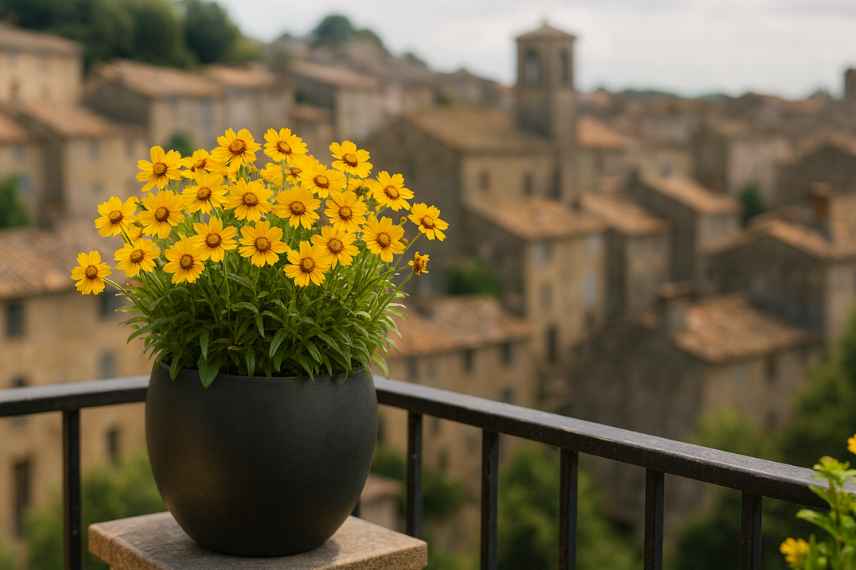
Coreopsis adapts very well to growing in pots (AI-generated image)
How to plant Coreopsis in a pot ?
- Soak the plant’s root ball in a bucket of water
- Fill half the pot with the substrate
- Position the root ball so that the collar is level with the surface of the pot
- Fill with the remaining substrate and firm with your fingers to avoid air pockets
- Water thoroughly and, if desired, mulch.
How to sow annual Coreopsis ?
- Fill small pots with a seed-sowing compost
- Sow by scattering, not burying the seeds too deeply (they need light to germinate)
- Water with a fine spray and keep the substrate slightly moist
- Germination takes 7 to 14 days, at 18 to 20 °C
- Transplant into a larger pot when the plants have 2 or 3 true leaves.
Read also
Choosing a CoreopsisWhat care does a Coreopsis need in a pot?
Whether planted in the ground or in a pot, Coreopsis is very low-maintenance. A few small attentions are nevertheless necessary.
Watering
Coreopsis tolerates drought well, especially the perennial varieties. In a pot, water evaporates more quickly, so plan for moderate but regular watering: in summer, water once to twice a week, depending on the weather, and in winter, very little, or even no watering for perennials in dormancy.
Always allow the surface of the potting mix to dry between waterings, and avoid waterlogging in the saucer or cache-pot. Watering should ideally be carried out at room temperature.
Fertilisation
Une fertilisation légère suffit. Apportez un engrais liquid pour plantes fleuries une fois par mois de mai à août. Un excès d’azote favoriserait le feuillage au détriment des fleurs.
Translation: A light fertilisation is sufficient. Apply a liquid fertiliser for flowering plants once a month from May to August. An excess of nitrogen would promote leafy growth at the expense of flowers.
Cutting back
- Regularly deadhead faded flowers to prolong flowering and encourage the appearance of new blooms
- Lightly prune the stems that become too elongated or bare
- In autumn, cut back the stems to 5–10 cm from the soil. You may also leave them to protect the rootstock and tidy the plant in late winter.
Reppoting
Perennial varieties should be repotted every 2–3 years. Take the opportunity to divide the rootstock if it becomes too dense. This stimulates flowering and renews the plant’s vigour.
Protection during winter
- Annual varieties do not survive the winter, but seeds can be collected for a new sowing
- Hardy perennials withstand -10 to -15 °C, but in pots they are more sensitive. Therefore, protect them by placing the pots against a sheltered, south-facing wall, generously mulching the base, and wrapping the pot in a winter veil.
It is also possible to bring the pots indoors into a bright, unheated garage.
Monitoring diseases and pests
Coreopsis is not prone to diseases. However, in pots, watch for:
- Powdery mildew: white patches on the leaves, encouraged by stagnant humidity. Remove affected leaves and air the plant
- Aphids, often on new growth. Use a jet of water or a soap-based solution.
- Subscribe!
- Contents
Comments