


The best yellow- or golden-leaved Hostas to brighten up the garden
A selection of Hostas to brighten shaded areas in the garden or in pots
Contents
Hostas are among the essential choices for brightening shaded, cool spots. Easy to grow and requiring little maintenance, these perennials captivate us especially with their foliage. They come in several colours, in solid or variegated forms, from the classic green to the more striking blue, including yellow and gold. These hues inevitably bring light to the garden, balcony or terrace. Let us look at which varieties of Hostas with yellow or golden leaves, how to choose them and how best to pair them in the garden.

The appeal of golden hostas in the garden
Yellow and gold are among the brightest colours for the garden. They evoke the sun, warmth and vitality, especially in areas that receive little light, such as shaded or semi-shaded spots.
These colours help create a focal point by drawing the eye, and provide a touch of depth. They stand out from more classic and monotone green foliage. But they can also beautifully enhance other colours by playing with contrasts, particularly with cooler tones such as red, blue or dark colours (crimson, violet, brown, burgundy…).
Golden foliage is also so decorative that it can compensate for a lack of flowers.
This colour is often represented in autumn, when leaves change hues and offer us a flamboyant display. Hostas have the advantage of displaying this colour for many months, sometimes from spring through to the approach of winter.
On Hostas, yellow can be expressed in several shades, ranging from lime-green with a hint of gold to a more intense yellow. Depending on light levels, these colours can even show variable hues.
As with all Hostas, golden or yellow varieties will brighten all areas that receive little light in the garden, even in heavy, damp soils. They will fit equally well in a bed as in a border, near a water feature, in woodland, in a cool rock garden or in pots. They are effective whether grown in isolation or paired with other plants.
Let us recall that, in the plant kingdom, yellow or golden colouring is not due to disease but to natural mutation or to hybridization (cross-breeding between two species carried out by humans).
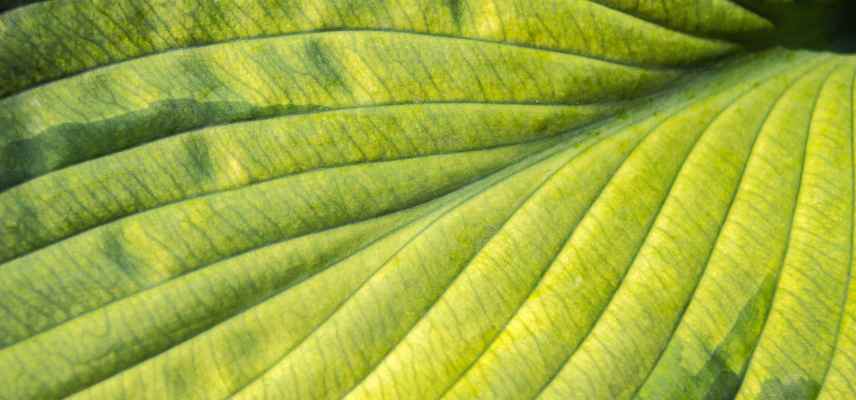
Yellow hostas bring welcome light to shaded areas
Read also
Hosta: planting, growing and careSmall Hostas with yellow or golden foliage
These are dwarf hostas, which will require very little space to grow well. They fit neatly into small pots to brighten a terrace, balcony or courtyard, but also in the ground in mini beds or borders.
The smallest varieties do not exceed 20 cm, as exemplified by the Hosta sieboldii ‘Wogon’ (15 cm tall), whose chartreuse green foliage evolves into shades of yellow. Also mini is the Hosta ‘Sun Mouse’, gracing us with a colour ranging from golden yellow to lime green. ‘Curly Fries’ (also 15 cm tall) stands out with the shape of its leaves, lanceolate and very undulate. They are variegated, nicely blending yellow and green.
Still among the dwarf varieties, let us mention the Hosta ‘Lipstick Blonde’, which reaches only 35 cm in height. It produces leaves of a lovely bright yellow that contrast wonderfully with a red petiole.
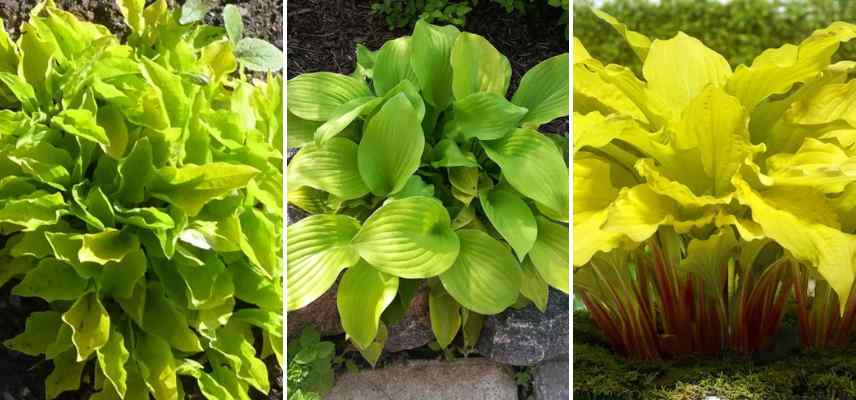
Hosta sieboldii ‘Wogon’, Hosta ‘Sun Mouse’ and Hosta ‘Lipstick Blonde’
A little larger, the intermediate varieties measuring between 40 and 80 cm in height remain easy to integrate into the garden or in pots. This is particularly the case for ‘Fire Island’, with a height of 45 cm and a spread of 60 cm. This Hosta produces leaves that are anise-green, almost translucent. With a subtle colour, ‘August Moon’ features veined foliage, pale green with golden accents, dusted with a fine bluish bloom. It measures 50 cm, but it spreads to nearly 1 metre, making it an excellent groundcover. Also let’s mention ‘Ki Ren Jyaku’, a much rarer variety, whose lush, rounded foliage bears a golden yellow turning to chartreuse green.
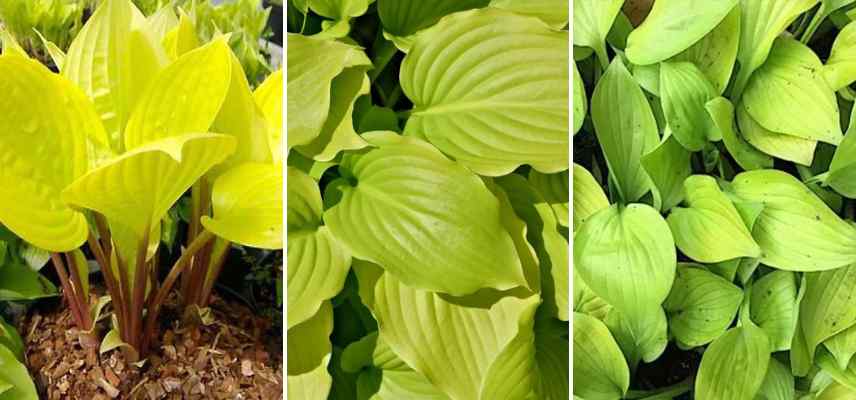
Hosta ‘Fire Island’, Hosta ‘August Moon’ and Hosta ‘Ki Ren Jyaku’
The most imposing hostas with yellow or golden foliage
Some Hostas are giants, reaching nearly 1.5 metres in height or spread. They make true focal points, stunning when grown on their own or in a handsome container to brighten a terrace, balcony or courtyard. They offer plenty of freshness and volume.
The golden-yellow varieties have a more modest silhouette, but some are nevertheless quite imposing, able to make their mark. Among them, notably ‘Coast to Coast’, which forms a lush clump of large golden-yellow leaves in spring, brightening as time passes. It reaches 75 cm in height with a 90 cm spread.
‘Sun Power’ also begins with golden-yellow foliage, which later turns chartreuse. Its veined, undulate foliage is particularly striking when it catches the soft light of the sun.
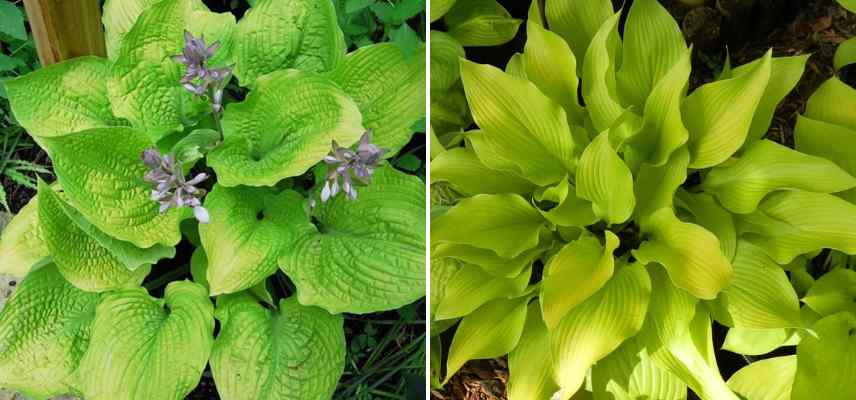
Hosta ‘Coast to Coast’ et Hosta ‘Sun Power’
Read also
The most beautiful variegated HostasYellow- or golden-leaved Hostas with fragrant flowering
Hostas offer a delicate flowering, with small bell-shaped or trumpet-shaped flowers, often white or lilac. They are borne on flowering stems that add height and vertical interest.
Flowering occurs from June to September, depending on varieties, and can last two months. In some varieties, it can even be scented. This is the case with Hosta ‘Fragrant Dream’ (which means ‘fragrant dream’), whose clusters of white bells tinged with mauve exhale notes of orange blossom. This variety also features bright heart-shaped foliage, dark green with yellow-green edging. Not large, it reaches up to 60 cm across.
Among more unusual flowering varieties, we again note ‘Ki Ren Jyaku’, which in summer produces semi-double flowers bearing delicate pink hues.
Yellow- or golden-leaved Hostas that are slug-resistant
As mentioned, Hostas are easy-to-care-for plants that don’t require much in the way of care or attention. However, they have two main enemies, especially at the start of spring: slugs and snails. Their tender foliage is indeed very appetising to gluttonous gastropods, which can cause heavy damage to a young hosta plant.
Fortunately, some varieties are reputed for their greater resistance to slugs. They indeed have thicker and tougher foliage, less attractive.
Among yellow and golden foliage, this is notably the case for:
- ‘Fire Island’, a very vigorous variety;
- ‘Sunny Halcyon’, with thick leaves;
- ‘Coast to Coast’, with very textured foliage.
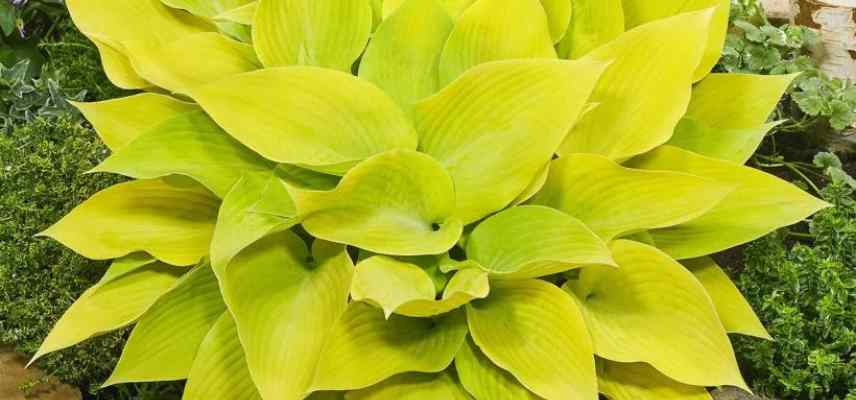
Hosta ‘Sunny Halcyon’
How to pair yellow- or golden-leaved hostas in the garden?
Golden foliage tends to attract the eye in the garden. For a striking effect, we recommend using them sparingly, here and there, to create focal points for the eye.
They work wonderfully alongside dark foliage or dark flowering displays, to create beautiful contrasts. Purple, dark green, violet or burgundy plants will thus make good companions and help create a dynamic scene. Namely, creeping bugle, the hardy geraniums or the heucheras. If grown in pots, since Hostas adapt well to it, take advantage of the containers to create interesting contrasts as well, by choosing dark pots or troughs for a striking visual effect.
Yellow- or golden-leaved Hostas are also interesting at the base of trees and shrubs, to attract the eye and bring light. Overall, they brighten up shaded areas and help lighten the scenes.
On the colour wheel, yellow pairs with violet. It will therefore work very well with mauve blooms that are fairly pale or, conversely, those leaning toward plum.
But pairing with orange or red flowering plants can also create a real burst of colour, with an exotic touch. Try a mix with plants that bloom with vibrant vitality, such as Cannas or the Crocosmias.
Finally, yellow and golden tones can be softened with white.
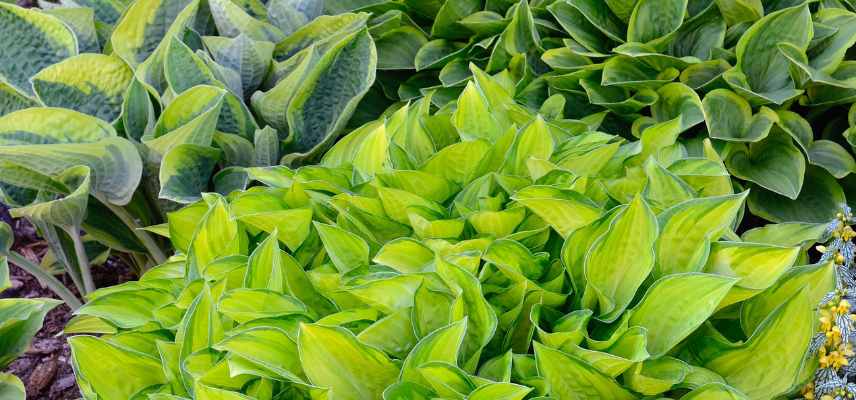
Also pair hostas of different colours with one another: the golden ones mix particularly well with variegated varieties edged with light green
How to successfully grow Hostas with yellow or golden foliage?
Yellow- or gold-coloured varieties have roughly the same requirements as their green or blue-tinged counterparts. They favour moist soils (which never dry out completely), or even damp ones, which can be heavy and clayey. They also prefer sheltered locations away from cold, drying winds. Ideally, the soil should be fairly rich in organic matter.
Consider mulching the base of your Hostas, formed of dead leaves, ramial chipped wood, flax or hemp chips, to help conserve soil moisture.
However, to intensify the colour of the yellow-to-gold varieties, it would be best to plant them in a slightly brighter exposure, but without scorching sun. They will indeed prefer partial shade to a position that is too shady. Ideally, place them in a spot that receives the gentle morning sun.
- Subscribe!
- Contents
Comments