


Why choosing Pittosporum for a hedge? Benefits, suitable varieties and tips
An evergreen shrub ideal for creating attractive and long-lasting hedges
Contents
Pittosporum are among the perfect candidates for creating hedges. Whether for delimiting an area, for concealing prying eyes or to provide a little shade, these shrubs are suited to all types of hedges.
With their evergreen foliage, they remain ornamental in all seasons, even in winter. Easy to grow and available in a wide range of varieties, you will surely find Pittosporum to suit you. Let’s see which varieties to choose for creating a hedge and how to proceed to ensure successful planting.

The benefits of Pittosporum for hedging
If you love Pittosporum, it’s for its numerous decorative merits. Its evergreen foliage is its main asset, which keeps the garden looking good all year round. It can display a fairly classic green, but can also appear in more striking versions: variegated, golden or purple.
Some varieties also have an attractive spring flowering, in the form of small bells that can be quite fragrant.
If Pittosporum is particularly suited to hedge design, it is primarily because of its round, compact habit, very harmonious, which allows the creation of a handsome vegetative screen. But in reality it comes in all sizes, from the smallest for simply delimiting space to the tallest for creating a large, dense, screening hedge. Tolerant of pruning, it can even be trained into topiary in neat, controlled gardens. It also has the ability to withstand pollution and salt spray, which makes it a good candidate for both urban gardens and coastal gardens.
Finally, it pairs very easily with shrubs in informal hedges, with conifers in a more structured hedge, or with Mediterranean shrubs in coastal gardens.
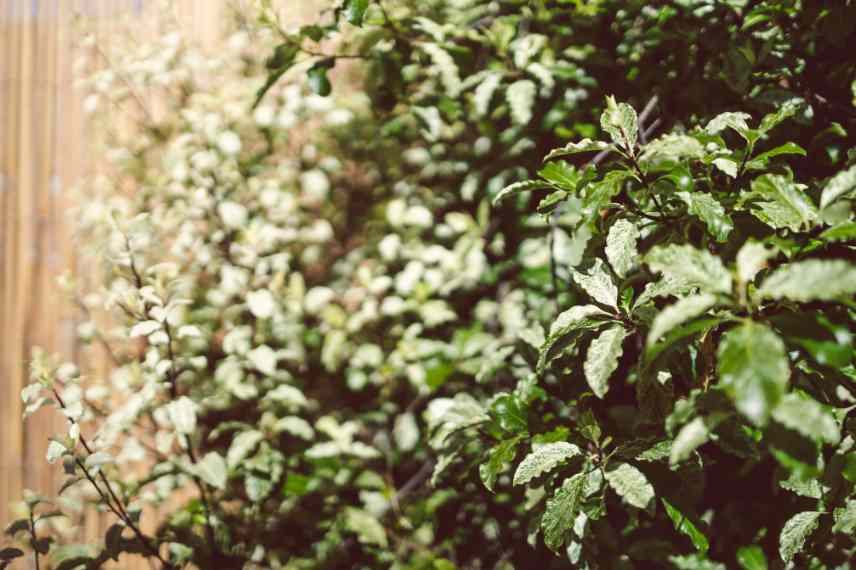
The variegated foliage and dark branches of some Pittosporum shape superb hedges
The best Pittosporum varieties for hedges
Depending on the Pittosporum variety chosen, you can imagine different hedge designs in the garden.
For low hedges
For small hedges, which mainly serve to delimit spaces, opt for the smaller Pittosporum, not exceeding 1.5 metres. They make an excellent substitute for box in neat borders.
For this use, turn to dwarf varieties such as Pittosporum tobira ‘Nanum’, which grows to only 1 metre in height and 1.2 metres in spread. It features attractive, dense foliage in a bright, glossy green.
You can also opt for Pittosporum tobira ‘Neige du mont Ventoux’, a small shrub about 1 metre in all directions. It bears variegated leaves, with green margins edged in cream to white.
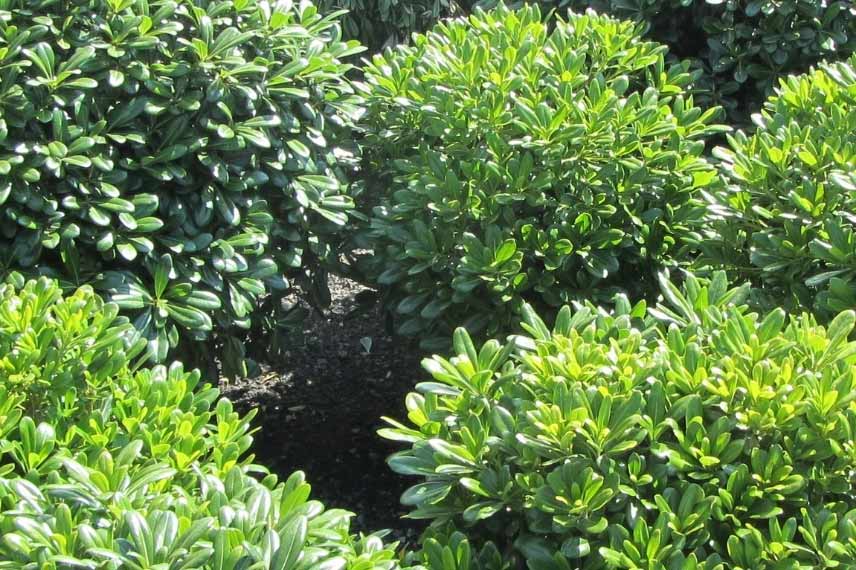
Pittosporum tobira ‘Nanum’
For tall hedges
To form hedges that truly act as a green screen in the garden, choose Pittosporum that reach about 2 metres in height. This is the case for Pittosporum tenuifolium, a botanical species that reveals glossy, undulate foliage in a bright green that contrasts with a white central stripe. It reaches 2 metres in height and 1 metre in spread.
For its part, the Pittosporum tenuifolium ‘Green Elf’ produces very small leaves borne on decorative black stems. It measures 2 metres in height and 1.5 metres in spread.
If you have space and want to create a large, free-standing hedge with a cottage-garden look, there are varieties exceeding 3 metres in height. This is the case for Pittosporum tobira (5 metres in height by 2 metres in spread), which produces thick leaves in a glossy green colour, and also Pittosporum tenuifolium ‘Irish Luck’ (3 metres in height by 2 metres in spread), which grows quickly and forms a dense, bushy cone.
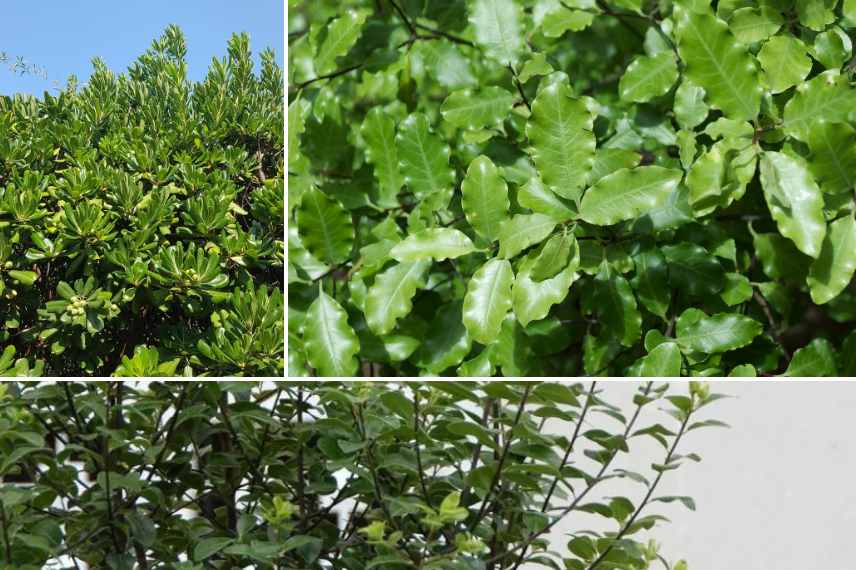
Pittosporum tobira, Pittosporum tenuifolium, and at the bottom the variety ‘Irish Luck’
For scented hedges
Would you like a hedge that combines several qualities? It’s possible by choosing scented Pittosporum varieties. They stimulate the senses and please pollinating insects.
This is the case with Pittosporum tenuifolium ‘Gold Star’. It first dazzles with its very bright, chartreuse-green foliage, contrasting with white veins and dark-green margins, which catches the eye. But in late spring it also bears small flowers, mainly valued for their intense honey-and-vanilla fragrance.
Pittosporum tenuifolium ‘Victoria’ also perfumes the surroundings with notes of honey during its flowering, in small purple bell-shaped blossoms. Very elegant, it produces green leaves with white-cream margins, which redden in cooler weather.
Colourful foliage
Looking to add a touch of originality and avoid a hedge of one colour green? No problem—the Pittosporum foliage offers a range of colours.
Fall for example for Pittosporum tenuifolium ‘Elisabeth’, with its beautiful variegated and changing foliage. The leaves are initially grey-green edged with cream-pink, before turning red in winter. At maturity, expect 2 metres in height and 1 metre in spread.
For its part, ‘Dark Diva’ offers light green new growth, before turning to purplish-violet. A very elegant variety, with fairly rapid growth.
For a more imposing variety, adopt Pittosporum eugenoides ‘Variegatum’ (5 to 6 metres in height by 3 to 4 metres in spread). It rewards with an oval, undulate foliage, green margined with cream.
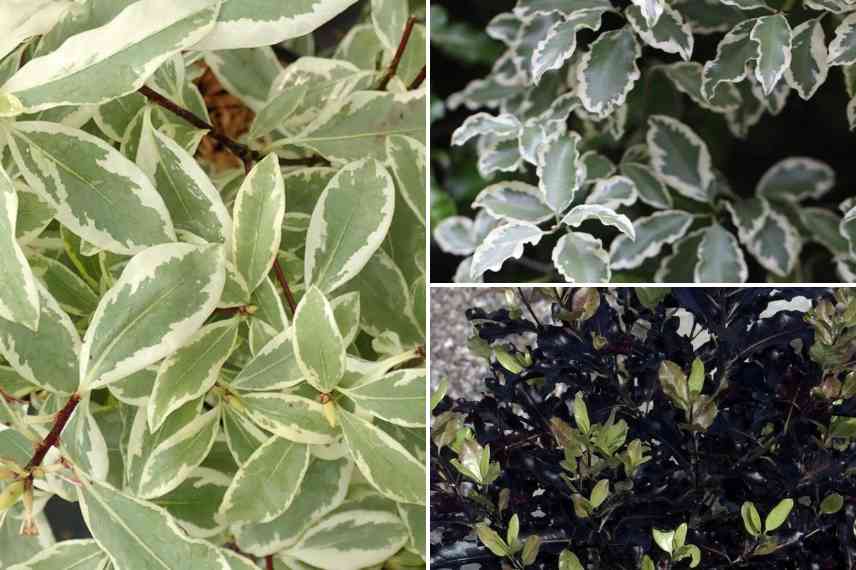
Pittosporum eugenoides ‘Variegatum’, Pittosporum tenuifolium ‘Elisabeth’ and Pittosporum tenuifolium ‘Dark Diva’
For hardy hedges
One of the Pittosporum’s few drawbacks is its mid-range hardiness, roughly around -7°C. This tends to limit it to gardens in milder climates, particularly near the sea. However, some varieties can withstand frosts down to -12°C or slightly more, provided the soil is well drained (not holding water in winter).
This is the case for Pittosporum heterophyllum, with very fine and glossy foliage, which benefits from tolerating cold down to -15°C as well as summer drought. Also worth noting is Pittosporum daphniphylloides, one of the hardier species. It is less well known, but very elegant with its loquat-like appearance.
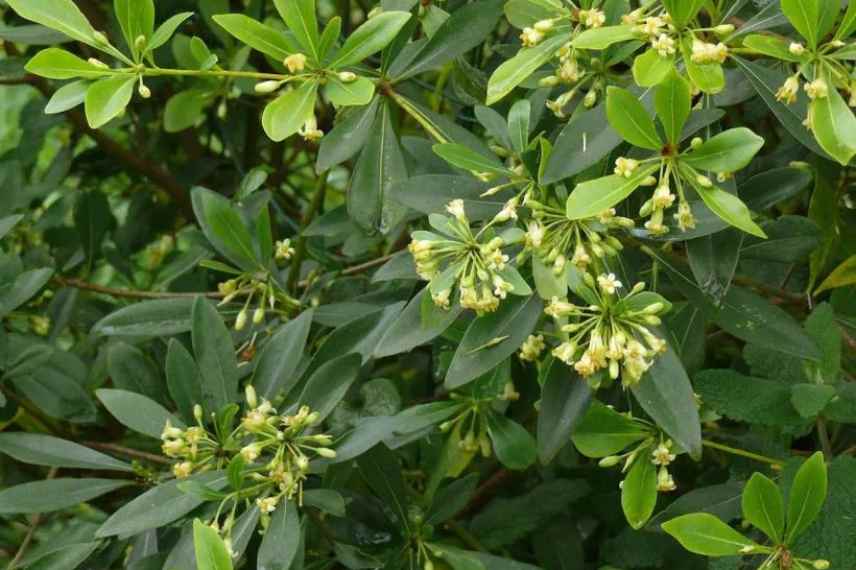
Pittosporum heterophyllum
How to plant a Pittosporum hedge?
Choosing the planting area
Start by defining the location of your hedge. Pittosporum prefers warm sun in temperate climate regions, but it can be placed in partial shade in southern regions with hot summers. Also choose a site sheltered from cold, dry winds.
The soil can be ordinary, but not too calcareous and must be well drained. Therefore prepare it before planting and add drainage elements (gravel, sand…) if it is heavy clay.
Also take into account the legal distances for planting trees and shrubs:
- Plant at least 50 cm from the boundary when Pittosporum are under 2 metres in height;
- Plant at more than 2 metres distance for all heights above.
For more details, consult our article: Hedges, bushes and trees: What planting distances?
Step-by-step planting
Plan to plant your hedge in autumn, between September and October. In cool climates, spring planting after the last frosts will be preferable so that Pittosporum can establish themselves before their first winter.
Allow about 1 metre of spacing between each Pittosporum or other hedge bush (slightly less if it is a low hedge made up of dwarf varieties).
With a garden fork, prepare the ground by removing adventive weeds and loosening the soil to decompact it. Remove any large stones and add drainage elements if needed. For a less strenuous, but slower method, you can cover the soil with old cardboard (no tape), weighted down with stones. Wait a few months for the soil to be ready to receive new plantings.
Next, dig planting holes (about twice the volume of the root ball) or a trench, depending on the length of your hedge and the conditioning of the plants (pots, bare-root…). You can choose either a single-row planting or in quincunx (at least two rows).
Apply organic matter (manure, decomposed compost…), then add garden soil or growing medium. Plant the root balls of your Pittosporum and keep them upright while you finish with substrate. Firm the soil with your hands and water generously before installing an organic mulch.
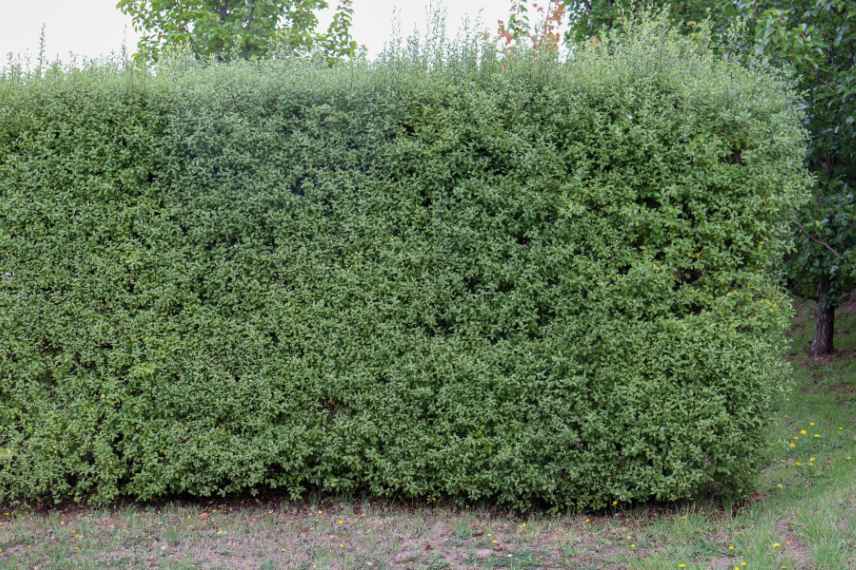
Plant closely to form a dense mass
Maintaining a Pittosporum hedge
Pittosporum are not particularly demanding and require little maintenance. During the first two years, however, remember to water regularly in the absence of rain, when the soil is dry at the top few centimetres. Thereafter, the shrubs will be more self-sufficient and drought-tolerant.
In an informal hedge, you will let Pittosporum grow without pruning. In a neatly clipped hedge or in a low hedge, perform pruning with clean and sharp cutting tools (pruning shear, hedge-cutting…) in late summer. For all you need to know about its pruning, consult our article: How to prune Pittosporum?.
Refresh the mulch when it has decomposed and perhaps apply compost in late winter to support growth.
Pittosporum is relatively resistant to pests and diseases.
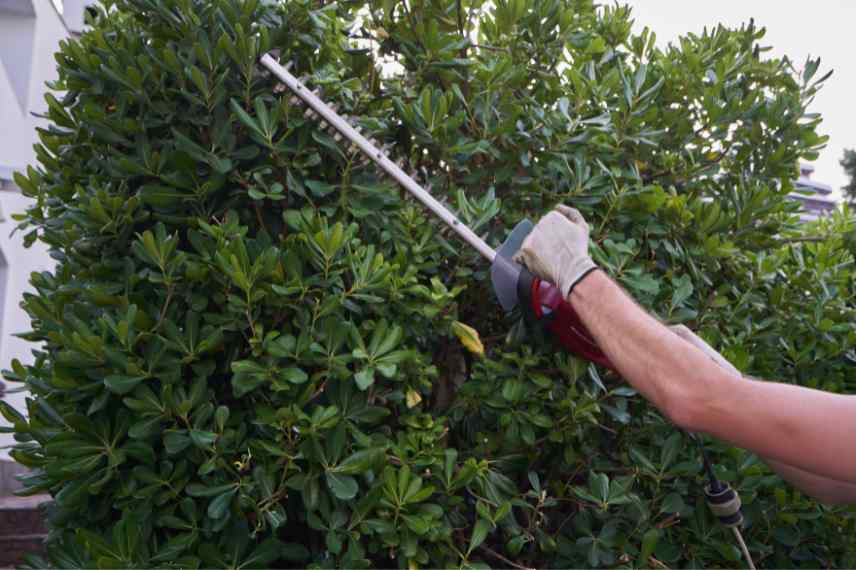
Pittosporum generally require little pruning (here a Pittosporum tobira)
- Subscribe!
- Contents
Comments