


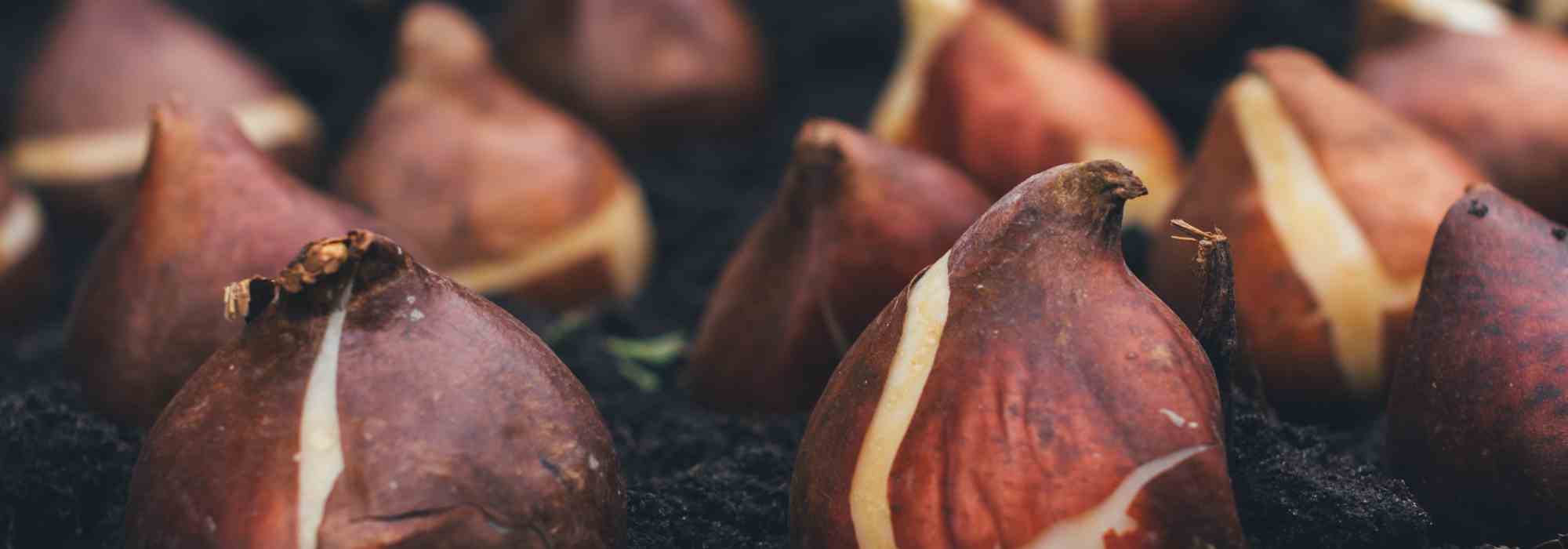
Everything you need to know about the different flower bulbs for successful cultivation.
Diverse range of easy-to-grow plants for the garden or in pots.
Contents
Bulbous plants are a staple in the garden. Their flowering can be very diverse, in terms of both forms and colours. You are sure to find varieties that you like and that fit into your garden style! To learn more about them, let’s explore together their various characteristics and cultivation requirements.
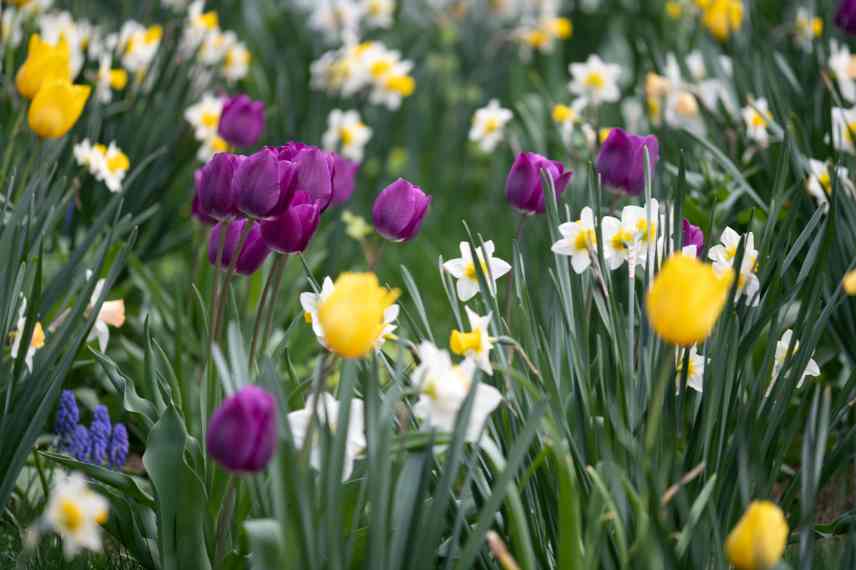
Spring bulbs bring a lot of freshness to our gardens and lawns

Bulbs, corms and rootstocks... How to tell them apart?
Let’s start with a quick vocabulary note. The term ‘bulbous plant’ generally refers to all plants that possess fleshy underground storage organs. This is what allows them to feed, grow and flower. But in reality, not all of them have a true bulb.
The bulb is typically bulging and rounded in shape. It is, in fact, an embryonic plant that has a stem and whose modified leaves (scales or tunicates) cover the central part. The bulb propagates by producing bulblets underground (sometimes called bulbils) next to the main bulb. If you cut an onion in half, you will indeed notice the stem and the scales surrounding it, as well as the base from which the roots originate. In bulbous plants, the foliage dries off a few weeks after flowering. But it will have allowed the plant to accumulate nutritive reserves, carefully stored in the bulb, to restart the life cycle the following year.
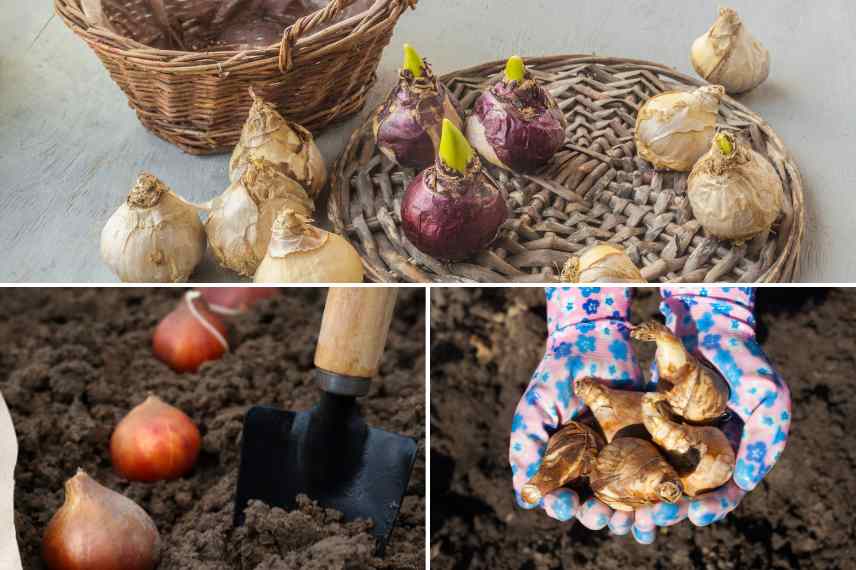
Above, hyacinth bulbs. Bottom left, tulip bulbs, and to the right, narcissus bulbs
Corms are also close to bulbs, but have a flatter face. They are also storage organs that allow the plant to store nutrients. But it is here, in the swollen scales, formed from modified leaves, that they are carefully kept. The corm does not have multiple layers of scales like the bulb, but it is whole. This is the case with crocus or gladioli.
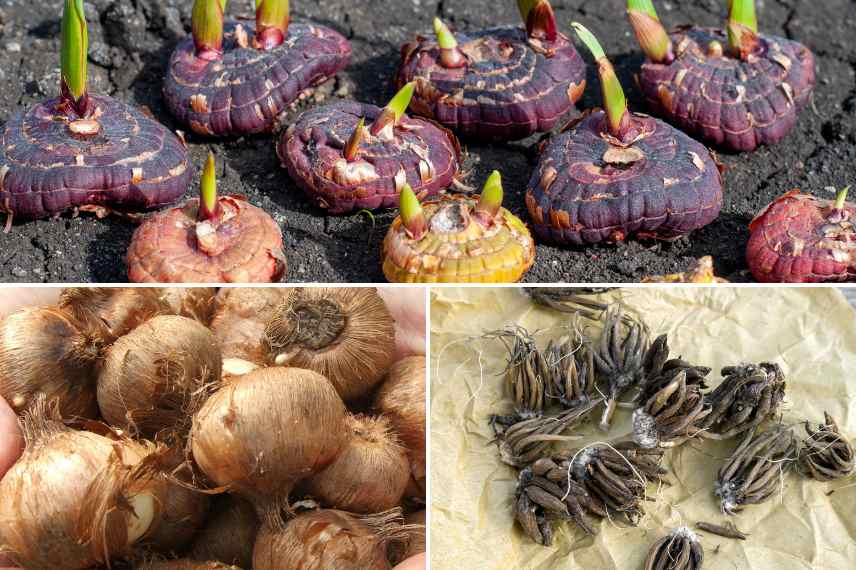
Above, gladiolus corms; bottom left crocus corms, and bottom right ranunculus tubers
Pour leur part, les rhizomes sont en fait des grosses racines charnues et renflées, comme chez le muguet, les iris ou les daylilies. Elles poussent à l’horizontale et portent des racines. Ici encore, c’est ce qui permet à la plante de créer des réserves nutritives. Le ginger fait aussi partie de ces plantes à rhizomes, tout comme les anémones. Les rhizomes sont généralement traçants, ce qui leur permet de s’étaler rapidement, voire de coloniser tout un espace. C’est ce qui rend notamment certains bambous envahissants, voire destructeurs.

En haut corms of gladioli, en bas à gauche corms of crocus and en bas à droite ranunculus tubers
Évoquons enfin les tubercules, qui sont en fait des morceaux de tiges ou de racines gonflées, afin de devenir des organes de réserve. C’est ce que l’on retrouve chez la pomme de terre. Les nouvelles pousses se développent directement sur les tubercules, ce qui permet de les diviser très facilement en les séparant du pied-mère. Les dahlias disposent aussi de tubercules.

Tubers of dahlias and Colocasia
Pour bien les planter, lisez notre article : “Which direction should bulbs be planted?“.
Read also
The best bulbs for potsWhy plant flower bulbs?
Bulbs multiply very easily. Many varieties naturalise themselves, that is, they return faithfully every year and spread within a defined area without any intervention from the gardener. A simple way to naturally obtain new plants that can flower quickly afterwards. By planting bulbs, you will thus see their numbers double, or even triple, over the years. This can give impressive carpets of flowers. It is also possible to divide them to propagate them yourself, to plant elsewhere in the garden or in pots.
- Bulbs multiply very easily. Many varieties naturalise themselves, that is, they return faithfully every year and spread within a defined area without any intervention from the gardener. A simple way to naturally obtain new plants that can flower quickly afterwards. By planting bulbs, you will thus see their numbers double, or even triple, over the years. This can give impressive carpets of flowers. It is also possible to divide them to propagate them yourself, to plant elsewhere in the garden or in pots.
- Bulbous plants have an incredible diversity of colours: from soft, pastel colours to brighter, more intense colours, there is really something to suit all tastes. The same goes for the shapes of the flowers, which can be very varied: in clusters, trumpet-shaped, bell-shaped, star-shaped, cornet-shaped, etc.
- Bulbous plants also vary in size and habit. The smallest, which do not exceed about 20 cm in height, can be grown even in small gardens or in window boxes on balconies, terraces or in inner courtyards. The larger ones, sometimes exceeding 2 metres, as with certain varieties of cannas or giant dahlias, will sit well in lush borders. Bulbous plants are also perfect for dressing the bases of trees and shrubs, brightening up a rock garden, a border or a lawn that is a little too tame. They readily fill gaps.
- Some are highly fragrant, ideal for bringing an aromatic touch to the garden or near areas where people pass. They are essential in a fragrance garden.
- Bulbous plants are easy to pair with any garden style: romantic, exotic, contemporary, Japanese-inspired, bohemian, naturalistic, etc. They generally do not hinder the growth of other plants.
- By planting different types of bulbs, it is possible to have the garden flowering almost all year round, from the end of winter to the end of autumn.
- They are generally easy to grow, even for beginner gardeners. You simply need to plant the bulbs in the ground and let nature take its course. No need for fertilisers or extra care. Their main requirement is well-drained soil in which water does not stagnate. This can indeed lead to bulb rot. The frost-prone will simply be dug up before winter to be stored dry, as with dahlias or cannas.
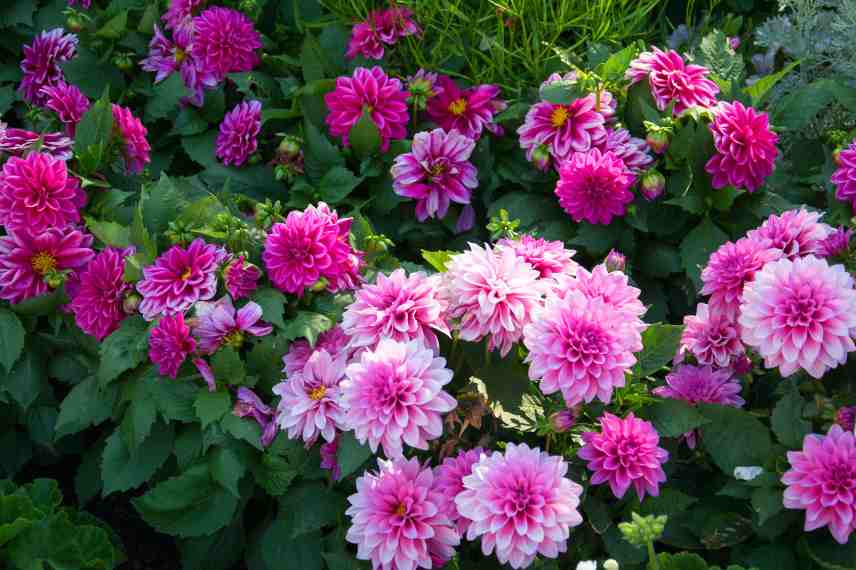
Dahlias
Key Spring Bulbs
Spring bulbs are, logically, those that bloom just after winter. Some are particularly early, showing their first flowers while winter is still with us, as early as January, such as snowdrops, cyclamens, crocuses or the ever-popular daffodils. A little later in spring, you’ll also observe hyacinths, grape hyacinths, tulips, anemones and irises. Towards the end of spring, or even early summer, it’s ornamental allium that takes over with its spherical, colourful flowers. Less known, but just as interesting, we mention scillas and their bell-shaped flowers, the camassias and their starry flower stalks, or erythroniums with charming lantern-like flowers.
They herald, with poetry, the imminent return of softness and light, while bringing a splash of colour and welcome movement during the garden’s quietest season.
These bulbs are planted in autumn.
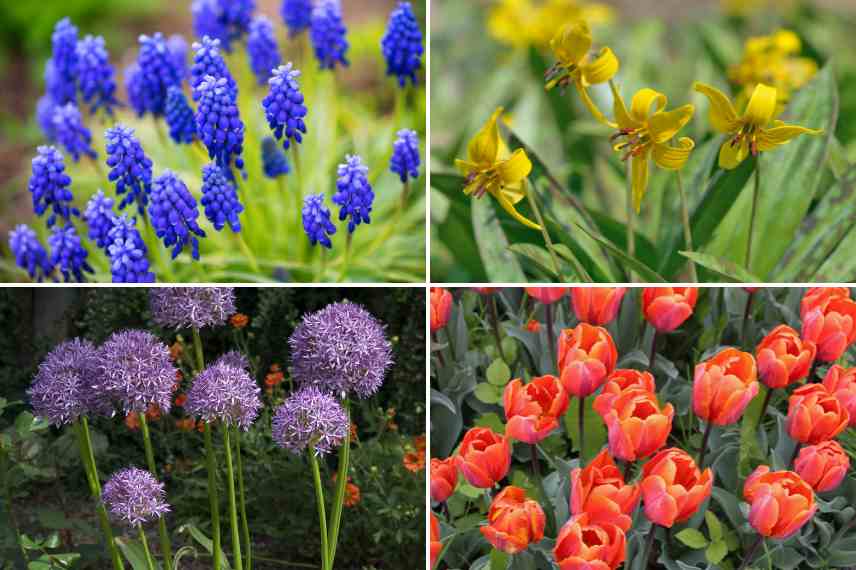
Muscari, Erythronium, Alliums and Tulips
Read also
Bulbs: flowers for every seasonMain Summer Bulbs
As you will have realised, the summer bulbs flower during the warm season. Among the best known are, of course, the dahlias, the lilies, the arums, the cannas, the amaryllis, the agapanthus and the alstroemerias. N’oublions pas les crocosmias, which look like small gladioli and boast vivid colours, perfect for adding an exotic touch. Let us also mention the Tulbaghias, with lanceolate foliage and tubular white or pink, graceful flowers. For a well-scented flowering, turn to some lilies— the freesias and their jasmine-like fragrance or the ornithogalums.
One of the few drawbacks of these floriferous and colourful bulbs? They require moist soil (which never fully dries out), at a time of year when water shortages affect many regions. Especially in southern gardens, it is therefore important to find them a spot sheltered from drying winds and the blazing sun. Mulching is also recommended to limit natural evaporation and to better retain soil moisture. Summer bulbs are also often the least hardy. Some of them are downright frost-prone and will need to be dug up before winter in regions where frost occurs.
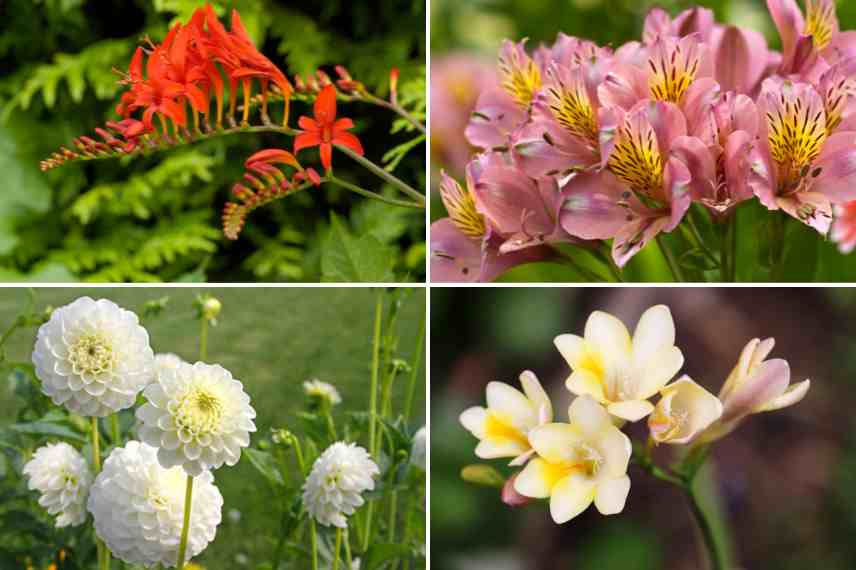
Crocosmia, alstroemeria, dahlia, and freesia
Key autumn bulbs
The autumn-flowering bulbs take over from flowering once the summer season has ended. They help extend the garden display and work wonderfully to create a woodland ambience, bringing a splash of colour. Among the must-haves, let us mention the ivy-leaved cyclamen and the autumn crocuses, capable of forming wide carpets. It is also the flowering period of the famous Crocus sativus, whose flowers yield the precious red spice: saffron. Less well known, the Sternbergia lutea or the autumn false crocus treats us to goblet-shaped flowers in a bright yellow, from September to October. Let us also mention nerines, whose late flowering occurs between September and November, revealing umbels of flowers with curled petals.
Under temperate climates, they are planted in late summer and have the advantage of flowering a few weeks later. In warmer and drier regions, they will be planted in autumn and will flower the following year.
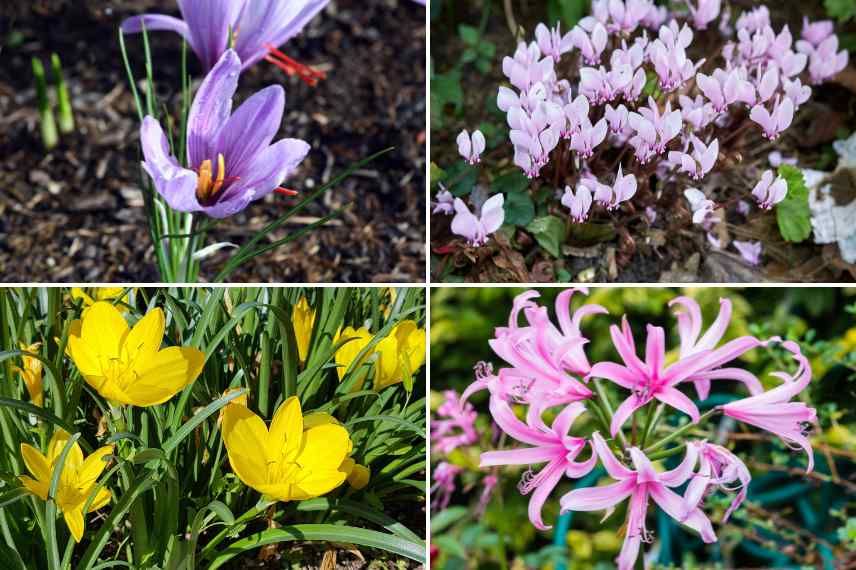
Crocus sativus, ivy-leaved cyclamen, Sternbergia and nerines
Choosing the right flower bulbs
As with all other plants, bulbs will be chosen according to your growing conditions. So consider the following:
- soil type (heavy, light, fertile, poor…), to adapt planting conditions (lighten the soil, feed it…);
- exposure (sunny, shaded, partly shaded…);
- available space (a small border or window box, a large border, lawn…);
- climatic conditions (salt spray, heat, humidity, strong winds, severe frosts…).
For example, large flowering bulbs, such as gladioli, do not tolerate exposures that are too windy, which can bend their flower spike. Plan therefore for a sheltered exposure or suitable staking.
In garden centres, bulbs are often available in bags. Make sure to choose bulbs that look healthy, which are firm and show no signs of mould or damage. Recall that calibre refers to the circumference of the bulb, usually indicated in centimetres. This information gives an indication of the future size of the flower: a snowdrop with calibre 4–5 cm will naturally produce a smaller flower than a tulip bulb calibre 10+.
- Subscribe!
- Contents
Comments