


Invasive aquatic plants: how to identify them and limit their spread?
Plants to avoid or control to prevent negative impacts on biodiversity
Contents
Around a basin, pond or lake, aquatic plants are essential. They perform several roles: oxygenation and filtration of the water, providing shade, shelter and food for wildlife, stabilising banks, and also aesthetics, of course. As with other plants, they will be chosen according to your growing conditions (soil, exposure, climate…). But it is also important to consider their capacity to spread. Some aquatic plants are in fact considered to be invasive species, with a negative impact on the medium. Let’s see which ones and how to limit their proliferation.

What is the impact of aquatic plants that are considered invasive?
Some aquatic plants are now prohibited from sale. They are, in fact, part of the EEE (invasive exotic species). This means they have been deemed too disruptive, even destructive, for wetlands. These are plants that were imported from other regions of the world and have naturalised, thereby altering the structure and functioning of natural ecosystems in a site. They will therefore disrupt the balance in place and have a negative impact on native biodiversity (naturally present in the habitat). The presence of invasive plants, sometimes also referred to as invasives, thus contributes to the current decline of our biodiversity.
These are often adaptable plants, capable of thriving under a range of cultivation conditions, even challenging ones. Moreover, they generally have a very strong capacity for reproduction (by stolons, rhizomes, propagation by cuttings…). They will therefore compete with their local homologues, which were adapted to the habitat’s fauna and on which many animals depended. This can create an imbalance in the food chain that is particularly detrimental. In a body of water, these plants can spread over several square metres in a matter of weeks and end up choking the habitat. The photosynthesis of other plants will then become more difficult, oxygen will become scarcer and the water will become more stagnant, which will harm the ecosystem.
Nevertheless, note that the issue is not as binary as it may seem: through evolution and due to climate change, plants are naturally migrating. For example, Mediterranean plants are gradually moving northwards and becoming naturalised, particularly along the Atlantic coast. Some species that we consider invasive at a given moment may, in the end, ultimately be seen as native. Moreover, a native plant can also prove invasive (bindweed on land, myriophyllum spicatum in the water).
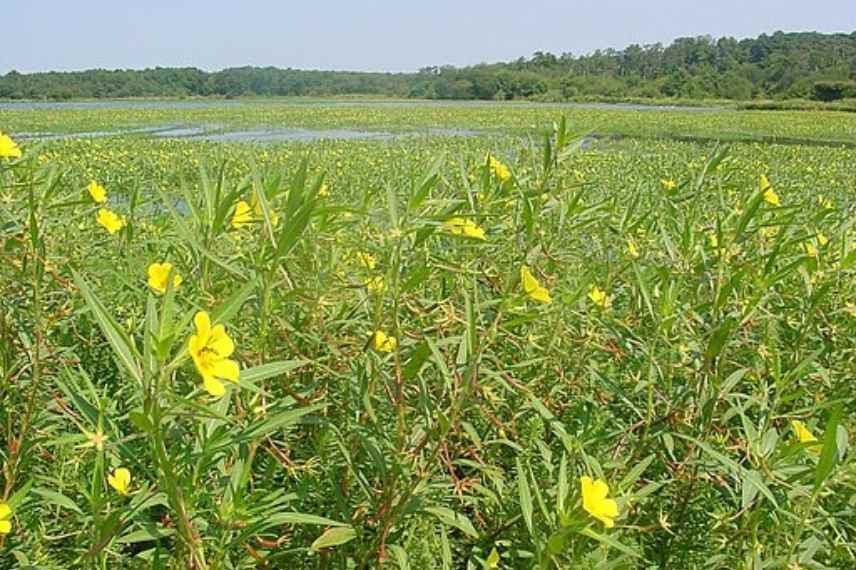
When discussing invasion, the term is not misused… here the water primrose (Ludwigia grandiflora) in a pond in the Landes in 2003 (© Wikimedia Commons, Alain Dutartre-Irstea)
Examples of invasive aquatic plants.
Many floating plants, which are not rooted but can form large mats that cover the water’s surface, are among invasive aquatic plants. They can be officially classified as invasive alien species (IAS) or simply known for their high rate of spread.
Among aquatic plants that colonise habitats very quickly and can cause imbalances, notable examples include:
- large-flowered Ludwigia (Ludwigia grandiflora);
- Brazilian water-milfoil (Myriophyllum aquaticum) and milfoils in general;
- water lettuce (Pistia stratiotes);
- Canada waterweed (Elodea canadensis), commonly called water weed;
- vallisneria (Vallisneria), commonly called water celery;
- broad-leaved pondweed (Potamogeton natans);
- broad-leaved arrowhead (Sagittaria latifolia);
- floating buttercup (Ranunculus fluitans);
- marsh spike-rush (Eleocharis palustris);
- mare’s-tail (Hippuris vulgaris);
- Heteranthera (Heteranthera).
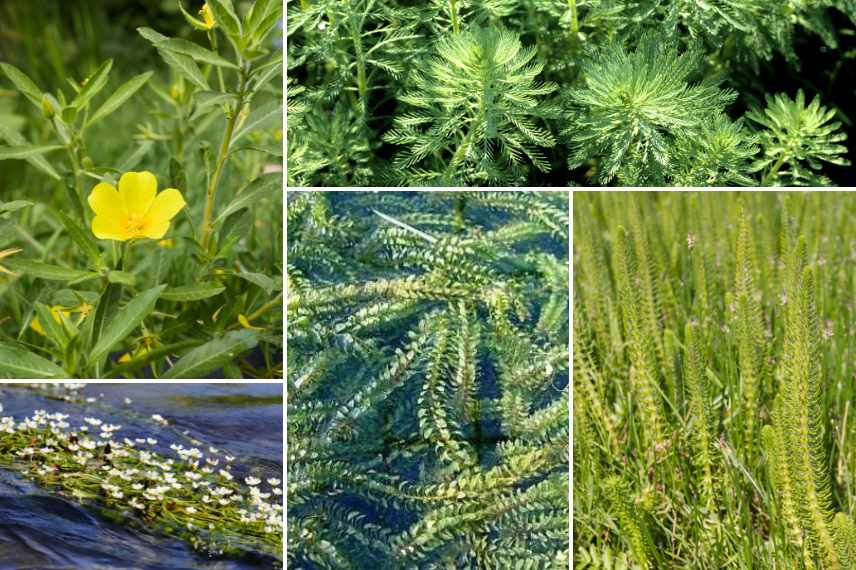
Clockwise from the top: large-flowered Ludwigia, Brazilian water-milfoil, mare’s-tail, Canada waterweed (photo Pl@ntNet) and floating buttercup
If these plants are recognised as IAS, they can no longer be sold within the country. However, the list of invasive or IAS plants can vary by location: because they thrive on sun and heat, an aquatic plant may be regarded as invasive in southern France but not in the cooler regions. The best approach is therefore to check by country and region.
How to limit the proliferation of certain aquatic plants?
Obviously, the first solution to prevent the proliferation of invasive aquatic plants is not to plant them. If some are anyway banned from sale, it is also important not to harvest them at random from the wild, when aiming to plant up your pond.
If you still wish to grow plants reputed to have vigorous growth, opt for container culture. As with potted plants, aquatic plants grown in small baskets will have growth that is easier to control. To do this, you need suitably sized baskets, which will be weighed down with stones, for example. The chosen growing medium must be heavy enough not to escape from the basket. This method also helps control their positioning on the water feature and to move plants with limited hardiness in winter. This method of cultivation is suitable for both submerged and semi-submerged plants. However, it is preferable to choose this solution only if you live away from natural wetland areas: some aquatic plants produce seeds that can be dispersed by wind and thus colonise sensitive spaces, even located several metres away.
Next, it is important to control nutrient inputs, which can promote the growth of already vigorous plants. First, avoid excessive fertiliser applications near the pond, basin or water body. Also consider regularly removing dead leaves and plant debris that can accumulate in the water feature and its surroundings. Limit any fish population according to the space available. A good balance in the water, which depends on several factors (natural light, temperature, presence of living organisms…), also helps control nutrient excess.
If invasive aquatic plants are already too widespread, it will be essential to reduce their spread by manual uprooting. To do this, use, for example, an aquatic knife to prune the plants concerned. Remove the pruning waste with a floating rake or pond net. Do this before the flowering season to prevent seed dispersal.
For some plants, such as marsh scirpus (Eleocharis palustris), it is also advised to remove the flowers to prevent significant dispersal.
Another, more radical solution is to deprive the plant of light by installing a shade net that prevents growth and gradually causes it to wither. There are purpose-made solutions for this function, available as UV-resistant fabrics or woven nets. Main drawbacks: they must remain in place for several months to be effective and are not very aesthetically pleasing.
Note that we would obviously discourage the use of pesticidal and chemical products, which would do more harm than good to the environment by indiscriminately removing all vegetation and polluting the water, thereby impacting biodiversity.
- Subscribe!
- Contents
Comments