


Mediterranean-climate pond: which aquatic plants to choose?
Varieties that will thrive in hot climates
Contents
Having a pond in the garden has many benefits: it fosters biodiversity and brings welcome refreshment in summer. Moreover, contrary to the common belief that a pond or basin attracts mosquitoes, they often help regulate them if managed in a balanced way.
The installation of a pond hinges on choosing aquatic plants that will play a variety of roles. In a Mediterranean climate as elsewhere, you obviously need to choose them according to growing conditions. Let us consider which elements to take into account and which plants to choose to enhance a pond in hot regions.

The particularities of the Mediterranean climate.
To succeed in growing plants, it is essential to take into account cultivation specifics, i.e., the constraints of the medium. This includes:
- climate (dry, wet, cold, mild, windy…);
- soil type (heavy and clayey, poor and free‑draining, acidic, calcareous, shallow…);
- exposure (sunny, shaded, or dappled/filtered…);
- available space (more or less large).
In a Mediterranean climate, gardens benefit from a climate favourable for growing plants that love heat and sun, but dread the cold. The seasonal temperature range is also more limited. Frost‑tender or tropical plants are therefore often ideal candidates, turning spaces into true exotic oases.
However, plants must also contend with constraints that are not tolerated by all :
- A soil fairly poor in nutrients and dry, which can be very stony and calcareous;
- Sea spray (fine droplets of saltwater), which can dry out, or even burn plants;
- Strong regional winds (mistral, levant, libeccio…), which can weaken or snap plants;
- Scorching sun in summer.
For pond plants, the drought issue will not apply, as the plants will have their roots in water, being more or less submerged. In hot climates, however, ensure that the pond or basin is deep enough to prevent natural evaporation from lowering their water level too much, especially in summer.
Read also
Creating a natural pond in your gardenHow to choose suitable aquatic young plants for a Mediterranean pond?
For designing a pond in a Mediterranean garden, you will need to turn to the mild-climate aquatic plants. Most of them will be frost-tender, but can stay in the ground in regions with short, mild winters.
To design your water feature successfully, think of the space a little like a border: diversity, varying heights, taking into account the needs of each plant, and pursuing harmony will be the keys to a successful display.
Each plant will have its place and a role to play.
- Floating plants. They are installed directly on the water. They will add aesthetic appeal, a bit of shade and a welcome ‘raft’ for small animals.
- Oxygenating plants. No surprise about their main function: they help to oxygenate the pond water, to promote the activity of bacteria that break down organic matter, and to clarify the water. Of course, they also provide shelter for all the fauna of the zone.
- Semi-aquatic plants. These are the ones that will have only their feet in the water. They have an aesthetic role, but also provide shelter, perhaps even food, for all the little creatures that frequent the medium. They can also contribute to purifying the water, helping to limit eutrophication (nutrient buildup), which is harmful to the balance of the medium.
- Shoreline plants. They are cultivated at the edges of the pond or basin, but do not always need their feet in the water. Damp, cool soil will suffice. They help stabilise the banks, but also, of course, provide shelter for wildlife. They are intermediaries between the terrestrial medium and the aquatic medium.
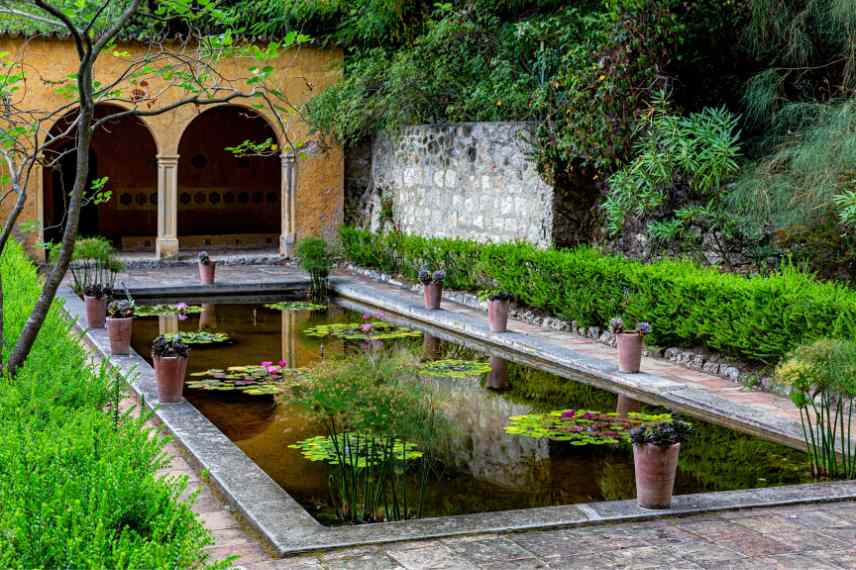
The pond at Jardin Serre de la Madone, Menton, in the Var (France)
The best aquatic plants for hot climates
Floating plants
Essential floating plants, water lilies will work wonders in a Mediterranean pond. For example, opt for the Nymphaea ‘Tina’, a tropical water lily that produces large round leaves about 25 cm across and reveals blue-violet flowers with golden stamens, nicely scented. Also worth considering ‘Pennsylvania’, with its large leaves mottled with rust and its long blue bloom. Susceptible to cold, they are better grown in easily manageable containers (open-weave baskets), so they can be overwintered at around 15°C.
The Nymphaea tetragona is a mini variety, ideal for small ponds. It produces star-shaped semi-double flowers, white with orange stamens, 5–8 cm in diameter. The foliage is olive green speckled with brown.
Pour sa part, the Phyllanthus fluitans helps prevent the development of algae that can upset the balance of the pond. It produces small round decorative leaves, red in colour.
Lotuses are also reliable choices, such as Nelumbo nucifera. It produces broad round leaves of nearly 60 cm in diameter, which rise up to 1.50 metres above the water surface. The summer bloom reveals large pale pink flowers. A plant suited to mild climates, its rhizomes cannot tolerate temperatures below 5°C.
Originale avec sa floraison en spadices allongés de couleur jaune brillant, rappelant des cierges, l’Orontium aquaticum forme une rosette de 60 cm de wide pour 40 cm de height.
For a scented bloom, turn to the Aponogeton odorant, a beautiful exotic floating plant that produces large white fleshy bracts with a vanilla fragrance in the evening. Its flowering recalls that of orchids.
Terminons avec la spongy frogbit, a small aquatic perennial with round, succulent leaves, very decorative. It does not tolerate temperatures below 5°C.

Nymphaea ‘Pennsylvania’, Phyllanthus fluitans, Aponogeton and Nelumbo nucifera
The oxygenating plants
The common bladderwort is a floating plant, but it also has the characteristic of being oxygenating. Carnivorous, it captures mosquito larvae and other aquatic insects. Its flowering emerges from the water in the form of a stalk bearing flowers in bright yellow.
Also note the water horsetail (Hippuris vulgaris), an aquatic perennial that is very decorative. Vigorous, it can even prove to be invasive. But it is a very good candidate for oxygenation and aeration of pond water. Aesthetically, it produces mini conifers that rise from the water and benefit all the little aquatic life. Summer flowering is fairly discreet, consisting of small green flowers.
The false Tenellus (Lilaeopsis brasiliensis) is also an oxygenating aquatic plant that helps purify pond water. It forms a small turf of rosette-leaved foliage and mats, not exceeding 10 cm in height. It needs plenty of light to develop well.
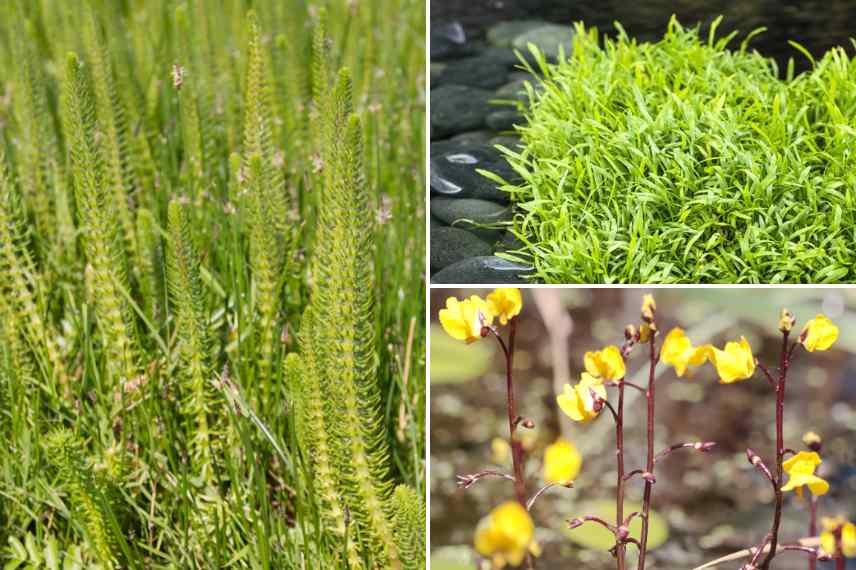
Hippuris vulgaris, Lilaeopsis brasiliensis and Utricularia vulgaris
The semi-aquatic plants
The white thalia is a beautiful aquatic or semi-aquatic plant measuring 2 metres in height by 1 metre in width. This tall perennial has the look of a giant canna, with its mauve flower spikes that emerge in summer. It is a perfect pond plant to bring an exotic touch, ideal in mild climates since its hardiness is limited. It is noteworthy for staying evergreen in Mediterranean regions.
Also mention the Manchurian wild rice (Zizania latifolia), a tall aquatic perennial grass with a graphic and slender silhouette. It should be planted at depths of 10 to 40 cm and enjoys very sunny exposures.
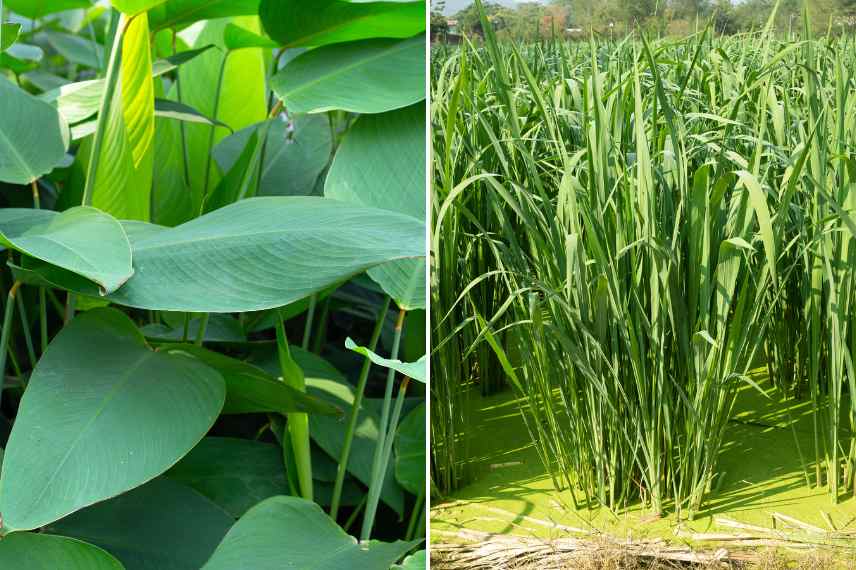
Thalia dealbata et Zizania latifolia
The shore plants
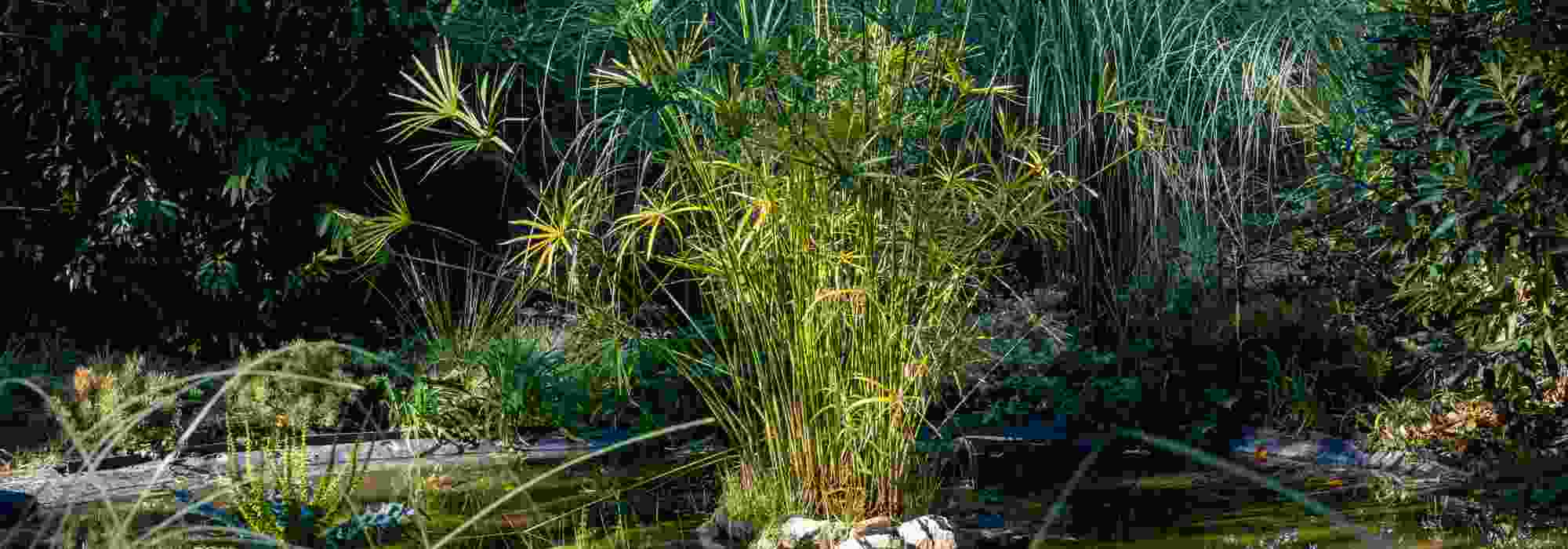
C’est certainement l’une des plantes de pièce d’eau les plus emblématiques : the Cyperus papyrus or Nile papyrus. Known for its use in papyrus paper by the Egyptians, it features long stems reaching nearly 2 metres in height and evergreen foliage. A plant for mild climates par excellence, it disappears if the thermometer falls below -3°C. Thirsty for warmth and light, even bright light, it’s a perfect candidate for a Mediterranean pond, bringing plenty of lushness.
A plant liking damp soils, Arundo donax ‘Variegata Versicolor’ is a variegated version of the Provence cane, but in a less vigorous form. It grows to about 1 metre in height by 2 metres in width, adding volume and verticality to the edges of a Mediterranean pond. Its foliage is damaged around -6°C.
In shady positions, install Farfugium japonicum‘Gigantea’, with its splendid, lush foliage. Each leaf can reach 45 cm in diameter. Still on the subject of impressive foliage near a water feature, consider Gunnera manicata or Colocasia, a tender tropical perennial.
Close cousin of the papyrus, Rhynchospora colorata is a warm-climate plant that requires plenty of humidity to flower. It will then reveal a multitude of inflorescences made up of three white bracts in the shape of stars, earning it its pretty name of “star dancer.” This makes it a perfect candidate for dressing pond sides in a Mediterranean climate.
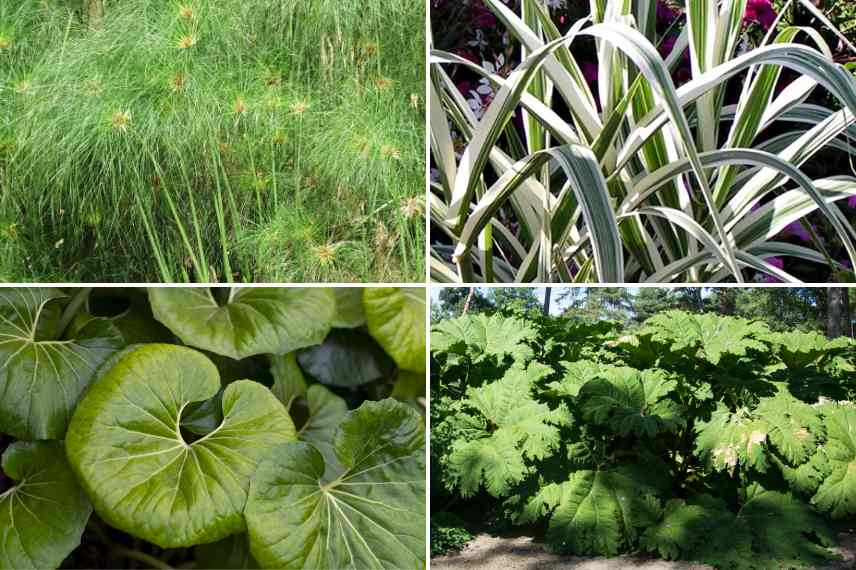
Cyperus papyrus, Arundo donax ‘Variegata Versicolor’, Farfugium japonicum ‘Gigantea’ et Gunnera manicata
- Subscribe!
- Contents
Comments