


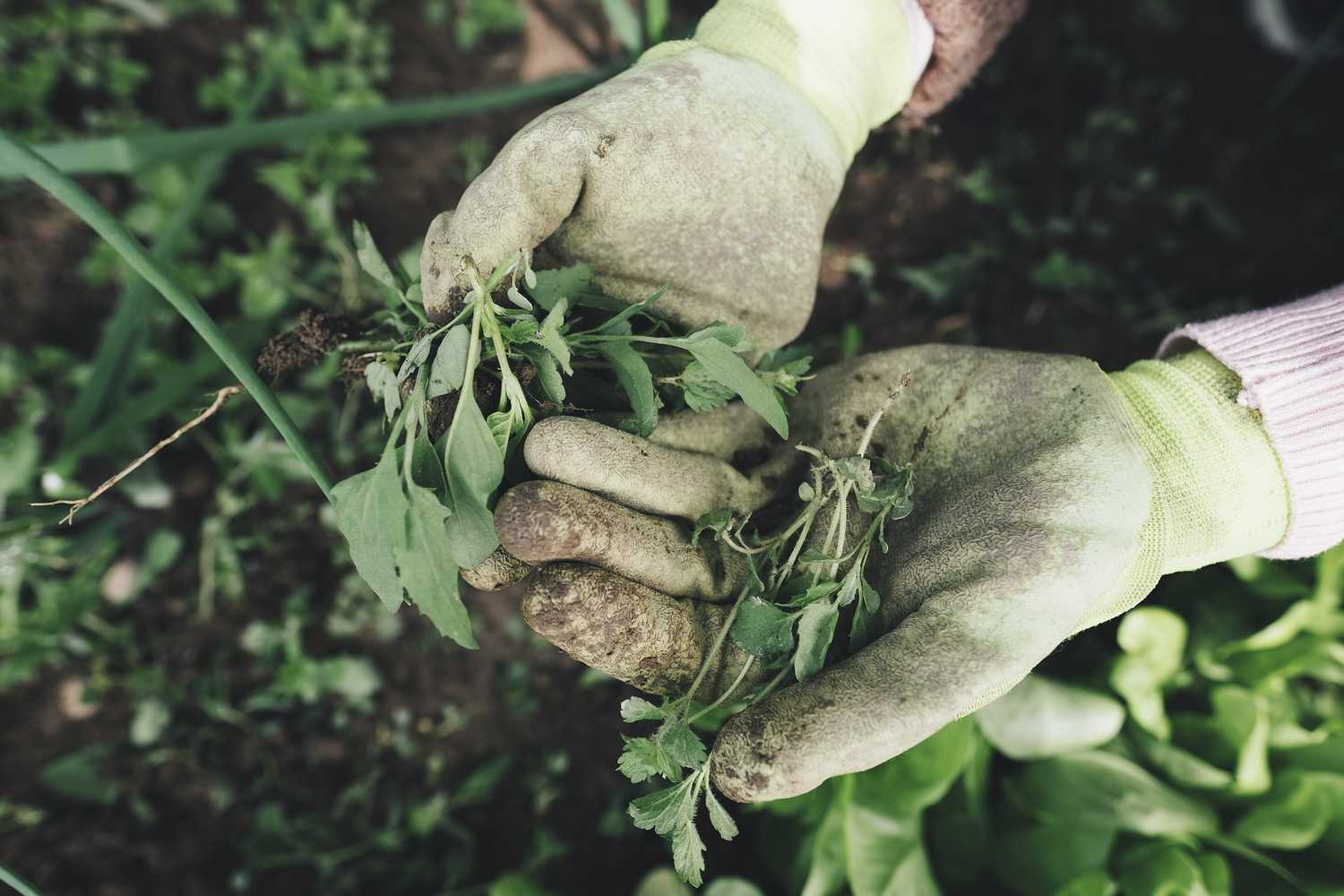
Weeding... the natural way!
Limit weeds without pesticidal methods
Contents
Weeds, which gardeners sometimes refer to as adventive plants, are everywhere! They can be found in flower beds, pathways, sidewalks… Everywhere! Weeding then becomes everyone’s responsibility, and adventive plants are the enemy to be defeated. For those seeking a miracle solution (white vinegar, nettle manure, salt…), be aware that there is no natural or organic weed killer that is selective, total, and permanent.
Moreover, legislation is evolving: since 1st January 2017, the law prohibits the use of chemical weed killers, including the infamous glyphosate, in public spaces, parks, and forests. Its use by individuals has been banned since 1st January 2019. It is therefore high time to seriously consider natural weeding and ecological weed killers!
From experience, we know that true gardeners who use weed killers are rare. However, many of us have a neighbour or a (annoying!) acquaintance who still uses them… Here are various tips you can share with them, as well as techniques that will help you weed, without chemical products, in different areas of the garden.
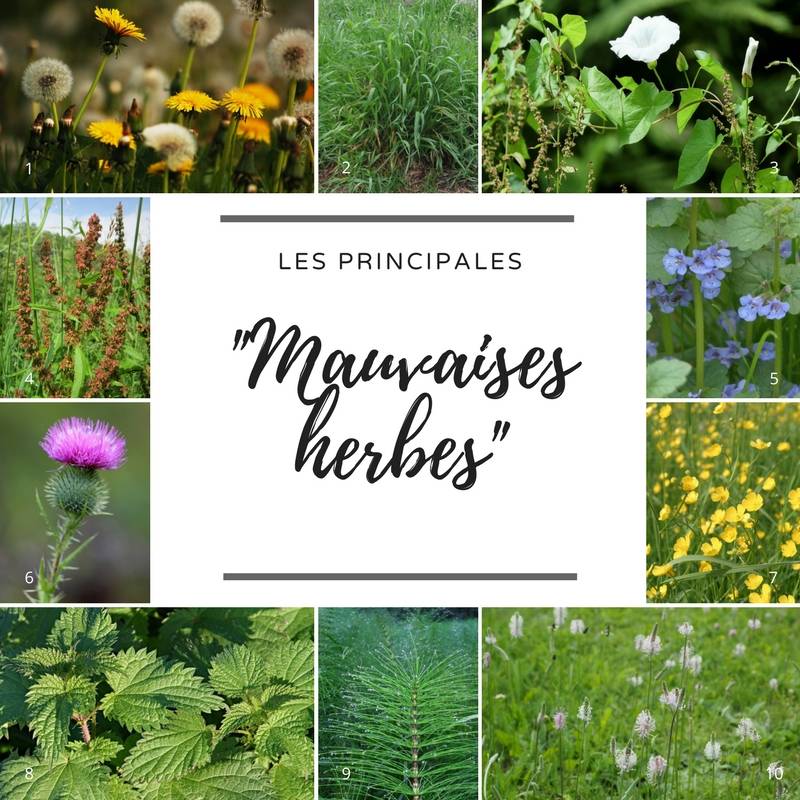
Weeds mostly seen in our gardens : 1. Dandelion 2. Couch grass 3. Bindweed 4. Wild sorrel 5. Ground ivy 6. Thistle 7. Buttercup 8. Nettle 9. Horsetail 10. Plantain

Weeding in gravel, sandy, or paved areas
Sandy, gravelled areas, and paved paths, as well as terraces, are not spared from the growth of “weeds”. They are particularly noticeable in these zones. These permeable areas should not be treated with a weedkiller: at the slightest rain, the product is leached away and ends up in watercourses. Here are some solutions for organic weeding!
How to weed?
- The thermal weederUsing a thermal weeder is a good solution, provided you have a lightweight gas bottle. It is to be used on young shoots, especially in spring and early autumn. You can also use it in winter when it is particularly cold: the significant temperature difference enhances its effectiveness. Note that heat does not affect the roots of mature plants: to eliminate them, you need to intervene frequently. The thermal weeder is very useful in paved paths without joints where adventives infiltrate. However, be aware that gas consumption is high and it is a non-renewable resource. Finally, be very careful if you are weeding at the foot of a hedge and do not use this tool in areas covered with mulch… in summer or dry weather, a fire can easily start!
- Manual weedingThis is a classic method that works very well! Using a scraper will help you dislodge young shoots. For plants with large roots like dandelions or plantains, use a hoe or a weeding knife.
- Using natural weedkillersMineral areas are the only places where the use of natural weedkillers is possible. Indeed, as they are non-selective, it is difficult to use them in flower beds or vegetable gardens. The most effective is vinegar. Here is the recipe recommended by Jean-Paul Thorez, a well-known author and speaker: with a 5-litre sprayer filled with pure white vinegar, you can treat 40 m² of your garden. Apply this treatment on sunny days and rinse your sprayer afterwards. The effect is almost immediate; the foliage is destroyed, but for the most resistant adventives like dandelions, the root system is not affected and regrowth may occur. Note that the plant is still weakened. You can repeat this treatment up to 6 times a year to improve effectiveness.
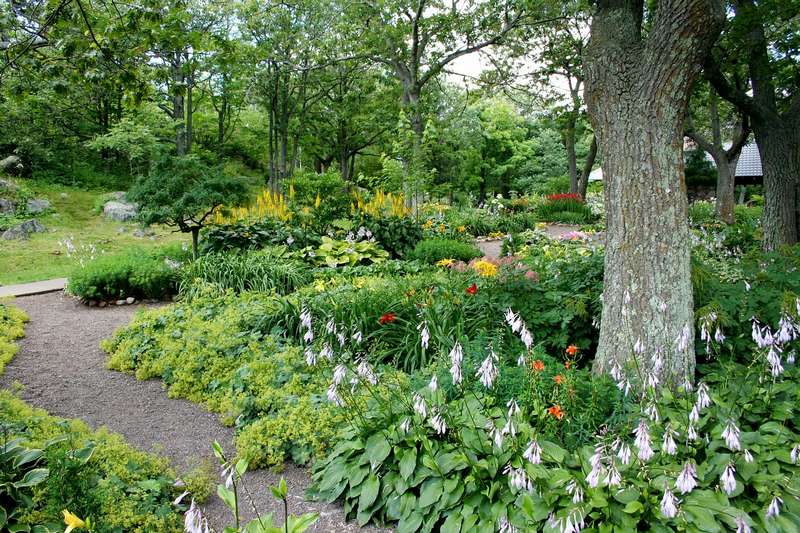
How to prevent the appearance of weeds in paths, etc.
- In sandy or gravelled areas, the installation of a geotextile should be considered: it prevents the invasion of herbs from below.
- Also consider borders, as they are very useful for preventing sand and gravel from escaping into the grass and for stopping running grass from colonising the mineral area.
- Seed a lawn! This solution may seem a bit far-fetched, but it works very well for large mineral areas that are very difficult to maintain. Many municipalities successfully implement this after making a slight addition of topsoil and using a slow-growing lawn. You will need to mow, of course… but it is much quicker than weeding!
Weeding the garden beds and the base of the hedges
Who hasn’t spent hours pulling out unwanted herbs from their garden beds? Here are some tips and tricks for effective weeding and preventing overgrowth.
How to weed garden beds?
As with lawns, the only natural way to weed a bed or the base of a hedge or tree is to manually pull out the adventive plants. To do this, we recommend:
- Using appropriate tools: a gouge to extract the roots of plants that form large rosettes, a hoe or a hand cultivator for seedlings.
- Weed at the right time. In clay soil, intervene when the ground is neither too dry nor too sticky. In dry soil, weed two days after a good rain; the soil will be loose and dry. This way, the weeds will come out easily.
- Be sure to remove adventive plants before they set seed. It is important to know these plants to manage them better and intervene at the right time.
- Don’t wait until May to start weeding. By this time, plants have developed strong root systems, and some may have already seeded. Start as early as March: it’s easier to spot weeds, and they come out easily. A quick swipe with a hoe at the collar cuts and kills the annuals, no need to exert more effort. For perennial unwanted herbs, however, this is not enough!
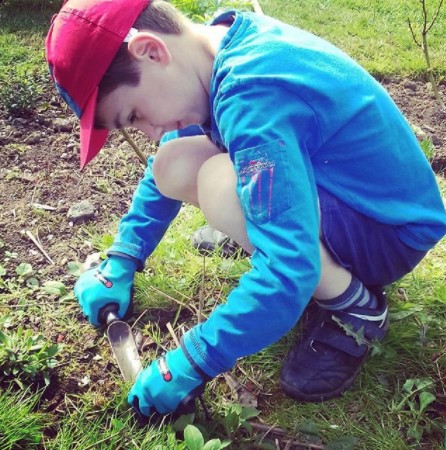 Weeding with a gouge: a true child’s play, easy and effective!
How to prevent weeds from establishing in garden beds?
To prevent your beds from being quickly overrun by unwanted herbs:
- Don’t hesitate to plant closely: your favourite plants will fill the space, leaving less room for adventive plants. Play their game and rely on competition.
- Plant groundcover perennials or groundcover shrubs if you need to occupy a large space or a slope! These plants are excellent at filling gaps quickly and help reduce the need for weeding, while keeping the area cool in summer. They also provide a refuge for beneficial garden insects. Some are deciduous, others evergreen, and there are options for all situations: Lysimachia nummularia, Ajuga reptans, Persicaria affinis, Epimedium, Stachys byzantina, Vinca minor, Phlox subulata, etc.
- Mulch! The presence of a mulch will limit the development of weeds as well as reduce watering needs and improve soil quality. To learn more about mulching, check out our advice sheet: “Mulch: why? How?“.
- Edge your borders: defining the beds with a border maker not only provides a neat appearance but also acts as a barrier against running weeds.
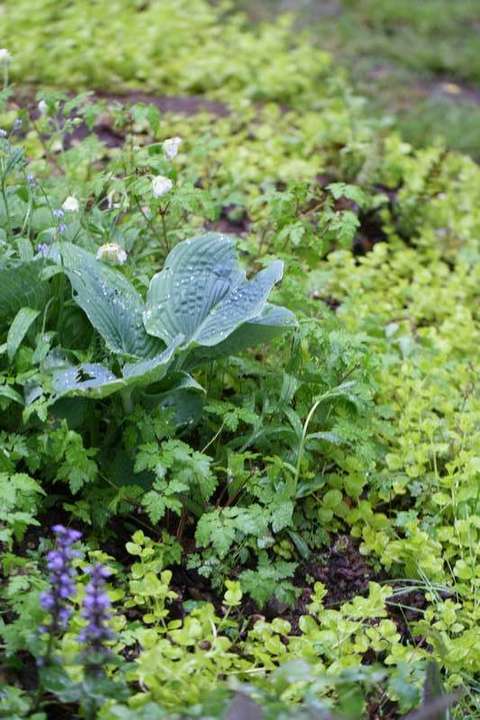 Carpet of Lysimachia nummularia ‘Aurea’
About mulching fabric or “planting tarp”
Covering the ground with a tarp may seem like a solution to avoid weeding a bed. However, this is a very short-term solution, as adventive plants always find a way through (even growing directly on the fabric), and manual weeding then becomes a nightmare. Not to mention that soil needs to be regularly amended to remain fertile. This is not possible through the fabric. As a result, the soil quickly becomes depleted, and plants struggle to thrive (but not the weeds!). For more information, check out our article: “Mulching fabric: for or against“.
Weeding the vegetable garden
In the vegetable garden, we often wish we could do without weeding! These few tips will help lighten your workload.
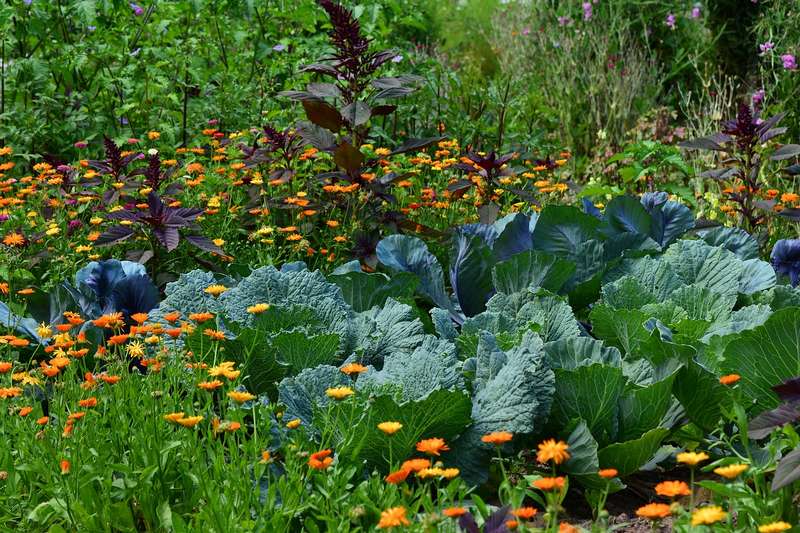 Preventing the Appearance of Adventive Plants in the Vegetable Garden
- As in the ornamental garden, remove adventive plants before they set seed; hoe and cultivate regularly.
- Practice the technique of false sowing. To do this, simply prepare the soil when it is warm enough, a few weeks before the planned date for planting or sowing vegetables. To learn more about this practice, consult our advice sheet: “False Sowing, an Effective Technique to Reduce Weeds.”
- Sow or plant in straight rows to facilitate the use of the hoe.
- Mulch as soon as possible. Indeed, permanent mulching is not always possible in the vegetable garden as the soil often needs to dry out in spring, and for sowing, the soil must be bare. Once the plants are sufficiently developed, use straw or dried grass clippings to cover the soil around your vegetable plants. At the end of the season, apply a good layer of fallen leaves, straw, or even cardboard in areas free of crops: this occlusion is very effective in preventing the encroachment of weeds.
- Practice the art of companion planting. Associating plants has many advantages. This technique allows for the combination of plants, whether they are vegetables or not. It helps to protect vegetables from certain pests and diseases while maximising the use of space, leaving little room for “weeds.” To learn more, consult our advice sheet: “Crop Associations in the Vegetable Garden“.
- Sow green manures between the rows, before or after a crop. This has numerous benefits: these plants enrich and improve the texture of the soil, protect it from leaching due to rain and erosion. They also compete with adventive plants. Notable examples include phacelia, clover, white mustard, or buckwheat. Each green manure has its own properties and can be used according to the desired effects. Consult our blog article: “Green Manures: Everything You Ever Wanted to Know!“
- Don’t forget to edge the borders or install borders made of wood or other materials that can block the running roots of grass, effectively cutting it off at the base.
Read also
Bindweed: how to get rid of it?Natural herbicides
It is possible to do without chemical weedkillers, largely thanks to certain natural substances that make the task a bit easier without causing pollution. Among them, we note:
-
White vinegar or acetic acid
Vinegar is a non-toxic, non-polluting, biodegradable product that is very inexpensive and effective! (In fact, it is the only ingredient in the new “Speed” formula from the market leader in weedkillers… the only difference is the price per litre!). Its impact on the soil and its fauna seems very limited given that the doses used are negligible, and it is biodegradable and volatile.
-
A bio weedkiller: pelargonic acid
This is a herbicidal substance naturally secreted by the famous balcony geranium, particularly from Pelargonium odorant. Permitted in organic farming, it is said to be effective on young plants with two applications per week. Temperature is an important factor; it should be at least 10°C, knowing that effectiveness will be greater at 25°C, for example. Act with caution and discernment; even a bio weedkiller is not harmless, and the evidence is not sufficient to judge the long-term toxicity of the product. Remember to handle it with gloves.
-
Boiling cooking water from potatoes or rice
Boiling cooking waters are effective, but this is a solution that cannot be implemented in flower beds. Reserve it for gravelled areas and avoid using this water if it has been salted.
Homemade organic weed killers: beware of false good recipes!
Many natural weed killer recipes circulate on the internet. Often based on salt or other easily found substances, they are not without consequences for the environment. Here are some substances we advise against using.
-
Salt
Beware, contrary to what is often read, using salt as a weed killer is anything but eco-friendly! Regardless of the amount, it has a more than harmful impact on the environment. Indeed, the accumulation of salt pollutes the soil, groundwater, and has destructive effects on wildlife and flora sensitive to salinity.
-
Bleach
Bleach is ecotoxic and corrosive. And as everyone knows, it is also a powerful biocide, so it is unlikely to be appreciated by bacteria, fungi, and other beneficial underground microorganisms.
-
Nettle Manure
Nettle manure is quite effective against adventive plants, but its intensive use could lead to soil and water pollution due to its high nitrogen content.
Check out our advice sheet: “Nettle, a plant with many benefits“.
-
Baking Soda
It should not be forgotten that baking soda (not to be confused with caustic soda) is a salt, and like salt, its use in large quantities is not harmless to the environment.
-
Chemical Weed Killers Labeled “Biodegradable”
Do not give in to the sirens of advertising promising immediate cleaning with no consequences for crops. Roundup, the leader in this type of campaign, long claimed to be biodegradable. It has since been banned from making such claims after it was discovered that glyphosate, which it contains, as well as many so-called “100% effective” weed killers, can be found in drinking water.
Instead, muster your courage, use a weeding tool, a broadfork, a hoe, etc. This is the most effective weed killer and the best for your health!
Another perspective on "weeds
There are no such things as weeds in the strict sense, just spontaneous plants that rarely grow where the gardener would like them to. What if we looked at these wildlings from a different perspective?
Moreover, often recommended in municipalities, grassing can significantly reduce maintenance and, by extension, the use of plant protection products, while greening urban areas.
Adventive plants can also be an integral part of the garden, even in flower beds. A lawn dotted with daisies, buttercups, or clovers is beautiful, and the bees will thank you.
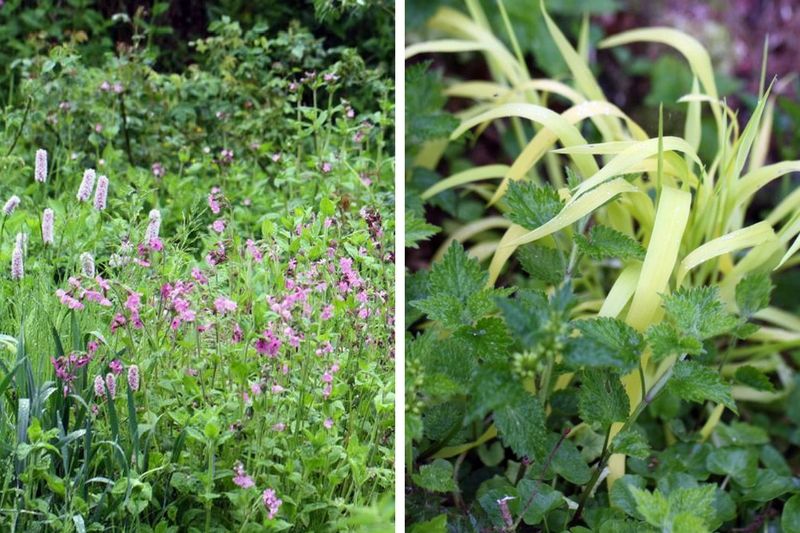
On the left: Persicaria bistorta and Silene dioica (red campion) – On the right: Millium effusum ‘Aureum’ and Lamium galeobdolon (yellow archangel)
Instead of exhausting yourself trying to eradicate them from your garden (which is a lost cause), simply limit their spread so they do not hinder the growth of your favourite plants.
Whether composted or placed directly in the flower beds, they naturally enrich the soil.
Wild plants are essential for wildlife, especially for the gardener’s allies, providing them with shelter, food, and breeding grounds.
Convert yourself; it’s not about abandoning your garden, but about de-dramatising and gaining tolerance. A garden with “weeds” can be beautiful! So, reconcile with them, learn to know them better to use them wisely. Don’t hesitate, welcome biodiversity into your garden!
- Subscribe!
- Contents
Comments