


Among the colour trends of the year that spark the imaginations of our most creative gardeners, Dark Academia offers an immersion into garnet, purples, crimsons and plum, edging toward an almost-black depth. These bold, dark tones originate from a baroque aesthetic, that of the hushed and mysterious world of old libraries and the hit series Wednesday.
In the garden, adopting such a romantic and melancholic palette requires a neat setting and scenes with subtle harmonies to soften the sombre colour and the intensity of the blooms and foliage.
Here are three borders imagined for you with this new trend in mind, updated for today!
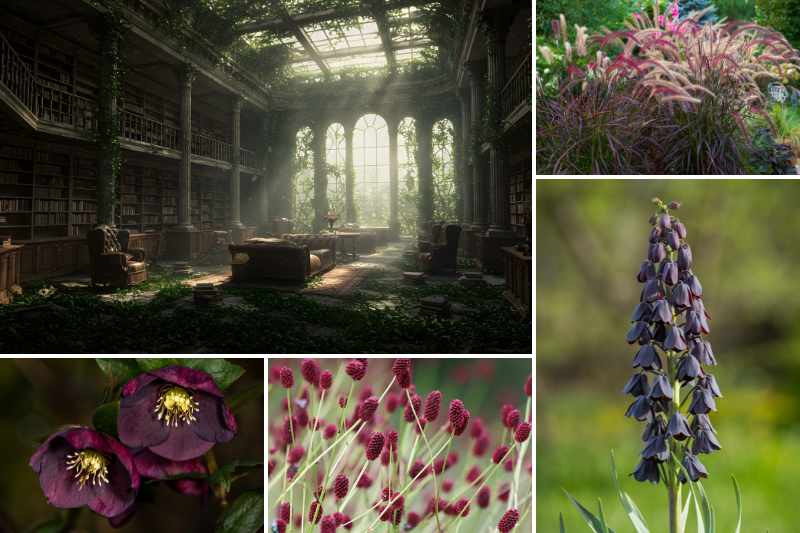
How to pair it with the garden?
The dark tones, from purple to black, should always be used with great care in plantings. They can overwhelm the eye and, if misused, impart a mood that is too sombre for a garden.
We therefore often pair them with a few neutral, diaphanous touches, drawing from the palette of white, pearly, cream and green blooms, as well as bronzy, greyed foliage. Don’t forget light, ribboned foliage, iridescent or variegated to diffuse the light around the deeper tones.
Some plants are thus particularly useful, especially those that work in a pointillist manner with their inflorescences, such as some grasses and airy perennials or the plush plants. In small doses, they instantly lighten the colour composition of a border.
A naturalistic scene: the poetry of black flowers and wild grasses
Dark-toned flowers can certainly suit a section of the garden treated as a large meadow or flowering border. In this case, favour beautiful wildflowers, such as Scabiosa 'Chile Black', and Cirsium rivulare 'Atropurpureum'. A mass of Penstemon with purplish flowers such as the variety 'Raven' will visually support the border, enriching it with a multitude of blooms right through to frosts.
The perfect accompaniment to temper, without masking, the depth of purple tones will simply come from a few very light grasses such as the Hordeum jubatum, or taller Panicum, or airy fennel. In mild climates, opt without hesitation for the Pennisetum setaceum 'Rubrum'. The presence of statice (Limonium latifolium) with tiny pale mauve flowers softens the scene and brings the essential gentleness to the dark colours.
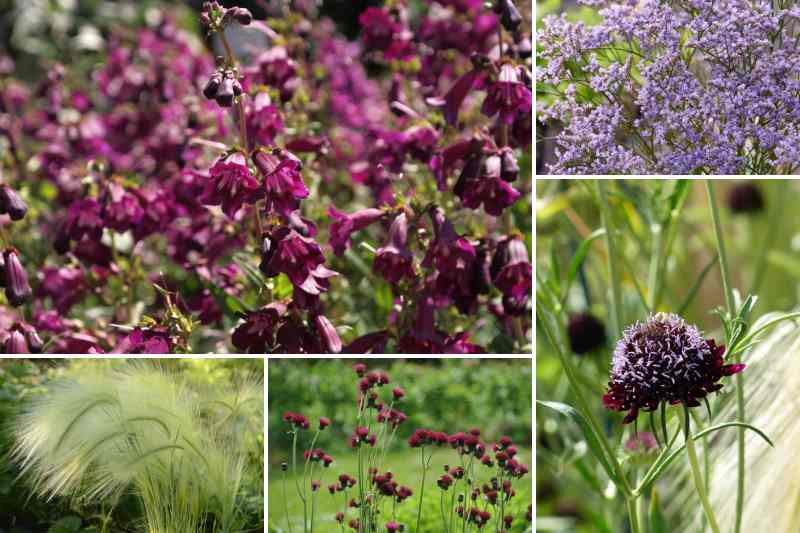
Clockwise from top left: Penstemon 'Raven', statice, Scabiosa 'Chile Black', Cirsium rivulare 'Atropurpureum' and Hordeum jubatum
A shrub border between lilac and burgundy
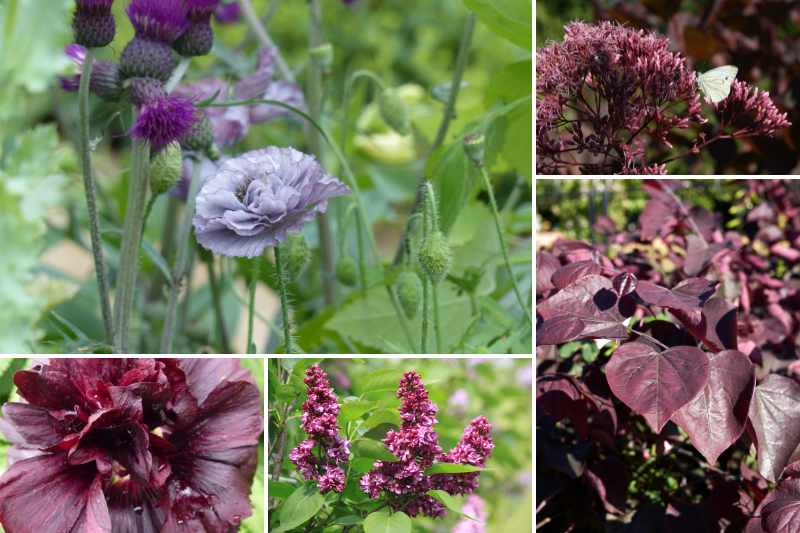
Around two fine shrubs chosen, one for its burgundy flowering with double blossoms—the lilac 'Charles Joly'—the other for its striking heart-shaped foliage, Cercis canadensis 'Forest Pansy', invite a few perennials in the same warm tones, and greyed foliage for softness. In our example, the lightness of the purplish inflorescences of a purple Eupatorium sits beside the delicate lavender-grey of a refined poppy (Papaver rhoeas 'Amazing Grey'), and the utterly graceful verticality of double-flowered hollyhocks 'Chater's Violet'.
Pensée to include some soft, greyed and silvery foliage such as Artemisia ludoviciana (Valerie Finnis) that will thread at the foot of the shrubs, and respond to the romantic colours of the poppies.
N.B. : other shrubs just as spectacular in their purple hues would work brilliantly in this border, such as certain varieties of the famous smoke tree (Cotinus coggygria) and its wispy summer flowering, a black elder, a physocarpus or Magnolia 'Black Tulip' for a poetic spring effect.
Velvety sophistication in partial shade
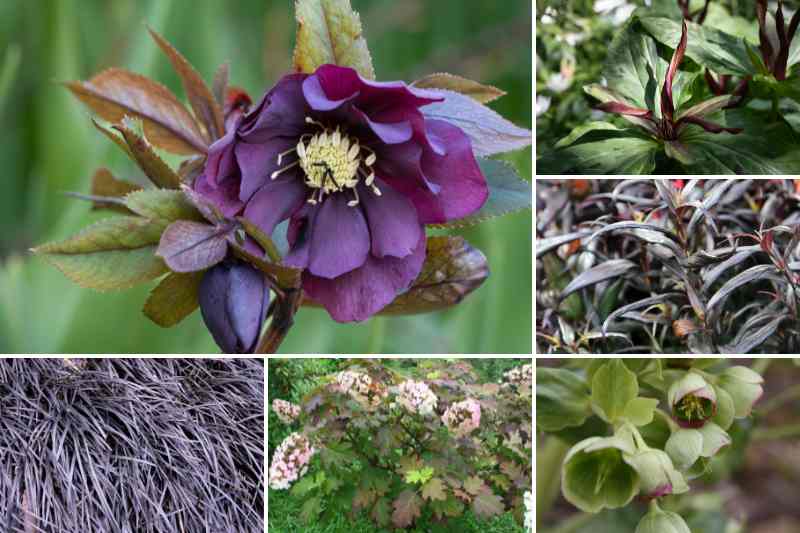
The two previous moods are envisaged in sunny settings. The purple-to-chocolate hues can also be used in a bright partial shade in the garden. In that case, work on an enveloping ambience, softening the dark impression with discreet touches of chartreuse green, together with pearly and iridescent whites.
The purple flowers of Hellebores will be the stars of this corner, with infinite grace and a very long flowering season, akin to botanical cousins such as Helleborus foetidus and its pistachio flowers. Invest here in a few purple foliage plants, such as Strobilanthes anisophyllus 'Brunetthy', a magnificent almost-black shrub, whose pale pink late-spring flowers contrast nicely, and a groundcover with marbled leaves like Trillium cuneatum and a mass of black Ophiopogons. Finally, for a touch of volume in the scene, use the assets of an oak-leaved hydrangea: distinctive foliage that clings on well into winter, taking crimson autumn tones, and white, anise-scented flowers, ranging from white through pink, in spectacular yet light panicles.
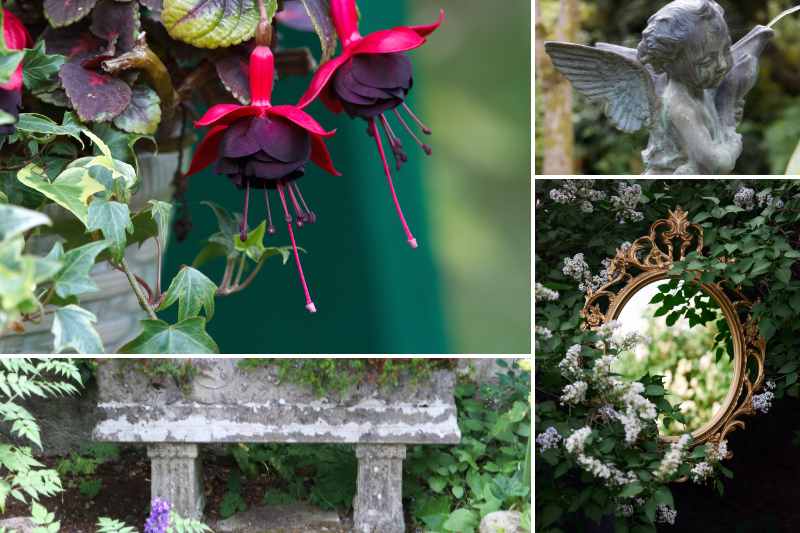
To refine this baroque ambience, why not insert one or two refined accessories: a latticed frame with a beautiful gilded patina or a mirror to reflect the light, a romantic vintage metal lantern or a statue representing a poet, an angel or a muse? A stone bench will also invite sitting and resting.
Discover our selection of plants in the Dark Academia spirit on our online nursery, as well as inspiration in the Trend Notebook 2026!
Also read on the topic: How to combine black-flowered perennials? ; 6 border ideas for a red/purple garden, Purple foliage: how to use it and pair it in the garden, and Pairing red or purple flowers.

Comments