





























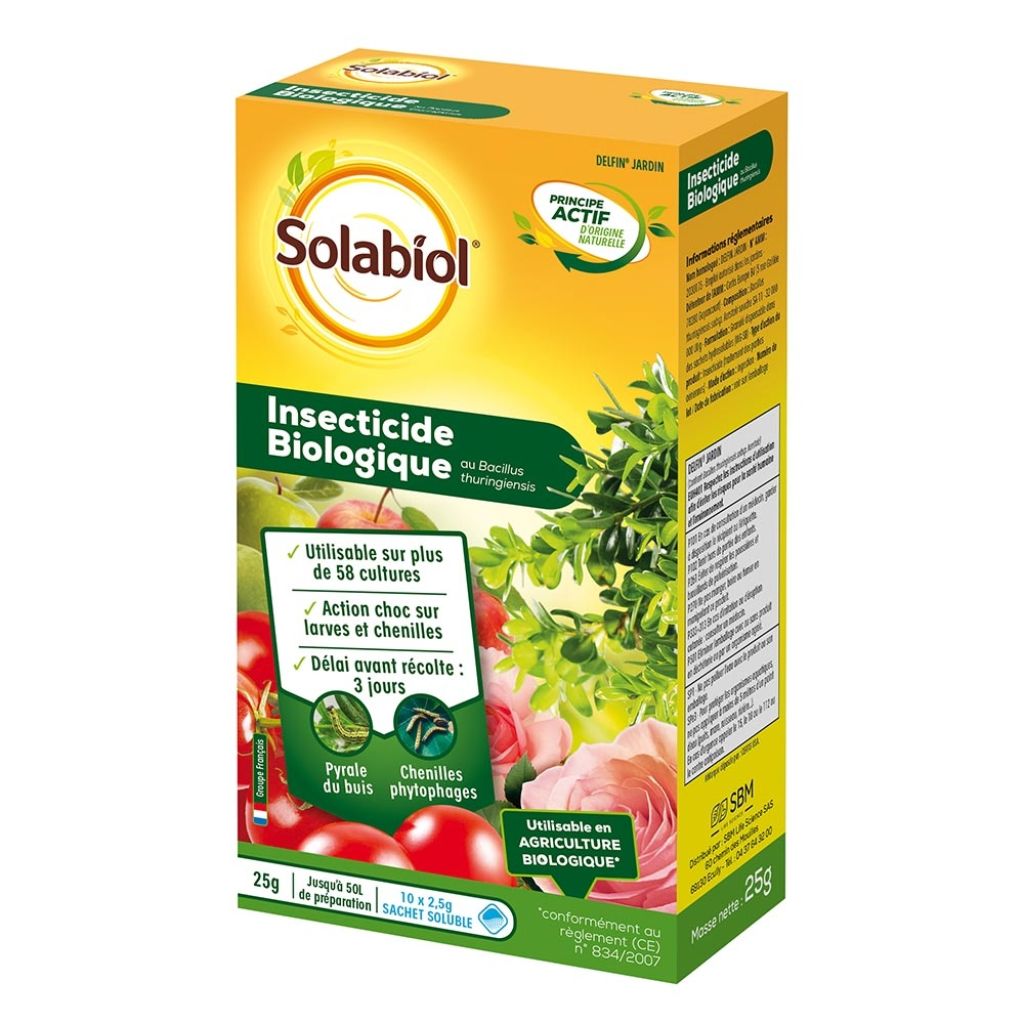
Organic insecticidal Solabiol in a box of 10 sachets of 2.5 g each
Organic insecticidal Solabiol in a box of 10 sachets of 2.5 g each
Special offer!
Receive a €20 voucher for any order over €90 (excluding delivery costs, credit notes, and plastic-free options)!
1- Add your favorite plants to your cart.
2- Once you have reached €90, confirm your order (you can even choose the delivery date!).
3- As soon as your order is shipped, you will receive an email containing your voucher code, valid for 3 months (90 days).
Your voucher is unique and can only be used once, for any order with a minimum value of €20, excluding delivery costs.
Can be combined with other current offers, non-divisible and non-refundable.
We guarantee the quality of our plants for a full growing cycle, and will replace at our expense any plant that fails to recover under normal climatic and planting conditions.


This Solabiol organic insecticidal product is formulated with Bacillus thuringiensis, a micro-organism naturally present in the soil capable of destroying lepidopteran larvae, i.e., caterpillars. Usable on over 58 vegetable, fruit, and ornamental crops, its effectiveness depends on the quantity of product ingested by the pests. The quality of the spraying is therefore a key factor for successful treatment: it must be uniform. This treatment is usable in Organic Agriculture. Packaged in a box of 10 dose sachets of 2.5 g each, it allows for the preparation of up to 50 litres of solution to spray.
This preparation in the form of a water-soluble powder contains only one active ingredient, of 100% organic origin: a bacterium named Bacillus thuringiensis subsp. kurstaki strain SA 11, at a rate of 32,000,000 IU/g. This bacillus acts by ingestion. Its mode of action, the production of protein crystals capable of perforating the caterpillar's digestive tract, followed by the release of spores inside the host, causes a rapid and definitive halt in feeding and therefore leads to its disappearance within 2 to 5 days. Bacillus thuringiensis var. kurstaki presents no toxicity to other animals, humans, or plants. This bacterium dies and degrades naturally, like all living organisms, without leaving toxic residues.
This insecticide is effective against:
- Tuta absoluta, the tomato leafminer which also affects cabbages and artichokes. This parasitic pest, recently appeared in France, is present in the south-east of our country.
- Summer fruit tortrix (Argyrotaenia pulchellana), mainly affecting apple trees (the fruit skin)
- Grape berry moth (Eupoecilia ambiguella): this larva bores into grape berries and promotes the development of rots.
- Codling moth (Cydia pomonella), whose larva develops inside the fruits
- Heliothis boring caterpillars, also called cutworms. These caterpillars, which work mainly at night, can affect many crops, both vegetable and ornamental. In the vegetable garden: carrots, cabbages, spinach, tomatoes, lettuces, potatoes, sorrel, radishes, celeries, artichokes, strawberries... In the orchard: apricot trees, vines... In the ornamental garden: annuals and perennials, particularly pelargoniums and phlox. Some trees such as ash, pine, or maple are also attacked.
To limit invasions, always promote biodiversity in the garden and particularly beneficial insects and animals (insectivorous birds, ladybirds, hoverflies, lacewings, tits, spiders), by creating refugium areas in your garden and by avoiding the use of synthetic pesticidal and weedkiller products.
- Use: from April to September. Treat by wetting both sides of the leaves and in the absence of rain for 3 hours. Repeat the application if necessary about 7 days after treatment or in case of heavy rain.
- Main application rates:
From 0.5 g/L to 1.5 g/L, i.e., 1 water-soluble sachet for 1.6 to 5 L of water.
- Pre-harvest interval: 3 days.
Delfin® Garden - Marketing Authorisation No.: No. 2030175.
Use plant protection products with care. Before any use, read the label and product information.
Product usable in organic farming in accordance with EC Regulation 834/2007.
Uses and advantages
Technical features
Tips
Tips
This item has not been reviewed yet - be the first to leave a review about it.
Haven't found what you were looking for?
Hardiness is the lowest winter temperature a plant can endure without suffering serious damage or even dying. However, hardiness is affected by location (a sheltered area, such as a patio), protection (winter cover) and soil type (hardiness is improved by well-drained soil).

Photo Sharing Terms & Conditions
In order to encourage gardeners to interact and share their experiences, Promesse de fleurs offers various media enabling content to be uploaded onto its Site - in particular via the ‘Photo sharing’ module.
The User agrees to refrain from:
- Posting any content that is illegal, prejudicial, insulting, racist, inciteful to hatred, revisionist, contrary to public decency, that infringes on privacy or on the privacy rights of third parties, in particular the publicity rights of persons and goods, intellectual property rights, or the right to privacy.
- Submitting content on behalf of a third party;
- Impersonate the identity of a third party and/or publish any personal information about a third party;
In general, the User undertakes to refrain from any unethical behaviour.
All Content (in particular text, comments, files, images, photos, videos, creative works, etc.), which may be subject to property or intellectual property rights, image or other private rights, shall remain the property of the User, subject to the limited rights granted by the terms of the licence granted by Promesse de fleurs as stated below. Users are at liberty to publish or not to publish such Content on the Site, notably via the ‘Photo Sharing’ facility, and accept that this Content shall be made public and freely accessible, notably on the Internet.
Users further acknowledge, undertake to have ,and guarantee that they hold all necessary rights and permissions to publish such material on the Site, in particular with regard to the legislation in force pertaining to any privacy, property, intellectual property, image, or contractual rights, or rights of any other nature. By publishing such Content on the Site, Users acknowledge accepting full liability as publishers of the Content within the meaning of the law, and grant Promesse de fleurs, free of charge, an inclusive, worldwide licence for the said Content for the entire duration of its publication, including all reproduction, representation, up/downloading, displaying, performing, transmission, and storage rights.
Users also grant permission for their name to be linked to the Content and accept that this link may not always be made available.
By engaging in posting material, Users consent to their Content becoming automatically accessible on the Internet, in particular on other sites and/or blogs and/or web pages of the Promesse de fleurs site, including in particular social pages and the Promesse de fleurs catalogue.
Users may secure the removal of entrusted content free of charge by issuing a simple request via our contact form.
The flowering period indicated on our website applies to countries and regions located in USDA zone 8 (France, the United Kingdom, Ireland, the Netherlands, etc.)
It will vary according to where you live:
- In zones 9 to 10 (Italy, Spain, Greece, etc.), flowering will occur about 2 to 4 weeks earlier.
- In zones 6 to 7 (Germany, Poland, Slovenia, and lower mountainous regions), flowering will be delayed by 2 to 3 weeks.
- In zone 5 (Central Europe, Scandinavia), blooming will be delayed by 3 to 5 weeks.
In temperate climates, pruning of spring-flowering shrubs (forsythia, spireas, etc.) should be done just after flowering.
Pruning of summer-flowering shrubs (Indian Lilac, Perovskia, etc.) can be done in winter or spring.
In cold regions as well as with frost-sensitive plants, avoid pruning too early when severe frosts may still occur.
The planting period indicated on our website applies to countries and regions located in USDA zone 8 (France, United Kingdom, Ireland, Netherlands).
It will vary according to where you live:
- In Mediterranean zones (Marseille, Madrid, Milan, etc.), autumn and winter are the best planting periods.
- In continental zones (Strasbourg, Munich, Vienna, etc.), delay planting by 2 to 3 weeks in spring and bring it forward by 2 to 4 weeks in autumn.
- In mountainous regions (the Alps, Pyrenees, Carpathians, etc.), it is best to plant in late spring (May-June) or late summer (August-September).
The harvesting period indicated on our website applies to countries and regions in USDA zone 8 (France, England, Ireland, the Netherlands).
In colder areas (Scandinavia, Poland, Austria...) fruit and vegetable harvests are likely to be delayed by 3-4 weeks.
In warmer areas (Italy, Spain, Greece, etc.), harvesting will probably take place earlier, depending on weather conditions.
The sowing periods indicated on our website apply to countries and regions within USDA Zone 8 (France, UK, Ireland, Netherlands).
In colder areas (Scandinavia, Poland, Austria...), delay any outdoor sowing by 3-4 weeks, or sow under glass.
In warmer climes (Italy, Spain, Greece, etc.), bring outdoor sowing forward by a few weeks.