


Growing Clivias indoors
Everything you need to know to get your Clivia to bloom and to care for it at home
Contents
With its orange flowers, Clivia is a popular indoor plant for its exotic beauty, its long flowering period and its overall longevity! It’s a very easy-to-care-for plant that suits even beginners. To grow and look after it at home, follow our tips: you’ll see, it’s a doddle…
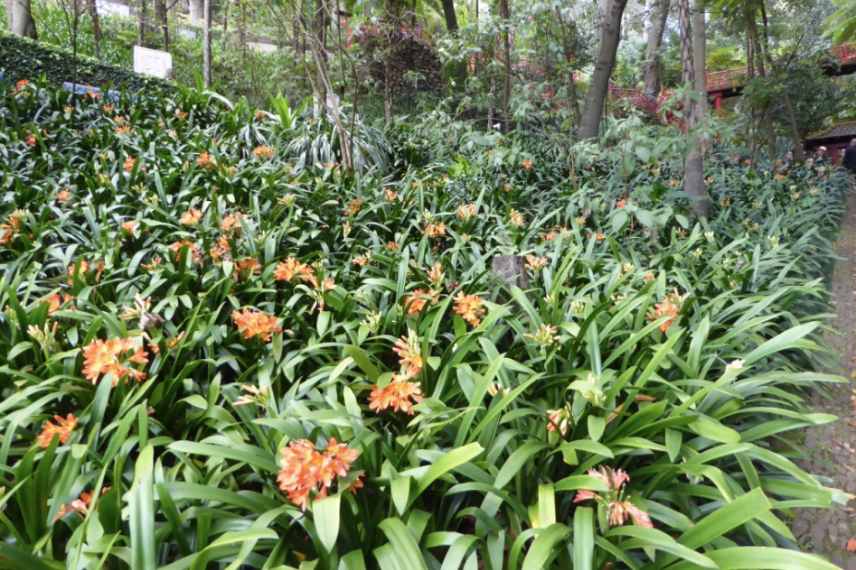
Clivias grow by the hundreds in Madeira’s gardens (© Gwenaëlle David Authier)

Clivia, a beautiful exotic plant
What is this orange beauty, grown with us mainly indoors—in our homes or flats—and in the ground only in the south of France, in mild microclimates around the Mediterranean coast?
There are five species in this botanical genus belonging to the Amaryllidaceae family, all native to South Africa: Clivia nobilis, le Clivia caulescens, the Clivia robusta, the Clivia mirabilis, and the Clivia miniata, the one that interests us, as it is usually offered in garden centres here. It originates from KwaZulu Natal, an eastern region of South Africa.
These plants grow in these regions in partial shade, in forest understorey, sometimes on tree trunks, behaving as epiphytic plants. Thus, they are also found closer to us in southern Europe, in Spain and Portugal, planted in warm but shaded conditions as long as the conditions remain fairly bright.
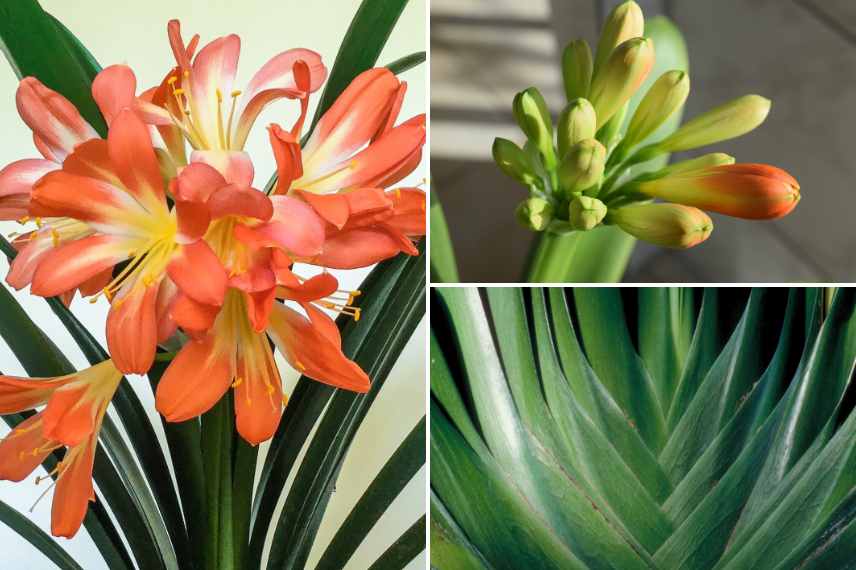
Clivia has evergreen strap-shaped foliage, which may recall that of Agapanthus, though its leaves are darker green and tougher in texture, finely veined. It forms a spreading, fan-shaped tuft.
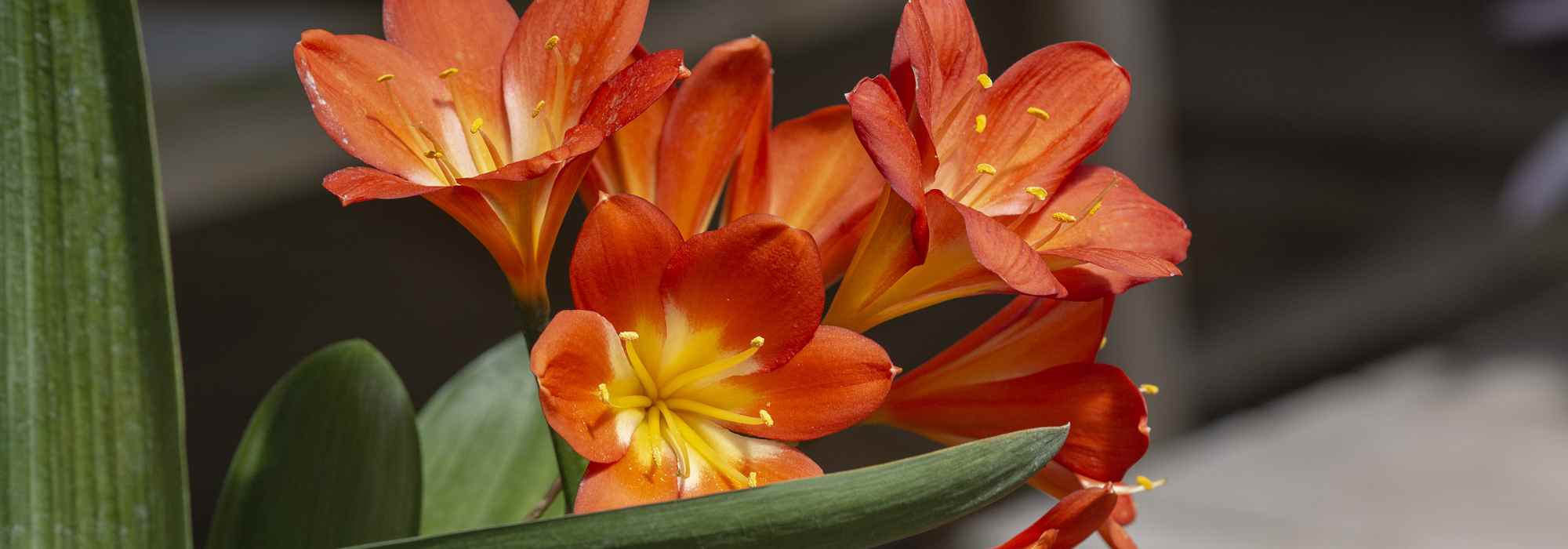
Its sun-loving flowering gives it all its exotic charm: it appears at the end of a stout inflorescence bearing 10 to 20 flowers in an umbel, orange trumpet-shaped with yellow throats in their centre. It flowers in our latitudes between February and March (but between March and October in its natural habitat). There is a yellow-flowered cultivar, Clivia miniata var ‘Citrina’.
Although it is part of the Amaryllidaceae, Clivia does not have a bulb. Its roots are fleshy, numerous and compact, resembling those of Agapanthus or orchids. They are readily visible and usually protrude above the surface of the pot.
Which type of pot should you choose?
A pot not too big! The Clivia is among the plants that like to have their roots a little snug. Choose a terracotta or plastic pot, with a diameter slightly larger than that of the root ball. A 15 cm diameter pot is generally ideal for a young Clivia bought from a garden centre. If you have a stoneware pot or a glazed ceramic pot at home, use it for your Clivia. It will help keep the potting mix cool and fresh.
Make sure the pot has drainage holes to prevent waterlogging, which would cause root rot.
→ Read also: Plants that prefer to have their roots snug.
Which substrate to use?
Clivia needs a rich substrate. It needs feeding to establish itself quickly. An ideal substrate for Clivia will be mainly well-drained and rich in organic matter: use a mix formed of all-purpose potting compost, sand and compost in equal parts. Add a small amount of perlite or vermiculite to improve drainage and achieve the same lightweight substrate in which Clivia is sold.
Read also
The ABC of Pot PlantingWhen and how to plant a Clivia in a pot?
Clivias are widely available in garden centres during the festive period, similar to Amaryllis bulbs. They have been forced to flower for Christmas. It is preferable, however, to buy them a little later so that you can re-pot them immediately into a larger pot and encourage late-winter flowering. You can also pot a Clivia in spring, when the plant begins its period of active growth. Avoid planting in winter, as the plant is in dormancy and less able to withstand handling.
- Optionally soak the root ball in water for a few minutes to thoroughly hydrate it if the potting mix is very dry.
- Place a thin layer of clay pebbles in the bottom of the pot (about 1–2 cm).
- Fill the pot halfway with the substrate mix, and place the plant in the centre. Ensure the base of the stem is at the correct level (about 2 cm should remain at the top of the pot).
- Fill around the roots with the remaining substrate. Gently firm around the base of the stems.
- Water immediately after planting to thoroughly moisten the potting mix
- Place the pot in a bright place, but away from direct sunlight.
The fleshy roots of Clivia are, in fact, delicate and must be handled with care when planting (or repotting).
Where should I place a Clivia?
We strive, as best as we can, to reproduce the conditions it experiences in its natural environment: bright light, yes, but not direct sun. Clivia, for example, prefers a spot behind a north- or east-facing window, where it receives enough light, without being bothered by excessive heat. If placed too much in the sun, it will tell you by developing blotches on its leaves… In summer, like all plants of this kind, it enjoys spending several months outdoors if possible. Again, we protect it from the sun and place it in bright partial shade, or even shade in the southern regions of France. It is the truly perfect houseplant, thriving at temperatures between 15 and 19°C, and it is one of the few to bloom with such generous flowers, brightening colonial and exotic interiors for a good month with its orange tones, but it actually fits into all kinds of decor.
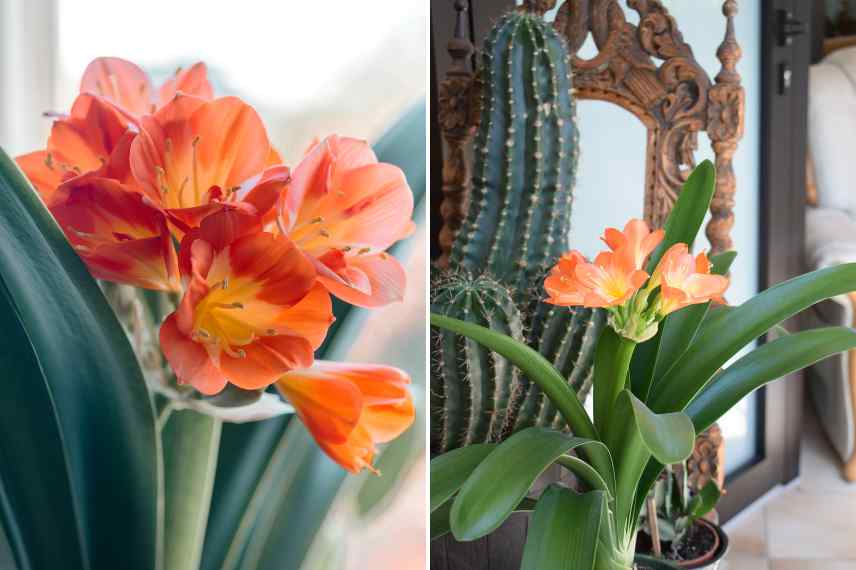
Install the Clivia behind a window, but not in direct sun. In a colonial and exotic-style interior, it looks truly splendid!
Care for a potted Clivia
If you leave the flowers on the stem after they have withered, they will, after several weeks, produce reddened fruits. Cut the stem flush with the fan formed by the leaves to avoid exhausting the plant in producing its seeds (which are not really satisfactory as a method of multiplication, due to slow growth, taking at least five years to produce a flower spike).
Watering
Watering is one of the keys to a successful Clivia flowering!
Water it more frequently as soon as it starts to push up its flower spike, one to two times a week maximum (the moisture or dryness of the substrate in the top two centimetres provides a precise indication of whether another watering is due: really let the substrate dry out between waterings, as they say!).
But between November and flowering, impose a little water stress on it by watering sparingly, no more than once a month. Clivia at this time needs a rest period, between the end of summer and winter. This is what allows it to reflower well. You will therefore reduce your watering during this period. Yellowing leaves will warn you that you are watering it too much…
Summer outdoors!
This plant, like Crassula, will enjoy spending the summer months outdoors. You can move your Clivia between May (or June) and September–October outdoors depending on the region. Do it gradually to avoid exposing Clivia to too bright sun that could scorch its leaves. The outdoor coolness of autumn will be beneficial, but bring it in as soon as daytime temperatures fall below 10°C and keep it sheltered from autumn rains. Water it sparingly until October.
→ Read also our tips in Taking indoor plants outdoors in the warmer months.
Repotting and propagation
Repot as soon as you see roots emerging from the root ball or completely filling the pot when you lift it, ideally after flowering. Do not do it earlier, as Clivia really likes to be snug in its pot to bloom well. Choose a pot 2 to 3 cm larger.
The Clivia produces offsets at its base as it grows and when it becomes mature. This gives you the opportunity to replant free baby Clivia by using base cuttings propagation. They’re handy for forming offspring from your plant and thus for giving them away or building a wonderful collection of pots, which will look superb for this type of plant! The growth of offsets is generally the sign that you can divide and repot your plant. Do this between March and April.
Plant them in a 10 cm diameter pot, burying only the base of the stems, and keep them at about 16°C. They will begin to flower three years later.
Fertilisation
As for fertilisers, don’t overdo it, and especially not when in full bloom. Give it a dose of liquid fertiliser (type green plant fertiliser or universal fertiliser) as soon as flowering finishes, normally around March, and every month until October when you will subject it to its short lean spell.
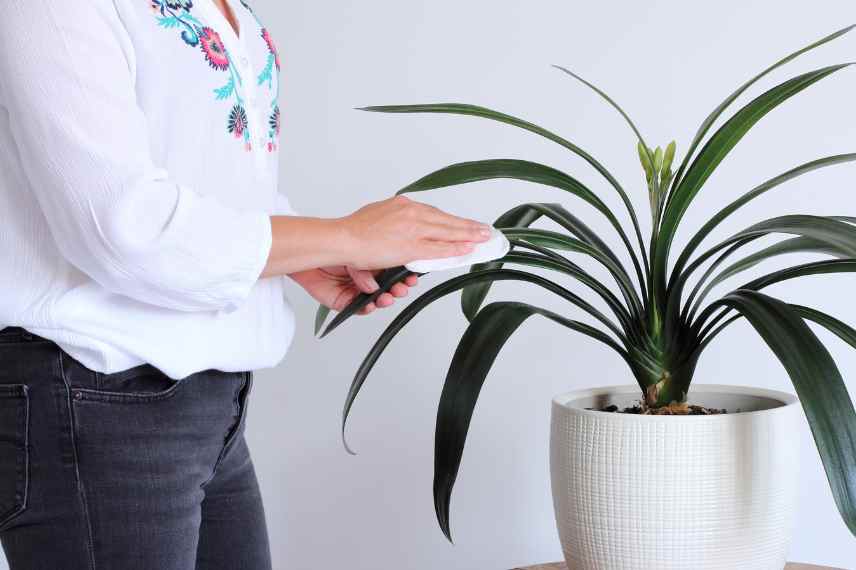
Finally, when the leaves are dusty, clean them with a damp cotton bud, on and under the leaves, taking care not to tear its strap-like foliage. Read my tips in How to clean the foliage of indoor plants?.
Make your Clivia bloom again
Like an Amaryllis whose bulb we like to keep for a future winter flowering, we hope Clivia will re-form that characteristic flower spike to bloom again within a few months. It is fairly easy to make it reflower, taking into account the care we’ve discussed above. Above all, avoid overheating the room it is in. A temperature between 15 and 21°C is beneficial; ideally, place it in a cool room, between 10 and 13°C during the winter months, to create a little stress and ensure its flowering.
Clivia is a long‑lived plant and with proper care will delight you for many years!
⇒ My tip: my mother, who grew around a dozen at one time, managed to make them all bloom year after year by keeping them in a bright, unheated cellar over winter.
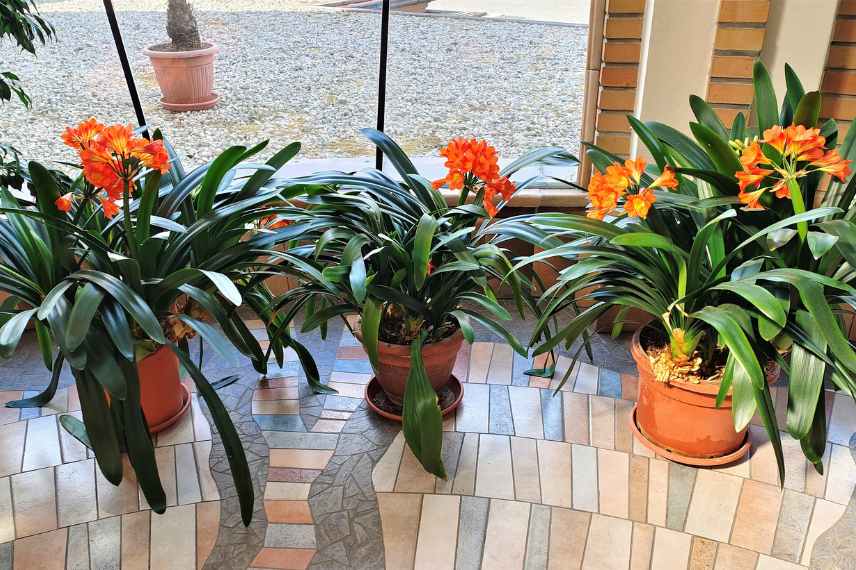 Here, placed in a cool, well-lit veranda, Clivia reflower generously
Its minor flaws
As a plant that thrives in a warm indoor environment, Clivia tends to be invaded by small waxy white and cottony clusters beneath its leaves: these are mealybugs. The cause is often found in an atmosphere that is too dry or a lack of ventilation.
If they are not too numerous, remove them one by one with a cotton bud or cotton wool, or with a cloth dampened with a little black soap (and 70% alcohol).
Apart from mealybugs, Clivia is generally free from pests.
→ Also read: Aphids and mealybugs: is black soap really effective?
- Subscribe!
- Contents
Comments