


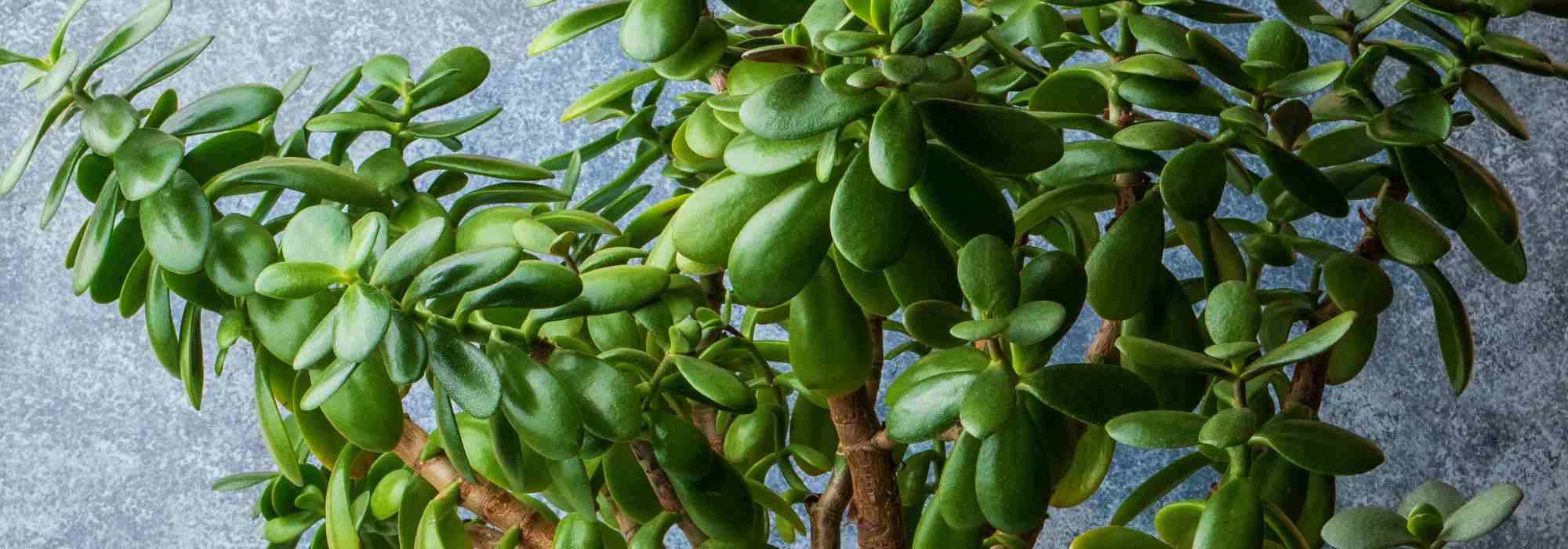
Growing Jade plant indoors
Everything you need to know about growing crassulas in our homes and flats
Contents
The Jade plant, or Crassula ovata in Latin, is one of the easiest succulent plants to find in shops and to grow at home.
This plant, extensively grown outdoors around the Mediterranean region, from Portugal to Greece, where it can take on the appearance of a small bush, is here more of an indoor plant due to its sensitivity to cold.
In this article I share a few tips to help your Jade plant thrive in your living room, and also when you take it outside during the warmer days.

A few words about the Jade plant
From the large Crassulaceae family, which also includes the kalanchoes, Aeoniums and the houseleeks, Crassula is a succulent plant, because it bears thick, fleshy leaves. It mainly comes from the Cape Provinces of South Africa, Mozambique and Namibia: it is important to remember this in order to understand how to grow and care for it. We will come back to this later in the topic.
Crassula flowers in winter and offers tiny star-shaped white flowers, but that isn’t really why we adopt it. It has, in fact, the advantage of being undemanding and of growing slowly year after year to become in the long run, even indoors, one of the most beautiful succulent plants there is, with the look of an original bonsai, gradually revealing a small swollen trunk and a multitude of oval, glossy leaves.
The most cultivated species here is the Crassula ovata, also called the Jade plant, but there are more than 300 Crassula species worldwide… The Jade plant is notably associated with luck and prosperity in Asian cultures; invite it into your home!
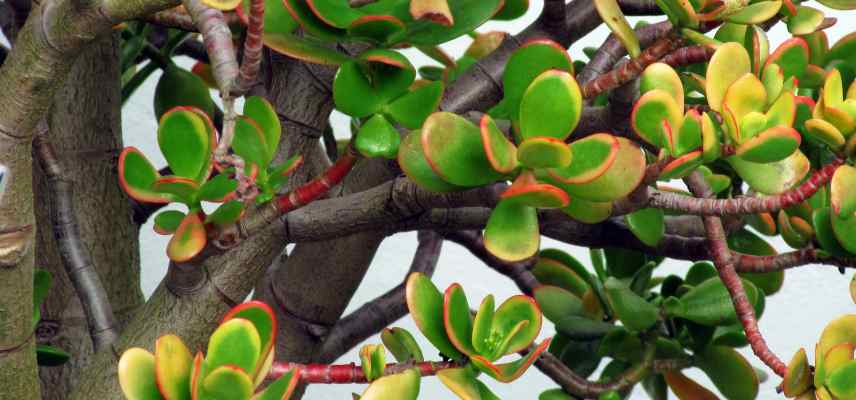
Crassula ovata
Read also
Crassula - Jade tree: planting and careWhich substrate and what type of pot for Crassula?
Like all succulent plants, Crassula ovata needs a specific substrate. It must be very well-drained. Prepare a mix of two-thirds potting compost and one-third sand or very fine gravel, or use a commercially prepared cactus potting mix. Do not enrich the planting compost; the jade plant does not need it.
A terracotta pot with a drainage hole is ideal, as it allows water to drain away easily and air to circulate around the roots. The pot size can stay small at first, since it is a plant that tolerates being a little cramped.
N.B.: When Crassula begins to take on large proportions and becomes quite heavy, I would advise repotting it into a plastic pot which will be more convenient to transport onto the terrace in good weather.
Where should a jade plant be placed indoors?
Crassula ovata loves to be placed in a well-lit spot in an apartment or a house, as it needs to regain the conditions of its natural habitat. Install it on the floor or on a small low piece of furniture near a south- or west-facing window or possibly east-facing, to provide it with at least four hours of direct light each day. This location will be ideal for it, provided you do not leave it there in summer if it is south-facing (see below).
Leave some space around it; its brittle leaves won’t tolerate a crowded environment. Avoid drafts and areas that are too cold, as the jade plant prefers temperatures between 18°C and 23°C. It will flower in winter provided it benefits from cooler temperatures, around 19°C.
It suits many interiors, especially in small city apartments, as it grows slowly, provided the exposure is favourable (west or south) to gain the most light.
Despite its South African origins, Crassula looks wonderful in Asian-inspired décor, where it lends a touch of bonsai so long as it stays small. Finally, do not, under any circumstances, place it in a room with water (kitchen or bathroom), as it is far too humid.
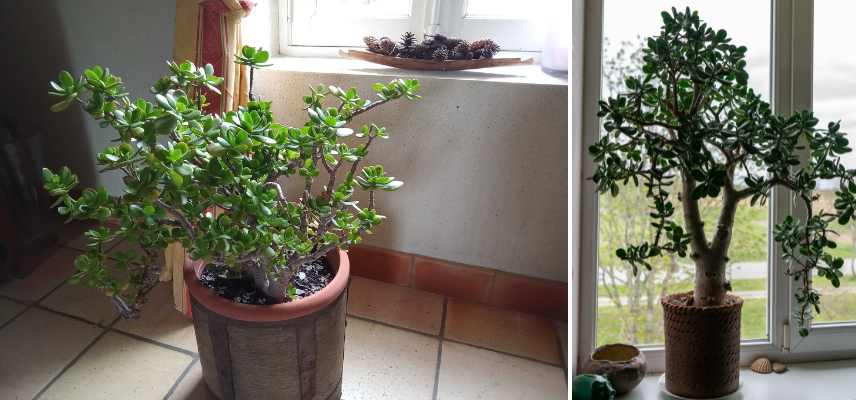
Place your jade plant on the floor if it becomes large, or on the windowsill: it needs plenty of light
How to plant a jade plant?
- Place a layer of gravel or clay pebbles at the bottom of the pot to improve drainage.
- Fill the bottom of the pot with succulent potting compost, or with a mix of potting compost and sand.
- Gently remove the plant from its current pot.
- Place the Jade plant in the centre of the new growing pot, adding potting compost all around the root ball.
- Gently firm and water to settle the potting mix. Leave to rest for about a week before watering again.
- Place the pot in a bright spot, near a south-, east- or west-facing window.
How should I water the jade plant?
One of the major advantages of the Crassula ovata is its minimal maintenance, particularly regarding watering. It stores water in its leaves and stems, like all succulents do. If you forget to water it, it won’t hold it against you, and it’s therefore the perfect plant for busy urban dwellers or beginners who don’t have much experience with indoor plants.
Wait until the potting mix is thoroughly dry to a depth of about 3 cm before watering your Crassula again indoors. On average, water it every fortnight in the year and just once a month in mid-winter. Remember that, for this type of plant, it is always better to water it sparingly rather than giving it too much water.
Your Crassula speaks to you, and you won’t be long in understanding it! If you notice its leaves becoming less firm (they flatten and wrinkle along their margins, or even brown), your jade plant is telling you it’s thirsty. Water it, always moderately and slowly, to avoid ending up with a saucer full of water and stressed roots.
If it suddenly loses its leaves, that’s certainly a sign that you’ve overwatered it.
As with all indoor plants, it is best to water the Crassula with rainwater collected from the garden, used at room temperature.
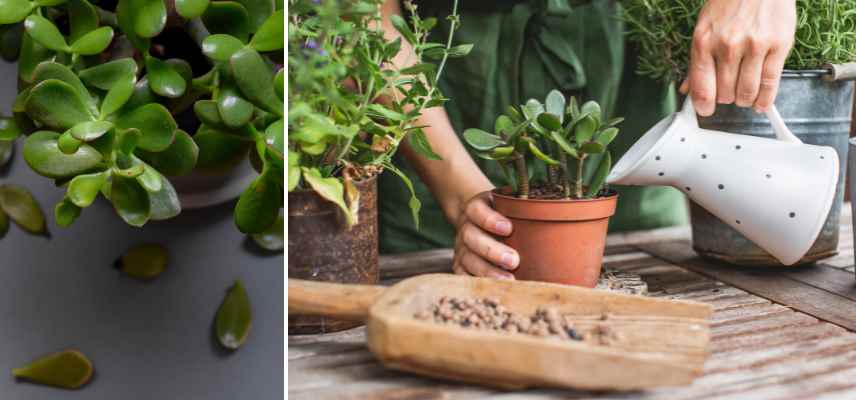
Leaf drop can be a sign of overwatering. It is better to water outside the cache-pot when the Crassula is still small.
What care does it need?
As soon as it starts to warm up, around May, it is recommended, if you have a balcony or terrace facing south or west, to place your Jade plant there. It is one of the plants that really enjoys spending the whole summer outdoors, where it will enjoy warmth for several months. But, like all indoor plants brought outside for the summer, proceed gradually, initially placing it for a few hours in bright partial shade, so as not to stress it or expose it to sun that is too harsh. A Crassula exposed to intense sun will tend to colour its leaves red. No need to worry, it is a response of the plant to high temperatures, but you can move the pot a little more into the shade.
The Crassula can become quite large, even when grown in a pot. Prune it a little, if needed to maintain its shape and encourage a more compact growth if space is limited. Cuttings are very easy to take and can readily root to create new plants. More on that in “How to prune the Jade Plant?”
Conversely, if you want to see it develop well, proceed with repotting (see below), especially if you notice a slowdown in its growth.
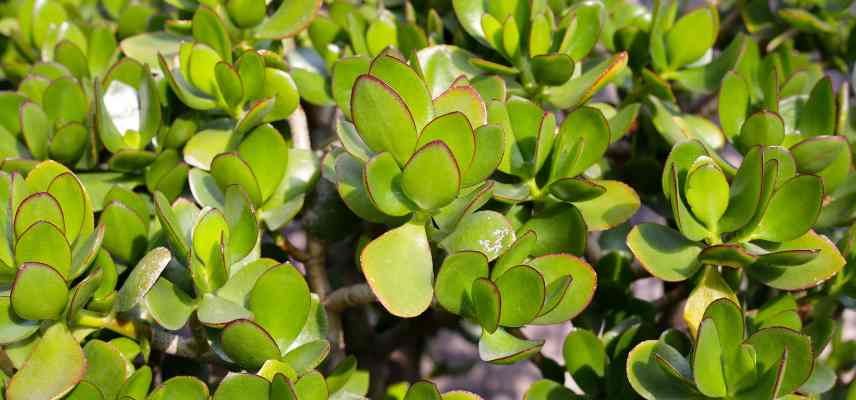
In summer, if possible place your Crassula pot outdoors in full sun or in bright partial shade, depending on the region
When should you repot a Crassula?
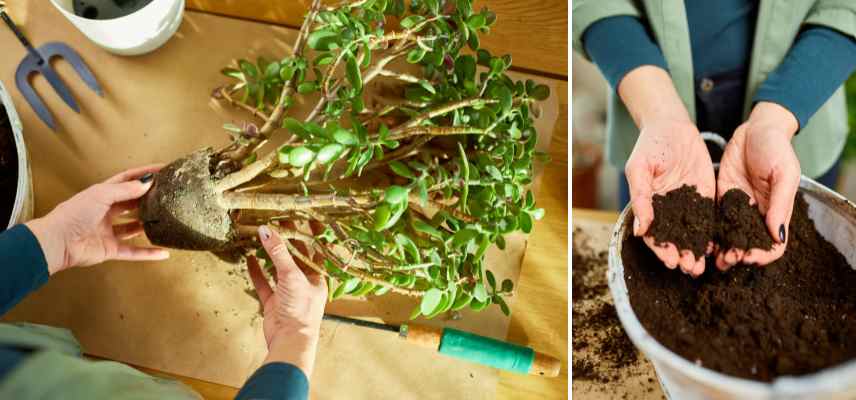
You will notice it, although it grows slowly and is happy with a small pot, your Crassula will soon grow and you will need to provide it with a container a little larger (about 3 to 4 cm larger in diameter). This repotting is therefore essential as it grows. Do this every two years if yours is very small, then as soon as it starts to grow well, a repot every 3 to 4 years will suffice.
Carry out this operation around April. Repot into a potting compost enriched with sand, and ensure the new pot is large enough as the plant starts to get heavier, to keep the pot stable.
→ Read also our article How to repot a houseplant?
The Jade plant's minor flaws
As with many houseplants grown indoors where the air is dry, Crassula tends to be prone to mealybugs mealy, which deposit white fluffy flecks at the base of the leaves or on the stems. Isolate it from other young plants to prevent spread.
Use a natural insecticide (neem oil diluted in water) or soap mixed with water and alcohol to treat infestations. Dab the leaves with a cotton bud or cloth soaked in the liquid solution. Repeat this treatment about ten days later if mealybugs persist. In all cases, ensure your plant is well-drained.
- Subscribe!
- Contents
Comments