


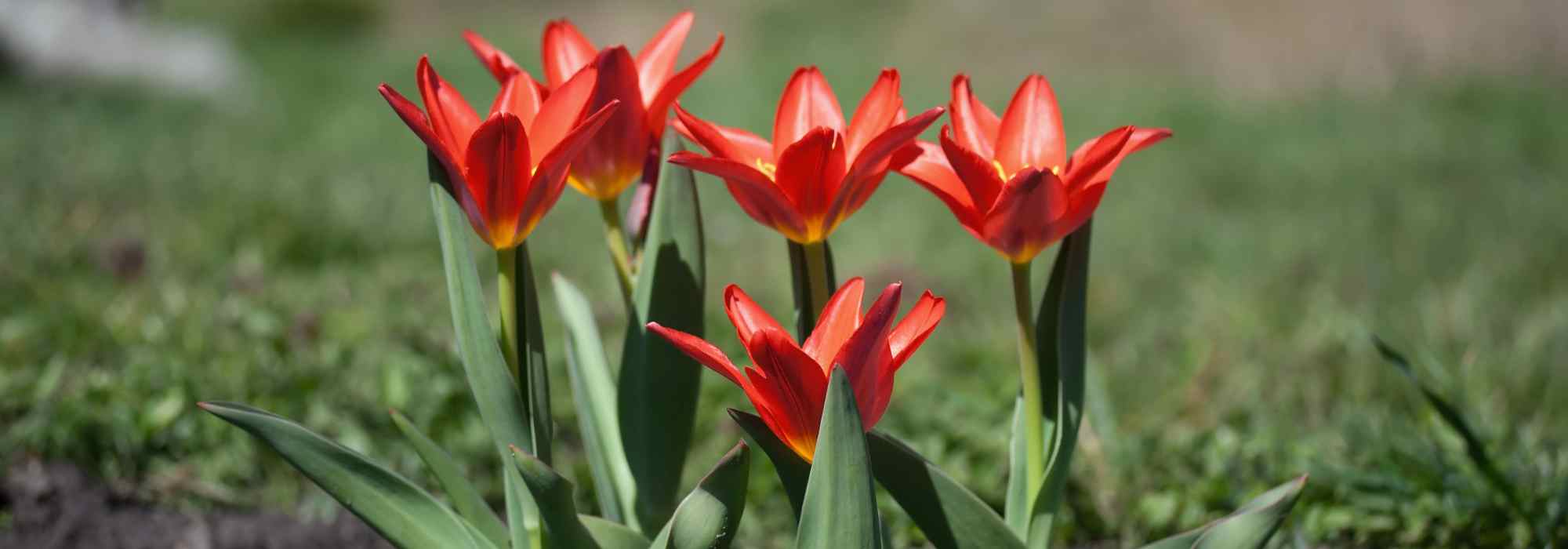
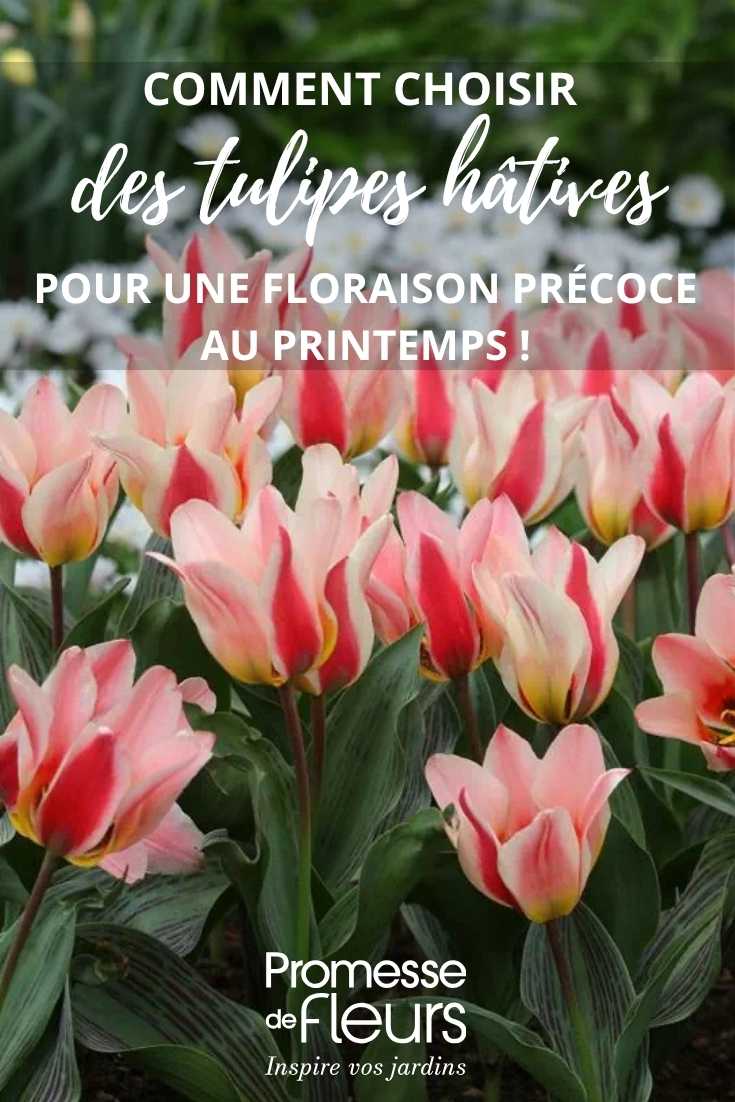
How to choose early tulips for early spring flowering?
Buying guide and criteria to help you find the ideal variety
Contents
Tulips are among the essential and timeless spring flowers. There is a wide range of varieties to suit every taste and garden style. Some also stand out for their flowering period: early tulips will be the first to reveal themselves at the end of winter, from March, heralding in a poetic way the return of mild weather and starting to enliven the garden and the containers. Conversely, late tulips will wait until the warmer days are truly established before flowering. Pairing them together means you can enjoy a long flowering period over several months.
We invite you to discover our buying guide to help you navigate and choose the early tulips that suit you, based on a range of criteria.

A few tips for enjoying the early flowering of tulips
To ensure tulips bloom early in the season, plan to plant them from the start of autumn. A September planting promotes early flowering, unlike a December planting.
The flowering period generally runs from March to mid-April. Note that it does depend on the region (earlier in the southern regions), but also on the weather (earlier in mild winters, later in cold springs).
Finally, consider pairing early-flowering tulips with other early-flowering plants, such as daffodil bulbs, crocuses and snowdrops.
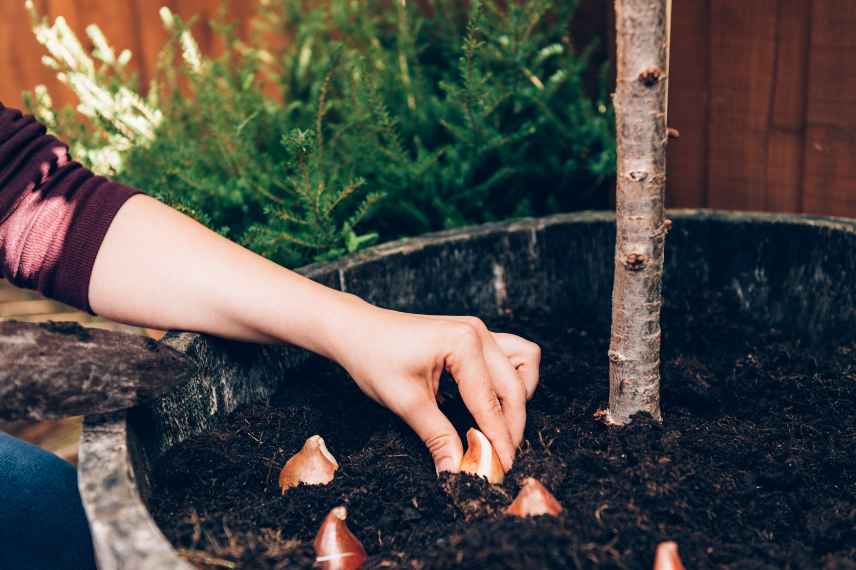
September is the best time to plant if you want to see your tulips bloom as early as possible in spring
Read also
Tulips: planting, growing and careChoosing early tulips by the colour of the flowers
Tulips are among those plants that delight us with a beautiful palette of colours, capable of pleasing all tastes and all garden styles.
Warm-coloured tulips
Red, orange, yellow and salmon… These tulips will bring a real boost of vitality at the start of spring to borders, beds and pots. They are perfect for waking up the atmosphere and brightening the space. They are very lively and warm tulips.
For example:
- Tulipa fosteriana ‘Red Emperor’ displays a vivid red colour;
- Tulipa fosteriana ‘Orange Emperor’ blooms in pale orange washed with vivid orange;
- Tulipa urumiensis graces us with a sunny yellow;
- Tulipa fosteriana ‘Yellow Purissima’ blends various shades of yellow, from pale to vivid.
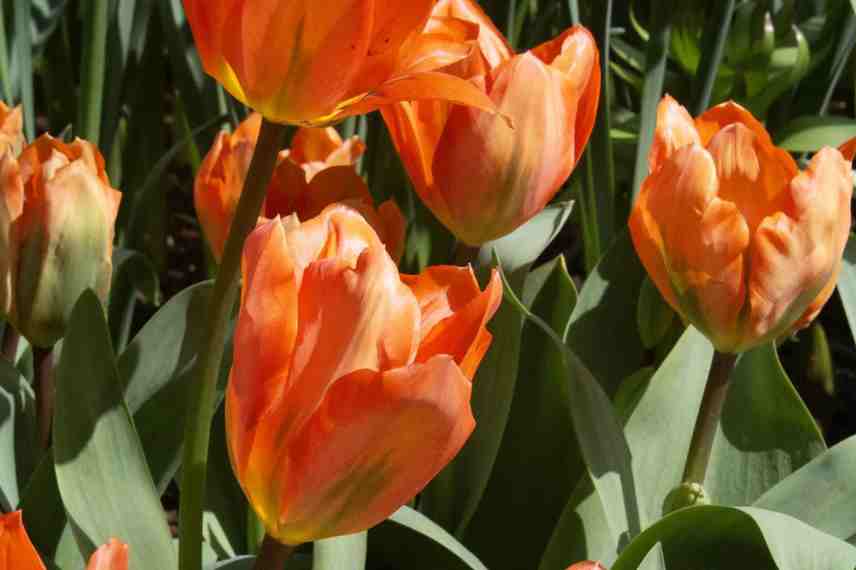
Tulipa fosteriana ‘Orange Emperor’
Pink-toned tulips
Pink flowers are among the most represented in the garden. They fit just as well in romantic settings as in cottage, modern or bohemian gardens. Pink ranges from the softest pastels to the deepest pink.
Tulipa greigii ‘Für Elise’ offers, for example, a very soft pink, slightly tinged with peach.
The tulip double early ‘Katinka’ displays a beautiful pink leaning toward lilac, rather uncommon, while the variety Dior offers cup-shaped flowers in bright and deep pink.
For its part, the single early tulip ‘Aafke’ blooms in romantic and pastel pink, but never dull.
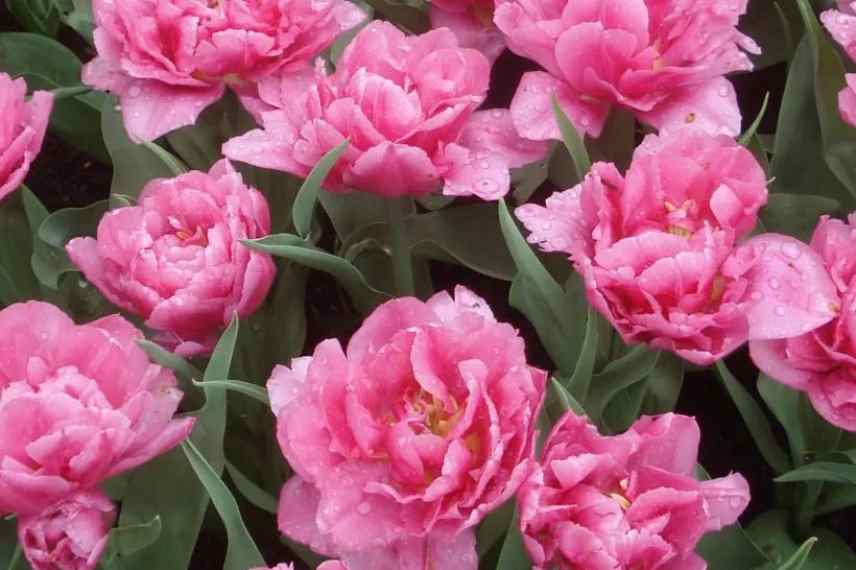
Tulip ‘Dior’
White tulips
These tulips will bring refinement and lightness. They will also highlight other colours present in the surroundings. This is notably the case with Tulipa fosteriana ‘Purissima Design’ with delicate cream-white flowers.
For its part, the semi-double variety ‘Exotic Emperor’ produces elegant white cup-shaped flowers, subtly brushed with green on the exterior.
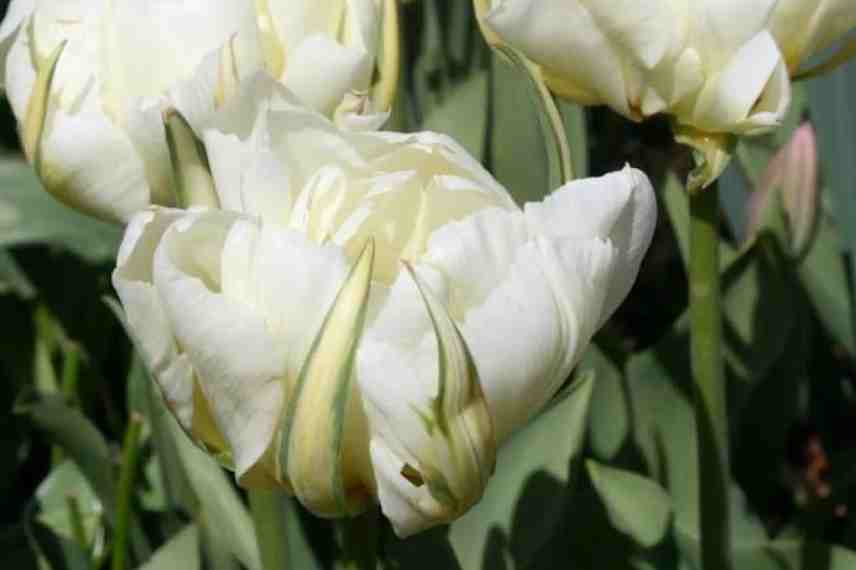
Tulip semi double ‘Exotic Emperor’
Multicoloured tulips
These tulips feature multiple colours and add an extra touch of originality. This is notably the case with the Tulipa humilis ‘Albocaerula Oculata’ , which produces star-shaped flowers in milky white, contrasting with a striking midnight-blue heart.
With its large double flowers blending bright yellow and red marbling, the early tulip ‘Monsella’ will liven up any corner of the garden.
For its part, Tulipa kaufmanniana ‘Johann Strauss’ shows a great deal of refinement, with white flowers bearing a yellow base, streaked with red.
Also worth mentioning is Tulipa greigii ‘Plaisir’, very graphic with its pink-red flowers, brushed with white.
Choosing early tulips based on flower type
Tulips are classified into different categories according to the shape of their flowers. They can have very fine and delicate petals or, conversely, very round and chunky ones. We also distinguish fringed tulips, lily-flowered, cup-shaped, goblet-shaped, or star-shaped.
Botanical tulips
Botanical tulips are derived from wild tulips. They are the smallest, measuring between 15 and 25 cm tall. They naturalise easily wherever they like and therefore return faithfully each year, without any gardener’s intervention. They will brighten the garden or pots for many years, with no particular maintenance.
Among these tulips, for example the Tulipa praestans ‘Fusilier’, with its large scarlet-red corollas.
Fosteriana tulips or emperor tulips
These are large-flowered tulips, which often bear a single colour, less commonly bicolour. One example is the Tulipa fosteriana ‘Flaming Purissima’, which produces large cup-shaped flowers up to around 20 cm across when in full bloom. It has the particularity of changing colour over time, from cream-white at opening to the pink fuchsia becoming increasingly intense, finishing in a beautiful gradient of pink and white.
Kaufmanniana tulips or water-lily tulips
As their name suggests, their flower form resembles that of water lilies. Among them, notably ‘Early Harvest’, with flowers in cups well opened, blending shades of red, orange and golden yellow.
Early single tulips
These are the tulips with the most classic form, in a tall cup, with six petals. They are often quite small, reaching up to 30 cm tall.
Cite the Tulipa ‘Triumph Shirley’, with its lovely white cup-shaped bloom edged with a violet border.
Early double tulips
These are tulips that have a greater number of petals, giving them either a sophisticated look or a somewhat tousled one. They often have a good diameter (around ten centimetres) and resemble peony or rose flowers. Generally, doubles are a little less early than those with single flowers. But there are still varieties that bloom early in the season, such as the variety ‘Peach Blossom’, forming a beautiful cup with numerous petals. It displays a gradient of pink and white, very refined.
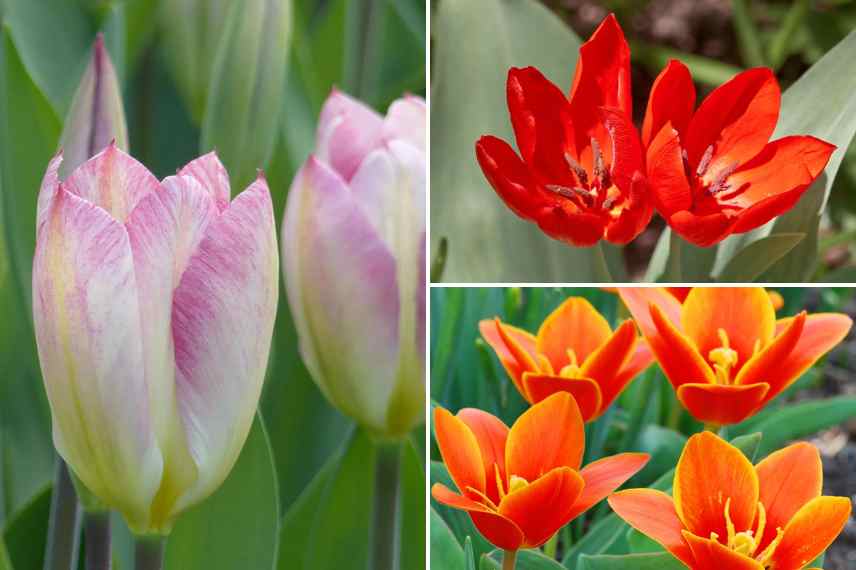
Tulipa forestiana ‘Flamina purissima’ on the left, and on the right, botanical Tulipa ‘Praestans Fusilier’ and Tulipa kaufmanniana ‘Early Harvest’
Choose early-flowering tulips based on their fragrance
If fragrance is not the tulips’ primary quality, some varieties are nonetheless quite fragrant. Among the most fragrant, let’s mention Tulipa polychroma. Its star-shaped flowers appear from February or March and exude a strong, fruity and sweet fragrance.
Also mention the Tulipa humilis ‘Tête à Tête’, a miniature variety that produces double flowers exuding an astonishing fragrance, blending sweetness and peppery notes.
Choose early-flowering tulips by their foliage
While the flowers are, of course, the main ornamental feature of tulips, some also have interesting foliage. The leaves, elongated and pointed, can be striate or striped. Kaufmanniana tulips often have variegated or purple-striped foliage. This is the case with the variety ‘Juan’, a pretty two-colour tulip with dark, purple-marbled foliage. It contrasts beautifully with the two-colour bloom of vivid orange, adorned with golden-yellow spots. Perfect in the garden and in bouquets!
Let’s also mention Tulipa greigii ‘Princess Charming’, a dwarf variety with bright red-orange flowers that combines several qualities. It is fragrant and produces grey-green foliage marbled with brown-purple.
For its part, ‘Concerto’ prefers to display green foliage with astonishingly silvery reflections, not common. It accompanies a delicate early flowering with cream-coloured corollas, warmed by a yellow base and contrasting with a striking black heart.
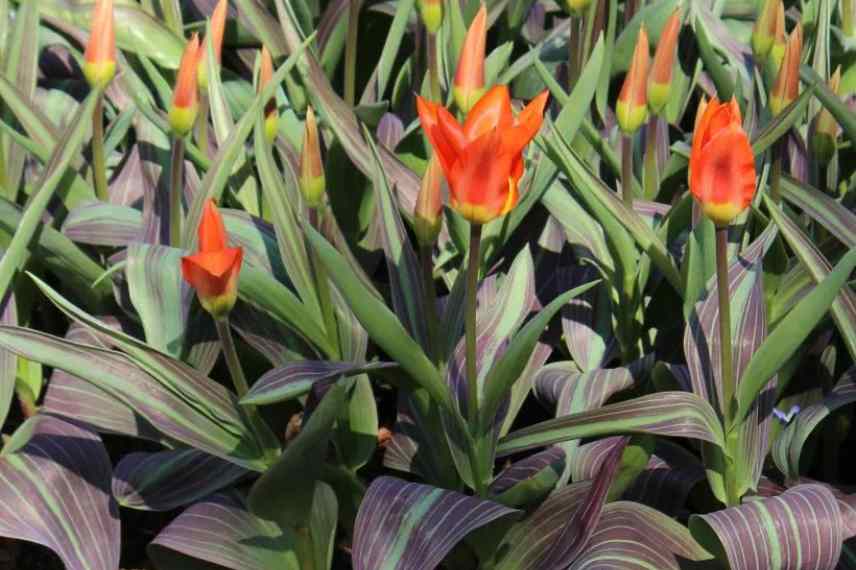
Tulip ‘Juan’
Choosing early tulips by their silhouette
Tulips are small bulbous plants. They generally reach a height of 10 to 60 cm.
For small spaces, in pots, borders and low rockeries, dwarf varieties will be ideal. This is particularly the case for the Tulipa x humilis ‘Samantha’, which does not rise more than 10 cm above the soil. The same goes for the Tulipa urumiensis, which is the smallest of the known species.
The tallest early varieties will be ideal in beds and for cut flower arrangements. This is the case for the Tulipa fosteriana ‘Sweetheart’, very pretty with its large lemon-yellow flowers 12 cm wide. This tulip reaches 35 cm in height at maturity.
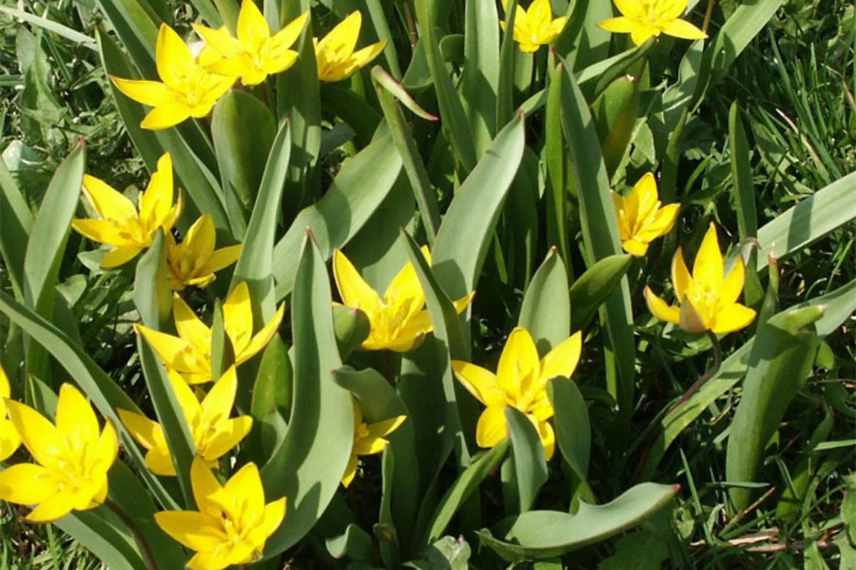
Tulipa urumiensis
Choosing early-flowering tulips according to growing conditions
Tulips prefer sunny exposures and rich, well-drained soil to prevent their bulbs from rotting. But botanical tulips are a little less demanding than horticultural tulips. They can therefore tolerate somewhat less ideal growing conditions, such as semi-shaded exposures, heavier, drier or poorer soils.
In terms of cold resistance, most tulips are hardy down to -15°C. If you live in a region with very harsh winters, opt for early-flowering tulips capable of withstanding stronger frosts. This includes Tulipa humilis ‘Persian Pearl’ (up to -20°C) or the Tulipa clusiana ‘Annika’ (colder than -20°C).
- Subscribe!
- Contents
Comments