


Hoya: all our tips for year-round care
Our tips for a thriving indoor plant
Contents
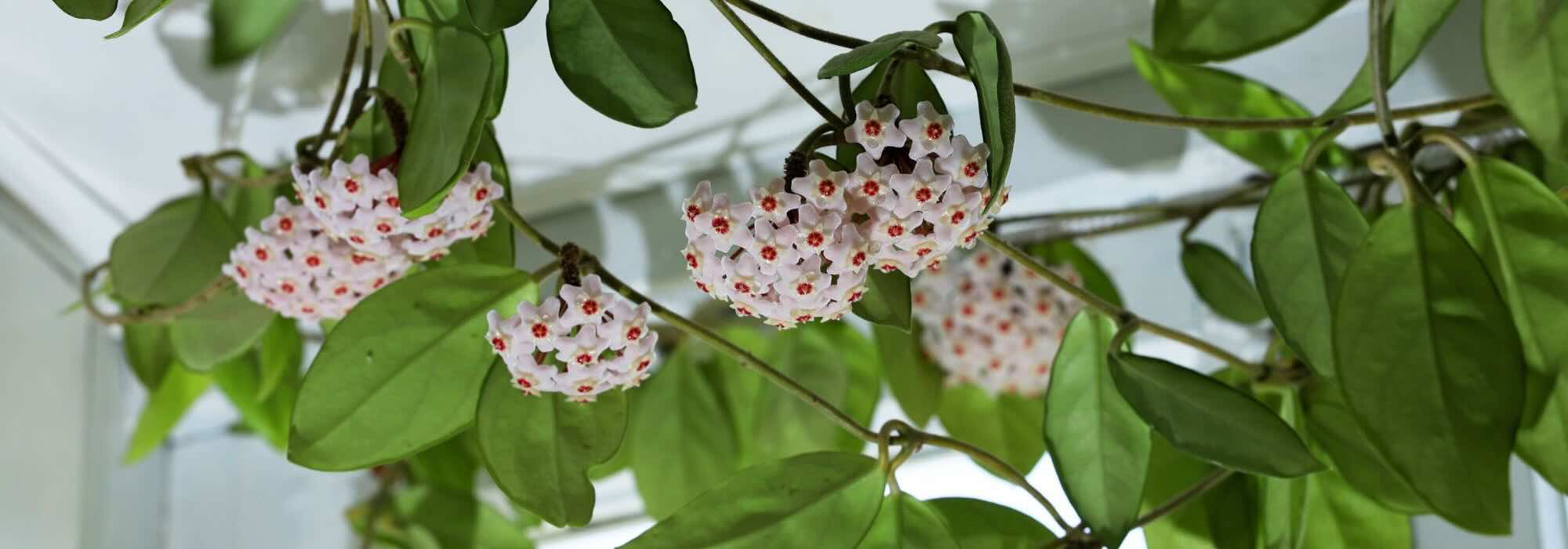
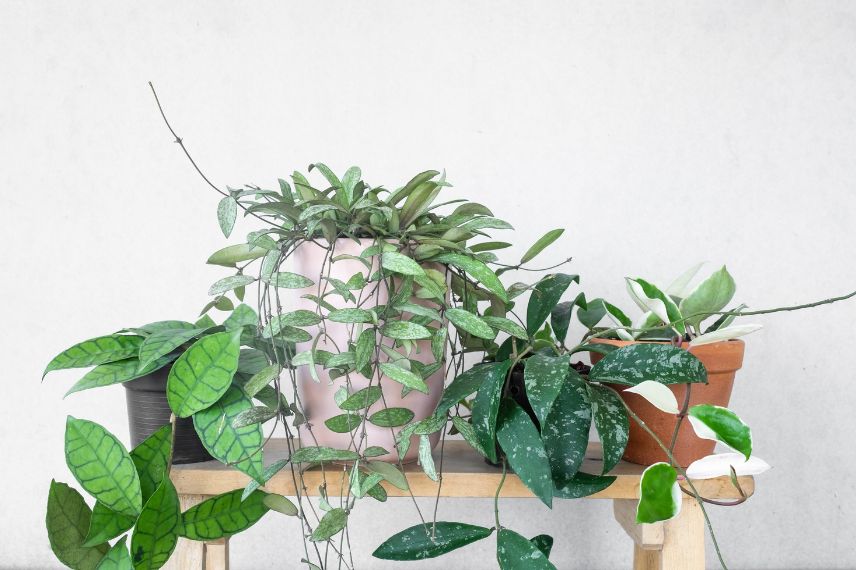
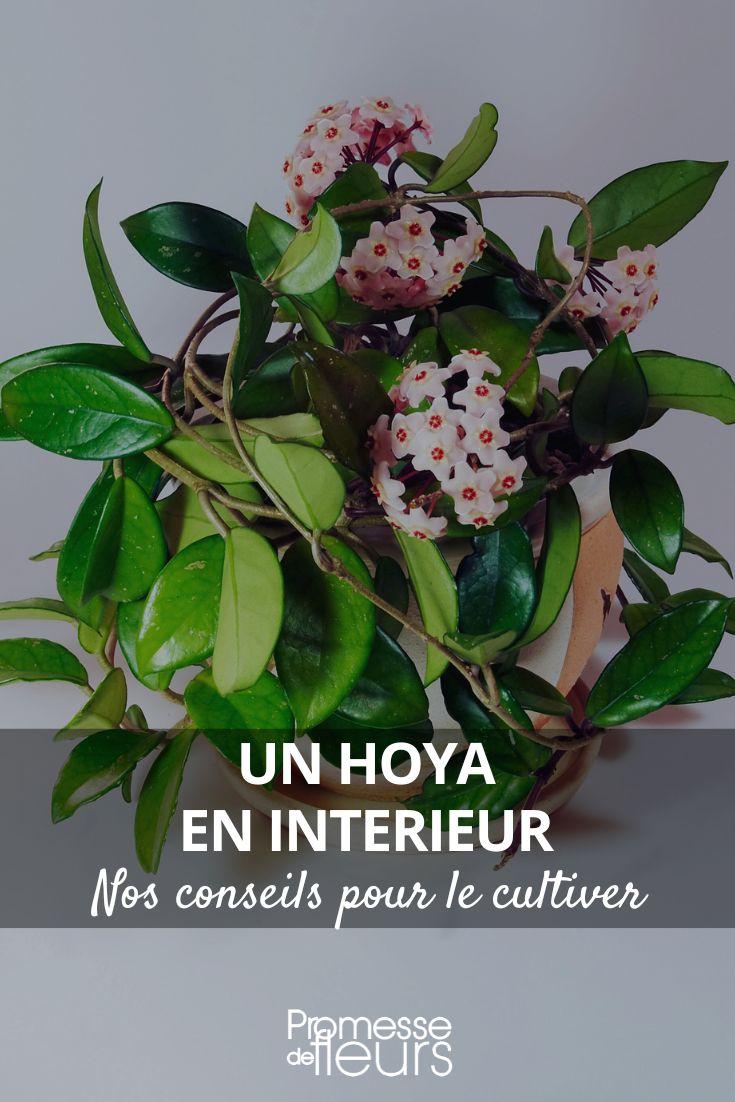
The Hoya, known for its “porcelain flower”, is a fascinating houseplant kept indoors here, which delights with its decorative foliage and star-shaped flowers, often deliciously scented, with a waxy and pearl-like texture. This tropical plant, native to Southeast Asia and Australia, comprises over 300 species and varieties: the classic and very easy to grow Hoya bella, the alluring Hoya carnosa, Hoya mathilde and its splash variant, the Hoya mathilde ‘Splash’, or the vigorous Hoya ‘Krimson Queen’, with leaves variegated pink and cream.
With proper care, the Hoya can offer remarkable flowering and vibrant foliage all year round. However, for it to thrive fully, it is essential to provide seasonally appropriate care. Its needs for light, water and nutrition vary between periods of active growth and rest, and these adjustments can also promote regular flowering.
In this article, we will see where to place a Hoya, when to water it, and how to encourage its flowering, while sharing practical tips to maximise the health and beauty of your Hoya. Discover our tips for caring for this unique and rewarding plant.

Where to place a Hoya?
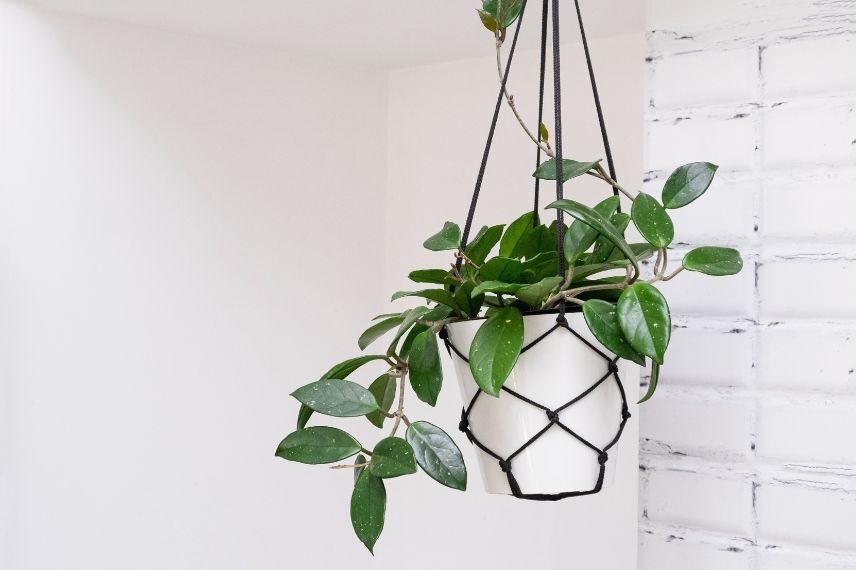
The Hoya is a tropical plant that loves light and tolerates direct sun, as it also enjoys warmth, particularly to encourage its flowering. Finding the ideal spot in your home is essential to promote its growth and flowering.
Place it near a window that is ideally south- or south-west-facing, though it will also grow in another orientation with good light, but may not reward you with its incredible flowering (many varieties have very ornamental foliage, though).
In summer, if it is directly in front of a window facing south or west, during periods of intense heat, monitor that the sun’s rays are not so strong as to burn its foliage. A light voile curtain or stepping back a few metres from the window may suffice to protect it.
In autumn and winter, when natural light decreases, move your Hoya closer to the brightest windows to compensate for the lack of sunlight. Insufficient light can slow its growth and delay its flowering. If you live in a region where winter days are particularly dark, a horticultural grow light can be a good supplement.
Temperature is also a factor to consider. The Hoya grows well in a moderate environment, between 18 and 24 °C, and dislikes abrupt changes. In winter, avoid placing it near drafts, poorly insulated windows, or heat sources such as radiators. These fluctuations can stress the plant and slow its development.
The Hoya needs plenty of light and tolerates direct sun in certain seasons
Read also
How to grow Hoya?When and how to water a Hoya according to the seasons?
The Hoya is a tropical plant and epiphyte, and it’s best not to overwater it. It tolerates drought. For a healthy Hoya, it is important to adapt your watering to the seasons and observe the signals it gives you.
When should you water a Hoya?
Water a Hoya infrequently and deeply.
In spring and summer, during the active growth period, you will water it more often, but less frequently than your usual indoor plants. Watering every 10 days or every two weeks may suffice. Increase the frequency in hot periods and in dry indoor air.
Watering is entirely dependent on the substrate, which must be carefully composed, and this is all the more true for this epiphytic plant, which grows in nature on bark and without soil. To learn how to compose the Hoya’s specific substrate, read the article “How to grow a Hoya?”.
In autumn and winter, the plant goes into rest and uses much less water. Reduce watering and allow the substrate to dry more between waterings. Watering every two to four weeks may suffice, depending on the conditions of your interior. If your interior is not well heated, start with the lower frequency and adjust according to the plant’s signals.
Best practices for watering a Hoya
Equally important as the substrate is the watering technique for an epiphytic plant. As the Hoya’s substrate, made of bark and without potting mix, is the most draining of all substrates, you must ensure the whole plant is thoroughly moistened at watering.
The ideal is to place the plant, without a cachepot, above a sink and water slowly and carefully so that all parts of the substrate are well moistened. Let it rest for a moment, then repeat.
- Use room-temperature water to avoid stressing the roots. If possible, favour rainwater or filtered water to avoid the accumulation of limescale, which can harm the foliage.
- Ensure excess water drains away after each watering and empty the saucer.
If all this seems complicated, bear in mind that once you understand the Hoya’s needs, it proves to be quite resilient and not prone to trouble.
Hoya flowering in spring or summer: practical tips
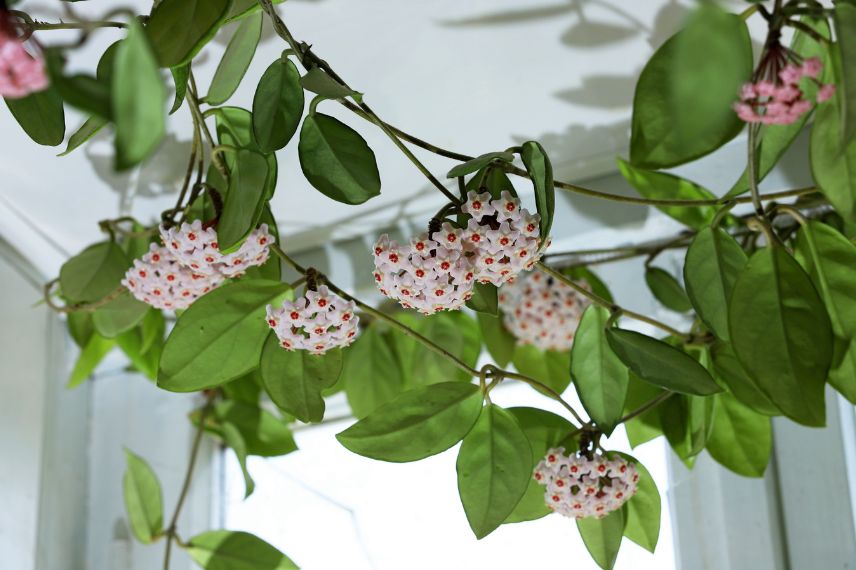
Throughout a Hoya’s four seasons, flowering is the moment most eagerly anticipated by Hoyas fans. Its star-shaped, waxy flowers are often deliciously scented, a true spectacle. To maximise your chances of seeing your Hoya bloom, it is important to understand its specific needs.
When does a Hoya bloom?
Most Hoyas bloom in spring or summer, during their growth period. However, some varieties such as Hoya bella or the Hoya carnosa can offer more regular flowering, sometimes into autumn. Note that Hoya bella flowers abundantly each year under proper cultivation conditions, whereas some varieties may take several years to flower under good cultivation conditions.
How can I encourage my Hoya to flower?
Hoya flowering depends on several factors:
- Providing your Hoya with bright light is essential. Insufficient light can delay, or even prevent, flowering.
- In winter, limit watering and allow the Hoya to undergo a rest period. The winter rest period, together with a drop in night-time or day-time temperatures (around 15–17°C), stimulates forthcoming flowering.
- Apply a liquid fertiliser for flowering plants every two to three weeks during spring and summer. This will give your Hoya the nutrients necessary to produce flowers.
- A golden rule with Hoyas is never to cut the peduncles bearing the flowers, even when they appear dry or inactive. These stems carry the flowers and often rebloom on the same locations.
- Paradoxically, a little stress, such as watering less frequently in winter, lower winter temperatures and brighter light in spring and summer, can encourage flowering. However, be careful not to over-stress your plant, which could have the opposite effect.
The flowering of the Hoya is a real delight for the indoor gardener
How to care for a Hoya?
Like many tropical plants, the Hoya follows a natural rhythm that varies with the seasons. Here are some additional tips for caring for your Hoya throughout the year.
Early spring
- You can also use a slow-release fertiliser and/or use a vermicompost.
- Lightly prune the long stems to encourage branching, but avoid cutting the flower peduncles, as they will bear the future flowers.
In summer
- Although the Hoya tolerates average humidity, it appreciates a slightly more humid atmosphere in summer. If the air is very dry, lightly mist the leaves or place the plant near a humidifier.
In autumn and in winter
- Suspend fertiliser applications during this period. The Hoya does not need extra nutrients when resting.
All year round
- Monitor the plant for signs of pests. Hoyas aren’t always particularly showy plants. They are hardy, but can suffer from common indoor pests.
- If leaves yellow or dry out, this may indicate a watering or light issue that needs correcting.
If, with all these tips, you find that you have adopted a variety particularly prone (which grows slowly or seems dry), try moving it to a terrarium. That’s what I did for a few Hoyas that thrive noticeably better in those conditions.
Different Hoya foliage, another of its attractions
To learn more about Hoya, Porcelain flower
Also read our full guide: “Hoya, Porcelain flower: growing and care
- Subscribe!
- Contents
Comments