
Antirrhinum majus Sweet Duet Rose Shades - Muflier des Jardins, Muflier à grandes fleurs, Gueule de loup
Antirrhinum majus Sweet Duet Rose Shades - Muflier des Jardins, Muflier à grandes fleurs, Gueule de loup
Antirrhinum majus Sweet Duet Rose Shades
Back-to-school special offer!
Get €10 off for every €50 you spend! And get up to €40 off on a single order.
How does it work?
1. Shop your favourites
Add your favourite plants to your basket. For every €50 you spend (excluding delivery charges, store credit and the plastic-free option), you’ll receive a €10 voucher.
€50 spent = €10 voucher
€100 spent = €20 voucher
€150 spent = €30 voucher
€200 spent = €40 voucher
2. Place your order
Once your basket reaches one of the spending thresholds, place your order. You can even choose your delivery date!
3. Receive your voucher
As soon as your order has been shipped, you’ll receive an email containing your personal voucher code and its value.
4. Use it on your next order
Your voucher is valid for 90 days from the date you receive it. It can be used once only, on a new order worth at least the value of the voucher, excluding delivery charges.
Please note: Vouchers can be combined with other offers, but cannot be split or refunded.
Home or relay delivery (depending on size and destination)
Important: You may be charged customs duties by your country’s customs authorities upon delivery.
Schedule delivery date
and select date in basket
This plant carries a 6 months recovery warranty
More information
We guarantee the quality of our plants for a full growing cycle, and will replace at our expense any plant that fails to recover under normal climatic and planting conditions.
Would this plant suit my garden?
Set up your Plantfit profile →
Description
The Snapdragon 'Sweet Duet Rose Shades' captivates as much for the brilliance of its flowers as for their sweet, sugary fragrance. Sown early in the year, this compact Snapdragon produces clusters of large double flowers all summer long, in a vibrant, deep pink. Highly decorative, they attract pollinators, thus promoting biodiversity in the garden. Perfect in a flowerbed alongside other flowering plants, this Snapdragon can also be grown in containers. It enjoys full sun and light, fertile, well-drained soils.
Formerly classified in the Scrophulariaceae family, the Snapdragon (Antirrhinum majus) has been transferred to the Plantaginaceae family, now keeping company with other flowering champions like Angelonia or the graceful Penstemon. There are about twenty species of Antirrhinum, mostly perennials from cliffs and rocky soils of the southwestern Mediterranean region, and also a few species, most often annuals, originating from western North America. Antirrhinum majus, nicknamed Common snapdragon, or garden snapdragon, grows naturally in France in the arid rocks and hillsides of the Midi, up to Lozère and Aveyron, naturalising on old walls. Flowering from May to September, the species forms a perennial plant 30 to 80 cm tall which is relatively cold-hardy. Nevertheless, through horticultural forms, it is generally cultivated as an annual, as its flowering tends to degenerate quickly over time.
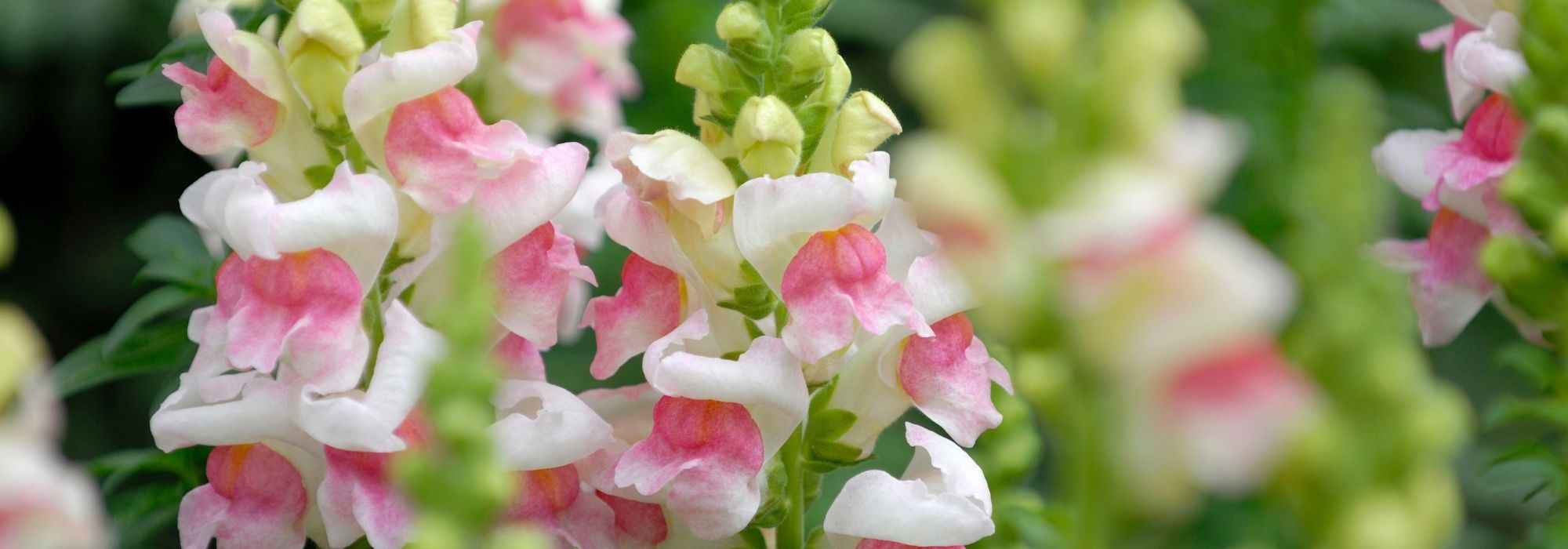
The Sweet Duet horticultural range has several remarkable characteristics, which are large, semi-double to double, very fragrant flowers, produced by relatively compact and well-branched plants. It comes in different colours: white, lemon, peach, pink, red, etc. The Snapdragon 'Sweet Duet Rose Shades' is the vibrant pink variant of the series. Early sowing at the start of the year allows for young plants 40 cm tall with a 35 cm spread, which form dense clumps with dark green foliage, ideal for highlighting the lighter flowering. This begins in June, sometimes even May, and stretches until August, or even September. The almost double flowers measure 4 to 5 cm long, grouped in clusters clearly visible above the dark vegetation that serves as their setting. In a beautiful vibrant pink, the flowering is particularly attractive and very fragrant. When you pinch a flower on each side, it opens like a mouth, hence its vernacular name of snapdragon. The tubular corolla is bilabiate, with rounded lobes; the upper and lower parts are uniformly pink. Bumblebees and other butterflies appreciate this plant which, in addition to being particularly ornamental, is therefore also useful for wildlife.
A plant once inseparable from cottage gardens, the Snapdragon is breaking free with new varieties like 'Sweet Duet Rose Shades', which proves attractive in more ways than one. You can thus grow it in a container if you wish to adorn your terrace, or plant it in a flowerbed alongside other flowering plants to create a beautiful summer scene. Sharing the same needs, Tickseed will pair very well with snapdragon: with their compound flowers in numerous colours, they will allow you to create a brilliant scene all summer long. In the background, a clump of White Gaura will find its place naturally, with its graceful flowers swaying in the wind like a colony of small butterflies. Also consider playing with foliage colours by interspersing some grey Artemisias, as well as with the contrasts in form that ornamental grasses can offer, such as Stipa pennata which fine silver spikes float gracefully in the wind.
Caution: seeds reserved for very experienced gardeners accustomed to sowing very fine seeds. These seeds are as fine as dust, barely visible to the naked eye.
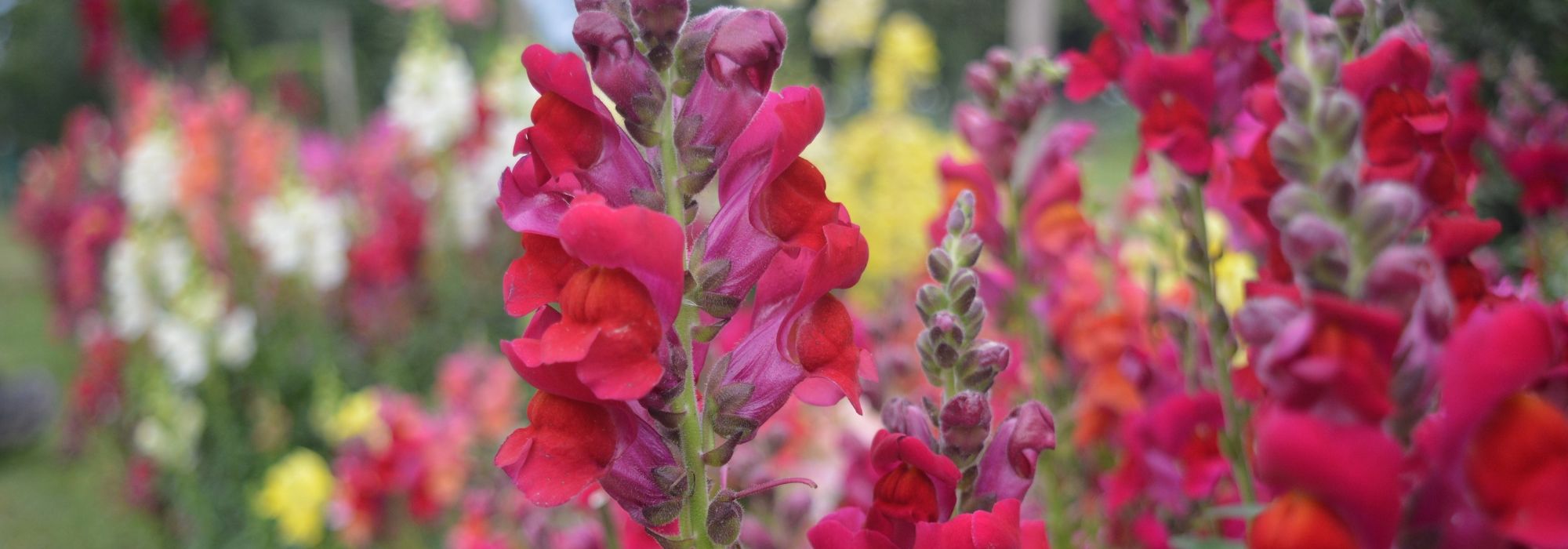
Antirrhinum majus Sweet Duet Rose Shades - Muflier des Jardins, Muflier à grandes fleurs, Gueule de loup in pictures
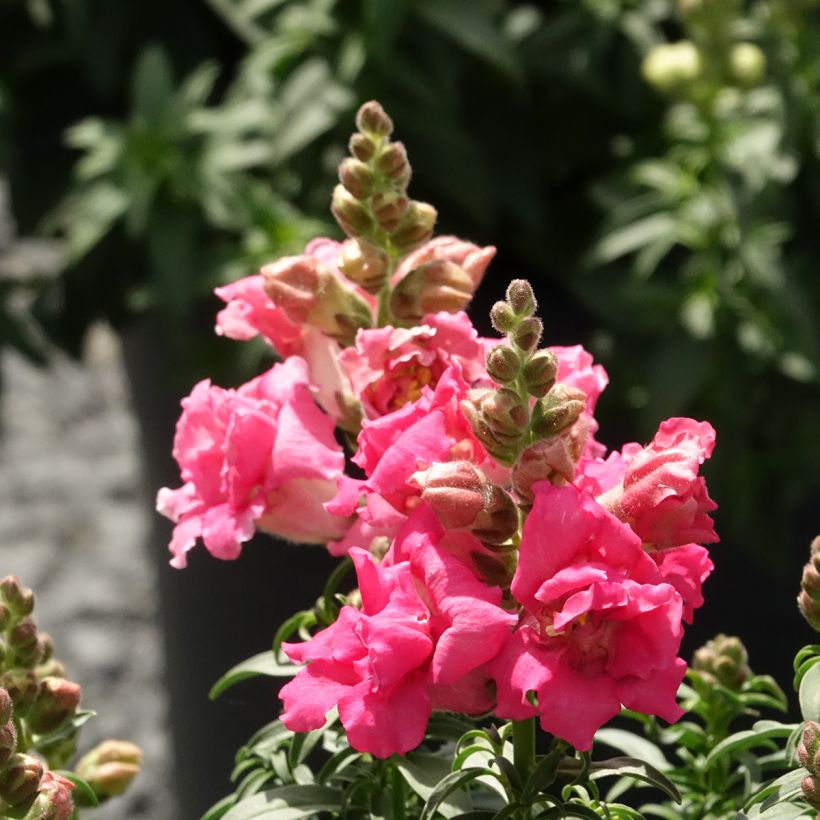
Flowering
Foliage
Plant habit
Botanical data
Antirrhinum
majus
Sweet Duet Rose Shades
Plantaginaceae
Antirrhinum majus ‘Sweet Duet™ Rose Shades’
Cultivar or hybrid
Planting and care
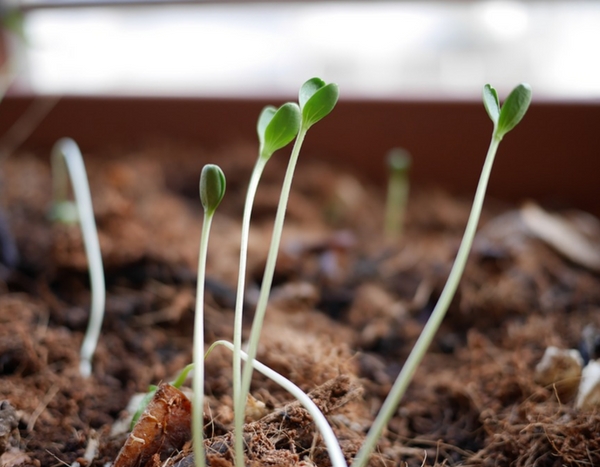
Sow your 'Sweet Duet Rose Shades' snapdragon seeds under cover between January and March, in a tray on the surface of a well-draining sowing compost. Cover the seeds with a very fine layer of compost and keep it slightly moist. Place your tray at a temperature between 20 and 25°C. Seed germination takes between 14 and 21 days. As soon as the young plants are large enough to handle (2-leaf stage), prick them out into pots. Pinch out the main stems to encourage branching. Plant them in their final position once the last frosts have passed. Space them about 20 to 30 cm apart.
Another option is to sow in September and then place the potted young plants under cover during the winter. You can then plant them out the following spring.
In mild climate regions, it is also possible to broadcast sow directly in open ground in April-May. Thin the ranks to keep one young plant every 20 to 30 cm. In this case, flowering is later, but this will allow you to extend the flowering period.
Snapdragons thrive in the sun in a light, fertile, and well-drained soil. They are most often grown as annuals, but they are perennials which, if well sheltered from the cold (mulching, soil that does not retain water), can survive the winter and start again as soon as the fine weather arrives.
Sowing period
Intended location
Planting & care advice
-
-

-
-

-

-

-

-

This item has not been reviewed yet - be the first to leave a review about it.
Recently viewed products
Haven't found what you were looking for?
Hardiness is the lowest winter temperature a plant can endure without suffering serious damage or even dying. However, hardiness is affected by location (a sheltered area, such as a patio), protection (winter cover) and soil type (hardiness is improved by well-drained soil).

The flowering period indicated on our website applies to countries and regions located in USDA zone 8 (France, the United Kingdom, Ireland, the Netherlands, etc.)
It will vary according to where you live:- In zones 9 to 10 (Italy, Spain, Greece, etc.), flowering will occur about 2 to 4 weeks earlier.
- In zones 6 to 7 (Germany, Poland, Slovenia, and lower mountainous regions), flowering will be delayed by 2 to 3 weeks.
- In zone 5 (Central Europe, Scandinavia), blooming will be delayed by 3 to 5 weeks.
In temperate climates, pruning of spring-flowering shrubs (forsythia, spireas, etc.) should be done just after flowering.
Pruning of summer-flowering shrubs (Indian Lilac, Perovskia, etc.) can be done in winter or spring.
In cold regions as well as with frost-sensitive plants, avoid pruning too early when severe frosts may still occur.
The planting period indicated on our website applies to countries and regions located in USDA zone 8 (France, United Kingdom, Ireland, Netherlands).
It will vary according to where you live:
- In Mediterranean zones (Marseille, Madrid, Milan, etc.), autumn and winter are the best planting periods.
- In continental zones (Strasbourg, Munich, Vienna, etc.), delay planting by 2 to 3 weeks in spring and bring it forward by 2 to 4 weeks in autumn.
- In mountainous regions (the Alps, Pyrenees, Carpathians, etc.), it is best to plant in late spring (May-June) or late summer (August-September).
The harvesting period indicated on our website applies to countries and regions in USDA zone 8 (France, England, Ireland, the Netherlands).
In colder areas (Scandinavia, Poland, Austria...) fruit and vegetable harvests are likely to be delayed by 3-4 weeks.
In warmer areas (Italy, Spain, Greece, etc.), harvesting will probably take place earlier, depending on weather conditions.
The sowing periods indicated on our website apply to countries and regions within USDA Zone 8 (France, UK, Ireland, Netherlands).
In colder areas (Scandinavia, Poland, Austria...), delay any outdoor sowing by 3-4 weeks, or sow under glass.
In warmer climes (Italy, Spain, Greece, etc.), bring outdoor sowing forward by a few weeks.
Shipping country and language
Your country of residence may be:
Your country of residence is:
For a better user experience on our website, you can select:
Your shipping country:
-
 Austria
-
 Belgium
-
 Bosnia & Herzegovina
-
 Bulgaria
-
 Croatia
-
 Cyprus
-
 Czechia
-
 Denmark
-
 Estonia
-
 Finland
-
 France
-
 Germany
-
 Greece
-
 Hungary
-
 Iceland
-
 Ireland
-
 Italy
Italy
-
 Latvia
-
 Liechtenstein
-
 Lithuania
-
 Luxembourg
-
 Malta
Malta
-
 Netherlands
-
 Poland
-
 Portugal
-
 Romania
-
 Serbia
-
 Slovakia
-
 Slovenia
-
 Spain
Spain
-
 Sweden
-
 Switzerland
Language:
-
French
-
 English
-
Spanish
-
Italian
-
German
-
Portuguese
-
Dutch
-
Finnish
My Account
Hello
My wish lists
My cart
Log in / Register
Existing customer?
This form is protected by reCAPTCHA - the Google Privacy Policy and Terms of Service apply.
New customer?
Create an account to track your orders, access our customer service and, if you wish, make the most of our upcoming offers.