


Dipladenia: our tried-and-tested favourites for a garden in bloom all summer long
Essential varieties to grow in the garden or in pots
Contents
Dipladenias are also known as Mandeville or Mandevilla. They are lovely climbing plants, with a generous display of colourful bell-shaped flowers. Unfortunately, they are not very frost-hardy. They can be grown as annuals, but many varieties can also live for several years when grown in pots, kept frost-free over winter.
Not sure which varieties to choose? Here is our selection of five reliable varieties, as beautiful as they are easy to grow.
To help you grow your Dipladenias, consult our comprehensive guide: Dipladenia, Mandevilla: planting and care.

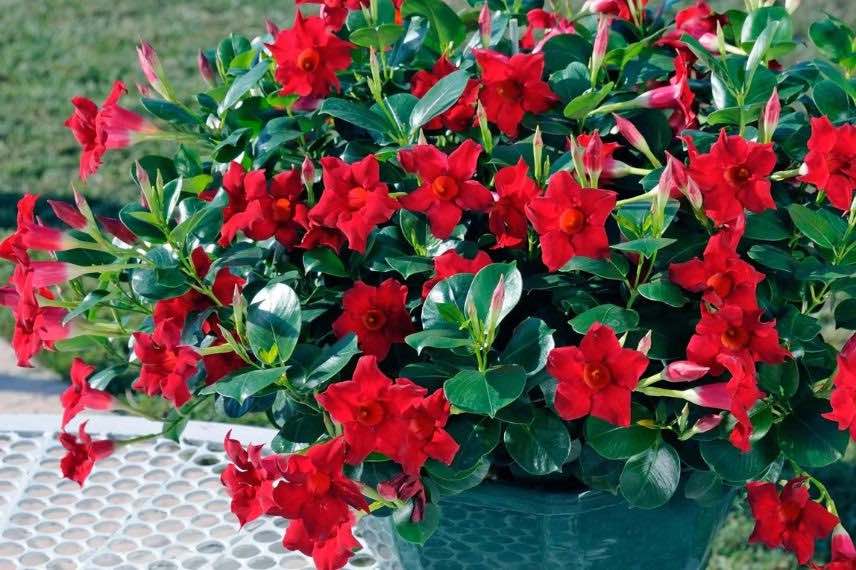
Dipladenia x sanderi 'Diamantina® Jade Scarlet'
‘Jade Scarlet’ is part of an hybridization programme aimed at producing Dipladenias that combine the following qualities: long, abundant flowering in stunning colours, and very easy to grow. This variety comes from the Diamantina® series, like many other new colourways.
From late spring to the first frosts, it graces us with flowers 6 cm in diameter, composed of four large lobes that overlap and recall the blades of a propeller. They form pretty trumpets grouped in clusters. It is their colour, a scarlet red, that makes all the difference.
This flowering is enhanced by evergreen, hardy foliage, a dark, glossy green that contrasts very well with the colour of the trumpets.
This variety is perfectly suited to pot culture, thanks to its modest dimensions and compact habit: it will reach only 85 cm in height with a 45 cm spread.
Fast-growing, it is an ideal plant for decorating terraces, balconies, patios, inner courtyards or even simple windowsills. It can be grown as a climbing plant, with a support to allow its twining stems to cling. But it also performs very well as a bushy plant or trailing from a hanging basket.
Thanks to their large tuberous roots that store reserves, Dipladenias are fairly drought-tolerant. Provide ‘Jade Scarlet’ with a bright, sunny position, but protected from the sun’s harsh rays. Grow it in light, well-drained soil.
Highlight this red flowering by pairing it with the pure white, funnel-shaped flowers of Calibrachoa ‘Superbells Unique White’.
Read also
How to pair Dipladenia?The Dipladenia x sanderi 'Diamantina® Opale Citrine 2.0'
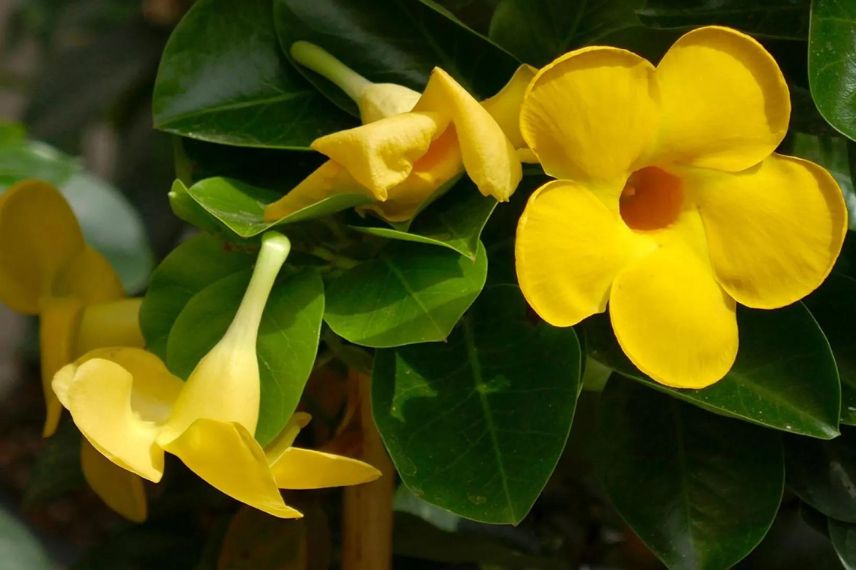
Another variety from the Diamantina® series, displaying exceptional floribundity: ‘Opale Citrine 2.0’. It graces us with an uncommon colour, a rich and bright golden-yellow. It has the ability to maintain the intensity of this colour over time and not fade, unlike other yellow-flowered varieties. Its flowers are also larger, measuring 6 cm in diameter. They have the typical star shape and bloom in near uninterrupted succession from late spring to early autumn, for a long colour display.
The foliage is evergreen, composed of small, entire leaves in a dark, glossy green.
These plants, native to Brazilian tropical forests, have little tolerance to cold. Outdoor cultivation in the ground should therefore be reserved for gardens in the milder southern regions of France. But ‘Opale Citrine 2.0’ is an excellent candidate for pot culture, allowing you to keep it easily in a bright room that is only lightly heated during the cold season (veranda or greenhouse, for example). You can thus enjoy its qualities for a long time, and not just for a year. Its semi-compact, well-branched habit reaches 85 cm high by 45 cm wide.
It will pair well with complementary purple blooms, such as Passiflora ‘Fata Confetto’ or ‘Violacea’. Pair it with a Black-eyed Susan in yellow tones.
Dipladenia x hybrida 'BELLA Pink'
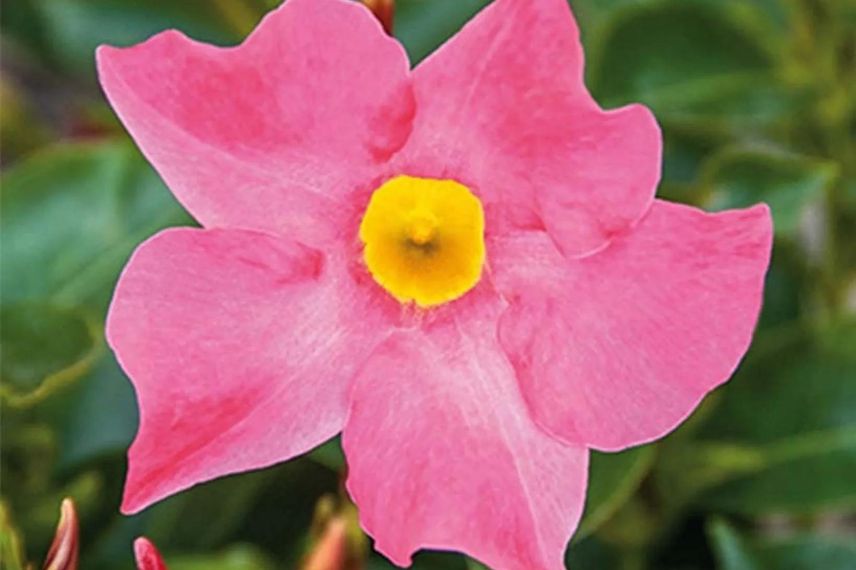
‘Pink’ is a Dipladenia from the ‘Bella’ collection, hybrids prized for their generosity and ease of cultivation. As its name suggests, this variety rewards us with a brilliant, vivid pink that contrasts beautifully with a yellow centre just as intense. The star-shaped flowers measure 6 cm and are arranged in clusters. They bloom from June to October, gracing the space for what seems like endless weeks.
Here again, the glossy dark green foliage provides a backdrop to this magnificent flowering.
This Dipladenia forms a liana about 1.5 metres tall with a 50 cm spread. It can climb up a tripod or supports, but can also spread into a true cascading display.
Like its companions, it tolerates drought and heat well, but fears frost. It will require light, well-drained soil in a sunny position, but not scorching.
In a Mediterranean-inspired garden, this variety will be perfect alongside rockroses and small oleanders.
Read also
How to grow dipladenia in a pot?Dipladenia x sanderi 'Diamantina® Jade XXL White'
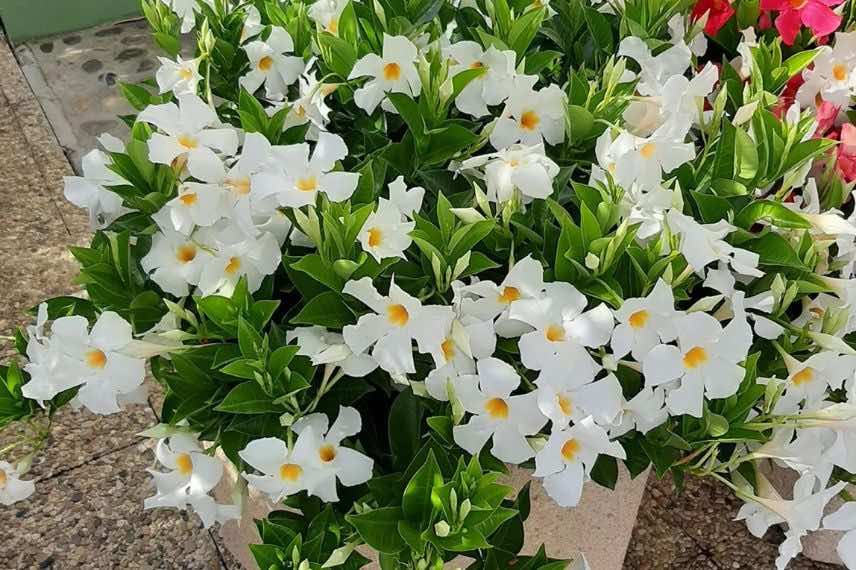
This Dipladenia ‘Jade XXL White’ stands out for the size of its large flowers, which reach up to 9 cm in diameter. They display a white colour uncommon among these plants, contrasting with the orange-yellow throat. Floriferous, this variety produces these star-shaped flowers tirelessly until frost. They are always accompanied by the same evergreen, tough foliage, a dark glossy green.
Its compact, bushy habit does not exceed 40 cm in all directions, which makes it ideal for pot culture. This Dipladenia is a good choice for ornamenting a terrace or balcony. It will thrive in ordinary soil provided it is well-drained, in a spot sheltered from the hottest part of the day.
For a refined monochrome display, pair it with Euphorbia ‘Diamond Frost’ and ornamental tobacco ‘Perfume White’.
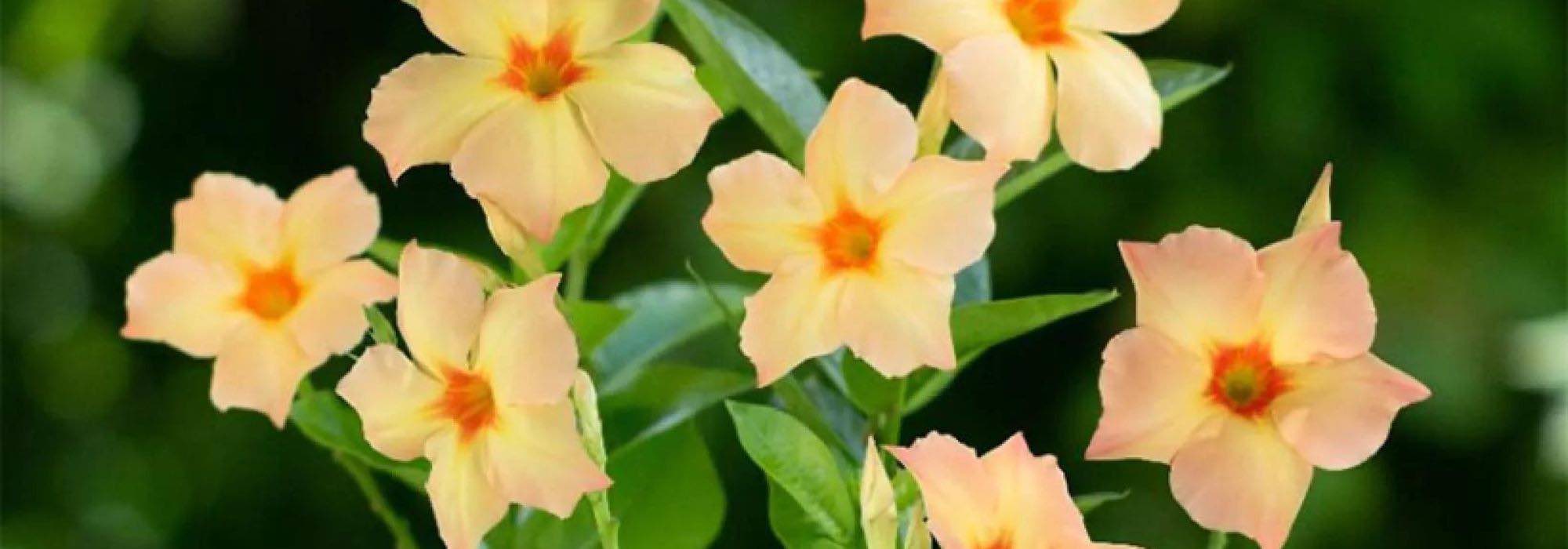
The Dipladenia x sanderi ‘Diamantina® Emerald Amber Star’
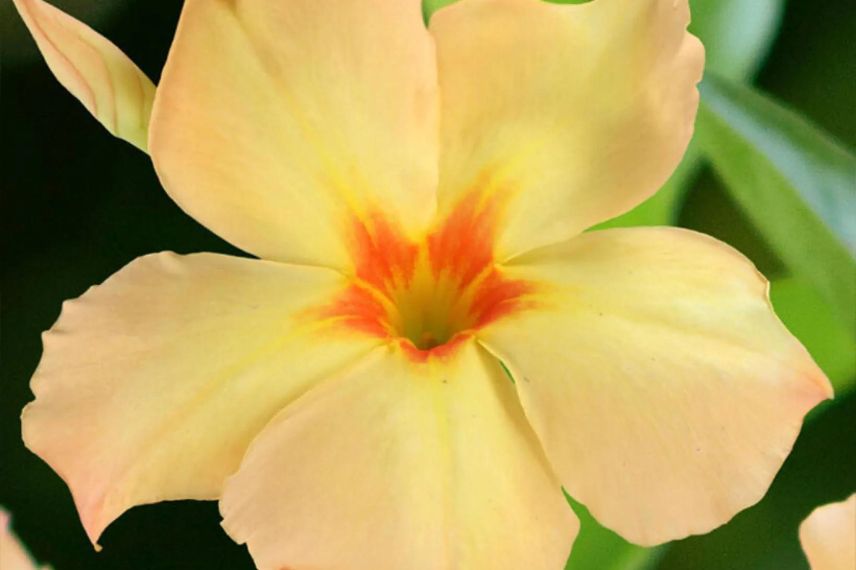
Latest selection from the Diamantina® series. The variety Emerald Amber Star offers a unique colour that evolves over time. Initially apricot when opening, the flowers then take a salmon colour, before turning amber-yellow. This flowering is interrupted from May to September–October. But its flowers are also notable for their size, larger than those of other varieties.
Dipladenia have the advantage of being very versatile plants. They can be trained as climbers to dress a trellis or an arch, placed in a container on the balcony or terrace, or adorn a rockery in regions with milder winters. This variety reaches 80 cm in height by 40 cm in width is no exception. It benefits from very good heat and drought tolerance, which makes it definitely very easy to grow.
For an exotic display, grow it beside a Verbena ‘Estrella Voodoo Red Star’ and small Cannas.
- Subscribe!
- Contents
Comments