


Dwarf conifers: perfect for small gardens
Small, easy-care conifers, varied and suitable for small spaces
Contents
When we talk about conifers, we often picture vast forests of firs, majestic and imposing. But did you know that these plants are not necessarily reserved for large spaces and that there are also dwarf varieties? They do not exceed 2 to 3 metres in height and retain most of the characteristics of their giant counterparts: needles or evergreen scales, but also sometimes aromatic scent and decorative fruiting.
Easy to grow and aesthetically pleasing, small conifers are ideal for brightening up compact gardens, as well as balconies and terraces. They are also suitable for growing in pots. Discover their various advantages here.

Why choosing dwarf conifers?
Conifers have enjoyed their heyday for many years before falling somewhat out of fashion. Overused, especially in hedges that have too monotonous and artificial-looking appearances, they are also associated with a dark and dreary image. Yet there are many ornamental conifers that deserve to rejoin our gardens.
These are plants that, indeed, have many strengths:
- they are generally easy to grow, grow slowly and require little maintenance if they are not used to form neatly clipped hedges;
- their foliage is evergreen, which allows them to stay attractive all year round, even in winter;
- they can adapt to different growing conditions;
- their great diversity allows them to fit into all garden styles, bringing a graphic and structured touch;
- they are beneficial for biodiversity, providing shelter for birds and bats, and food for squirrels, etc.
Small varieties will have additional advantages: they will be easy to place within borders, in pots or in hedges. Their silhouette will add volume, but their understated appearance allows all their neighbours with flowers, fruits, decorative foliage or coloured wood to stand out.
Dwarf conifers with coloured foliage
If you don’t want a small conifer bearing the classic fir-green colour, no problem: there are varieties that are bolder or that will change colour with the seasons to break the monotony. They offer foliage nuances of blue, silvery, golden yellow or can even be variegated.
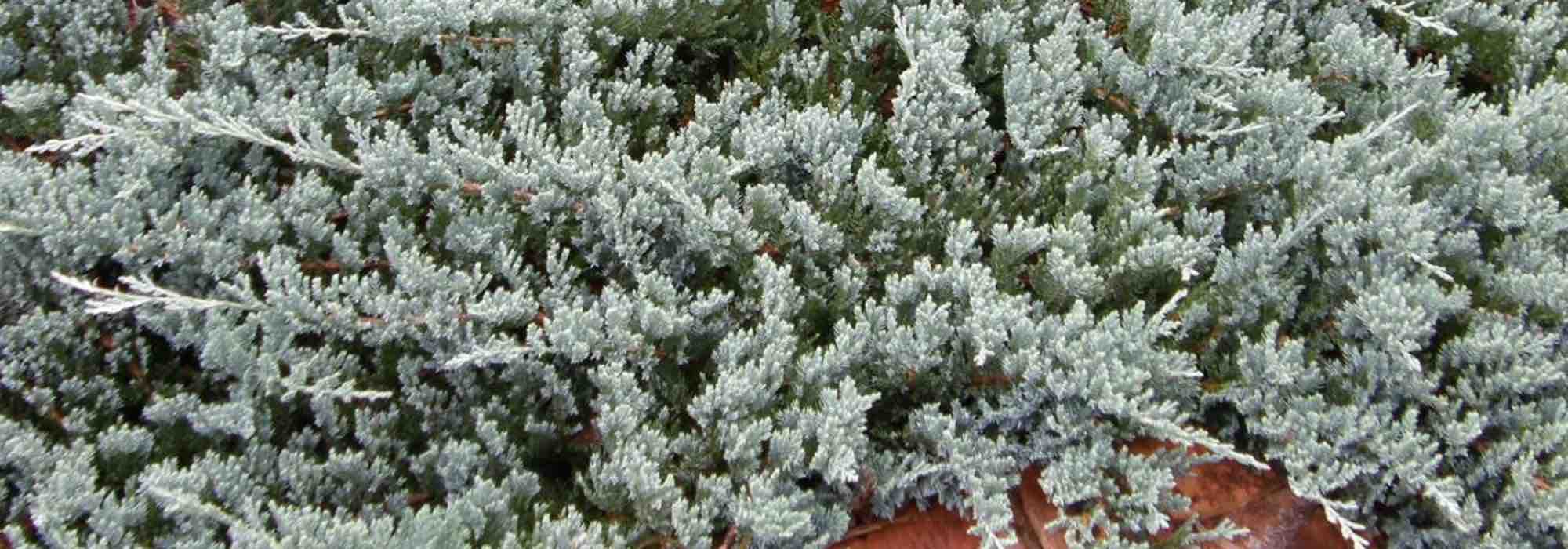
This is especially true for junipers, as exemplified by the Juniperus squamata ‘Blue Carpet’, which perfectly lives up to its name. It indeed forms a dense, compact cushion, 40 cm tall with a spread of 1.5 m. But it is mainly for its foliage that we love it, as it bears beautiful blue-silvery hues. For its part, the Juniperus communis ‘Goldschatz’ proves sunny. If it is nicknamed a “treasure”, it is because its base-green foliage is adorned with magnificent golden shoots. A very bright groundcover for small gardens. Also mention the Juniperus pfitzeriana ‘Glauca’, a large groundcover of interest for its grey-blue foliage.
Boring, the thuja? Not necessarily: the Thuja occidentalis ‘Golden Tuffet’ forms a warm cushion, with its yellow foliage in summer, which takes on orange-bronze hues in winter.
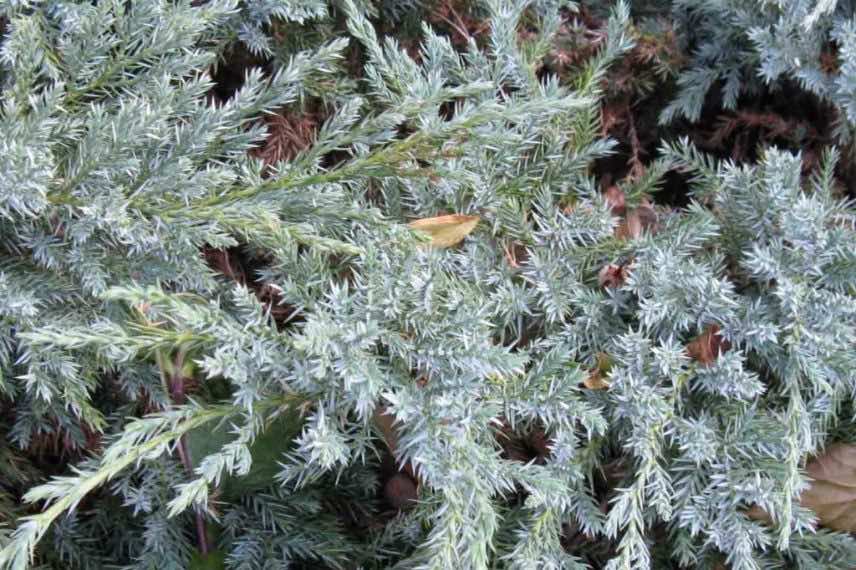
Juniperus ‘Blue Carpet’
On the dwarf Japanese cedars side, let us mention the adorable Cryptomeria japonica ‘Vilmorin Gold’, which forms a small ball just 1 metre across. It has green foliage, but it is adorned with young golden shoots that will become cream-coloured in summer.
For its part, the mountain pine ‘Ophir’ forms a compact mini-shrub, bearing a bright light-green colour that turns golden-yellow during winter.
Another little jewel: the Podocarpus lawrencii ‘Blue Gem’, whose bluish foliage creates a striking contrast with the fruiting in the form of red berries.
Let us not forget the yews, such as Taxus baccata ‘Summergold’, forming a bright carpet thanks to its golden shoots in summer.
Also mention the handsome blue spruce Picea pungens ‘Karpaten’, a groundcover conifer forming a dense dome of blue-grey foliage.
And for an even more original touch, we opt for the Chamaecyparis obtusa ‘Baldwin Variegated’. This little Hinoki Cypress from Japan delights with green foliage variegated with white, beautiful all year round.
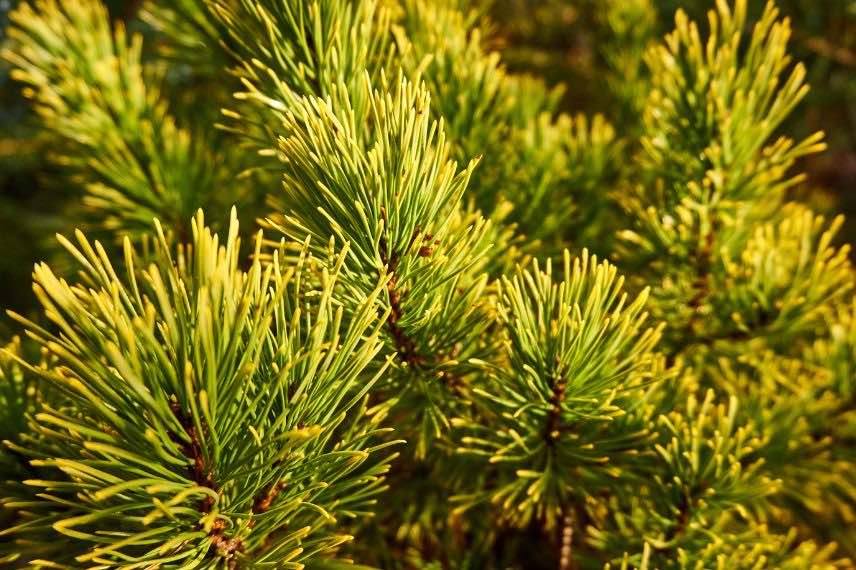
Pinus mugo ‘Ophir’
Small conifers with distinctive silhouettes
When one thinks of conifers, the image that often comes to mind is the tall, upright fir with a single trunk. But there is in fact a beautiful diversity of growth habits and silhouettes: creeping, globose, weeping, pyramidal, etc.
Round and spherical forms
For small conifers with an adorable spherical silhouette, you’ll be spoiled for choice. For example, consider the Japanese cedar Japanese cedar ‘Green Pearl’ forming a 50 cm ball in all directions. The dwarf mountain pine ‘Picobello’ likewise forms a spherical shrub of 80 cm across. For its part, the dwarf Weymouth pine ‘Minuta’ will become a slightly flattened sphere, covered with blue‑green needles. Let us also mention the compact silhouette of the Chamaecyparis pisifera ‘Blue Moon’ (80 cm across). Finally, the dwarf Sitka spruce ‘Tenas’, whose well-rounded silhouette tends to become a little more conical with time.
The mat-forming and creeping forms
To dress the foot of a slope, a rock garden or the top of a stone wall, mini-conifers with creeping and ground-covering silhouettes are ideal. Use them also to add volume to the foreground of a bedding scheme. Wider than tall, they form real plant carpets that remain ornamental year round.
This is the case for many junipers. For example, adopt the Juniperus horizontalis ‘Icee Blue’, which over time will form a beautiful ground-cover with a 2 metre span, with bluish‑silver needles. For its part, the beach juniper ‘Blue Pacific’ forms a carpet of pliant, scaly branches. Starting off apple green, it takes on bluish tints under the effect of cold winter weather. Also note the scaly juniper (Juniperus squamata) ‘Holger’, with its spreading habit, reaching 70 cm in height and 1.2 m in width at maturity.
The Korean fir ‘Green Carpet’ also has a well‑spreading habit, reaching nearly two metres across. Very small, at only 35 cm in height and 45 cm across, the variety ‘Tundra’ will form a flat, dense, spreading cushion, almost perfect.
Let us also mention the prostrate silhouette of the Siberian creeping cypress, a particularly tolerant and easy-to-live-with conifer, capable of spreading over more than 2.5 metres in width.
And to dress the top of a low wall, think of Chamaecyparis pisifera ‘Sungold’. Also called Sawara cypress, it is a small conifer with very bright foliage, in yellow‑green tones that sometimes turn golden. With 1.2 metres in height and 2 metres across, it will form a true cascade of foliage.
Other interesting silhouettes
Striking with its branches that trail to the ground, Tsuga heterophylla ‘Thorssen’s Weeper’ has a weeping silhouette that is wonderfully flexible. It can be staked to form a genuine little fountain of vegetation or used as a ground-cover.
In Thuja plicata ‘Whipcord’, the branches are also weeping and help give this conifer a graceful appearance. Suitable for the garden or in a pot.
Surprising is the tousled look of Canadian arborvitae ‘Filiformis’, with branches that seem to be fraying.
Also note the Japanese cow-tail pine, which offers an open, slightly flared column silhouette. It consists of upright branches, unbranched at their tips, which certainly explains the name of this conifer.
As for the American larch ‘Arethusa Bog’, it opts for a silhouette described as a “witches’ broom.” It indeed produces horizontal branches bearing drooping twigs.
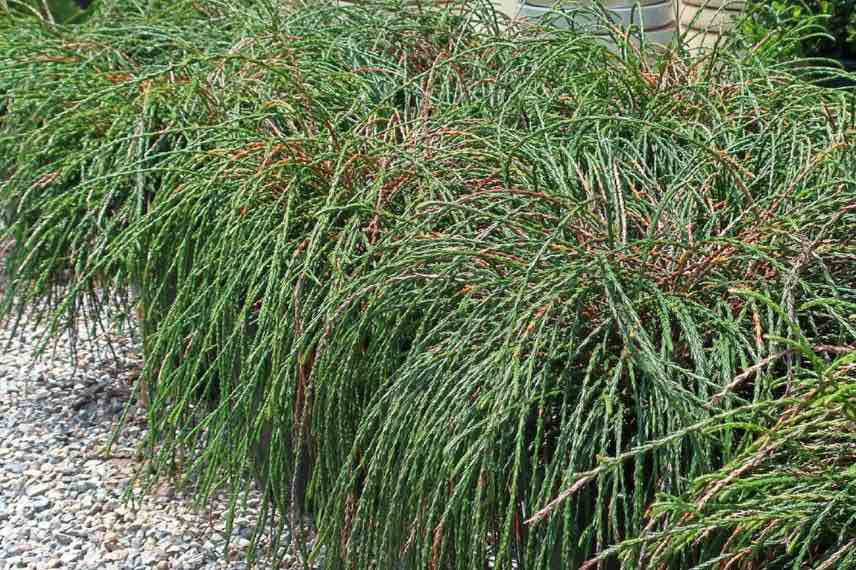
Thuja plicata ‘Whipcord’
Dwarf conifers with decorative cones.
If conifers do not display ornamental flowering as we appreciate in other plants, they may nevertheless dress themselves with pretty decorative berries, such as the famous pine cones. But some can also be very colourful. This is notably the case with l’Abies koreana ‘Green Carpet’ previously mentioned, which produces in spring numerous upright cones in a pretty pinkish-purple. In ‘Luminetta’, the cones tend towards a powdery bluish-purple.
On the shore juniper ‘Schlager’, pretty blue berries sit alongside the scaly foliage.
The female plants of the common golden yew (Taxus baccata ‘Summergold’) are adorned with bright red decorative berries. They are toxic to humans and animals, but are highly prized by birds.
Small conifers for shade
Most conifers do best in sun that isn’t scorching or in partial shade. But some varieties will tolerate shade: a boon for small, less-exposed gardens, or for terraces and balconies that get little light.
For example, the Canadian hemlock, a small creeping conifer ideal for brightening a shaded slope or a rockery that gets little sun. It offers a striking contrast between the white bark on its central branches and the green of its needles.
For its part, the Oriental spruce (Picea orientalis ‘Silver Seedling’) will illuminate shaded or subdued areas with foliage variegated with silver and sand.
Very accommodating, the Pinus mugo ‘Green Column’ tolerates all exposures, even shaded. With a compact size, it will reach only 2 metres in height and a 1-metre spread.
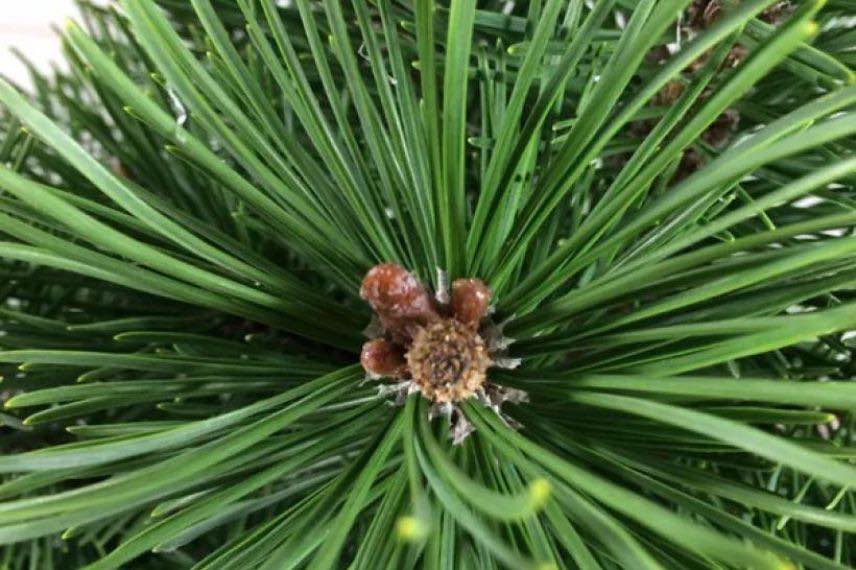
Pinus mugo ‘Green Column’ is planted in shade
- Subscribe!
- Contents
Comments