


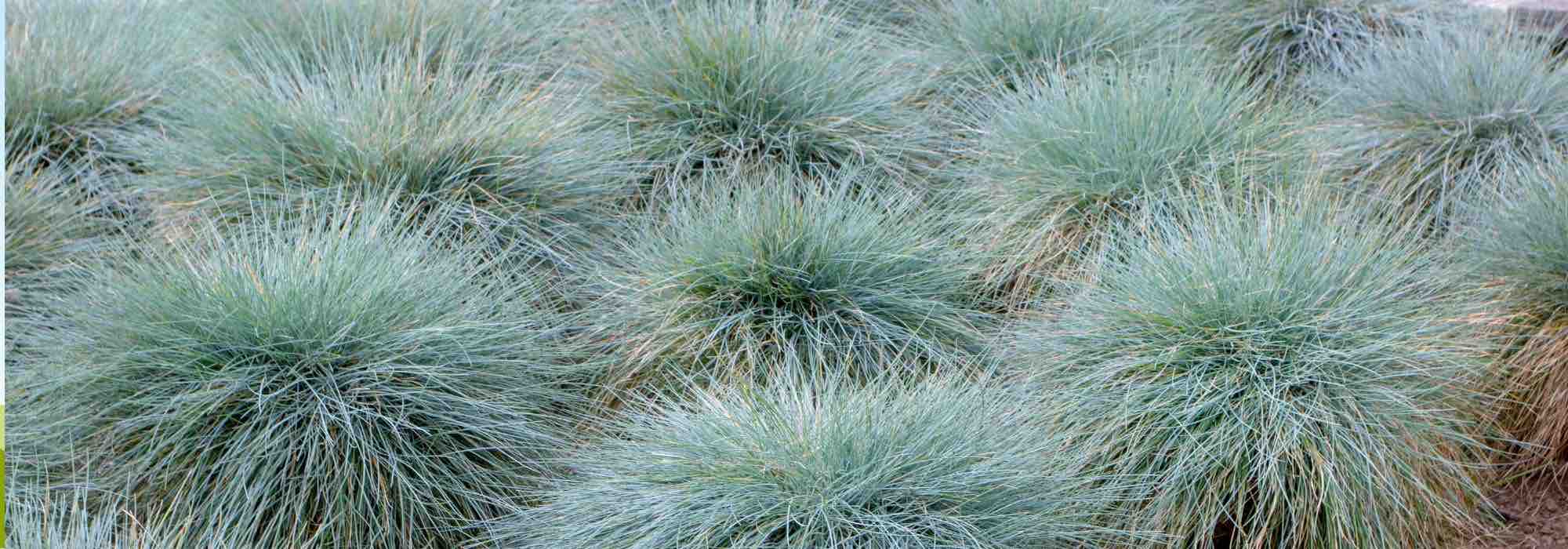
Using and pairing blue foliage in the garden
How to make the most of bluish foliage plants?
Contents
Using and pairing foliage in the garden should be one of the aims of any seasoned gardener. Certainly, the flowering displays attract us and mark the seasons, but they are nonetheless much more ephemeral than the foliage. They also offer a very wide diversity of colours, shades and nuances, enabling you to create long-lasting decorative displays. Trees, bushes and perennials with blue foliage have the advantage of pairing easily with almost any other colours, present in both the flowers and the leaves. Discover what the bluish colour brings to your beds and which plants to select to achieve the loveliest colours and how to use them to enhance them or highlight their neighbours.

Think blue leaves
Blue refers to calm, trust, stability, well-being, freshness, and even spirituality. It is one of the three primary colours, alongside red and yellow, from which other shades can be obtained. Although flowering displays offer a fairly wide palette of blues, sometimes leaning towards mauve, violet or purple… plants with true blue foliage are, to be honest, quite rare. Many of them indeed tilt much more towards green, grey or silvery. In horticultural circles, some varieties of plants bear evocative vernacular names which are an indication of the colour of their foliage. Thus, the Juniper ‘Blue Carpet’ is equipped with needles with a blue-silver tint, while a Hosta ‘Blue Vision’ unfurls broad leaves with a green heavily tinged with bluish hues. Sometimes, it’s the only vernacular name that conveys the shade of the plant. If the Latin name Helictotrichon sempervirens may seem opaque to beginners, its common name Blue Oat Grass is far more evocative of its colour. However, if you see the term glauca appear in the botanical name, you can be sure that the plant has foliage green with blue-toned nuances to a greater or lesser extent. Do not rely on the French word ‘glauque’ which carries a somewhat negative connotation, for this hue remains well within the theme, and when used well, such plants can add a real visual impact to your display.
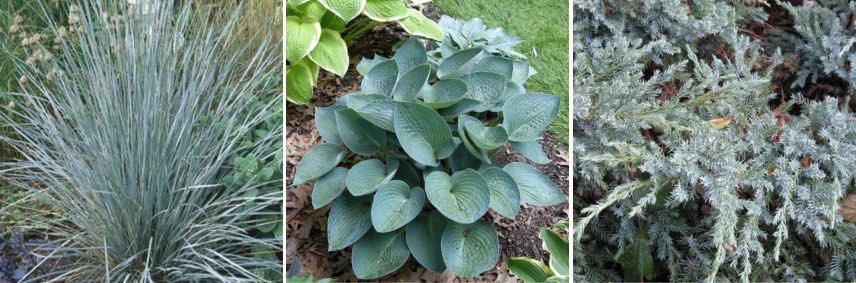 Blue oat grass, Hosta ‘Blue Vision’, Juniper ‘Blue Carpet’
Read also
7 blue grassesImpact of blue in the garden
Blue is part of what are known as the cool colours, just like green. Soothing colours convey a sense of calm and serenity and also have the ability to make a space feel larger or at least to give that impression. Blue indeed adds depth and makes things appear more distant, whereas other colours such as red tend to bring things closer. This is an asset which can therefore be particularly put to good use in a small garden or in a patio to visually push back its boundaries. Placed in the sun, blue can seem paler, or even resemble a bluish-grey.
Plants with blue or glaucous foliage
Depending on exposure and soil type you provide for your plants, here is a non-exhaustive selection of plants with blue-tinged foliage.
Shrubs for sun and dry soil
Most blue- or glaucous-leaved shrubs prefer full sun, possibly partial shade. Some also show good drought tolerance: Eucalyptus gunnii (shades from blue to grey depending on the variety), Senecio mandraliscae (low hardiness, its succulent foliage is a beautiful blue-silvery), Yucca rostrata and Yucca rigida (with respectable hardiness, they are valued for their architectural form), Brahea armata (a palm with striking blue-grey fronds, quite uncommon), Protea magnifica (its glaucous foliage with red or yellow veins frames a spectacular flowering, for mild climates).
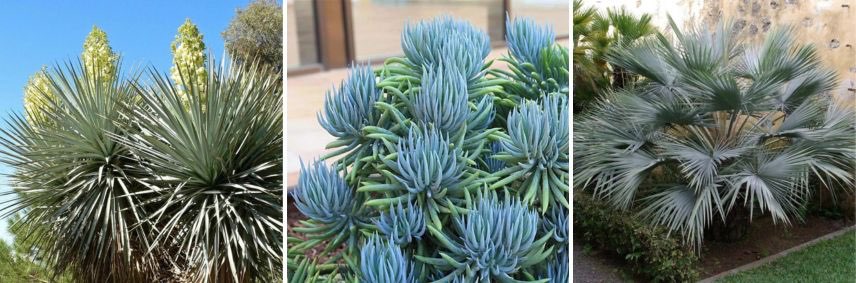
Yucca rigida, Senecio mandraliscae, Brahea armata
Perennials for full sun
Some blue-leaved perennials reveal their beauty in the sun, sometimes even with pretty flowering: Agave parrasana (a succulent that resembles a cabbage with bluish-silvery, spiny leaves), Helictotrichon sempervirens (a grass with fine, blue-tinged foliage for well-drained soil), Festuca glauca (‘Elijah Blue’ and ‘Intense Blue’ are the two varieties whose foliage is the bluest), Leymus ‘Blue Dune’ (a grass well suited to sandy soils, but with a robust temperament), Panicum ‘Dallas Blue’ (a tall, architectural grass with bluish-green foliage), Sedum ‘Marina’ (perhaps the bluest of all the stonecrops), Euphorbia ‘Blue Wonder’ (a lovely contrast between its blue-grey foliage and chartreuse-green flowers).
Perennials for shade
Shade suits admirably certain perennials whose blue-tinged foliage takes on a distinctive depth: Actaea ‘Misty Blue’ (a hardy perennial with decorative blue-tinged foliage, ideal for woodland planting), Carex ‘Blue Zinger’ (an evergreen perennial with grass-like foliage, perfect as a ground cover under trees), Hosta (many varieties are renowned for their broad, colourful leaves, among which ‘Halcyon’, ‘Fragrant Blue’ or ‘Drinking Gourd’ are among the bluest).
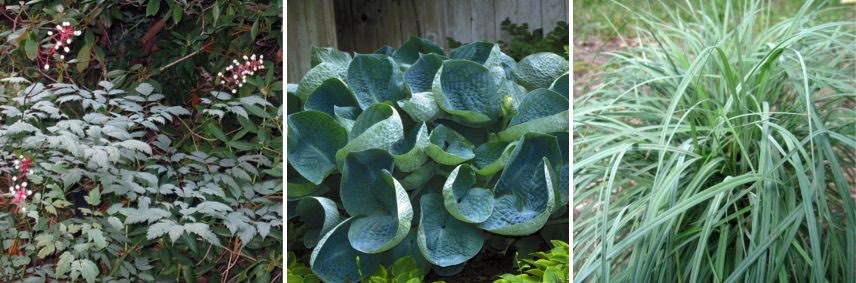
Actaea ‘Misty Blue’, Hosta ‘Drinking Gourd’, Carex ‘Blue Zinger’
The case for conifers
When it comes to blue foliage in the garden, it is impossible not to mention conifers. Available in dwarf and compact varieties or in imposing, majestic trees, some offer especially blue foliage, whose colours can shift with the seasons. With few exceptions, they all have evergreen foliage and remain decorative all year round.
- Among the bluest varieties, suited to small gardens, one can cite: some false cypresses (Chamaecyparis ‘Baby Blue’ which adopts a pyramidal habit and does not exceed 2 m, while Chamaecyparis ‘Blue Moon’ forms a dome with silky needles under 1 m), many spruces (Picea ‘Glauca Globosa’ is particularly blue when its new spring shoots appear and Picea ‘Blue Pearl’ forms a steel-blue ball of 50 cm in all directions), many junipers (Juniperus Juniperus ‘Blue Carpet’ stays low, but forms a dense blue-silver carpet, while Juniperus ‘Moonglow’ quickly draws a pyramidal silhouette that is not demanding).
- For large gardens and parks, some conifers command respect with their size: the Cedar of Lebanon (capable of growing up to 20 metres, its bright blue foliage in spring then shifts to blue-silver) or the Giant Sequoia ‘Glaucum’ (its towering stature of nearly 35 metres and pyramidal habit showcases its bluish-grey foliage).
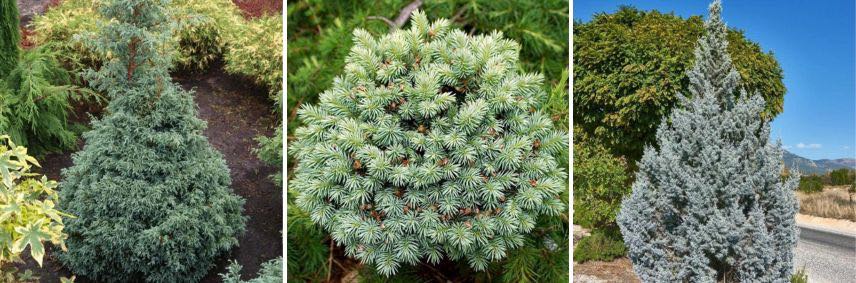
Chamaecyparis pisifera ‘Baby Blue’, Picea pungens ‘Blue Pearl’, Juniperus scopulorum ‘Moonglow’
Read also
Designing a blue gardenUse blue foliage
Bluish foliage plants are often underused in garden design. Yet, bluish foliage provides a display far more lasting than that offered by flowering, and the blue it offers is neither ostentatious nor aggressive, allowing for numerous pairings with either other foliage or flowering displays.
- A deep, intense blue adds dynamism, particularly with brighter hues such as yellow or pink.
- Blue, like grey, softens other colours while uniting them.
- It is also a shade that enhances nearby greens.
- Blue and violet pair with reds and golds.
- Yellow and orange are two colours that are often set against blue, rightly so.
- When paired with variegated foliage, blue provides both depth and roundness.
- Avoid clustering too much bluish foliage in one place to avoid flattening your display and producing a dull overall look. Prefer to highlight this shade with other colours.
Examples of plant pairings
Bluish foliage combinations are plentiful. Here are, however, a few ideas tailored to your exposure, your garden style, or the ambience you desire.
Soft ambience in the shade
Some shade- or partial-shade loving plants display beautiful bluish tones, such as Hosta, with a range of hues. Hosta ‘Halcyon’ is a benchmark in this regard. You can plant it in the foreground, paired with Hakonechloa ‘All Gold’, whose fine golden foliage is further intensified by the presence of its neighbour. Some ferns with graphic foliage and a neutral green such as Matteuccia orientalis complete the colour palette, with no flowering required.
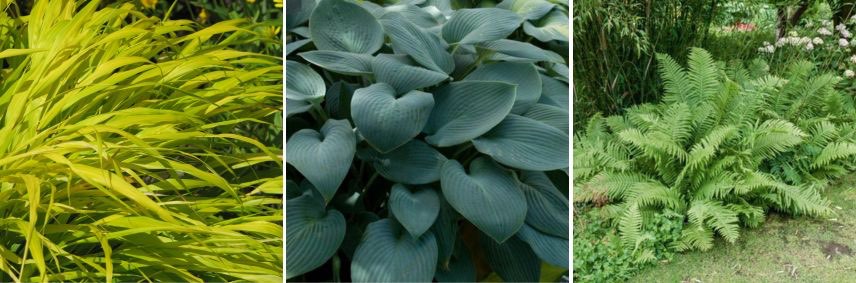
Hakonechloa macra ‘All Gold’, Hosta ‘Halcyon’, Matteuccia orientalis
Border edging to showcase
Use blue as a border to frame the plants placed at the back.
- In full sun, clumps of Festuca glauca establish, for example, the presence of Lavenders, Erigerons or contemporary-looking plants such as the Agaves.
- In less sunny areas, Carex ‘Blue Zinger’ form a setting for the superb foliage of Japanese maples, a Fatsia variegated ‘Spider’s Web’ or pale pink Japanese Anemones such as ‘Queen Charlotte’ for a soft rendering.
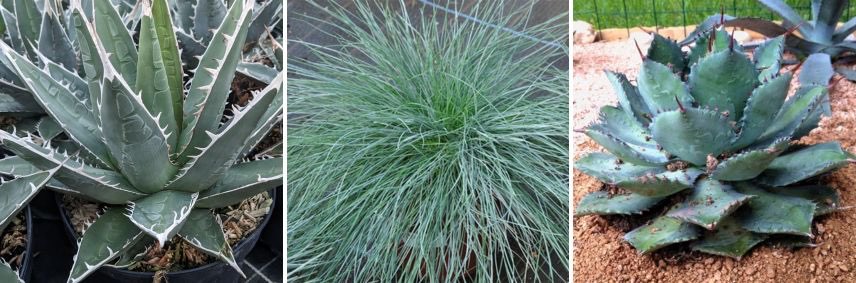
Agave kerchovei, Festuca glauca, Agave isthmensis
Blue to accompany roses
A rose is never as beautiful as when it blooms in good company.
- Make the most of bluish-grey foliage and the acid-yellow flowering of a Euphorbia ‘Blue Wonder’ by pairing it with a cream rose such as ‘Kosmos’ or the sulphur-yellow hue of the climbing rose ‘Mermaid’.
- You can also set glaucous foliage of a Panicum ‘Dallas Blue’ against the bright orange of a long-flowering rose such as ‘Westerland’ or the fresh pink of ‘Ballerina’.
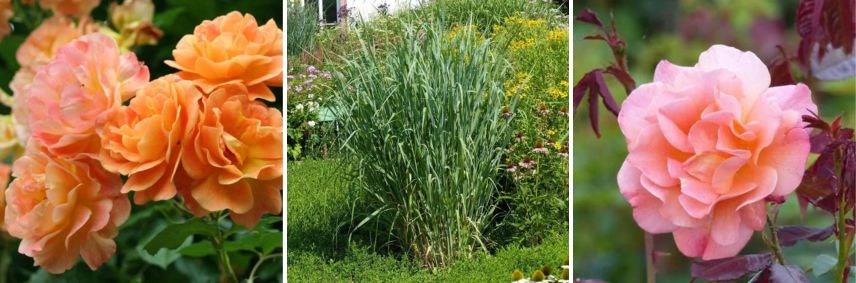
Rosemary ‘Westerland’, Panicum ‘Dallas Blue’, Rose ‘Ballerina’
Blue and purple contrast
Blue and purple form a beautiful marriage of cool and warm colours. To create this duo, imagine, for example, installing an Eucalyptus ‘Baby Blue’, renowned for its distinctly blue-toned aromatic foliage alongside a Cotinus ‘Royal Purple’ whose dark, intense hues create a striking contrast. To enhance the effect, opt for perennials with orange-coloured blooms such as Hemerocallis ‘Burning Daylight’ or Kniphofia ‘Tawny King’.
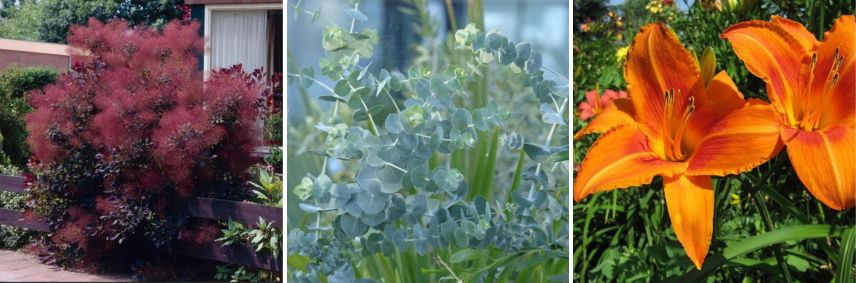 Cotinus ‘Royal Purple’, Eucalyptus ‘Baby Blue’, Hemerocallis ‘Burning Daylight’
Classic blue and yellow
Yellow admirably opposes the bluish hue for a dynamic pairing. An Helictotrichon sempervirens splashes the base of a Cotinus ‘Golden Lady’ with bright golden hues. Toss in a few Buenos Aires Verbenas to bring a blue-mauve note with translucence, or some Echinops ritro with their electric-blue, spiky globes.
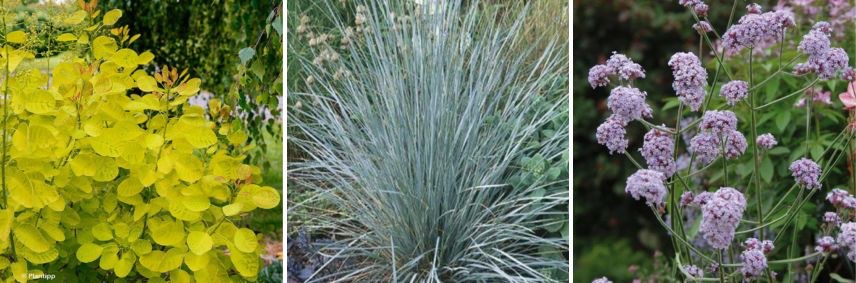 Cotinus ‘Gloden Lady’, Helictotrichon sempervirens, Verbena bonariensis ‘Cloud’
Autumn border with a spicy touch
For a striking autumn display, choose trees and shrubs with showy autumn foliage in late season (Cotinus, maples, Amelanchier, Parrotia… the choice is vast). Pair them with conifers with bluish needles such as Picea ‘Glauca Globosa’ or Juniperus ‘Moonglow’ whose cooler notes give the scene remarkable depth. Then complete with late-flowering perennials such as the Asters, the Japanese Anemones, or bulbs such as the Sternbergia, not forgetting a few grasses that lend movement to the whole.
- Subscribe!
- Contents

Comments