Eleutherococcus, Acanthopanax: planting, growing and caring for
Contents
Eleuthero in a nutshell
- Eleutherococcus is a small thorny shrub with an elegant habit
- It bears attractive, deeply divided foliage with lush, exotic appearance
- In summer it produces small white flowers, followed by small black berries on female plants
- Perfectly hardy and easy to grow, it adapts to any soil that stays cool in summer
- It brightens shaded areas and can even be planted as a hedge
A word from our expert
Eleutherococcus or Eleutherococcus (syn. Acanthopanax) is a small, unjustly overlooked spiny shrub, closely related to Aralia of Japan. It shares with its close cousin luxuriant palmate foliage that suggests exoticism and brightens even the shadiest corners of the garden. In summer, it produces discreet white flowers, followed by small decorative black berries that persist until late autumn. Very adaptable, this perfectly hardy shrub thrives in any soil that remains cool over summer, in partial shade. It really needs little maintenance, apart from regularly removing any suckers that appear. It fits equally well in a hedge, a shrub border or even in the understorey. Its graphic habit and deterrent spines make it an ideal choice for naturalistic or Japanese-style gardens, or for creating an elegant yet effective defensive hedge. Moreover, the root of Eleutherococcus senticosus is recognised for its benefits in herbal medicine, notably for its ability to increase resistance to stress. Discover this easy, low-maintenance shrub, ideal for lovers of exotic, wooded settings!

Botany
Botanical data
- Latin name Eleutherococcus
- Family Araliaceae
- Common name Eleuthero, Acanthopanax, Siberian ginseng
- Flowering June to September
- Height 1.3 m to 3 m
- Exposure Sun, partial shade
- Soil type fresh, ordinary soil
- Hardiness -18°C
Eleuthero (formerly called Acanthopanax) belongs to family Araliaceae, which includes more than 1,500 species, such as Aralia elata (“devil’s Walking stick”), to which it is very close, ivy (Hedera helix), ginseng (Panax ginseng) and Fatsia. This Asian shrub is native to central and western China, the Philippines and Japan. The plant prefers temperate zones, where it grows in woodlands, damp forests and on mountain slopes. Adaptation to these environments allows tolerance of a wide range of climatic conditions.
Genus includes around thirty species of shrubs and spiny trees, best known being Acanthopanax or Eleutherococcus henryi (Henry’s eleuthero), Acanthopanax sieboldii, now called Eleutherococcus sieboldianus (Siebold’s eleuthero), prized for ornamental qualities, as well as Acanthopanax senticosus (Eleutherococcus senticosus), sometimes nicknamed “Japanese ginseng” or “Siberian ginseng”, often used in herbal medicine.
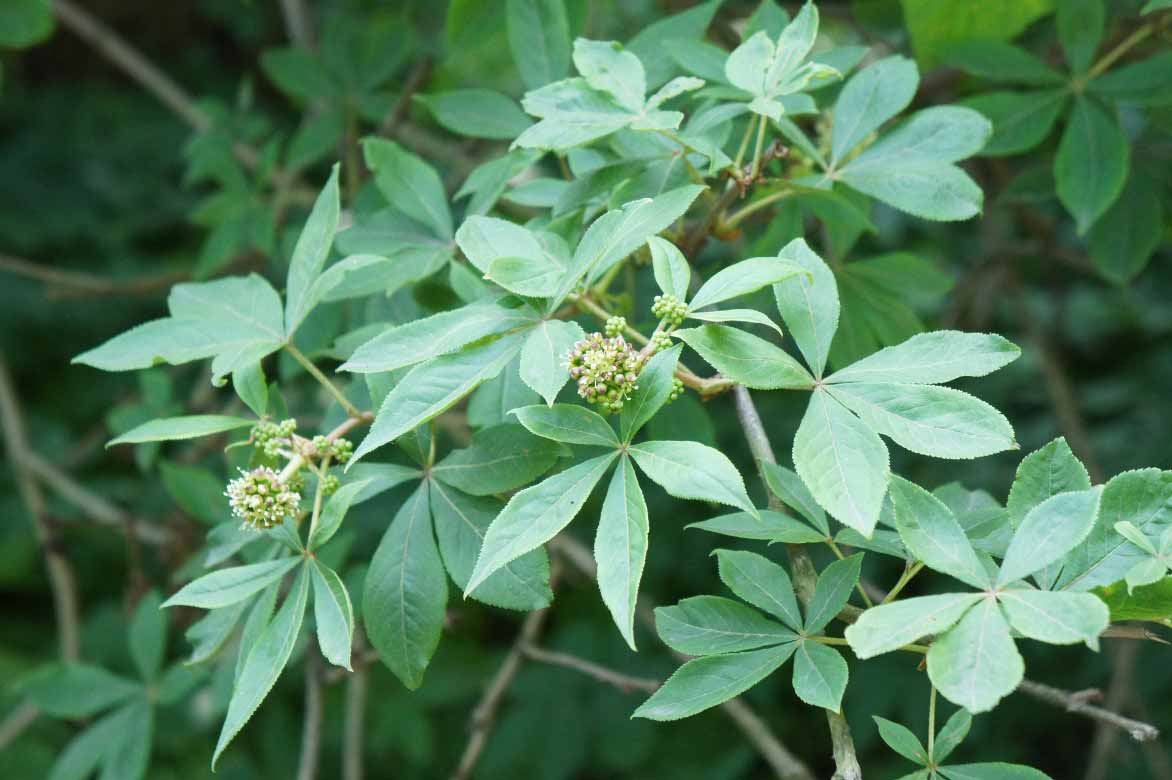
Palmed foliage of Eleutherococcus senticosus
Size of Eleuthero varies by species and cultivar, from about 1.5 m for dwarf forms to around 2–3 m in height. In natural habitat it can reach up to 3.5 m. It has a spreading habit and a growing like a bush habit, both dense and elegant. Arching branches are densely branched and armed with sharp, deterrent spines, giving compact, bushy appearance useful in defensive hedging, hence nickname “Devil’s bush”.
Deciduous foliage appears in spring, rather late. Palmate and ornamental, it is typical of Araliaceae with a lush aspect. Each leaf is divided into five leaflets with toothed margins, arranged like a star around a central petiole that can be spiny. They open at branch tips, producing an umbrella-like effect. Leaves often have slightly leathery texture and a rough upper surface. They measure 3–8 cm long. Eleutherococcus henryi is distinguished by larger, more numerous leaves. Each leaf may have up to nine leaflets, which are elongated and pointed, sometimes reaching 15 cm. Leaves are usually green to grey-green, turning golden yellow in autumn before falling. Some cultivars such as ‘Acanthopanax sieboldii ‘Variegatus’ stand out with bright cream-variegated foliage.
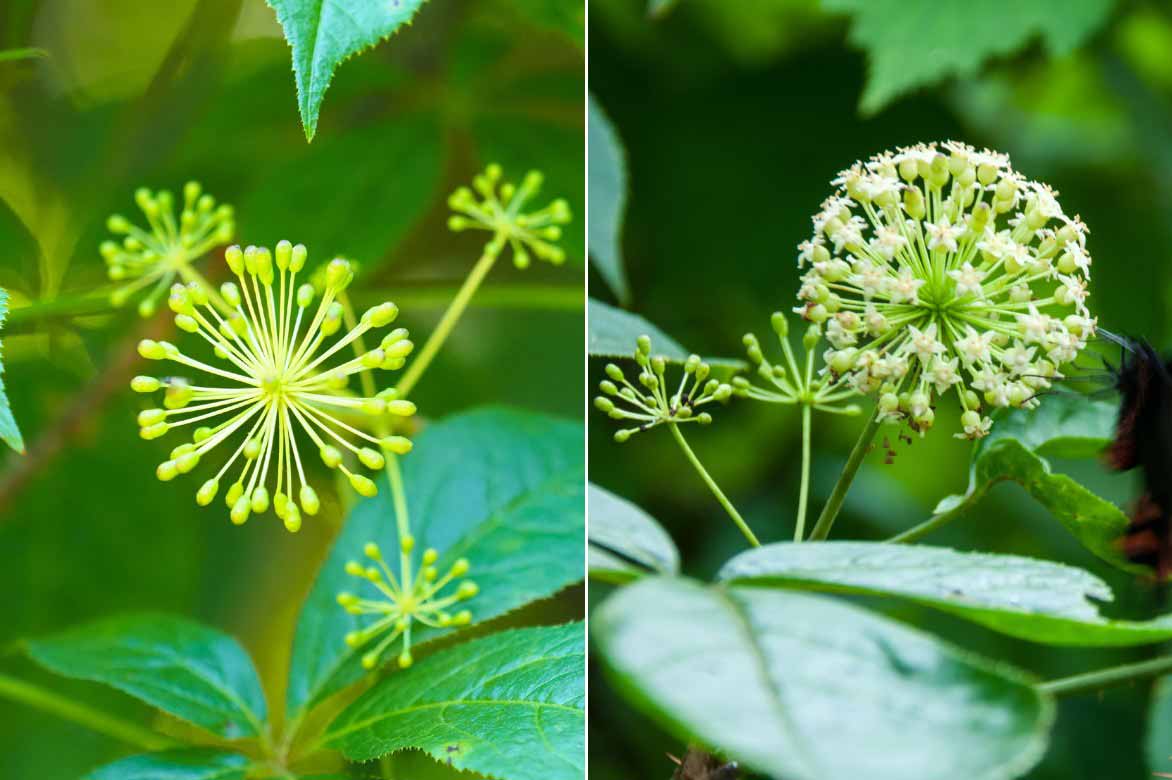
Flowering of Eleuthero
Eleutherococcus generally flowers between June and September, timing varying with climate. Flowering appears as small flowers grouped in umbels 2–3 cm in diameter, at branchlet tips. Flowers are cream-white to pale yellow, fairly inconspicuous due to small size, arranged in tight, lightweight spherical clusters. Each flower has five petals surrounding a centre of prominent stamens. Unscented, flowers are nevertheless melliferous, attracting pollinating insects, notably bees.
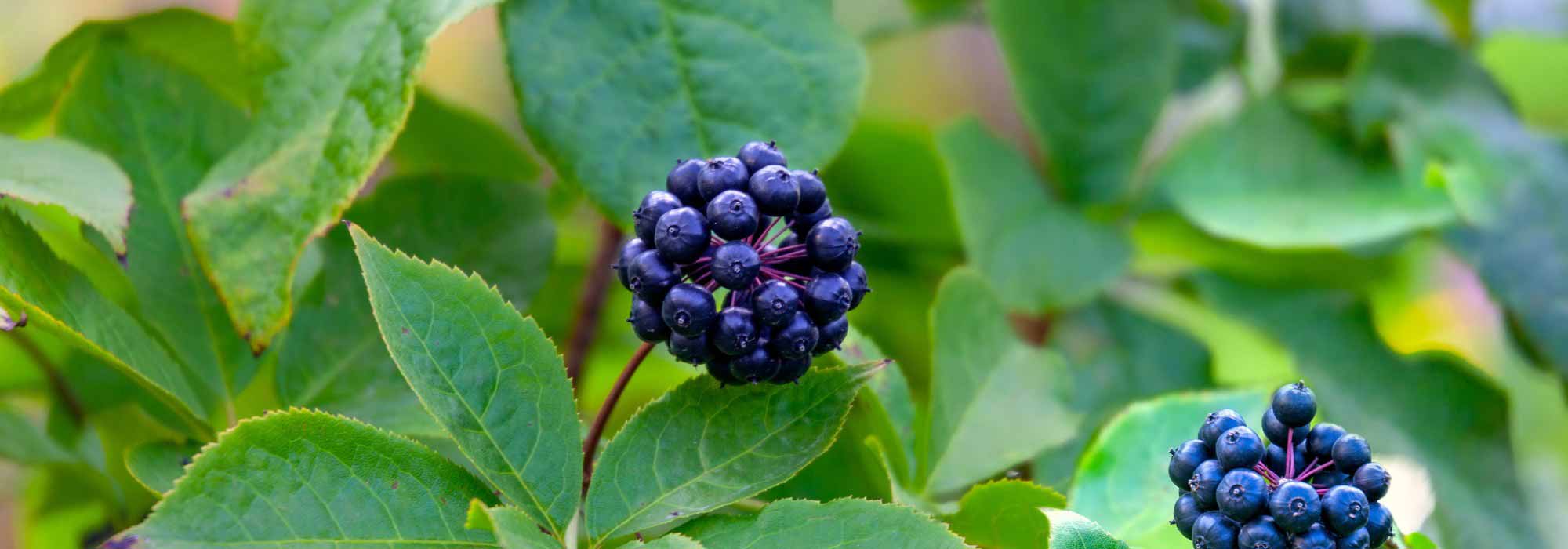
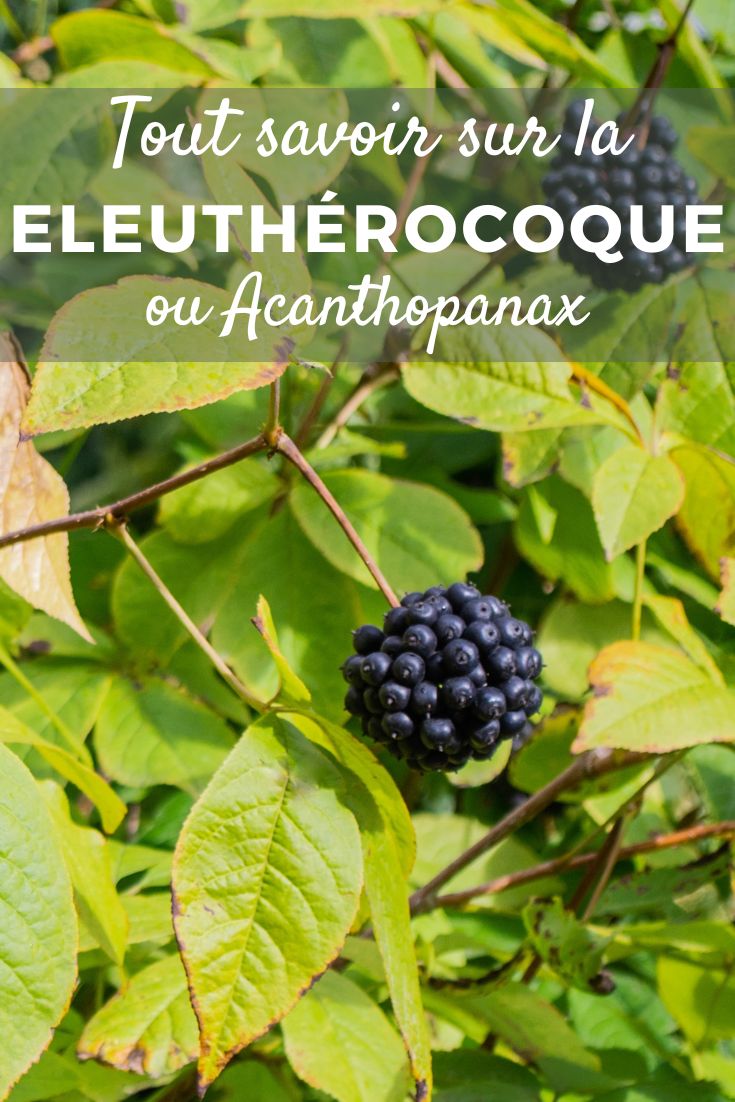
Only female plants can produce fruit. Female flowers must be pollinated by pollen from male flowers: once pollinated, female flowers develop into small ovoid fruits that turn black at maturity, similar to ivy fruit. These shiny berries in tight clusters, often grouped into balls about 5 cm across, sometimes persist into winter. Each berry contains five yellow seeds.
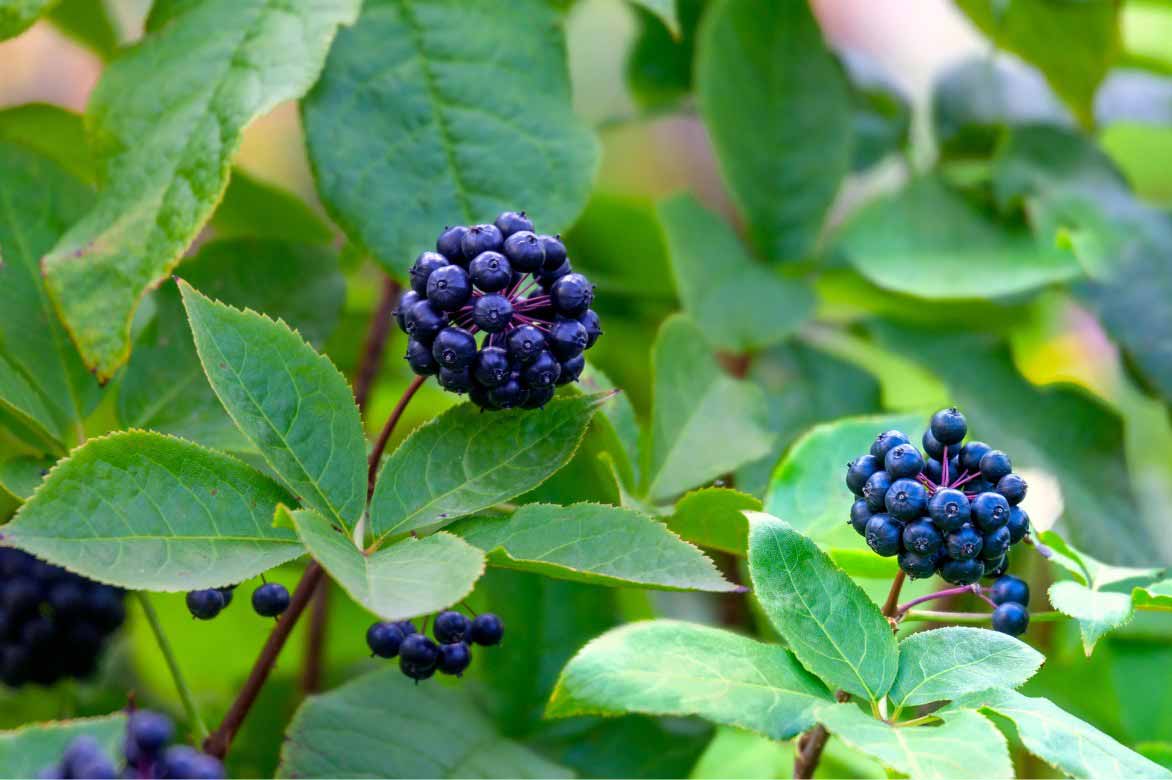
Fruits of Eleuthero
Read also
8 shrubs for a defensive hedgeMain species and varieties
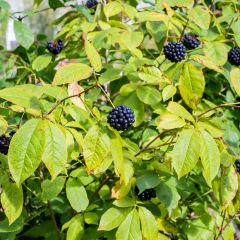
Acanthopanax henryi - Henry's Aralia
- Flowering time September, October
- Height at maturity 2 m
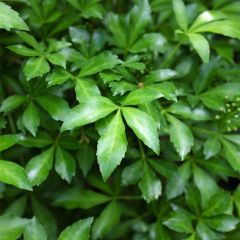
Acanthopanax henryi Nana - Henry's Aralia
- Flowering time July, August
- Height at maturity 1,30 m
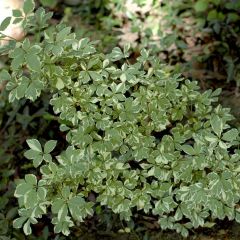
Acanthopanax sieboldianus Variegatus
- Flowering time July, August
- Height at maturity 2 m
Planting
Where to plant?
Hardy to -18°C, Eleutherococcus (or Acanthopanax) is grown outdoors in many regions. However, it is advisable to plant it in a spot sheltered from cold, drying winds to protect foliage and young shoots. A position near an east- or north-facing wall or under the canopy of taller trees can provide this natural protection. Ideal aspect is partial shade or light shade, although it can also tolerate deeper shade. In hot regions, part shade, especially shelter from direct afternoon sun, is essential to prevent foliage scorching. In cooler areas, a sunnier position can be beneficial to promote flowering and fruiting.
Very accommodating, and adaptable to different soil types, it will perform best in any good, free-draining garden soil rich in organic matter. As a woodland plant, humus-rich soil that stays cool in summer will support its growth. It tolerates dry shade well. Only extremely hot, sunny exposures and waterlogged soils are a problem.
Perfect for planting on woodland margins, at the edge of understorey, in a shrub border or in a free-standing or clipped hedge, for screening or ornamental purposes. With its highly ornamental foliage, it fits perfectly into naturalistic, Japanese-style or exotic gardens. Variegated cultivars are ideal for bringing brightness to shaded corners of the garden.
When to plant?
Plant Eleutherococcus in autumn (September to October) or in spring (March to May), avoiding periods of frost or extreme heat.
How to plant?
- Loosen soil to about 30–40 cm depth to encourage rooting. If soil is heavy or clayey, incorporate compost or planting compost to improve drainage and structure.
- Soak rootball for a few minutes to moisten it.
- Dig a hole twice as wide and deep as the rootball.
- Place Eleutherococcus in centre of the hole so top of rootball is level with collar.
- Backfill, then firm soil lightly around the rootball to remove air pockets without over-compacting.
- Water well after planting to help establishment. A mulch can be spread around the shrub to retain moisture and protect roots.
- Continue to water regularly.
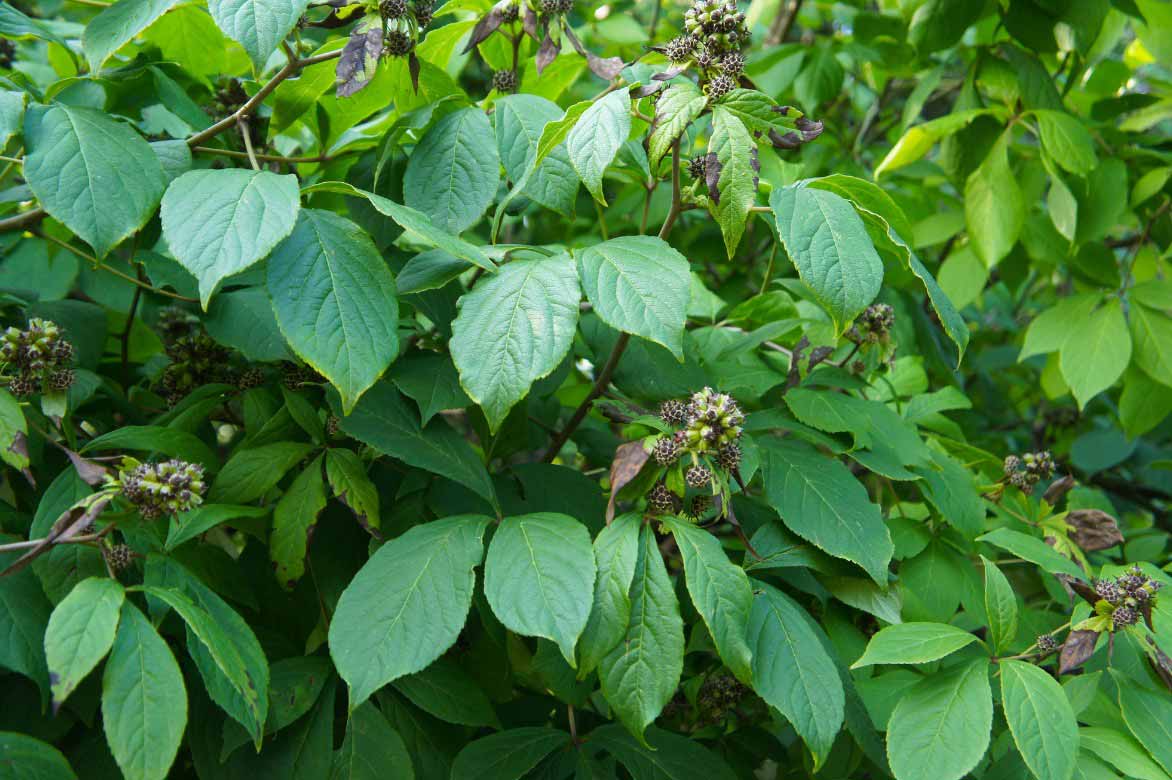
Eleutherococcus sessiliflorus
Read also
How to create a defensive hedge?Maintenance, pruning and care
Caring for Eleutherococcus is relatively simple. It is a robust, undemanding shrub that will benefit from regular watering, especially during its early years after planting and during periods of drought. Mulching around the base will help conserve soil moisture. In spring, apply an organic fertiliser or well‑rotted compost on the stump to enrich soil, and incorporate it superficially by lightly forking in.
Eleutherococcus is not susceptible to diseases or pests.
Pruning
Pruning Eleutherococcus is generally not necessary. However, a light prune can be carried out to encourage branching, limit its spread or to remove dead, damaged or diseased branches. Pruning stimulates the emergence of new shoots. Best time to prune is late winter or early spring, in March, before budbreak to encourage branching and limit spread. It tolerates repeated pruning, which is useful if growth is excessive. You can cut it back hard every 4 or 5 years.
Eleutherococcus is a shrub that tends to sucker. These suckers can quickly spread and colonise surrounding space to form a dense groundcover or an impenetrable hedge. To remove them, cut them at the base, as close as possible to the root, using a sharp pruning shear.
Multiplication
We recommend propagating Acanthopanax by lifting suckers, which develop on the mother plant’s roots to produce new plants. Sowing is also possible if you have access to seeds of Eleutherococcus, so if your plant fruits; however this method is more tedious and unpredictable.
Removing suckers
To propagate the shrub, simply:
- Lift well-formed suckers in late winter, around February or March, taking care to retain part of their roots.
- Replant young offshoots directly in another part of the garden or in a pot, where they will establish quickly.
Sowing
You can harvest the fruits to collect the seeds they contain. They must be cold-stratified by placing them in the refrigerator for about 3 months. You can then sow them in a mix of potting compost and sand at a temperature between 20 and 30 °C. Pot on the young plants as soon as they have 6 to 8 leaves. Let them strengthen for one year in a pot before transplanting to their final position in the garden.
Association
The large palmate leaves of Eleutherococcus create beautiful, exotic-tinged atmospheres in shady parts of the garden, for example. In a slightly “jungle” planting, it can be paired with other large, lush foliage such as Aralia elata, Gunnera, Fatsia japonica, for interesting contrasts.
In a very natural understorey setting, Eleutherococcus can be planted close to hostas, ferns, and Paris polyphylla, a striking shade-loving perennial with very graphic foliage — plants that, like it, prefer semi-shade and soils rich in organic matter that remain somewhat cool.
It is also excellent in a clipped or informal hedge with other equally easy-care shrubs, such as privets or Ligustrum, shrubby honeysuckles or hedgerow honeysuckles (Lonicera xylosteum).
Botanical roses and white spiraeas will also make good companions in a natural, wild shrub bed. Japanese maples, with their delicate, colourful foliage, also harmonise well, especially if you want to create Asia-inspired scenes. Low, soft‑textured ornamental grasses such as Carex or Japanese (forest) grass can thrive alongside to brighten and cover the soil in shady corners of the garden.
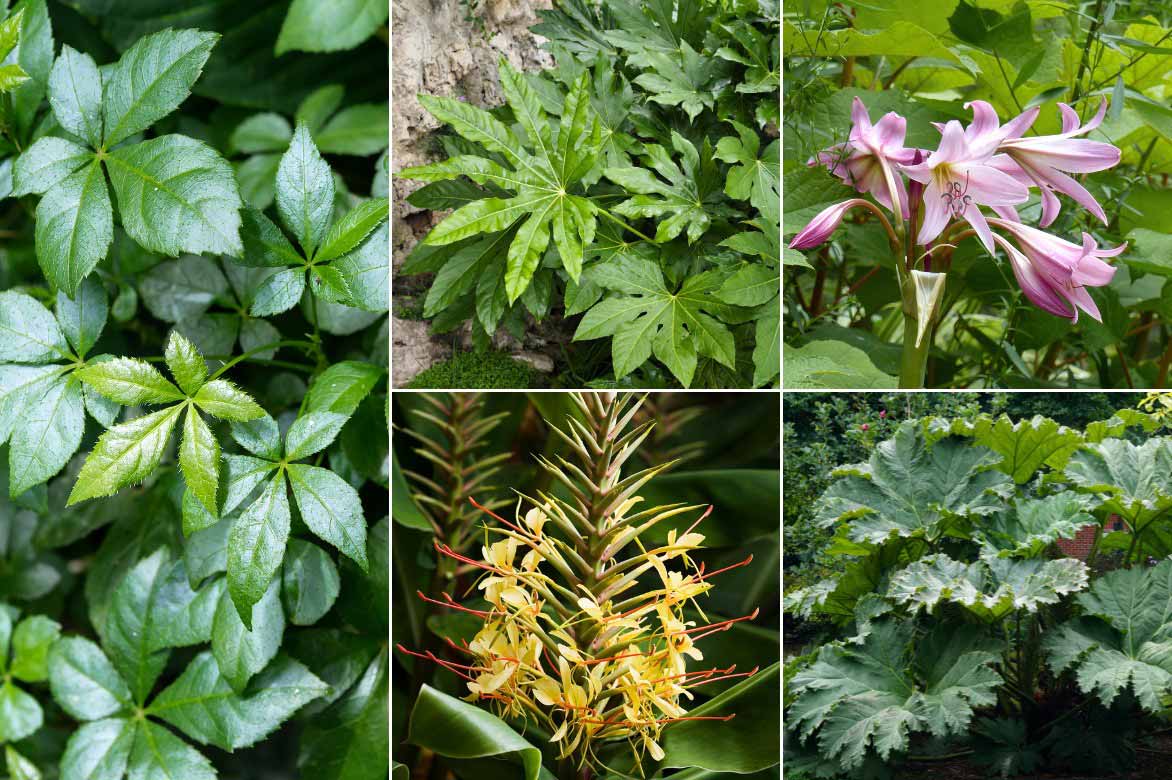
Eleutherococcus fits wonderfully into an exotic garden, with lush foliage and spectacular blooms. Eleutherococcus trifoliatus, Fatsia japonica, Crinum powellii, Hedychium gardnerianum (photo: J.J. Harrison) and Gunnera manicata
Did you know?
Eleutherococcus senticosus or “Siberian ginseng” is commonly used in traditional Chinese medicine for its adaptogenic properties, helping body adapt to stress and fight states of weakness. Root, which constitutes medicinal part of plant, is generally dried, powdered, then processed and used as substitute for ginseng.
- Subscribe!
- Contents
This form is protected by reCAPTCHA - the Google Privacy Policy and Terms of Service apply.

































Comments