How to grow ivy-leaved cyclamens in pots?
Our tips for successful planting and care
Contents
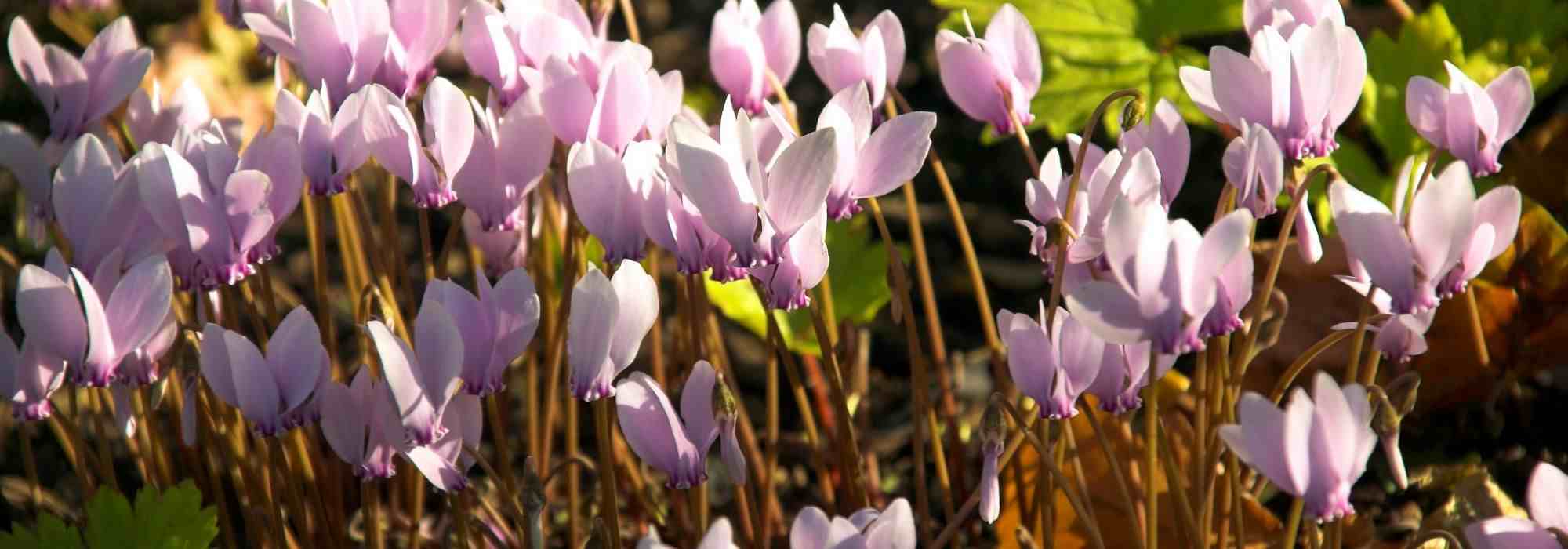
Ivy-leaved cyclamens are tuberous plants that flower late. They brighten up autumn with their fragrant flowers, in shades of pink or white, shaped like butterfly wings.
Ideal for greening difficult-to-grow areas in shade or partial shade, they offer decorative foliage, naturalise easily and can become beautiful flowering carpets within just a few years.
Easy to grow, ivy-leaved cyclamens or Cyclamen hederifolium (ivy-leaved cyclamen) can be grown just as well in the ground to dress the base of trees, beds or rockeries, as in containers to create beautiful flowering pots.
Here is our advice for successfully planting and caring for ivy-leaved cyclamens in pots.
Which varieties of ivy-leaved cyclamen should you choose for growing in pots?
Because of their small size, ivy-leaved cyclamen can easily be grown in pots. Indeed, they barely exceed 15 cm in height, with a spread of 20 cm.
Choose the pink ivy-leaved cyclamen or the white variety, which will add charm to small spaces, window boxes, patios and balconies in autumn.
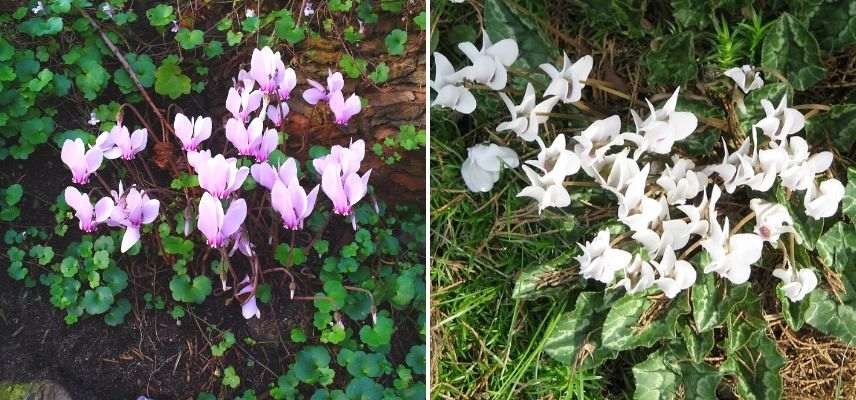
Cyclamen hederifolium (photo H. Zell) and Cyclamen hederifolium ‘Album’ (photo Meneerke bloem – Wikimedia) are perfectly suited to growing in pots or planters
Read also
Cyclamen: planting and careWhen should you plant ivy-leaved cyclamen in a pot?
Ivy-leaved cyclamen tubercles are ideally planted during the summer, in July-August, during the plant’s dormant period.
Flowering will take place between September and November. The first leaves will then appear and persist throughout the winter until spring. Please note that cyclamens may take a year to become well established and flower.
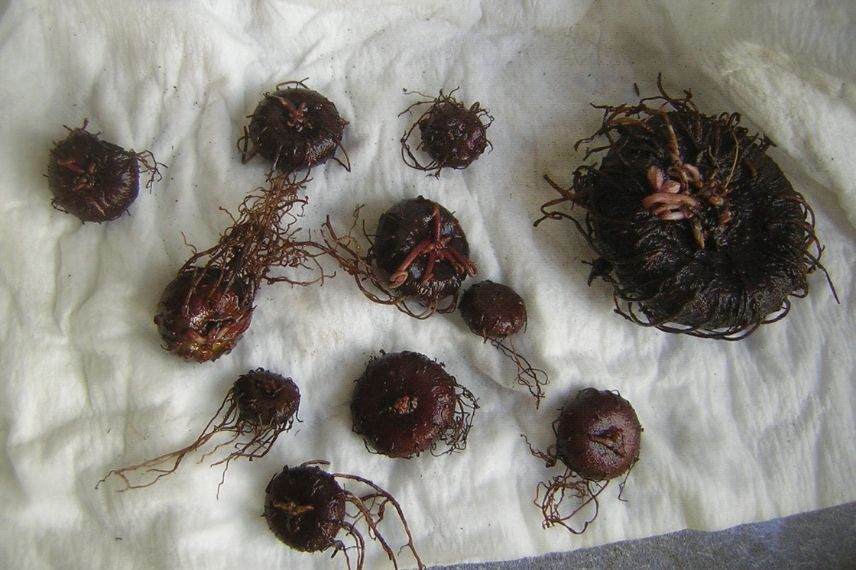
Tubercles of Cyclamen hederifolium (photo Erutuon – Flickr)
Planting ivy-leaved cyclamens in pots
The container
To plant your ivy-leaved cyclamen, choose fairly wide containers (at least 50 cm), so that you can grow 3 to 4 plants and create an attractive flowering display. Large planters and tubs are the preferred containers.
A moderate depth of around 30 cm will generally be sufficient.
As for materials, although growing in plastic pots is possible, we recommend choosing terracotta pots, which allow the growing medium to breathe better.
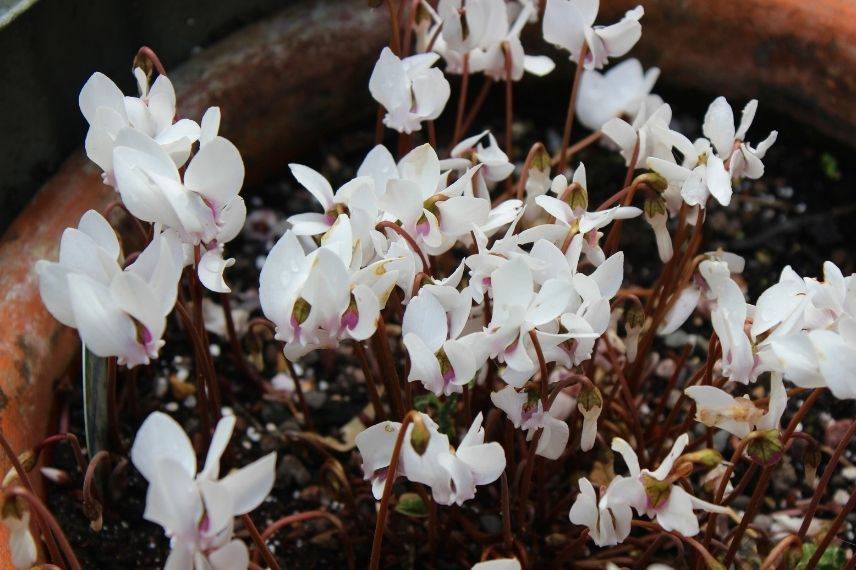
Cyclamen hederifolium ‘Album’ growing in a terracotta pot
The growing medium
Ivy-leaved cyclamen appreciate rich, well-drained and cool soil.
Choose a mixture of:
- half garden soil,
- half potting compost for planters and pots or potting compost for perennials and borders to encourage flowering
- a handful of sand to improve drainage
- a handful of well-rotted compost (optional)
Planting
Ivy-leaved cyclamen are generally available as tubers. Plant them soon after purchase. If the tuber looks shrivelled, soak it in a bowl of water for an hour before planting, to allow it to rehydrate properly and encourage it to establish.
Similarly, if you have chosen young plants in pots, soak them for around an hour before planting. You can also choose to sow ivy-leaved cyclamen. Do not hesitate to consult our dedicated guide to ensure success.
- Place a thin layer of gravel, terracotta crocks, pouzzolana or clay pebbles around 4 cm deep in the bottom of the container, to create a drainage layer and prevent water from stagnating
- Fill the container with the mixed growing medium
- Place the tubers of ivy-leaved cyclamen with the smooth, flat side (sometimes slightly concave) facing upwards and the domed side facing downwards, spacing them around 15 cm apart
- Plant them at a depth of around 3 to 5 cm (not too deeply, so that the plant can emerge properly from the soil)
- Cover with growing medium and gently firm it down with your fingers
- Water moderately
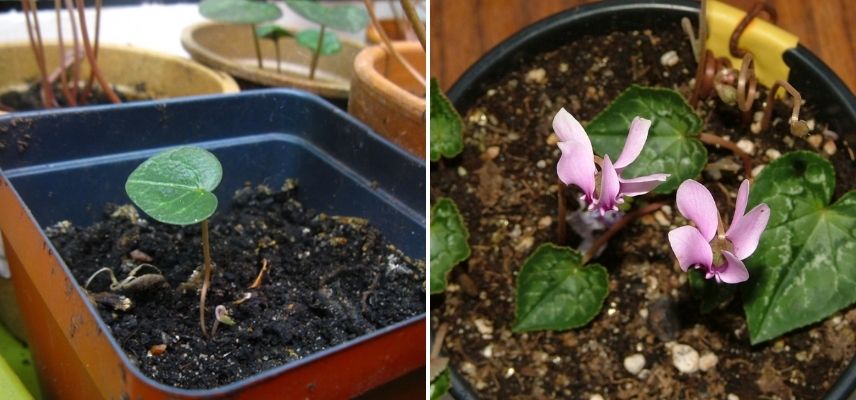
Young ivy-leaved cyclamen shoots (Flickr photo sources: Erutuon (left); Rebecca Partington (right))
Position
Potted ivy-leaved cyclamen should be placed in partial shade, preferably facing east or north. In a hot summer climate, the pot can be placed in the shade. In winter, avoid locations exposed to prevailing winds and heavy rain.
Read also
Planting bulbs: which tools to choose?Caring for Potted Ivy-leaved Cyclamen
Ivy-leaved cyclamen require little care and maintenance.
Watering
In a pot, the growing medium inevitably dries out more quickly than in the ground. However, thanks to the reserves stored in its tuber, ivy-leaved cyclamen can withstand periods of drought.
Water moderately as soon as the soil becomes dry, without wetting the foliage.
Reduce watering after flowering, except during a particularly dry winter. In this case, water sparingly, never allowing the growing medium to become waterlogged, as this may cause the tubers to rot.
Stop watering during the plant’s dormant period (after the foliage has died back).
Fertilisation
Applying fertiliser when growing ivy-leaved cyclamen in pots helps promote flowering. Apply it approximately every 15 days or follow the manufacturer’s instructions on the packaging.
Use either a liquid fertiliser (fast-acting but short-lived) or fertiliser sticks (slower-acting but longer-lasting). Choose fertilisers specially designed to promote flowering or suitable for planters and containers.
Pruning
Pruning ivy-leaved cyclamen consists of removing faded leaves, stems and flowers as they appear.
Never remove the foliage before it has completely died back, as it enables the plant to build up its nutrient reserves.
Repotting and propagation
Ivy-leaved cyclamen tubers multiply on their own over time. Unlike other bulbs, they cannot be divided. Propagation is carried out from seeds, sown in a new container.
Cyclamen do not really like being moved. Leave them in place for 3 or 4 years in their container. When the tuber becomes too large, repot it into a larger pot or plant it in the ground.
Diseases
Apart from rot caused by excess water, ivy-leaved cyclamen are robust and not very susceptible to diseases, parasites or pests.
If the foliage dries out before the normal period of dieback, this may be due to excessive sunlight. Move the pot to a cooler, shadier spot. Prematurely yellow leaves, as well as weak or dull flowering, may indicate a lack of fertiliser. Wilting leaves may result from overwatering: allow the growing medium to dry out thoroughly before resuming more moderate watering.
Overwintering
Ivy-leaved cyclamen are hardy plants, generally down to -15 °C, which adapt to all climates in France. They can therefore remain outdoors all year round.
In the event of severe, prolonged frosts, you can nevertheless protect the container if it is fragile (terracotta) by placing a thick mulch around it, wrapping it in bubble wrap or planting it directly in the ground for the duration of the cold season.
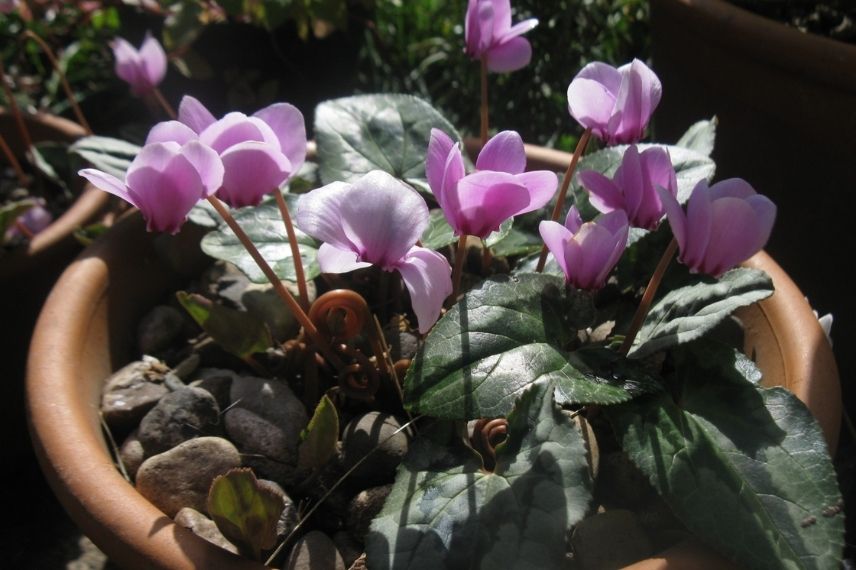
Cyclamen hederifolium rose (photo Erutuon – Flickr)
For further reading
- Subscribe!
- Contents
This form is protected by reCAPTCHA - the Google Privacy Policy and Terms of Service apply.

































Comments