Alocasia or Colocasia: how to recognise them?
How to stop confusing these two tropical plants
Contents
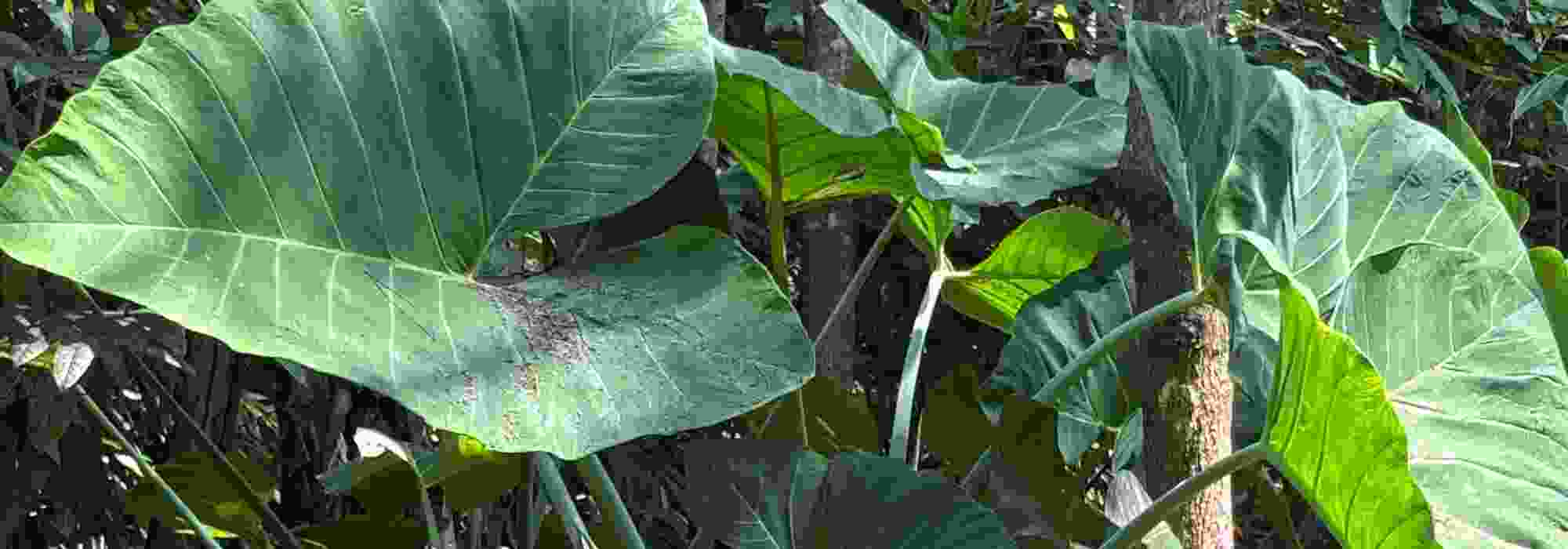
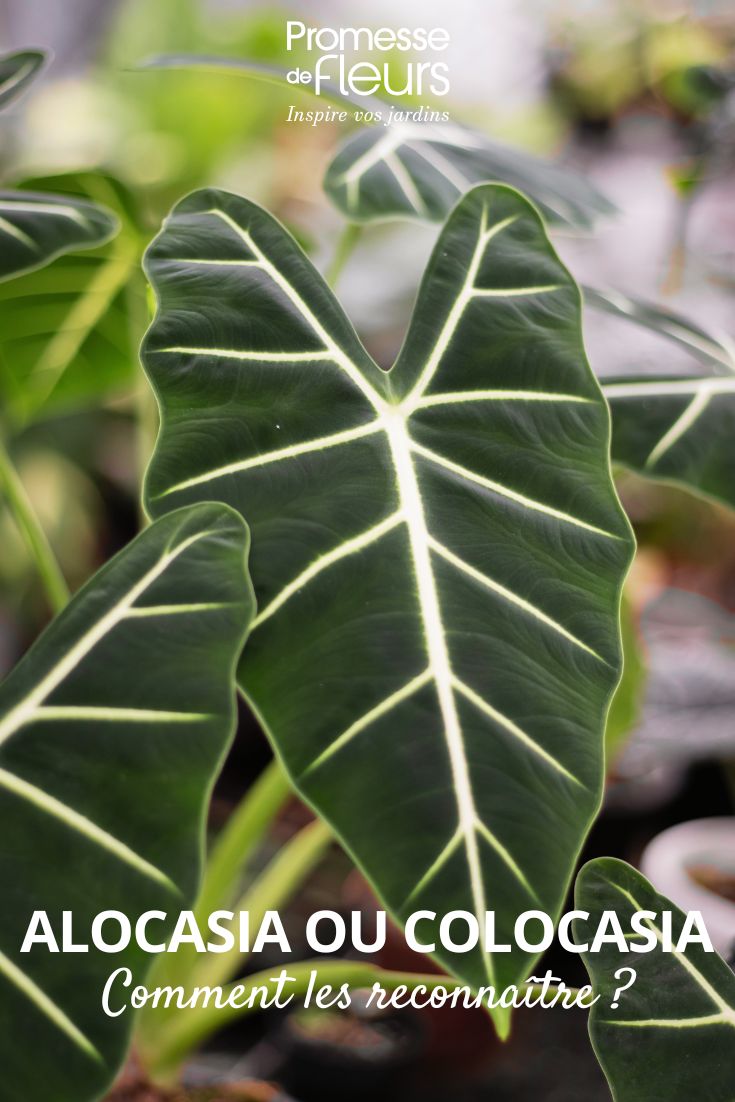
Alocasias and Colocasias are easy to spot from afar with their large elephant-ear leaves, which earned them this nickname.
They belong to the same botanical family (Araceae). However, they differ in leaf orientation, foliage texture and cultivation method. These two tropical plants have spectacular foliage often similar at first glance. Yet several criteria make it easy to tell them apart, whether in the garden or grown in pots.
I’ll explain how to recognise them correctly so you no longer confuse them.
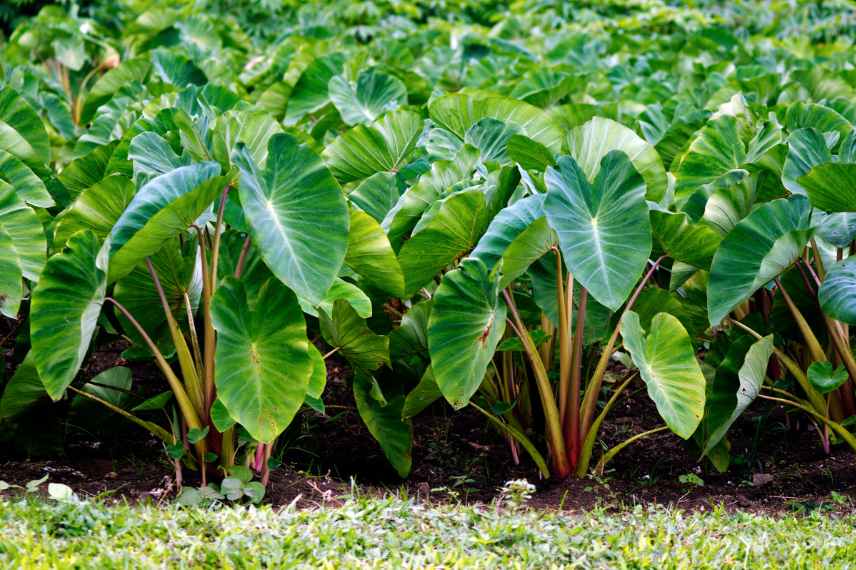
Plants with magnificent foliage; here, Colocasia in a cultivation field
Alocasia vs Colocasia: how to tell them apart?
| Criterion | Alocasias | Colocasias |
|---|---|---|
| Leaf orientation | Leaves often held upright | Broad leaves often pendulous or horizontal |
| Foliage texture | Thick, rigid leaves with very pronounced veins | Leaves more flexible, veins less visible |
| Petiole insertion | Petiole attached to leaf edge | Petiole attached more to centre of lamina |
| Plant size | Generally more compact | Can reach 1 to 2 m |
| Cultivation | Often grown in pots or as an indoor plant | Garden or wetland plant |
| Sun tolerance | Prefers shade or partial shade | Tolerates sun better |
| Use | Primarily ornamental | Some species are edible (taro) |
Read also
Leaf shapes: how to recognise them?Their similarities
Physically and botanically, it’s true: these two plants share many traits!
- Their botanical family: they are both Araceae (same family as Anthurium or Zantedeschia – the garden arum)
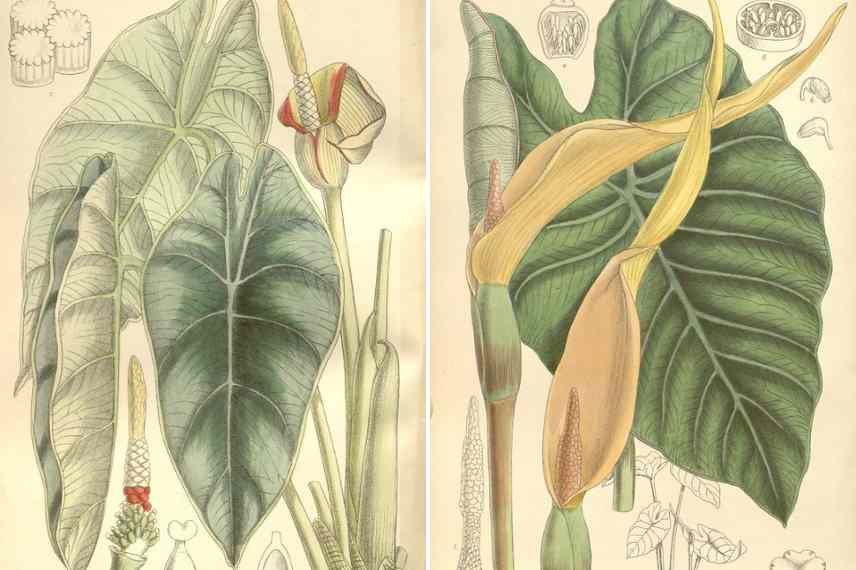
Alocasia reversa and Colocasia antiquorium: these two species show a slight family resemblance…
- Their origins: plants native to tropical regions (South Pacific, India, Malaysia…)
- Their natural habitat: tropical and subtropical zones worldwide
- Both are herbaceous perennial plants, with tuberous rootstocks, and frost-tender
- Their flowering takes the form of a spathe, typical of Araceae, with that large funnel-shaped flower (botanically a large sepal)
- Their foliage sagittate, with prominent veins
- Both prefer fresh to moist soils, shade or partial shade
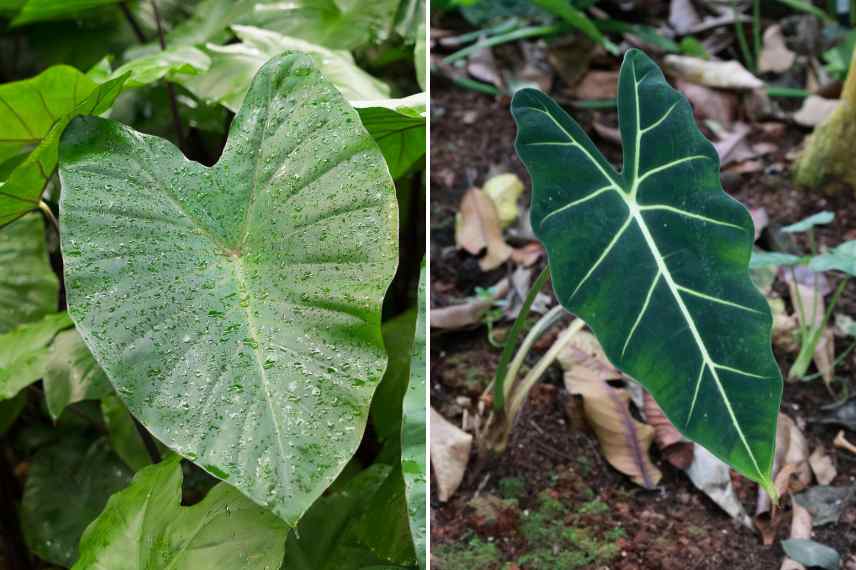
Some similarities at first glance (left Colocasia esculenta, right Alocasia)
What sets them apart
Let’s look in detail at their anatomy, as it is specific botanical nuances that really set them apart :
- Leaf shape : for both plants the leaves are described as sagittate (arrow-shaped), but Colocasia leaves are often very large, pendulous or held horizontally, shield-like and pointing downwards, whereas Alocasia leaves are smaller and, in large species, point upwards. This is one of the distinguishing features.
- Petiole insertion : a useful difference to avoid mistakes, because in Alocasia the petiole is sheathing at the base of the leaf, whereas the sagittate leaf is also peltate in Colocasia, with the petiole inserted more centrally into the lamina.
- Foliage texture : Alocasia has stiffer, thicker, coriaceous foliage, sometimes puckered or streaked, with prominent veins, while Colocasia has more supple foliage with much less marked nervature. Glossy leaves are more frequent in Alocasia but are also found in Colocasia.
- Size and growing environment : Colocasia reaches 1 to 2 metres tall (more so in humid tropical zones), some varieties being aquatic or semi-aquatic. Alocasia generally stays more compact, except for some species grown in tropical areas such as Alocasia macrorrhiza, a giant. Most are terrestrial and form a trunk in their natural range. Alocasia is often offered here in dwarf forms for indoor cultivation.
- Flowering is more common in Alocasia, cream-coloured, rare or even absent in Colocasia.
- Cultivation, although similar with partial shade exposure and moist soil, still differs in that Alocasia can be grown in pots. It is therefore often marketed here as an indoor ornamental for its graphic qualities (and because it is less cold-hardy). Alocasias are thus mainly ornamental rather than utilitarian, unlike Colocasia in many countries. Note that Colocasia tolerates much more sun than its cousin Alocasia.
- Another major difference: one is edible (the large tubercle of Colocasia esculenta), the other is not, except for a single Alocasia species (see below where this culinary aspect is presented). This tubercle is particularly prized in Polynesian cuisines.
- Finally, vernacular names leave little doubt when wandering markets at the edges of the globe! Although it is common to call both “elephant’s ear”, local names tell you whether you are looking at a Colocasia or an Alocasia.
Colocasia is most often called taro, with different names across South Pacific islands: mei in the Marquesas or kalo in Hawaii. In Southeast Asia it has other common names: in Bali and Indonesia, for example, it is called talas.
Alocasia is sometimes also called taro, but it is in fact Alocasia that should be called elephant’s ear, which does not make things any easier!
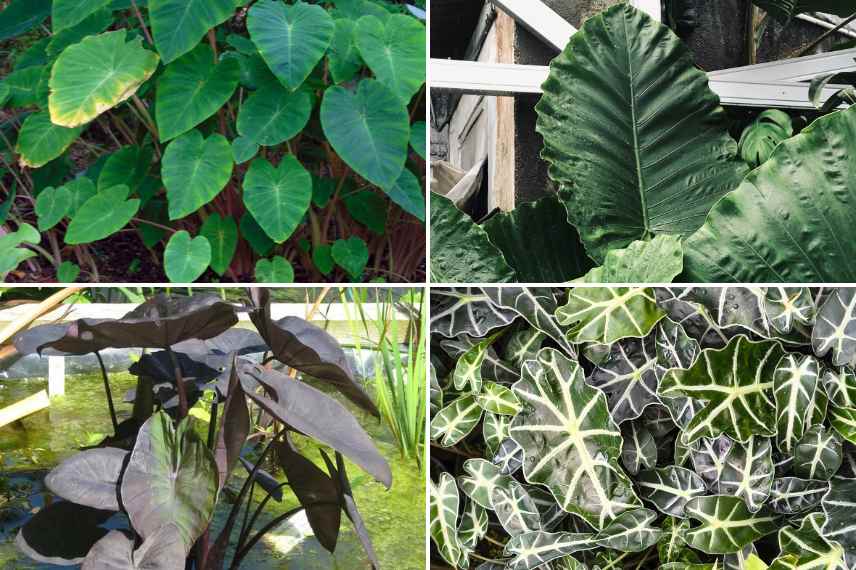
Top left Colocasia ‘Madeira’ and bottom the cultivar ‘Kona Coffee’. Top right, Alocasia macrorrhiza and bottom Alocasia amazonica
Read also
5 large-leaved perennialsWhich plant is edible taro?
In southern hemisphere countries, notably in what is called the Polynesian Triangle, taro is eaten almost daily in villages. It is regarded as a local potato; it is a starchy staple, on a par with uru, the fruit of the breadfruit tree also highly symbolic, or with cassava, which is widely consumed.
Taro is actually the corm of Colocasia esculenta (or sometimes of Colocasia gigentea) which is harvested year-round, then cooked by long boiling and eaten as fried slices, mashed, gratin, po’e and other fritters. Rich in starch, taro is delicious, but beware: raw it is toxic and must be thoroughly cooked. Tubercles of Alocasia macrorrhiza can also be found, likewise toxic raw, but far less commonly used as a food resource.
In Tahiti and its islands and throughout Polynesia’s archipelagos, fafa can also be seen on market stalls — simply the young shoots of taro, the local spinach. As they say there, “everything from taro is good!” It is especially widely cultivated in the Austral Islands, where vast taro plantations are found.
Taro is among the world’s sacred plants. Find out more in this article: Sacred plants and trees around the world.
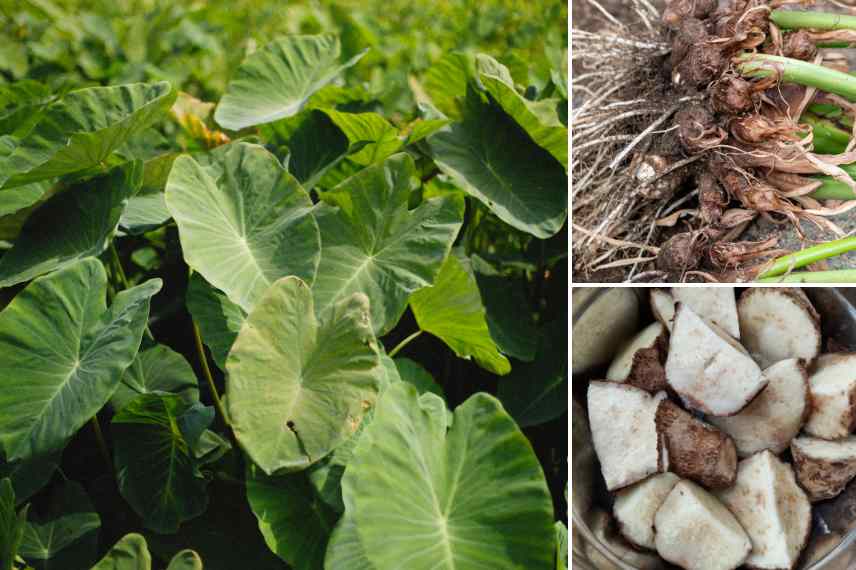
Colocasia esculenta and its tubercles
Other "elephant ears
It would all be simple if we stopped there… But the world of botany is full of surprises. So, be careful not to confuse Alocasia and Colocasia with other plants also called elephant ears, or with plants that look almost identical!
This is the case with Caladium, often with very colourful, variegated leaves (but with a toxic tubercle), and especially Xanthosoma (one species is also called taro, but luckily it is edible). This is normal since these plants — houseplants for us — are also part of the Araceae family.
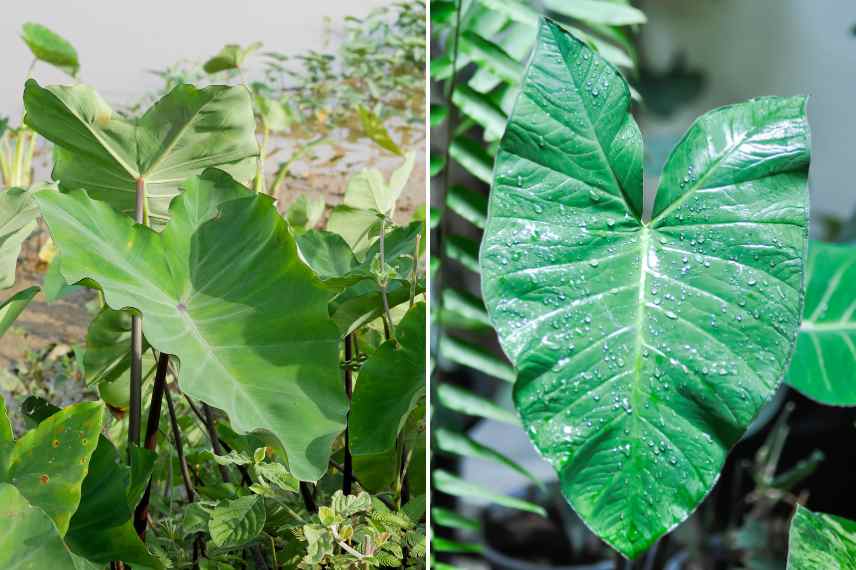
Xanthosoma violaceum on left, and Xanthosoma sagittifolium (edible) on right
- Subscribe!
- Contents
This form is protected by reCAPTCHA - the Google Privacy Policy and Terms of Service apply.
































Comments