Tips to propagate your indoor plants easily!
Get off to a good start without making mistakes
Contents
Propagation by cuttings of indoor plants is a simple technique accessible to all, even to beginner gardeners. It allows you to easily multiply your plants without spending money, to share cuttings with your loved ones and to extend the life of a slightly tired plant. With a few basic steps, it’s possible to successfully obtain new green or flowering plants in no time. A glass of water, a pair of scissors, and you’re ready to create a new plant… What are you waiting for!
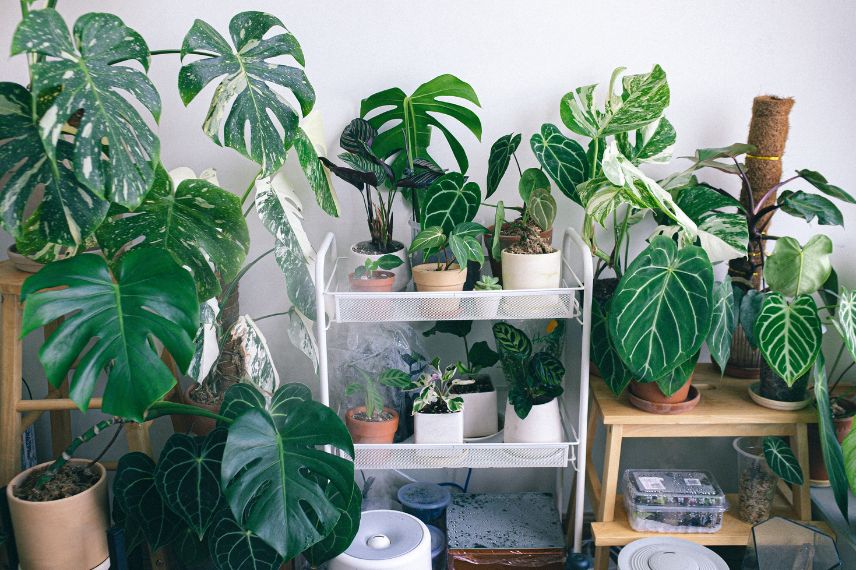
Few indoor plants cannot be propagated by cuttings. Give it a try! You’re bound to succeed.
Summary table
| Key point | Key takeaway |
|---|---|
| Aim | Propagate houseplants by cuttings in 5 simple steps to multiply plants easily at no cost. |
| Best time | Spring–summer (long days, mild warmth). Indoors possible year‑round, faster success during active growth. |
| Methods | In water (roots visible) or in a light substrate (potting mix + perlite/sand) depending on species. |
| Easy plants | Pothos, Monstera, Philodendron, Tradescantia, Coleus, Chlorophytum, Sansevieria… |
| Delicate plants | Orchids, indoor palms, bulbous plants (e.g. Clivia, Hippeastrum): favour division, sowing or layering. |
| Equipment | Disinfected pruning shear, small pots with drainage holes, clear glass, well‑draining substrate |
| Key steps | 1) Take a cutting from a healthy plant 2) Cut below a node 3) Remove lower leaves 4) Place in water or substrate 5) Gentle light + humidity. |
| Ideal conditions | Bright indirect light, 20–24 °C, air slightly humid; protect from drafts. |
| Care | Change water weekly or keep substrate just moist; ventilate to avoid mould. |
| Timeframe | Roots in 7–30 days depending on species; some (e.g. Sansevieria) take longer. |
| Repotting | When roots are 3–5 cm long or when the cutting offers slight resistance; transfer to an individual pot. |
| Signs of failure | Yellowing, blackening, soft stem, smell of rot → take a fresh healthy cutting. |
| Pro tips | Group several cuttings for a fuller pot, keep at least 1 node submerged, use a mini greenhouse, non‑calcareous water at room temperature. |
| Hygiene & safety | Disinfect blades after each cut; some plants exude an irritating latex → wear gloves. |
Understanding propagation by cuttings for houseplants
Propagation by cuttings involves taking part of a parent plant to replant it and obtain an identical new plant.
Depending on species, several techniques are used: stem cutting (for example on Pothos or Monstera), leaf cutting (Sansevieria, Begonia rex) or offshoot cutting (Chlorophytum). Some houseplants, rich in reserves and fast-growing, develop new roots more easily, making them ideal for beginners.
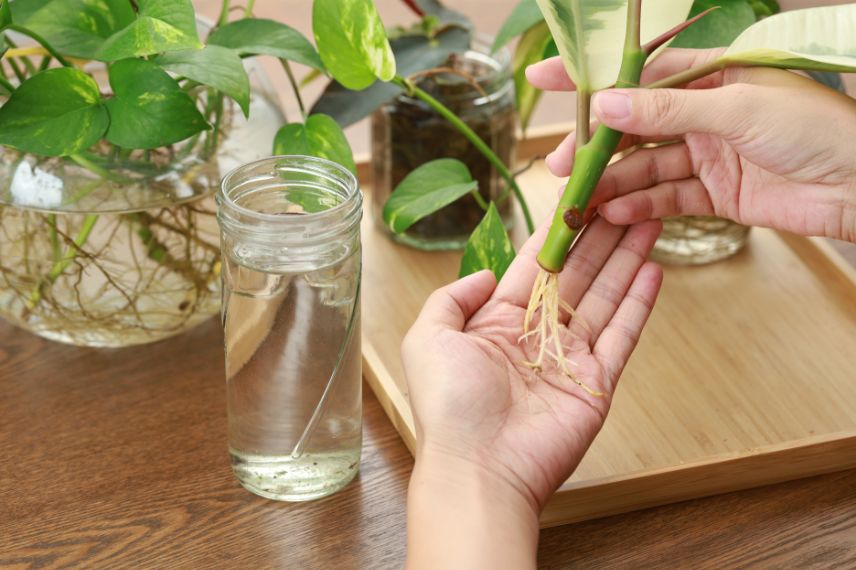
The advantage of propagation by cuttings in water is that you can see roots develop before potting up.
When to propagate indoor plants?
Best time to propagate is spring and summer, when plants are in active growth. Longer days and mild warmth encourage rooting.
Indoors, propagation is possible almost all year round, but results are quicker during periods of active growth. Succulents and tropical plants can also be propagated after maintenance pruning.
Easiest houseplants to propagate
Some species are particularly well suited to propagation by cuttings and guarantee great success for beginners. Among them, Pothos and Philodendron which produce aerial roots, Tradescantia and Coleus which take root in water within a few days, Monstera deliciosa which quickly develops substantial roots, Chlorophytum with its offshoots ready to use, or Sansevieria which multiplies from leaf fragments.
By contrast, orchids, some indoor palms or bulbous plants (Clivia, Hippeastrum) are much more difficult, even impossible, to multiply by this method. In those cases, better to use division, sowing or layering depending on species.

Some cuttings of houseplants are very easy to root in water: Coleus, Pothos, Chlorophytu…
Essential equipment for propagating green plants
You don’t need much equipment to succeed, but it must be good quality.
- A pruning shear cleaned and disinfected with alcohol prevents the spread of disease.
- Small pots with drainage holes or clear cups allow monitoring of rooting.
- A light substrate, made of potting compost mixed with sand, perlite or vermiculite, encourages rooting.
- Finally, a rooting hormone, or natural solutions such as a willow infusion or a little honey, can stimulate root formation.
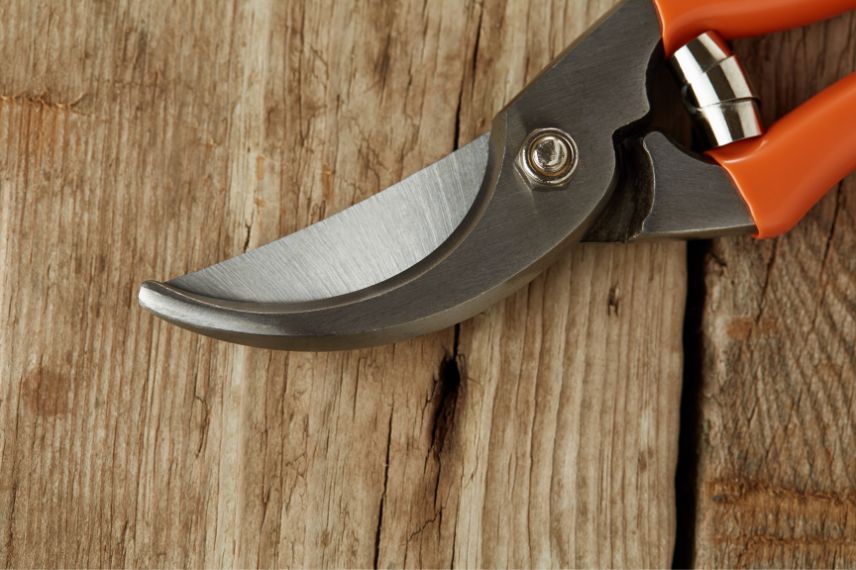
Whatever cutting you take, your cutting tool must always be kept sharp and disinfected to prevent any risk of infection.
Easy steps to propagate an indoor plant
- Prepare the stock plant: choose a healthy, vigorous specimen free from pests. Take a stem or a leaf with a sharp tool.
- Take the right section : a cutting has a better chance of success if taken from a non-flowering stem, young but not too soft, with at least one visible node.
- Prepare the cutting: remove lower leaves to prevent rotting and re-cut the stem just below a node.
- Choose the method of propagation by cuttings: in water, ideal for Pothos or Philodendrons, as roots appear quickly and are visible. In substrate, preferable for plants that develop more fragile roots.
- Place the cutting: put the stem section in a glass of clean water, or plant it directly in a small pot filled with moist substrate.
- Create good conditions: keep your cuttings in light, out of direct sun, in a warm, humid atmosphere. A propagator or a simple clear plastic bag can help maintain humidity. Ventilate regularly to avoid mould.
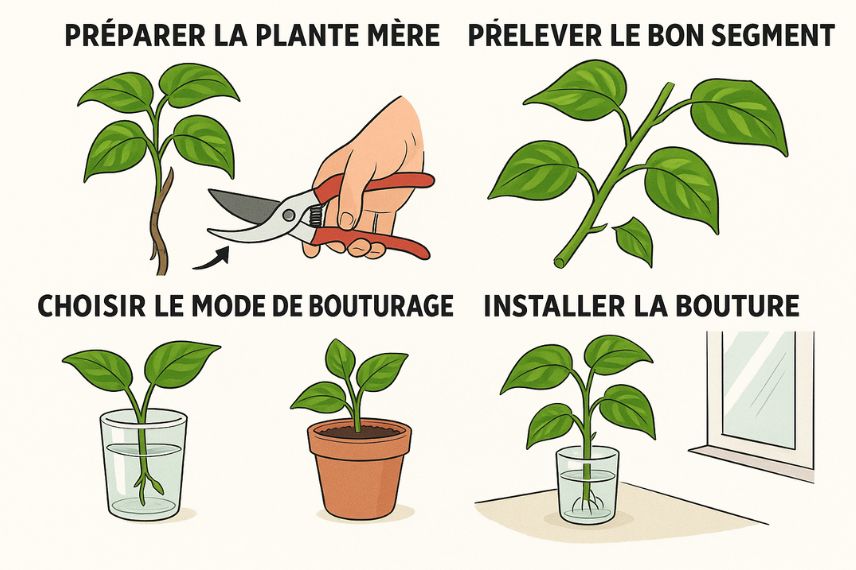
Propagation by cuttings is a simple technique to multiply your plants (AI-generated illustrations)
Choosing a method for propagation by cuttings
Propagation by cuttings in water or in substrate?
• In water: handy and quick, ideal for beginners (Pothos, Monstera, Tradescantia). Roots are visible but fragile: pot on early.
• In substrate: slower to establish at first, but roots are stronger and already adapted to potting compost. Better for Ficus, Peperomia or Begonia.
Tip: start in water to learn, then try substrate for long-lasting cuttings.
Special cases of propagation by cuttings for houseplants
Some houseplants require a little more attention or a specific method to succeed in propagation by cuttings.
Succulents and cacti should not be planted straight after cutting. It is important to let the cutting dry for a few days so the cut can form a callus. This avoids risk of rot when in contact with damp soil.
Plants with aerial roots, such as Monstera or Philodendron, are very easy to propagate. Simply take a stem with a node that already bears a small visible root: it will take root very quickly.
Species with large fleshy leaves, such as Sansevieria or the Begonia Rex, can be propagated from a simple leaf fragment. Rooting is slower, but you will then obtain a new, fully formed plant.
Saintpaulia (African violet) is also well suited to propagation from leaf cuttings, which produces young plants after a few weeks in a light growing medium.
Finally, some plants naturally produce offshoots or stolons, such as Chlorophytum or certain ferns. In that case, it isn’t even necessary to propagate: simply separate and replant the young shoots already formed.
Aftercare following propagation by cuttings
Depending on species, first roots appear within a few days to a few weeks.
Check cuttings regularly: if leaves yellow or stem rots, start again.
As soon as roots reach a few centimetres, pot the cutting into an individual pot with light potting compost, then water moderately.
Tips to maximise your chances
- Bright, indirect light remains key to success.
- Change water for cuttings every week to prevent stagnation and monitor root formation.
- Grouping several cuttings in the same pot produces a denser plant from the start.
- Take multiple cuttings as insurance: taking several cuttings from the same plant increases chances of success and helps ensure a well-filled pot.
Common mistakes to avoid
Beginners often make the same mistakes :
- taking cuttings from a weakened plant,
- leaving the cutting in water for too long before potting on,
- placing the glass in direct sunlight
- overwatering the substrate.
⚠ Safety and hygiene during propagation by cuttings
Some houseplants, such as Dieffenbachia or Euphorbia, produce irritating latex for skin and mucous membranes.
Always wear gloves when cutting, use clean, disinfected tools, and wash your hands after handling.
This protects both gardener and plant.
Frequently asked questions
-
How long should you leave a cutting in water?
On average, it takes 2 to 4 weeks for first roots to appear. Once they reach about 3 to 5 cm, it's best to pot up the cutting so roots quickly acclimatise to the substrate. -
Can you propagate indoor plants in winter?
However, cuttings will often take longer to root due to lack of light and cooler ambient temperatures. To increase your chances in winter, place cuttings near a bright, well-exposed window or use a grow light. -
Why is my cutting turning yellow?
Yellowing can indicate excess stagnant water, lack of light, or that the cutting was taken from a weakened plant. It is recommended to start again with a new healthy stem and to change the water regularly. -
Should you add fertiliser when propagating?
No. Cuttings do not yet have a sufficient root system to absorb fertilisers. Clear water (changed weekly) or a light, moist substrate are sufficient. Adding fertiliser is only useful after repotting, once the plant is well rooted. -
Bonne question — plusieurs plantes d’intérieur ne se bouturent pas facilement, soit parce qu’elles ne produisent pas d’adventices racinaires sur des segments de tige, soit parce qu’elles demandent des techniques spécifiques (spores, division, greffage ou culture en laboratoire). Voici les cas les plus courants, avec pourquoi et quelles alternatives utiliser. Plantes peu ou pas adaptées au bouturage - Palmiers (ex. Howea, Kentia, Chamaedorea) : tige sans capacité à former des racines adventives. Propagation par semis ou, rarement, par division de rejets adultes. - Cycas et autres « palmiers fossiles » (ex. Cycas revoluta) : souvent impossibles à bouturer ; propagation par graines ou par division de bulbilles si présentes. - Orchidées épiphytes courantes (ex. Phalaenopsis, Cattleya, Vanda) : pas de réussite fiable par boutures de tige. On utilise la division des touffes (pour espèces qui forment des pseudo-bulbes) ou on favorise la formation de keikis ; sinon culture in vitro (flaskage) pour multiplication en masse. - Fougères et mousses (plantes inférieures) : se reproduisent principalement par spores ou par division de rhizomes, pas par boutures classiques. - Palissandres/arbres avec bois dur et point de croissance unique (certains arbres d’intérieur ou sujets bonsaïs) : les boutures peuvent être difficiles à prendre ; greffage, semis ou air-layering peuvent être préférables. - Certaines plantes à croissance très lente ou avec tissues très ligneux (ex. certains bonsaïs, sujets d’intérieur âgés) : bouturage long et peu fiable, mieux vaut semis, greffe ou division si possible. - Zamioculcas (ZZ plant) : on peut bouturer feuilles, mais processus long et à faible taux ; division des rhizomes est plus rapide et sûre. Pourquoi les boutures échouent souvent - Absence de capacité à former des racines adventives sur tige/feuille. - Tissus très ligneux ou trop gorgés d’eau/latex empêchant cicatrisation. - Besoin de conditions très spécifiques (température, mycorhizes, stérilité). - Croissance lente — racines mettent trop de temps à apparaître et le segment se dessèche. Alternatives et solutions - Division de touffes ou séparation d’offsets/pousses : idéal pour agapanthes, broméliacées, certaines succulentes, etc. - Semis : souvent la méthode la plus fiable (palmiers, cycas, beaucoup d’arbres d’intérieur). - Keiki pour orchidées ou stimulation hormonale pour obtenir rejets. - Air-layering (marcottage) : très utile pour sujets ligneux qui refusent les boutures. - Greffage : pour variétés horticoles spécifiques (citrus, ficus en bonsaï, etc.). - Culture in vitro (flaskage) : pour multiplication de masse d’espèces difficiles ou protégées. - Améliorer conditions de bouturage : hormones d’enracinement, substrat propre et drainant, chaleur de fond et haute humidité (châssis, sac plastique, mini-serre). Conclusion courte Si une espèce refuse les boutures, cherchez la méthode adaptée à son type de croissance (semis, division, marcottage, keiki/greffage ou culture in vitro). Si vous me dites quelles plantes d’intérieur vous voulez multiplier, je peux indiquer la meilleure méthode et donner une procédure détaillée.
Orchids, indoor palms and certain bulbous plants (such as Clivia) are difficult to multiply using propagation by cuttings. In such cases, favour division or sowing.
- Subscribe!
- Contents
This form is protected by reCAPTCHA - the Google Privacy Policy and Terms of Service apply.


































Comments