Schisandra: planting, berry harvest, care
Contents
Schisandra in a nutshell
- Schisandra is a deciduous Asian liana, very hardy
- It offers a handsome flowering, white or red, in late spring to early summer, then in autumn edible berries, described as “five-flavoured”, with medicinal properties
- It thrives in partial shade, sheltered from scorching sun, for example on the edge of woodland.
- It requires soil that remains moist, as it is sensitive to drought
- You can train it to climb trees! You can also guide it over a pergola or a trellis…
A word from our expert
Schisandra is a climbing plant of Asian origin, which produces beautiful red or white flowers in late spring. They are followed by edible berries, sometimes nicknamed “five-flavour berries”, which have many medicinal properties and are used in traditional Chinese medicine. They are also very decorative, forming clusters of rounded fruits in a lovely bright red! Several species are found in cultivation: notably the Schisandra chinensis, the species most used for its berries, the Schisandra grandiflora, which offers elegant white flowers, and the Schisandra rubriflora, with red flowers. They are vigorous lianas that you can train up trees, or guide over a pergola, a trellis… Schisandra remains too little grown in gardens. It is not very well known.
Schisandra prefers partial shade and should be sheltered from the sun during the hottest hours. Although it likes good light and tolerates dappled sun, it needs its base in shade. It prefers soil that stays cool and does not dry out. It is quite hardy, tolerating between -15 and -25 °C, depending on variety, which allows it to be grown even in fairly cold regions. It requires very little maintenance. It is robust and vigorous, and can reach up to 10 metres in height.

Botany
Botanical data
- Latin name Schisandra sp.
- Family Schisandraceae
- Common name Schisandra, Schizandra, five-flavour berry
- Flowering depending on variety, between May and July
- Height up to 10 metres
- Exposure partial shade
- Soil type fertile, rich in humus, moist
- Hardiness between −15 and −20 °C
Schisandra are deciduous or evergreen climbing plants native to East Asia. About 25 species are known, found in China, Burma, India and Mongolia. They sometimes grow in mountain areas, up to over 2,000 metres altitude, which probably explains their excellent hardiness. The centre of diversity is in China, where the berries of this vine have long been used for their medicinal properties. There is also one species native to the United States, Schisandra coccinea. In the wild, Schisandra grows in understoreys, on moist soils, sometimes at the edges of streams. Its twining stems allow it to climb trees and shrubs nearby.
Schisandra berry (notably S. chinensis) is also called “five-flavour berry”. It is sometimes spelled Schizandra. In English it is known as Magnolia Vine.
Schisandra belongs to the family Schisandraceae (formerly Illiciaceae). This small family includes only 73 species distributed across three genera: Illicium, Kadsura and Schisandra. Star anise (Illicium verum), a spice and medicinal plant, also belongs to this family. So does Kadsura japonica, an Asian climbing plant that could be mistaken for Schisandra and which also produces white flowers and red berries.
Schisandra is a twining plant. It grows and wraps its stems around supports by itself, enabling it to gain height. In good growing conditions it can reach up to 10 metres, but it grows fairly slowly. Young shoots are green and tender, later lignifying to form wood. They then take on a pleasing reddish hue. Similarly, the petioles and veins on the underside of the leaves are often pinkish-red.
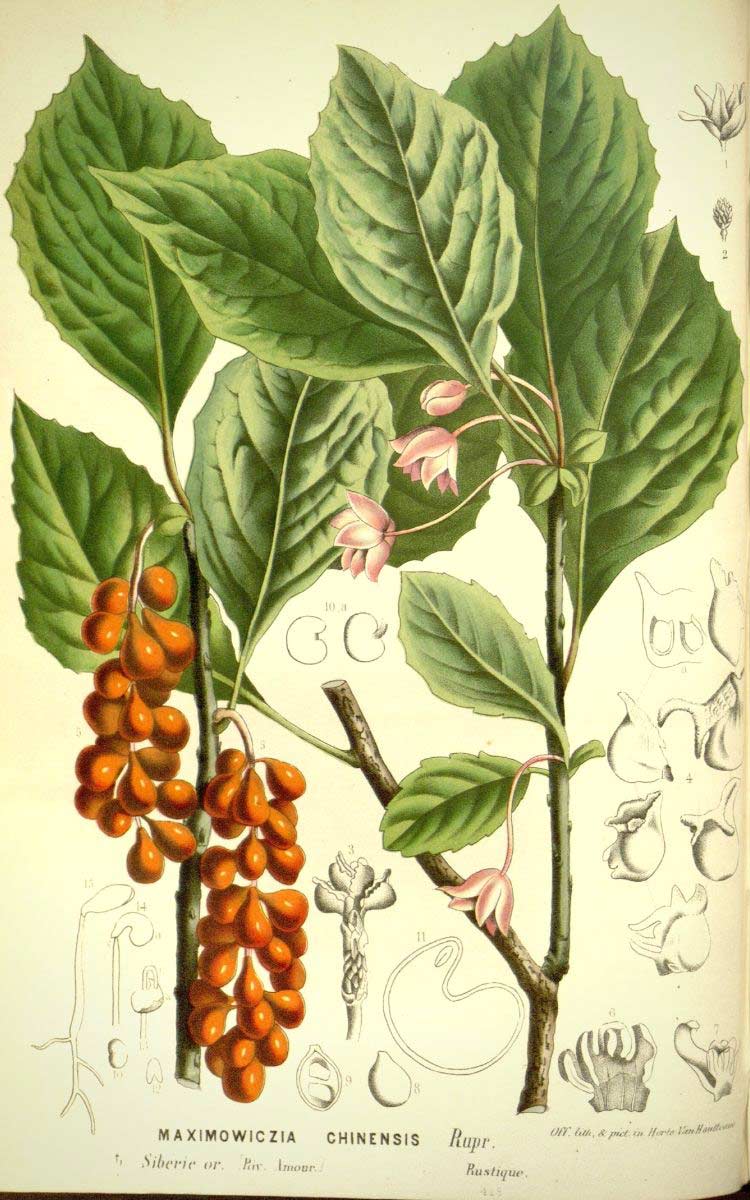
Schisandra chinensis: Botanical illustration
Leaves of Schisandra are simple, entire, generally oval in shape, with the lamina margin sometimes toothed. They are fairly ordinary, measuring between 5 and 15 cm in length. They are arranged alternately along the stems, one after another.
Leaves of cultivated species are deciduous, falling in autumn with the cold and unfolding again in spring when temperatures rise.
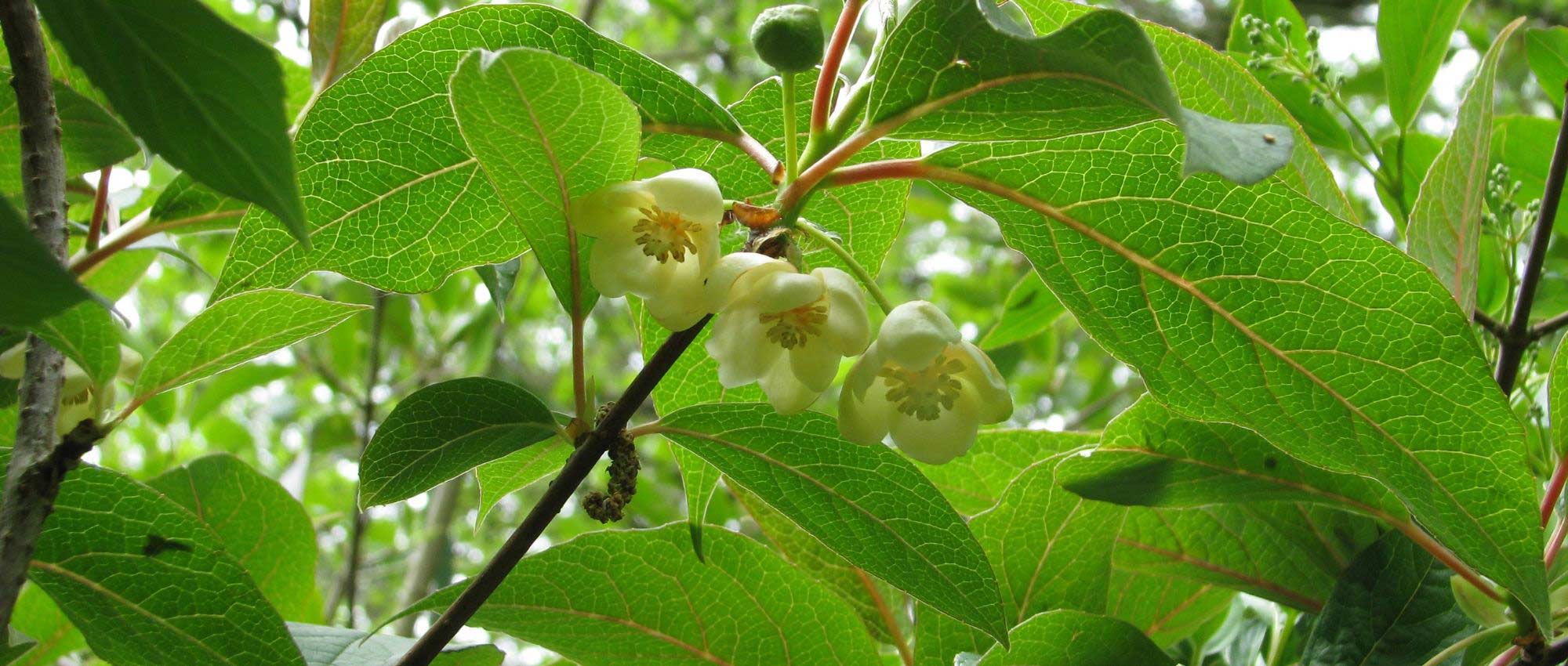
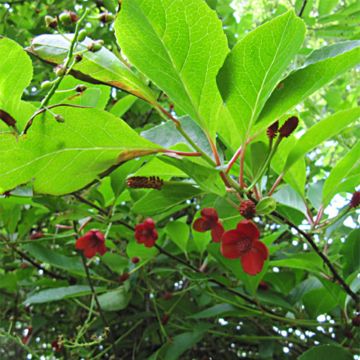
Flowering occurs in spring or early summer, between May and July depending on variety. Flowers can be a vivid red, as in Schisandra rubriflora, white, or even yellow (S. henryi). Schisandra grandiflora is notable for its elegant, highly fragrant white flowers. Flowers of Schisandra chinensis are also white but smaller and less conspicuous than those of other species, with thinner petals.
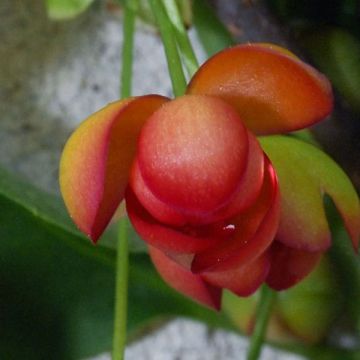
Flowers are borne on a long peduncle and are pendulous, facing the ground. They may be solitary or grouped in clusters. They are axillary, inserted in leaf axils. Flower buds are very rounded and gently open to reveal stamens or the pistil. Petals are convex, concave in shape. Flowers are delicate and soft, cup-shaped, up to 2–3 cm in diameter. Each flower bears between 5 and 12 tepals (undifferentiated sepals or petals) arranged in two whorls.
Flowers, particularly those of Schisandra grandiflora, are pleasantly fragrant.
Flowers are unisexual: either male or female. Male flowers bear stamens and release pollen that fertilises female flowers by landing on the pistil, enabling fruit development.
Schisandra is dioecious: there are male and female plants. Only female plants therefore produce fruit. To obtain fruit, we recommend planting both male and female plants to allow pollination.
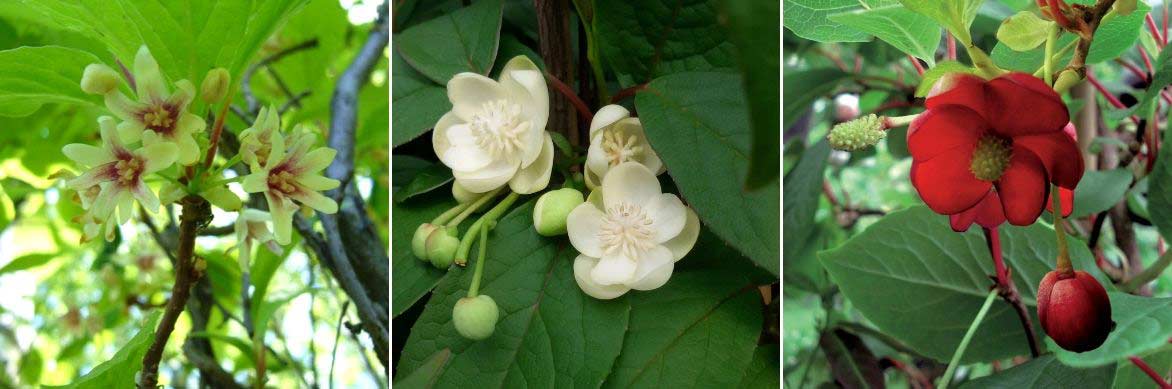
Flowering of Schisandra chinensis, Schisandra grandiflora and Schisandra rubriflora
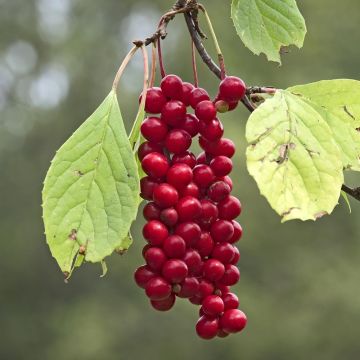
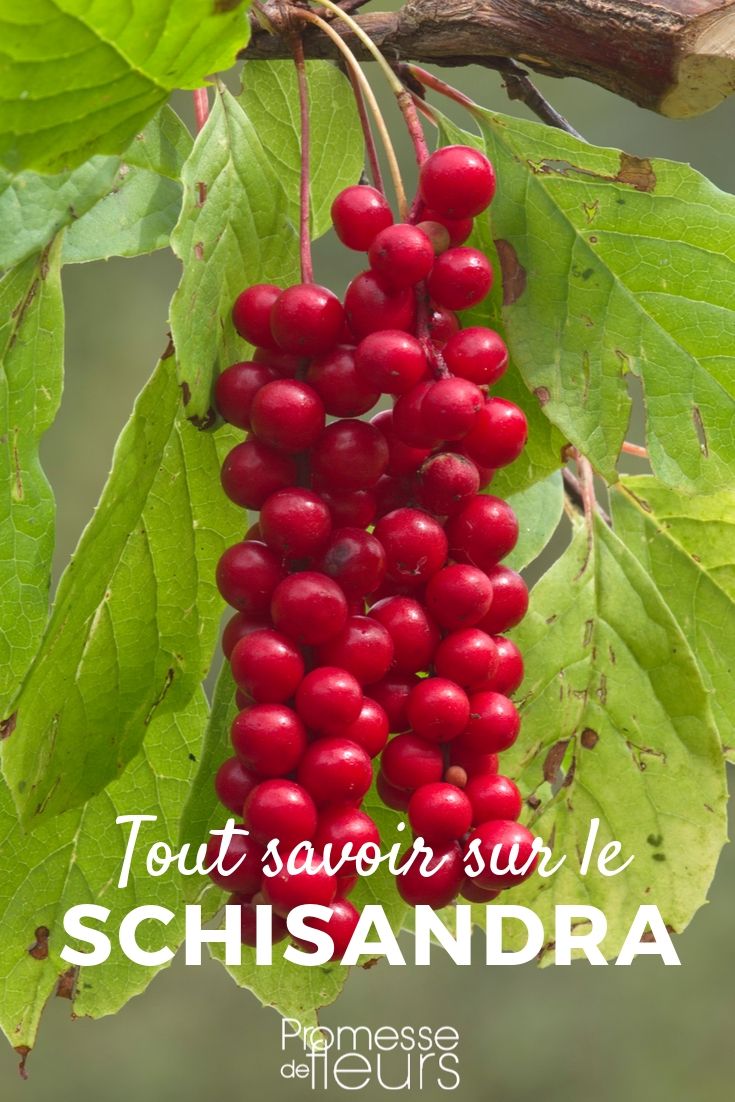
In late summer or early autumn Schisandra produces fleshy, rounded, bright red berries, usually five or six millimetres in diameter. They are gathered in clusters and are highly decorative. Clusters measure between 3 and 20 cm in length. Each fruit contains between one and three seeds.
Fruits are harvested in early autumn, around September–October. It is primarily the berries of Schisandra chinensis that are used. They can be eaten fresh but are usually dried. They are called “five-flavour berries” because they combine sweet, bitter, salty, sour and spicy tastes. They can be made into juices, infusions, tinctures… They can also be added to salads. Commercially, they are also sold in capsule form. They are used in Chinese medicine and are known as Wu Wei Zi.
Schisandra berries have many medicinal properties. They are adaptogenic and stimulating, helping revitalise the body, improve resistance to stress and combat fatigue. They enhance endurance and physical and mental performance. They are said to have positive effects on memory and concentration. They are also aphrodisiac and may increase libido. They have a protective effect on the liver. Nutritionally, Schisandra berry is rich in vitamins, trace elements and amino acids and also contains phytoestrogens. It should not be consumed by pregnant women.
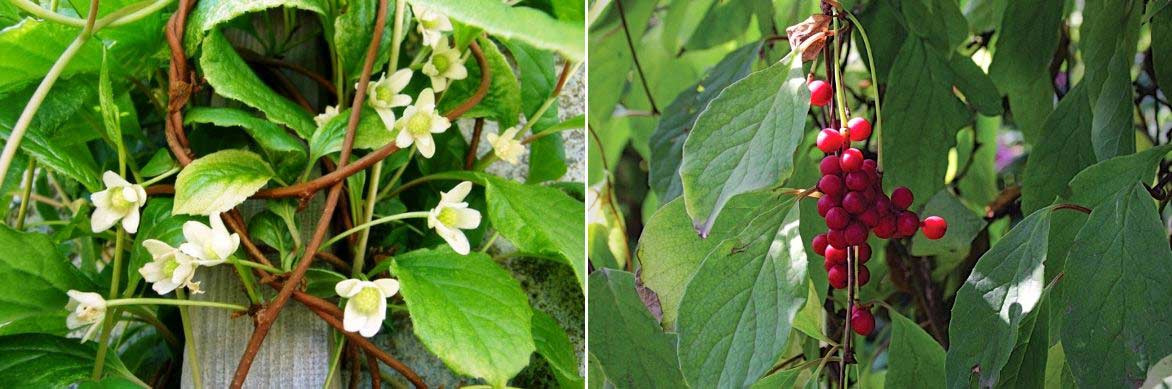
Flowers and fruits of Schisandra chinensis (photos VoDeTan2 / Vladimir Kosolapov)
Main varieties of Schisandra
Most popular varieties
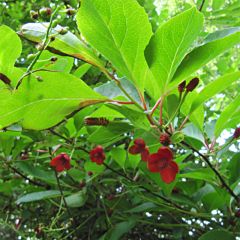
Schisandra chinensis
- Flowering time June, July
- Height at maturity 8 m
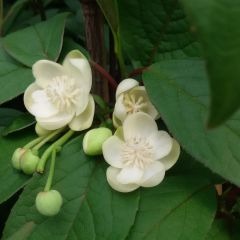
Schisandra grandiflora
- Flowering time June, July
- Height at maturity 6 m
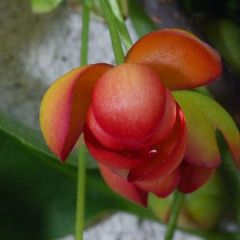
Schisandra rubriflora
- Flowering time June, July
- Height at maturity 3 m
Discover other Schisandra
View all →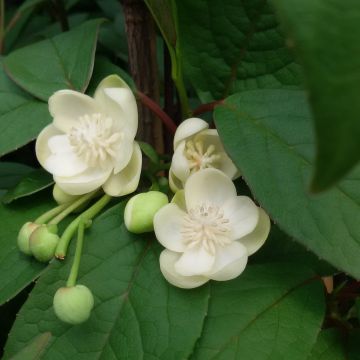
Available in 1 sizes
Available in 1 sizes
Available in 1 sizes
Available in 1 sizes
Planting Schisandra
Where to plant?
As Schisandra grows naturally in the understorey, best is to plant it in partial shade. It likes to have at least the base in shade, and if possible the rest of the foliage in sun. You can also site it so it gets morning sun but shade during the hottest hours of the afternoon. Avoid strong, scorching sun. Feel free to plant it on the woodland edge so you can easily train it to climb trees. Another good option is to grow it against a wall in a sheltered, shaded spot.
As it likes soils that remain cool, Schisandra will appreciate proximity to a pond or stream. Schisandra prefers cool, humus-rich, fertile, deep soil. It does not like dry, poor ground. Schisandra tolerates heavy, clayey soils. It favours forest-type soils as found in the understorey and also prefers slightly acidic conditions.
Schisandra is quite hardy and does not need winter protection. It can even be grown in relatively cold climates, for example in mountainous areas.
You can train Schisandra to climb a trellis, a tree, a pergola, an arch or an arbour. It is also possible to espalier Schisandra on horizontal wires. It can also climb a trellis against a wall. Give it a suitably large support. Bear in mind it can reach up to 10 m tall.
→ Discover how to plant your Schisandra in a pot and how to prune and train Schisandra in Pascale’s advice sheets
When to plant?
Plant Schisandra preferably in spring, around May, or otherwise in autumn (September–October). We recommend planting in mild, slightly overcast weather, avoiding periods of frost or very high temperatures.
How to plant?
To enjoy Schisandra fruit, we recommend planting at least one male and one female plant to allow pollination.
- Place the rootball in a tub of water to allow it to rehydrate
- Dig a planting hole two to three times the size of the rootball
- Put some soil mixed with well-rotted compost in the bottom
- Place Schisandra in the planting hole.
- Backfill soil around the rootball.
- You can install a stake or a trellis and train the stems onto it.
- Water thoroughly.
In the weeks following planting, continue to water regularly.
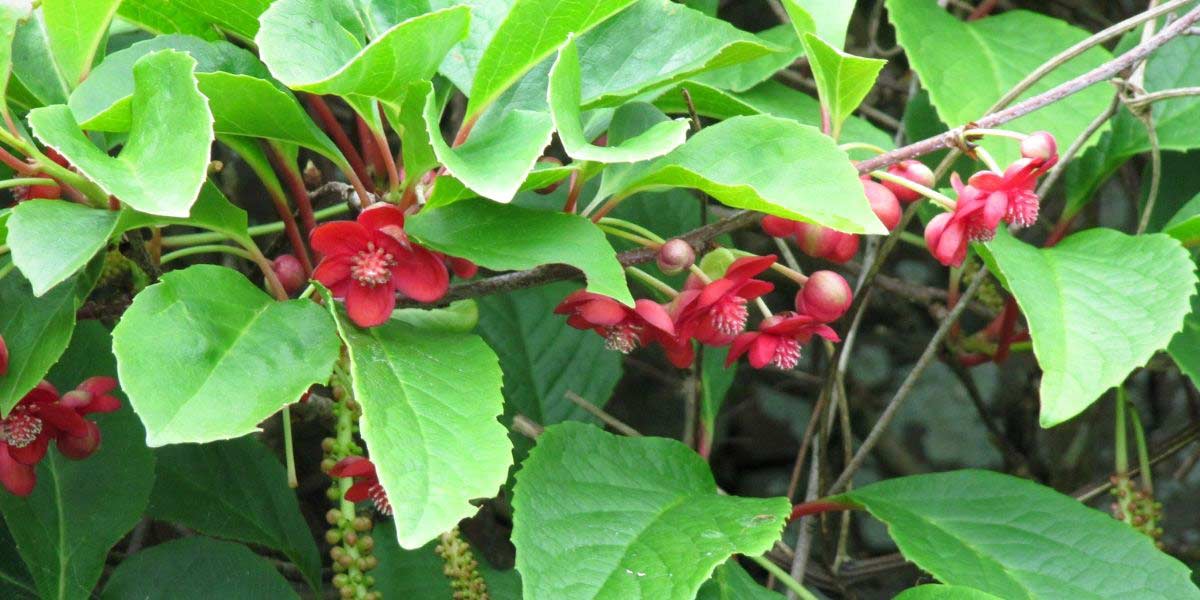
Schisandra rubriflora (photo Leonora Enking)
Care, berry harvesting
Water regularly, at least during the first year after planting, as Schisandra is sensitive to drought. Soil should remain cool, even moist. We also recommend applying a layer of organic mulch around its base.
Don’t hesitate to add well-rotted compost to enrich the soil. Indeed, Schisandra prefers fertile soils rich in organic matter. In addition, this will improve soil structure, increasing its water-retention capacity.
Apart from these precautions, Schisandra requires very little maintenance. It is not very susceptible to diseases and pests, but can nevertheless be affected by powdery mildew.
Schisandra berries are harvested around September–October. You can eat them fresh or dry them to preserve them, then brew them as an infusion. You can also harvest the berries to extract the seeds and try sowing, but this can be somewhat tricky.
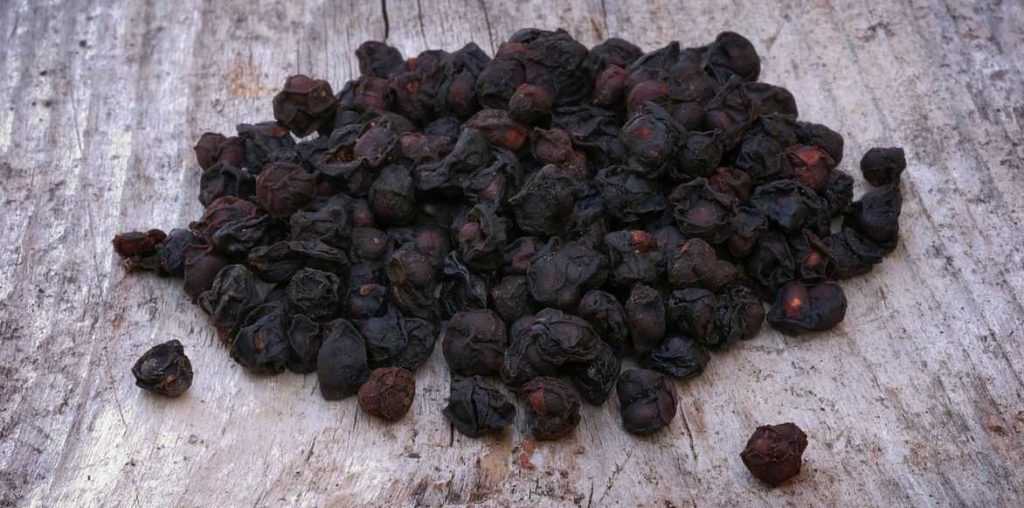
Schisandra berries
Propagation
Schisandra can be propagated by sowing or by propagation by cuttings. In any case, this climber is not easy to propagate and germination or rooting rates are quite low. Furthermore, plants obtained from sowing will take several years before producing berries. For propagation by cuttings of Schisandra, take either herbaceous cuttings in spring, around May–June, or semi-woody cuttings in late summer.
Sowing
You can sow Schisandra in spring, or in autumn using freshly harvested seeds.
Seeds are a little tricky to germinate. They require cold stratification, which you can achieve by placing them in the fridge before sowing. Because germination rate is quite low, we recommend sowing more seeds than you would for other plants.
- Prepare a pot with potting compost.
- Sow Schisandra seeds.
- Cover with a thin layer of compost, then firm down gently.
- Water with a fine spray.
- Place pot under cold frame, in bright position but out of direct sunlight.
- Continue to water regularly so compost remains moist but not waterlogged.
Association
As Schisandra favours shaded positions and rich, cool soils, it will fit perfectly in a woodland garden. You can recreate a lovely natural scene by planting beside it decorative-leaved plants such as ferns, Paris polyphylla, Brunnera macrophylla… Also enjoy the dense, groundcovering foliage of Pachysandra! For delicate flowers, choose Geranium nodosum, corydalis, astrantia, Solomon’s seal, bleeding heart… You can include grasses such as woodrush, carex, Hakonechloa macra… Also discover the superb Cornus canadensis, a dogwood groundcover that bears large, beautiful white flowers made of four bracts, and decorative foliage that turns red in autumn.
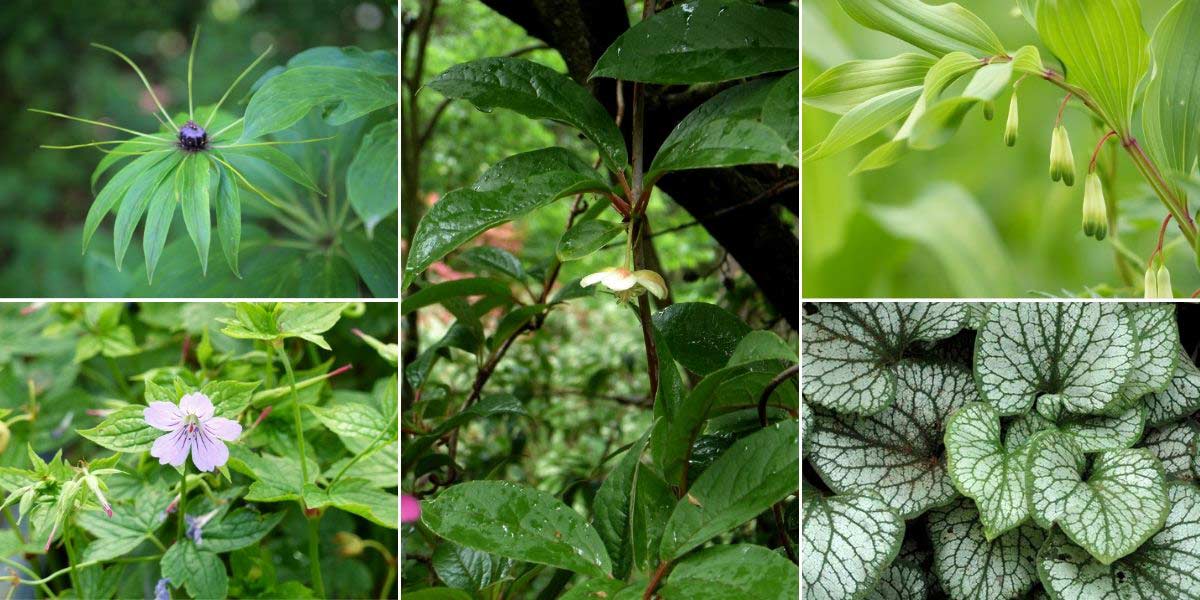
Schisandra is a climber that fits perfectly into woodland gardens! You can pair it with other plants that enjoy cool, shaded positions. Here, in order, Paris polyphylla, Geranium nodosum, Schisandra grandiflora (photo Peganum), Polygonatum odoratum, and Brunnera ‘Jack Frost’
You can also pair Schisandra with other climbers. For example, discover Akebia quinata, which offers finely divided, soft-green foliage and an unusual spring floral display. Also, its berries are edible! You can also plant clematis, which, like Schisandra, prefer roots in shade and the remainder of foliage in sun. Also discover Kadsura japonica, another Asian climber in a similar style to Schisandra.
You can pair Schisandra with trees and shrubs it can climb. Plant it at the base of a fruit tree and let it climb into the canopy. Also make use of fruit-bearing shrubs! You can pair it with persimmon, pawpaw, raspberry canes, mulberries, blue honeysuckle, Lycium barbarum (which produces goji berries!)… Pair it with plants that, like it, produce unusual, medicinal and highly nutritious berries.
Don’t hesitate to plant perennials at its feet. This will also help shade the base of Schisandra and keep soil cool – everything it needs! Make use, for example, of hardy geraniums, heucheras or hostas…
Useful resources
- Discover our range of Schisandra
- Schisandra on Plants and Botany, with extensive botanical information on different species
Frequently asked questions
-
My schisandra is not producing fruit, or is producing too few — why?
Firstly, Schisandra is a dioecious plant: only female plants can produce fruit. To produce fruit, they need pollination from male plants. Therefore, to obtain fruit, we recommend planting several plants of both sexes.
Next, perhaps conditions are not optimal for Schisandra: it needs a rich, humus-bearing, cool soil, and berries develop better with good light and a little sun. If your soil is poor and dry, or shade is too dense, Schisandra will struggle to fruit. Don’t hesitate to add organic matter and mulch around the base of the plant.
Finally, perhaps your plant is too young. When obtained from sowing, they need at least three to four years before they start producing fruit. Be patient.
- Subscribe!
- Contents
This form is protected by reCAPTCHA - the Google Privacy Policy and Terms of Service apply.

































Comments