Eucryphia: planting, growing and caring for
Contents
Eucryphia in a nutshell
- Eucryphia are trees and shrubs native to Australia and Chile, still little known in France
- They have a columnar habit and generally evergreen foliage
- In summer they produce beautiful white or pink flowers, pleasantly scented
- They are particularly suited to mild regions of the Atlantic coast, notably Brittany
- Not very hardy, they prefer mild, humid climates and fresh, non-calcareous soils
A word from our expert
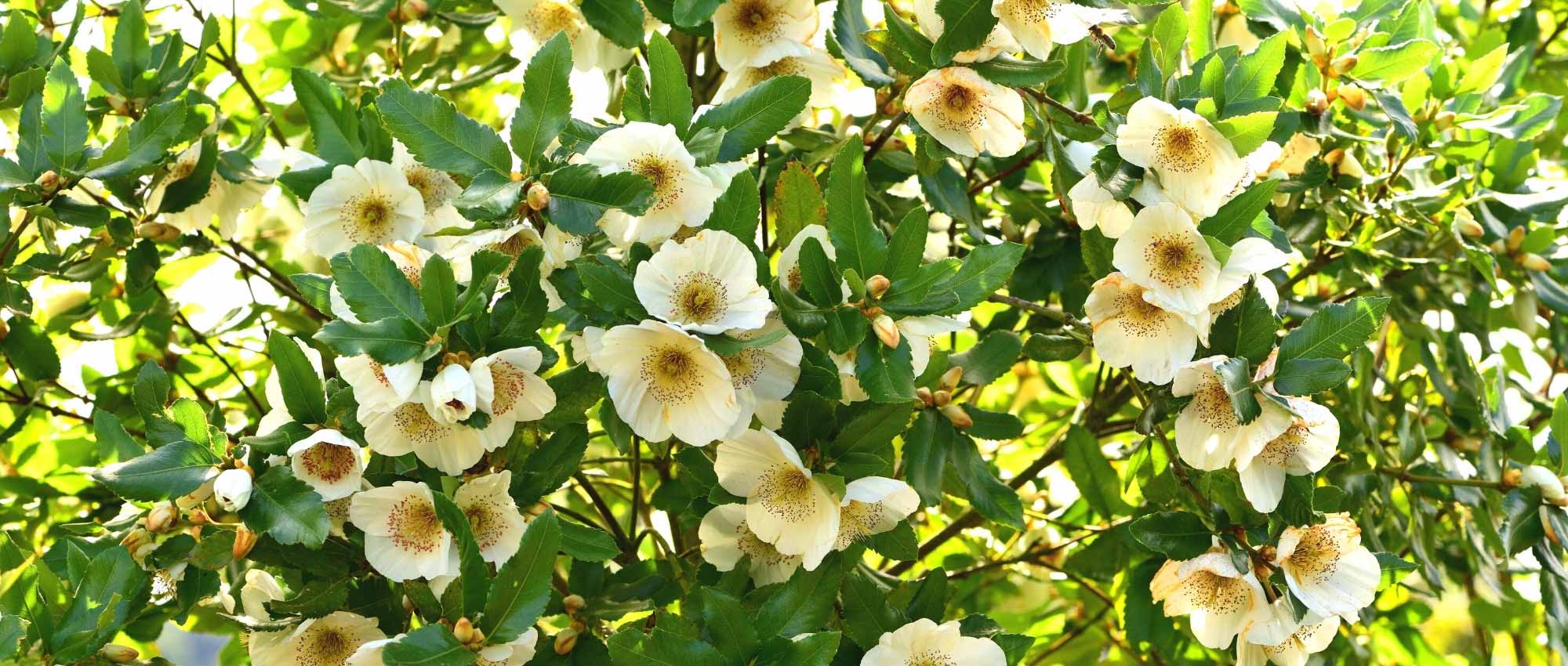
Native to Australia, Tasmania and Chile, Eucryphia are trees and shrubs still little known, but which produce a spectacular display in summer. They then produce pleasantly scented white or pink flowers, made up of four petals and a cluster of central stamens. Their simple, elegant style is somewhat reminiscent of wild rose flowering. Their foliage is fairly ordinary, generally composed of entire, dark green, glossy leaves; however some varieties stand out for distinctive foliage: Eucryphia ‘Gilt Edge’, for example, has leaves beautifully variegated with yellow, and Eucryphia moorei bears finely divided leaves.
Eucryphia are demanding shrubs, requiring specific conditions to thrive: mild, rather humid climate, non-calcareous soil… however, if these conditions are met, Eucryphia rewards gardeners with a superb floral display! Eucryphia are not very hardy (although species Eucryphia glutinosa can withstand down to −15 °C), and are particularly suited to the mild climate of the Atlantic coast, notably Brittany and Normandy. Discover all our advice for successfully growing Eucryphia in the garden!

Botany
Botanical data
- Latin name Eucryphia sp.
- Family Cunoniaceae
- Common name Eucryphia
- Flowering between July and September
- Height 3 to 10 m
- Exposure sun or partial shade
- Soil type fresh and well-drained, not calcareous
- Hardiness variable, but hardiest tolerate between −10 °C and −15 °C
Eucryphia include 11 species of trees and shrubs native to the Southern Hemisphere, notably temperate regions of Australia, Tasmania and Chile. They favour mild, humid oceanic climates and are not very hardy (Eucryphia glutinosa is the most cold-tolerant, able to withstand down to −15 °C). They grow mainly in rainforests and on acidic soils.
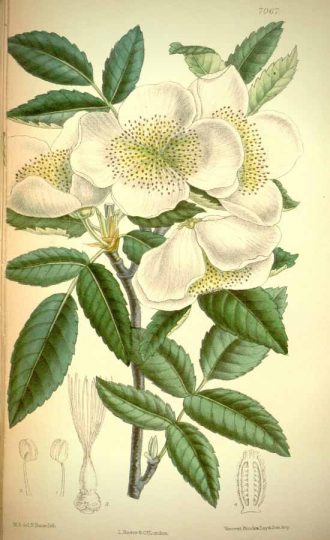
Eucryphia cordifolia: Botanical illustration
Eucryphia belong to family Cunoniaceae, a group little known in France and rarely cultivated, mainly native to the Southern Hemisphere, notably Chile and Australia. They were formerly classed in family Eucryphiaceae.
Name Eucryphia comes from Greek Eu: “well” and Kryphios: “hidden”, referring to the sepals that meet at tip of floral buds before they open. Specific epithet of Eucryphia lucida refers to shiny leaves, that of E. glutinosa to sticky aspect of young shoots, E. cordifolia denotes heart-shaped leaves, while Eucryphia moorei was named in honour of Charles Moore, a Scottish botanist of the 19th century who served as director of the Royal Botanic Garden, Sydney ( E. moorei is native to Australia).
Eucryphia reach between 3 and 10 metres in height, depending on species and growing conditions. They commonly develop a columnar habit, with a high, narrow crown.
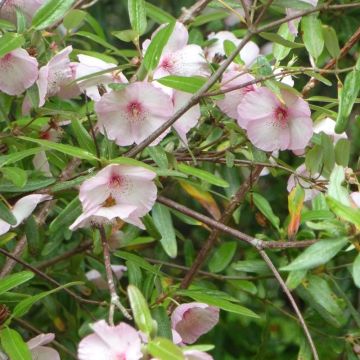
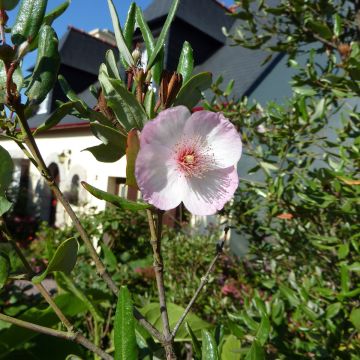
In summer, between July and September, Eucryphia produce their splendid, scented display of flowers, a reward for gardeners who take the trouble to grow them. They bear beautiful white or pale pink flowers, borne in leaf axils, solitary or in pairs. Flowers are simple, cup-shaped to somewhat flattened, with four large petals surrounding a cluster of stamens and styles. They somewhat resemble dog-rose flowers. Flower diameter ranges from 2 to 6 cm, except in Eucryphia milliganii, which has much smaller flowers of 1–2 cm across.
Flowers are usually fragrant, with a scent reminiscent of honey and lime blossom. They are melliferous, attracting bees and numerous insect pollinators. Nectar of Eucryphia lucida in Tasmania and of Eucryphia cordifolia in Chile both produce renowned honey with fruity, exotic flavours, known respectively as Leatherwood honey and Ulmo honey.
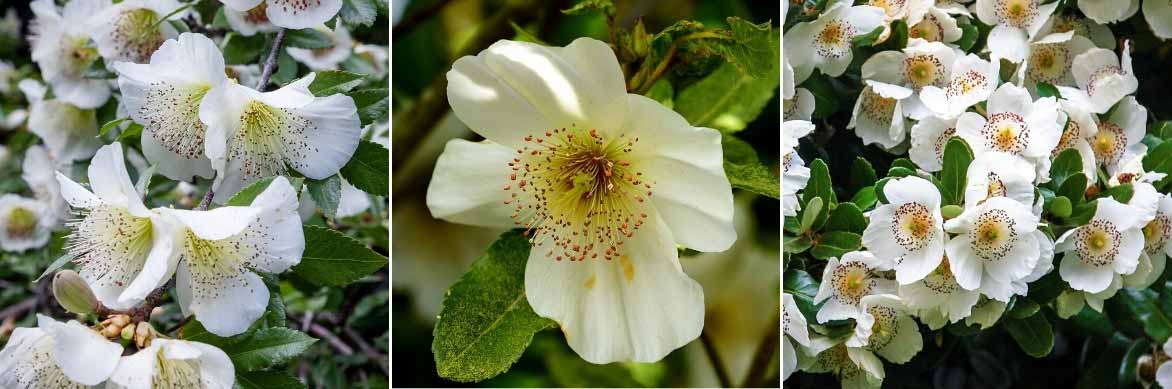
Flowering of Eucryphia glutinosa, Eucryphia x nymansensis (photo Ashley Balsam) and Eucryphia cordifolia
Eucryphia generally have dark green leaves glossy above, glaucous beneath, except for Eucryphia lucida ‘Gilt Edge’, which is distinguished by foliage nicely variegated with yellow. Eucryphia leaves are elliptical to oblong, thick and leathery, measuring 3–6 cm long. Leaf margin may be toothed or smooth depending on variety. Leaves are opposite, inserted in pairs, one opposite the other on the branches. Leaves are generally simple and entire, but can be divided, as in Eucryphia moorei, which bears very attractive foliage divided into 5 to 13 leaflets.
Eucryphia are evergreen to semi-evergreen (losing leaves in severe winters), except Eucryphia glutinosa, which is deciduous. Its foliage turns attractive orange–red tones in autumn before falling.
After flowering, Eucryphia form oblong, woody capsules 1–1.5 cm long, containing several winged seeds. Capsules may remain on the tree for up to a year before opening to release seeds. Seeds are wind-dispersed, their wing allowing them to be carried away, similar to samaras of maples.
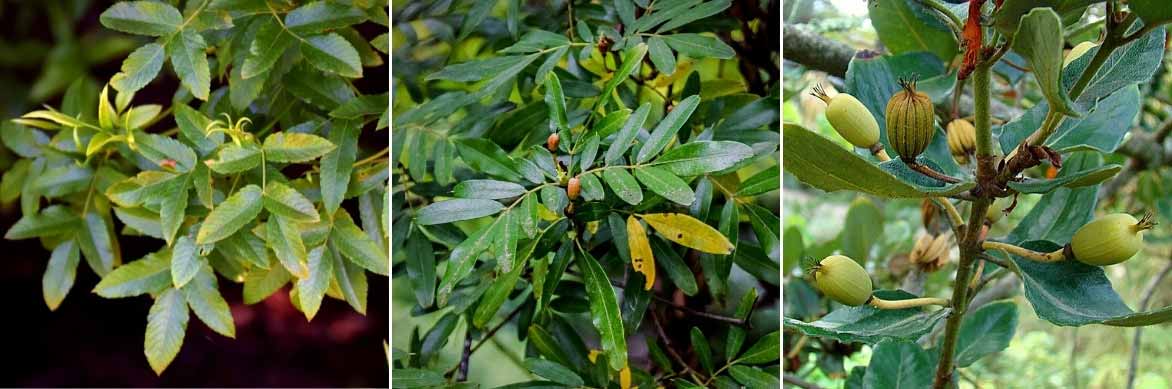
Foliage of Eucryphia glutinosa and Eucryphia moorei (photos: Krzysztof Golik), and fruits of Eucryphia cordifolia (photo: Dick Culber)
Main varieties of Eucryphia
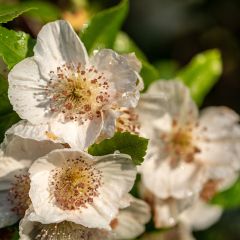
Eucryphia x intermedia Rostrevor
- Flowering time September, October
- Height at maturity 6,50 m
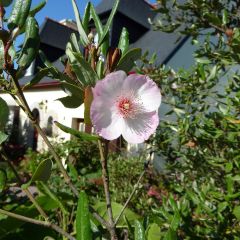
Eucryphia lucida Pink cloud
- Flowering time August to October
- Height at maturity 4 m
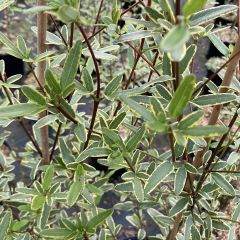
Eucryphia lucida Gilt Edge
- Flowering time September, October
- Height at maturity 4 m
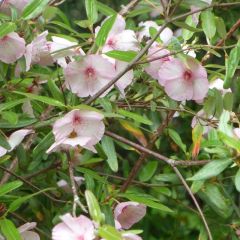
Eucryphia lucida Ballerina
- Flowering time September, October
- Height at maturity 6 m
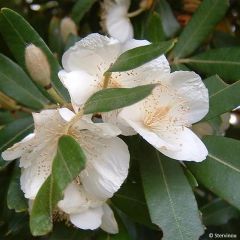
Eucryphia moorei
- Flowering time August, September
- Height at maturity 8 m
Discover other Eucryphia
View all →
Available in 1 sizes
Available in 1 sizes
Available in 1 sizes
Available in 1 sizes
Available in 1 sizes
Planting
Where to plant Eucryphia?
Eucryphia is not very hardy: it needs a mild climate with low risk of frost, and also moisture. In France, it will do well in Brittany and Normandy, near the English Channel or along the Atlantic coast. You can also plant it near a pond so it benefits from ambient humidity. Eucryphia are not really suited to Mediterranean climate, which is too hot and dry for them in summer.
Eucryphia favours light, humus-rich, fertile soil. It does not tolerate drought: it needs cool yet well-draining soil, without excess winter moisture. Eucryphia cordifolia and Eucryphia x nymansensis are the only ones to tolerate lime; other species prefer rather acidic soil: feel free to add some heather soil at planting time.
Eucryphia will do well in sun or partial shade. In general, it likes roots in shade, kept cool, and crown in sun, which will promote generous flowering. Avoid hot, dry sites, and if possible place it sheltered from wind, for example protected by a hedge, walls, or garden shed.
Choose location carefully because Eucryphia does not like being transplanted (roots are fragile). It is not suitable for growing in pots.
When to plant?
We recommend planting Eucryphia in spring, around May, after last frosts. If you live in a mild area with low frost risk, you can also plant in autumn (September–October).
How to plant?
- Start by placing the rootball in a tub of water so it can rehydrate.
- Dig a large planting hole, two to three times the size of the rootball.
- Add some heather soil and a little compost, mixing these with the backfill. If your soil tends to retain water, you can also add some coarse sand to improve drainage.
- Place Eucryphia in the centre, ensuring it stands upright.
- Backfill around it, taking care not to bury the collar, then firm the soil lightly.
- Feel free to install a stake so Eucryphia remains upright.
- You can also create a watering basin to help water soak into the soil around its base.
- Water generously.
→ Gwenaëlle explains in this tutorial how to plant a tree in heather soil.
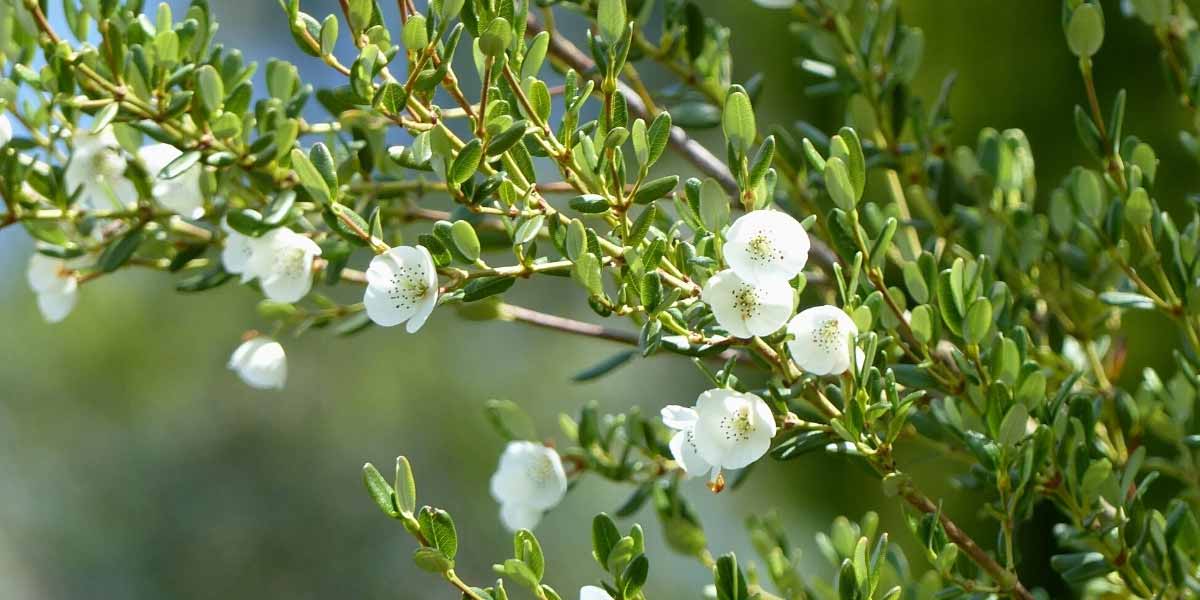
Eucryphia milliganii, a charming shrub distinguished by its small oblong leaves and small white flowers
Read also
Plant young ericaceous plantsCare
Once established, Eucryphia requires little maintenance, as it is resistant to diseases and pests and does not normally need pruning. However, you can prune it if necessary to remove dead, damaged or poorly placed branches. Prune after flowering.
Eucryphia does not tolerate drought: it needs the soil to remain relatively cool in summer, so do not hesitate to water regularly, preferably with rainwater. We recommend mulching Eucryphia by placing a layer of pine bark mulch at its base. This will help the soil stay cool for longer. You can also plant groundcover plants at its base to help retain soil moisture.
You can topdress each year by adding heather soil and a little compost, which you should work into the soil with a light raking.
During the first few years, protect Eucryphia during severe frosts by covering it with a fleece.
Multiplication
Eucryphia can be propagated by sowing, however we recommend propagation by cuttings instead; this technique will provide a higher success rate.
Propagation by cuttings
Eucryphia can be propagated by cuttings of semi-woody stems in summer, around July.
- Take a healthy, semi-woody shoot (soft at the tip and lignified at the base), 8 to 10 cm long, cutting just below a node (point where leaves attach to the stem).
- Remove leaves from the lower part, leaving only 2 or 3 at the tip of the shoot. Also remove any flowers or flower buds you see.
- Dip the base of the stem in plant hormone for cuttings.
- Fill a pot with light, free-draining potting compost, then water.
- Plant the stem in the substrate, then firm the substrate well around it to expel air bubbles and ensure good contact between the shoot and the substrate.
- Place the pot in a sheltered, bright spot out of direct sunlight.
Eucryphia cuttings can take between one and six months to root. Ensure the soil remains moist until they have rooted by watering regularly. Keep young plants under cover for the winter, then repot them the following spring into larger pots to support their development.
To find out more, please consult our advice sheet on propagation by cuttings
Association
As it thrives in acidic, moist, well‑drained soil and likes to have its roots in shade, do not hesitate to pair Eucryphia with heather soil shrubs, such as rhododendrons and azaleas, Pieris japonica, Daphnes, Japanese maples and hydrangeas. Discover the Crinodendron hookerianum, charmingly nicknamed Lantern Tree, a shrub that bears delightful red bells from May to September. Also consider azaleas from the ‘Encore’ series, which flower two to three times a year in successive waves from spring to autumn. Beside them, you can add a Japanese maple, for example the cultivar ‘Summer Gold’, whose golden foliage will add plenty of brightness!
Find our full range of heather soil shrubs by clicking here: all our heather soil shrubs.
To keep soil cool and shaded while highlighting its silhouette, you can pair Eucryphia with low, spreading groundcover shrubs. Think, for example, of the azalea ‘Pink Cascade’, which does not exceed 50 cm in height, Cotoneaster dammeri, heathers and the creeping spindle Euonymus fortunei ‘Radicans’.
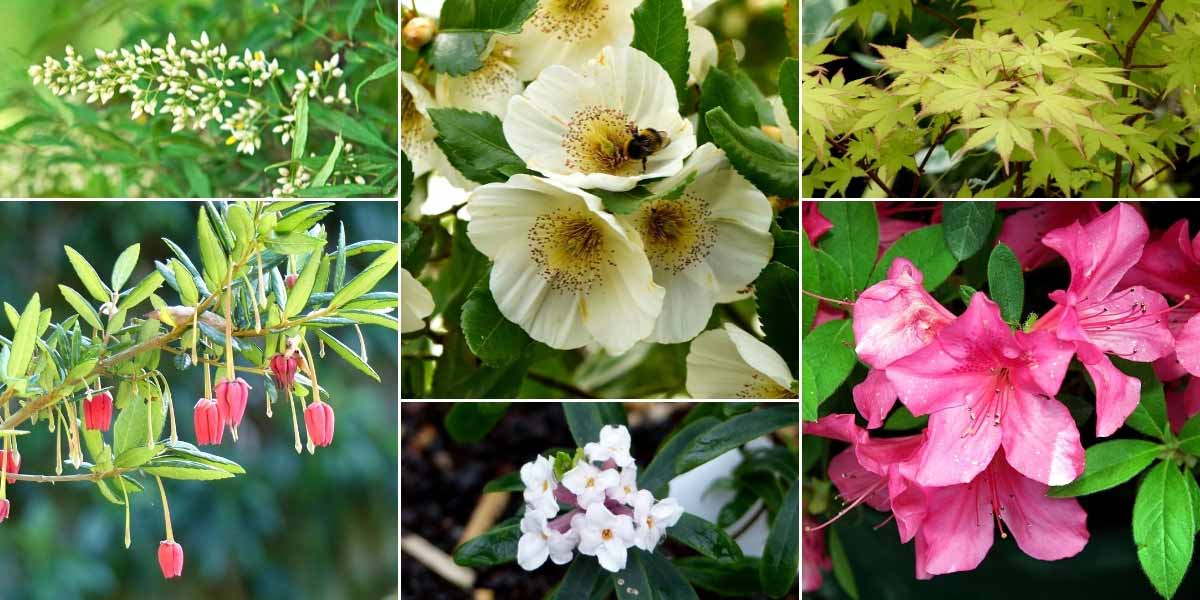
Nandina domestica, Eucryphia x nymansensis ‘Nymansay’, Acer palmatum ‘Summer Gold’, Crinodendron hookerianum, Daphne ‘Eternal Fragrance’ and Azalea ‘Encore Sangria’ (photo David J. Stang)
→ Discover more ideas for pairing Eucryphia in our advice sheet!
Related articles
- Discover our full range of Eucryphia by clicking here
- Our article “5 tips to successfully grow heather soil shrubs”
- To pair with Eucryphia, discover our full range of heather soil shrubs
- Subscribe!
- Contents
This form is protected by reCAPTCHA - the Google Privacy Policy and Terms of Service apply.

































Comments