


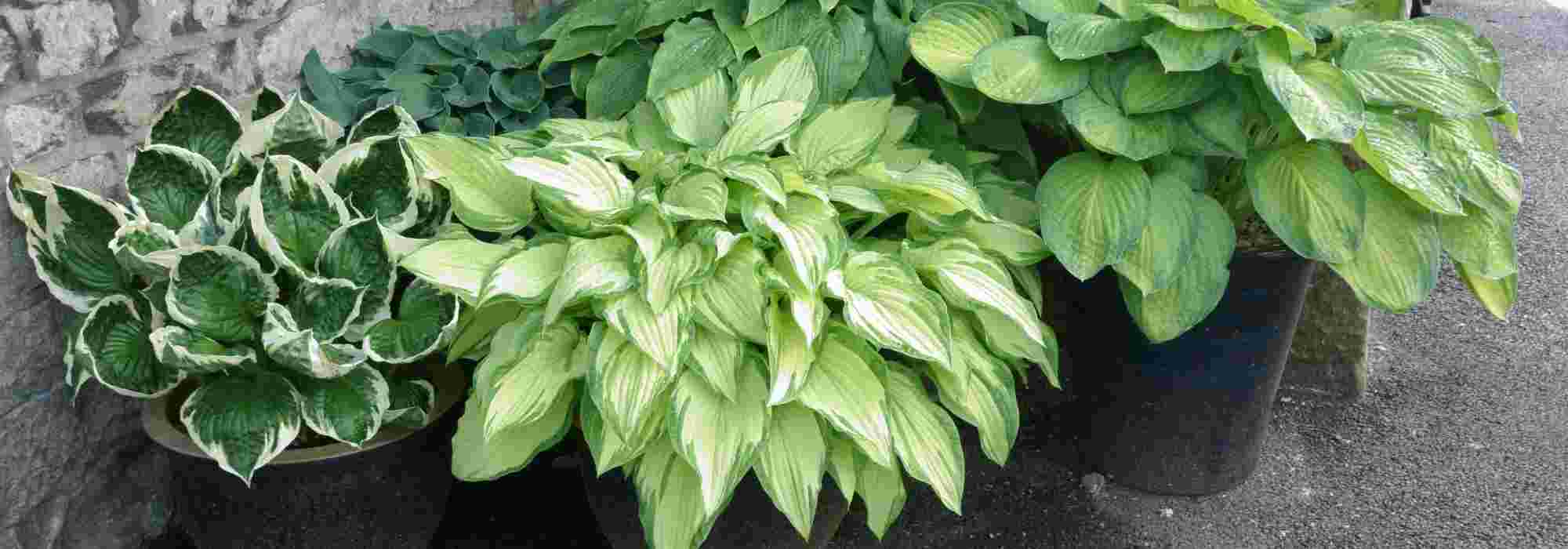
Hostas: The best varieties for pots
Selection of small hostas suitable for growing in pots and care tips
Contents
Hostas are perennials with highly ornamental foliage, perfect for planting in cool, shady spots. But You don’t necessarily need a garden to enjoy their qualities : almost all varieties can be grown in pots. This helps bring lushness, light and vitality to terraces, balconies and other inner courtyards. Let’s look at how to choose them well and successfully grow Hostas in pots.

The appeal of hostas in the garden
Hostas are among those plants that are quite common in gardens. And for good reason: they have a multitude of advantages.
This are, first and foremost, essential candidates to dress and illuminate cool, shady areas. They thrive in heavy, moist soil, but not waterlogged. In woodland settings, near water features, in beds, in shade rock gardens or along borders, Hostas work wonders. But they can also certainly be grown in pots. Their silhouette is indeed fairly modest, not exceeding 1.5 metres in height. Moreover, container growing has a not-insignificant advantage, even when you’re lucky enough to have a garden: it helps to better protect these plants from the nibbling of slugs, snails or even field mice.
Hostas offer us a wide choice in terms of varieties. They can be distinguished by leaf colour (green, blue, golden, solid, variegated…), the flowering, fragrance or the silhouette (spreading, compact). You will surely find a Hosta to suit your preferences.
To top it off, Hostas are easy-to-grow perennials that last a long time. Hardy and requiring little maintenance, they will simply benefit from protection from the appetites of slugs and snails.
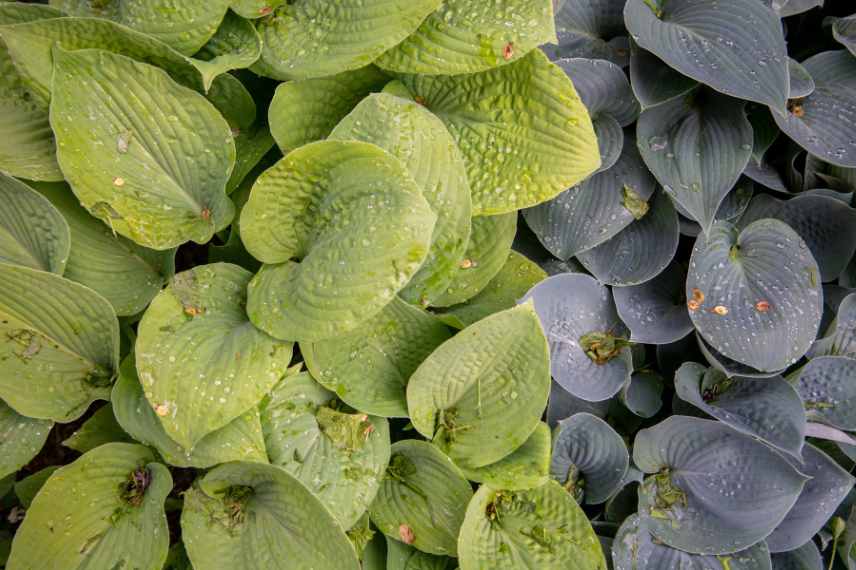
Leaf colours are highly varied among hostas, enabling stunning colour combinations
Read also
Hosta: planting, growing and careHow to choose hostas for pots?
Hostas can easily be grown in pots, making them well suited to urban gardens, on a terrace, a balcony or in a patio.
Foliage
Lush foliage of these perennials provides volume, structure and light. It helps to showcase other flowering displays and will bring an exotic touch as well as a graphic, contemporary one, depending on the combinations used.
Leaf colour is the first distinguishing feature. Golden foliage brings brightness and sparkle to shaded areas. This is the case with the variety ‘Lipstick Blonde’, with golden leaves borne on a red petiole, or with ‘Sunny Halcyon’, whose leaves transition from chartreuse green in spring to gold in summer.
Blue Hostas are striking and add a touch of mystery. They are notably represented by the Hosta tardiana‘Halcyon’ or by ‘Big Daddy’.
For variegated foliage, combining originality and brightness, let us mention the handsome ‘Autumn Frost’ blending yellow and bluish-green, or the Hosta ‘Pin Up’ with its lanceolate blue-green leaves contrasting with a white centre.
But foliage also varies with size, shape and texture. Leaves can be long, pointed and undulating, as with ‘Waterslide’, round and crinkled as with the Hosta abiqua ‘Drinking Gourd’, or in cordate, veined and very glossy form, as with ‘Ayesha’.
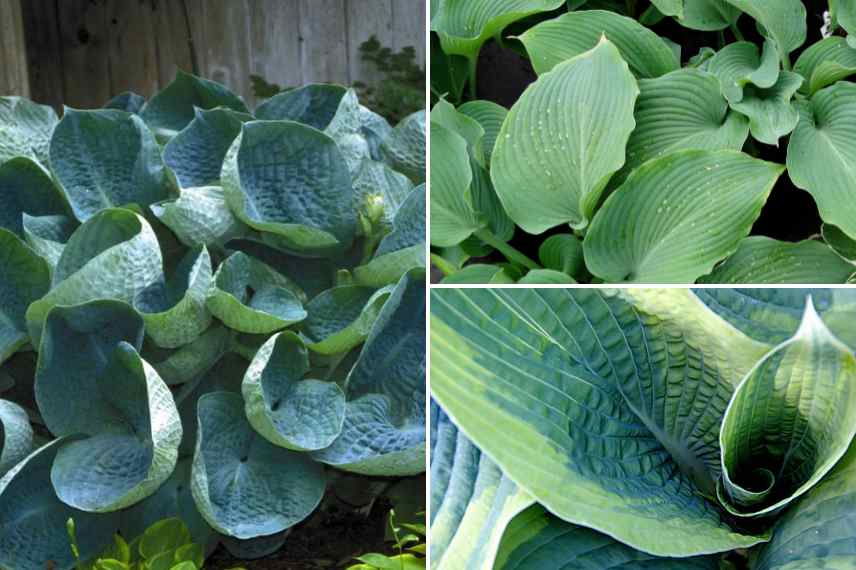
Hosta abiqua ‘Drinking Gourd’, Hosta tardiana ‘Halcyon” et Hosta sieboldiana “Frances Williams’
According to the flowering
Hostas are also appreciated for their bell-shaped mauve or white flowers, which appear in summer. Some varieties have the particularity of being scented, which adds an extra ornamental interest. This is the case of the Hosta plantaginea grandiflora, which emits a fragrance of lilies, especially in the late afternoon. Also include ‘Royal Standard’, whose flowering releases notes of orange blossom, or ‘Honeybells’, which produces bell-shaped flowers with sweet fragrances.
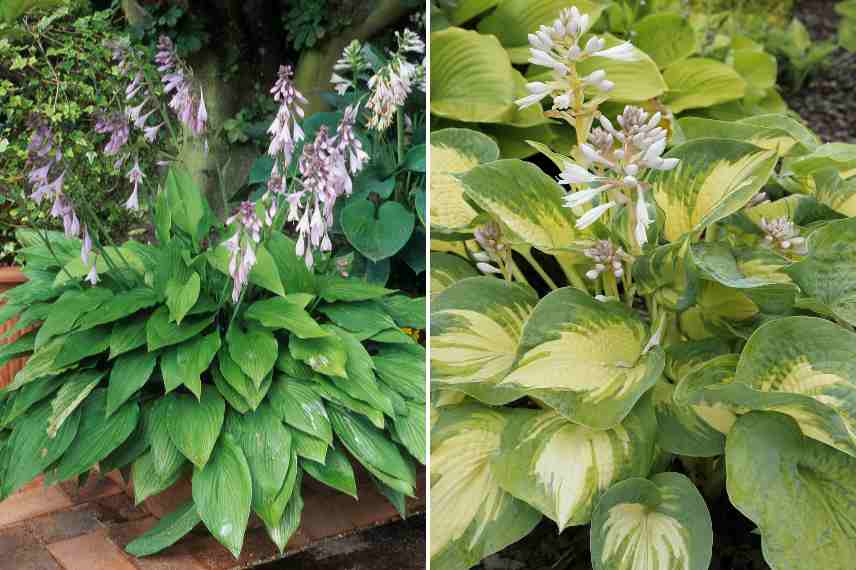
The flowers of hostas range from white to mauve
According to the habit
The size of Hostas varies by species, from 30 cm for the dwarf Hostas to more than 1 metre for the giant Hostas. Dwarf varieties have slower growth, but can fit anywhere, even in small spaces, as with the charming ‘Mighty Mouse’. It is a miniature Hosta that does not exceed 15 cm in height and 20 cm in breadth.
For mid-sized Hostas, varieties range between 40 and 80 cm in all directions, as with ‘Frances Williams’ or ‘Mediovariegata’.
And if you’re looking for a focal piece to place in a stylish pot or a large container, opt for a giant variety. It will inevitably bring a touch of freshness to a balcony, terrace or courtyard. You’ll notably have the choice between ‘Jurassic Park’, impressive with its 1.3 metres in all directions and leaves around 40 cm in length. Also mention ‘Blue Mammoth’, with its cordate leaves of 35 cm in diameter, making it one of the largest blue-leaved varieties.
Many Hostas are used as groundcover due to their spreading habit, broader than tall. However, there are also Hostas with a more compact, bushy habit, ideal for pots. Among them, for example ‘Liberty’ (60 cm in all directions) or ‘Hand’s Up’ (40 cm in all directions).
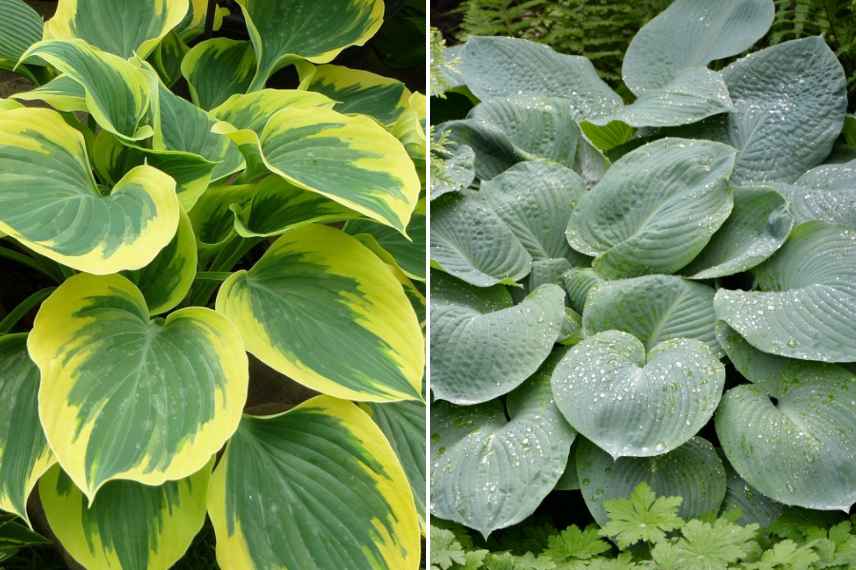
Hosta ‘Liberty’ et Hosta ‘Blue Angel’
Slug resistance
One of the drawbacks of Hostas is that they are a magnet for gastropods. If slugs are very prevalent in your garden, it’s best to opt for varieties with better resistance, thanks to their thicker and tougher foliage. This is notably the case with ‘Great Escape’, a pretty variety with variegated foliage, or with ‘Fragrant Blue’, valued for its blue foliage and scented flowering.
Best companions for potted Hostas
Hostas quickly form a handsome clump of foliage and can therefore quite happily thrive on their own in pots. You can simply choose to pair different Hosta varieties, which have different foliage colours.
Alongside them, consider planting other shade-loving perennials, such as ferns with their decorative fronds, the Heucheras with their equally ornamental foliage, the Astilbes with their plume-like flowering, the Ophiopogons with their ribbon-like leaves, the Caucasian forget-me-nots for their spring flowers, or the moist-soil grasses for their lightness.
On the shrub side, bamboos for pots, Japanese maples for pots, Mexican orange blossoms or the dwarf rhododendrons also help create lush planting schemes.
Also try pairing with bulbous plants, such as Alliums or the Agapanthus, very graphic and architectural. Finally think of spring bulbs, which will brighten a pot display during the first months of the year: snowdrops, daffodils, muscari, etc.
To create a striking mass effect, the ideal is to group the pots and play with heights, by selecting Hostas of varying sizes and placing them, for example, on the steps of a staircase or on other supports at different heights.
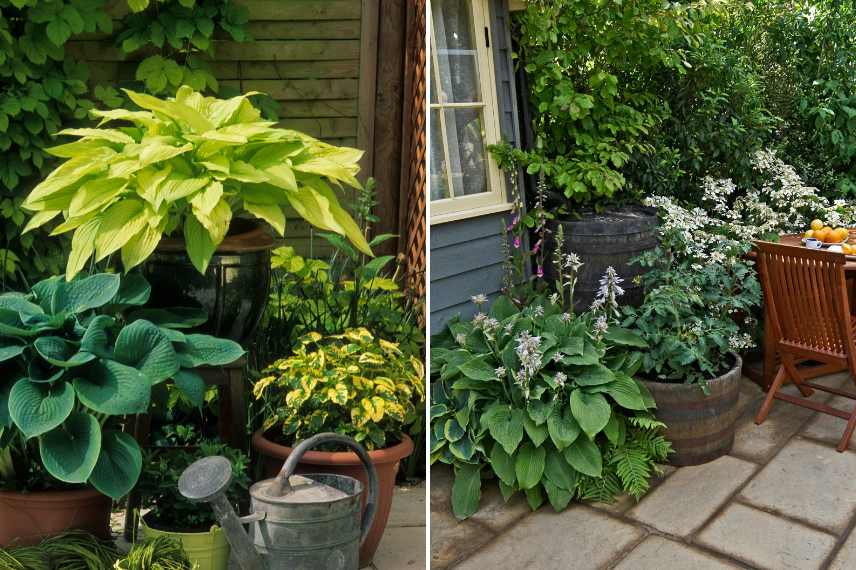
On a tripod to create varying heights or laid on the ground on a shaded terrace: Hostas are fairly easy to pair with other plants
Read also
Growing hostas in potsHow to grow and care for your Hostas in pots?
As we’ve said, Hostas are not particularly difficult to grow. Pot planting can theoretically be carried out year-round, except during periods of extreme heat or frost. Spring and autumn, however, remain the seasons most suitable.
Choose a container suited to the chosen variety: a diameter of 30 cm will be sufficient for the smaller ones, but allow at least 60 cm for the larger specimens. The only constraint: make sure to use a pot or tub with a perforated bottom, so excess water can drain away and not stagnate in the roots.
For planting, install a drainage layer of about 3 cm at the bottom of the container (clay pellets, gravel…). Opt for a rich, well-draining substrate. You can, for example, mix some potting compost with one to two handfuls of well-decomposed compost. Plant the Hosta crown, then add a organic mulch (chips, RCW…). It will help retain moisture and limit evaporation, which will help reduce the frequency of watering.
In terms of exposure, potted Hostas should be placed in partial shade, especially for golden and pale foliage, which should receive a little light, but not blazing sun. Prefer shade for blue varieties. If you have a white wall, beware of placing Hostas in front of it, or risk excessive heat reflection. Finally, avoid exposures subject to cold, drying winds.
For the care of your potted Hostas, ensure regular watering, ideally in the morning. As soon as the soil surface is no longer cool to the touch, it’s time to water. If you have a drip tray under the container, be sure to empty it after about twenty minutes.
Hostas can stay in pots for several years. However, nutrients are depleted more quickly than in open ground, so we recommend applying fertiliser or compost in spring, to support the plant’s growth. It should be rich in nitrogen, to support the production of healthy foliage.
In spring, when slugs and snails emerge from dormancy with a voracious appetite, it is advisable to protect the crowns of your Hostas. Beer traps, natural barriers, organic granules, hand-picking… There are various solutions to test, depending on your tolerance. For more, read our article “Slugs: 7 ways to fight effectively and naturally”.
To multiply your Hostas or renew aging plants (after about 5 to 8 years on average), you can perform a division in autumn.
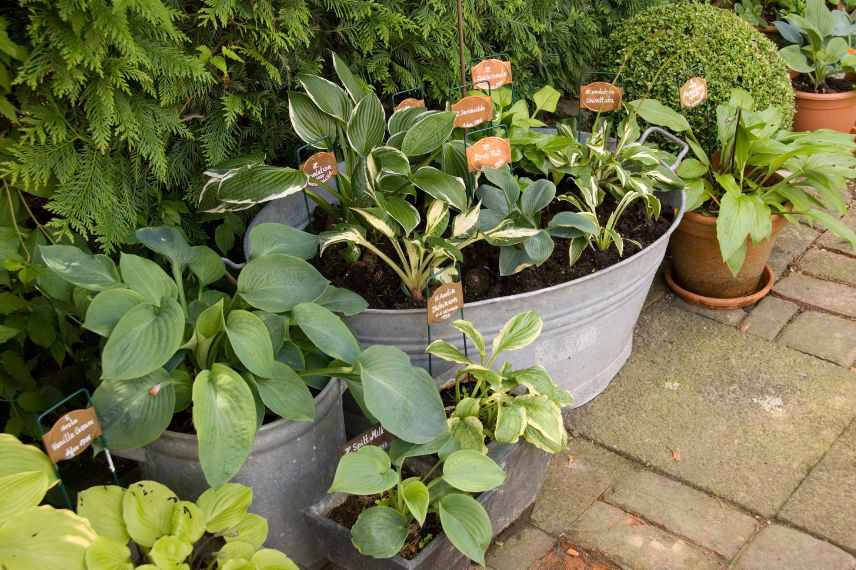
You can plant several small hostas in a large pot, but they look particularly attractive and well-developed in a single container
- Subscribe!
- Contents
Comments