


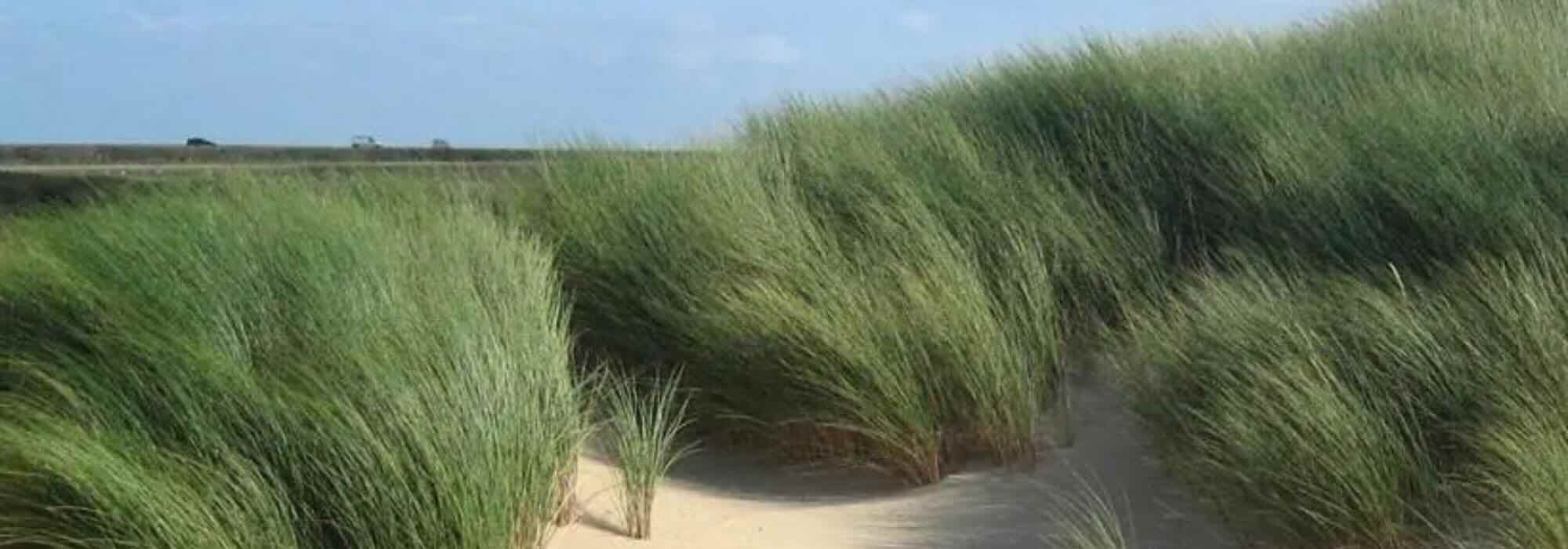
Which grasses to choose for sandy soil?
Grasses adapted to poor, well-drained soils
Contents
Sandy soils present very specific growing conditions that are not suitable for every plant. Fortunately, the vegetable kingdom is vast and it is possible to find options to dress and enliven these often deemed ungrateful areas. This is especially true of certain ornamental grasses, these grasses accustomed to sometimes challenging growing conditions.
Let’s look at their strengths and how to incorporate them into a sandy garden.

What are the characteristics of sandy soil?
Logically, a sandy soil contains at least half in sand. It therefore lacks real structure: when you pick it up in your hands, it slips and crumbles. Unlike clay soil, it sticks very little to shoes or tools.
On the plus side, this type of soil proves very easy to work with. Digging a planting hole is thus much less laborious than in heavy soil. It warms up quickly as temperatures rise, which allows some plantings to be brought forward. Rainwater or irrigation does not stagnate, which suits plants that do not tolerate excess moisture and that prefer well-drained soils. This helps prevent their roots from rotting. This type of soil can limit the development of cryptogamic diseases (fungi), typically favoured by damp conditions. Finally, plants grown in sandy soils are more resistant to cold.
But sandy soils also have drawbacks, as they are very well-drained.
- Water drains quickly downwards, so the soil dries out quickly;
- The soil is not very fertile, since nutrients (minerals) are quickly drained;
- the soil, lacking structure, can be unstable, especially in exposed, windy sites.
For these growing conditions, it is therefore necessary to turn to undemanding plants, which do not require many nutrients. They must also tolerate drought, have a root system deep enough to draw moisture from far down in the soil and to stay well anchored.
Finally, in coastal gardens, sandy soils can also be accompanied by other challenging conditions: salt-laden winds, storms or scorching sun, which increase natural desiccation and can affect the growth of the most fragile plants. Thus, grasses, particularly those that naturally grow along the sea coast, make ideal candidates for these spaces.
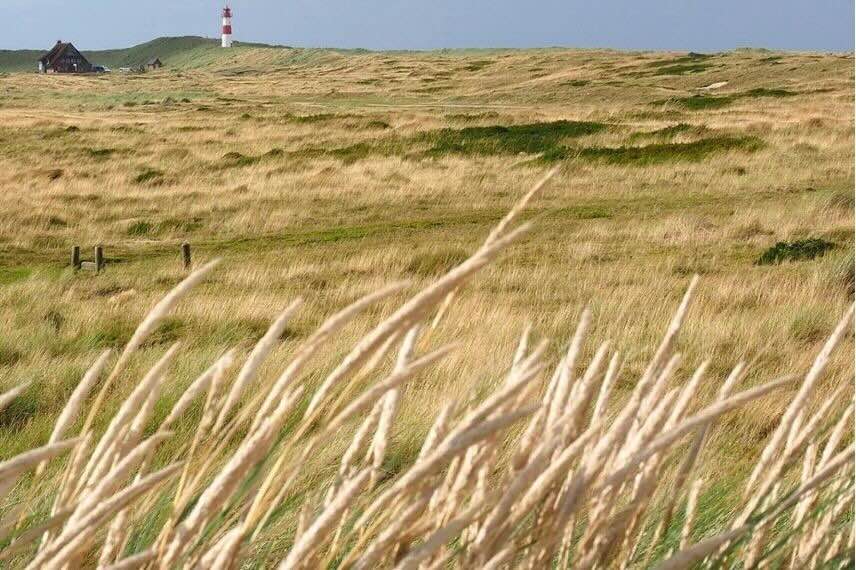
Oyat, or Marram grass, a grass that grows naturally along the coast
Why choosing ornamental grasses for a sandy garden?
If grasses are among the must-have choices for every garden, large or small, it’s because they are full of qualities.
- Many grasses are evergreen, meaning they stay decorative in all seasons, even in winter.
- Their cultivation is generally easy: they are plants that do not require much maintenance and are not susceptible to diseases or parasites. They are thus suitable even for beginner gardeners. The grasses adapted to sandy soils will tolerate dry, hot and windy conditions very well. They will simply require regular watering during the first two years of growth, to allow time for them to become well rooted. Then they will become almost autonomous, making them ideal for low-maintenance gardens.
- Their habit adds volume, lightness, graphic quality and structure to the garden. They showcase other plants and lighten areas that feel a little crowded. Their foliage, often linear and light, undulates in the wind, creating movement and animation.
- They establish themselves everywhere: in large borders as well as in hedges, along edges, in rockeries or pots. They have no preferred garden style: whether contemporary, romantic, exotic or rustic, they will never look out of place due to their understated elegance.
Grasses for sandy soils with colourful foliage
Foliage is one of the main decorative assets of grasses. But if you wish to add a touch of originality and break the monotony of green, you’ll be spoilt for choice.
For foliage in bluish tones, for example adopt the blue fescue, which forms a real colourful clump.
Originally, the Schizachyrium scoparium has a foliage that changes colour with the seasons. It shifts from blue-green to orange, then to purplish-red, before turning blond.
Also equally interesting, the Panicum virgatum ‘Sangria’ produces blood-red foliage with a vivid green base.
Little-known, the Lygeum spartum is however a pretty grass for sandy soil, with emerald-grey foliage.
Also worth mentioning is Andropogon gerardii ‘Red October’, with ribbons that become increasingly red culminating in an autumn display.
For very bright variegated foliage, head towards Carex, as with the Carex oshimensis ‘Everest’ with its green foliage margined with white, or the variety ‘Evergold’ with its green ribbons highlighted with cream-yellow.
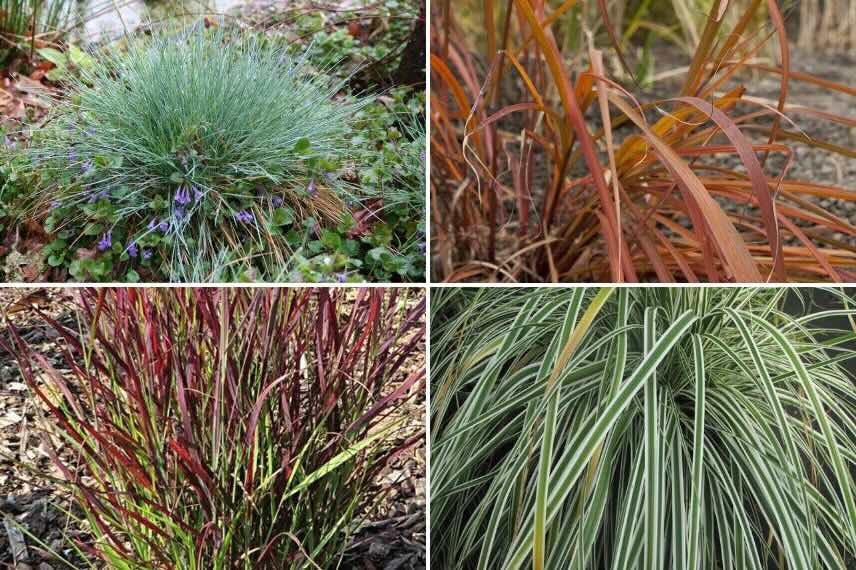
Festuca glauca blue, Andropogon gerardii ‘Red October’, Carex oshimensis ‘Everest’ variegated, Panicum virgatum ‘Sangria’
Grasses for sandy soils with decorative flowering
Some grasses do not merely offer ornamental foliage, but also reward us with an interesting flowering.
Notably, Andropogon ‘Purple Konza’, one of the most colourful grasses for dry, poor soils. It pleases us first with its blue-green foliage, which gradually turns red-brown as time passes. In late summer, it unveils beautiful plume-like inflorescences in brown, red and coppery tones.
Also, the Muhlenbergia capillaris, which enlivens autumn with its flowering in wispy panicles, ranging from white to pale pink to vivid pink.
For a very bright touch, the ciliate melic offers, in late spring, delicate cream-white flower spikes.
Let us not forget the Stipa pulcherrima, this wild-looking grass that produces impressive inflorescences in summer, like long silver brushes that sway at the slightest breeze.
Lovely, the Briza maxima, or amourette, rewards us with highly decorative heart-shaped spikelets. It is an annual, but it self-seeds freely and returns faithfully each year in sandy soil.
For its part, the Sporobolus heterolepis ‘Cloud’ indeed transforms into a true cloud at the height of its summer flowering. This grass produces long flowering stems in a deep red, bearing panicles of pink flowers marked with brown. They possess the distinctive coriander-spice fragrance.
Let us finish this non-exhaustive list with the Pennisetum thunbergii, for its small cylindrical plume-like inflorescences in a colour that shifts from red to purple.
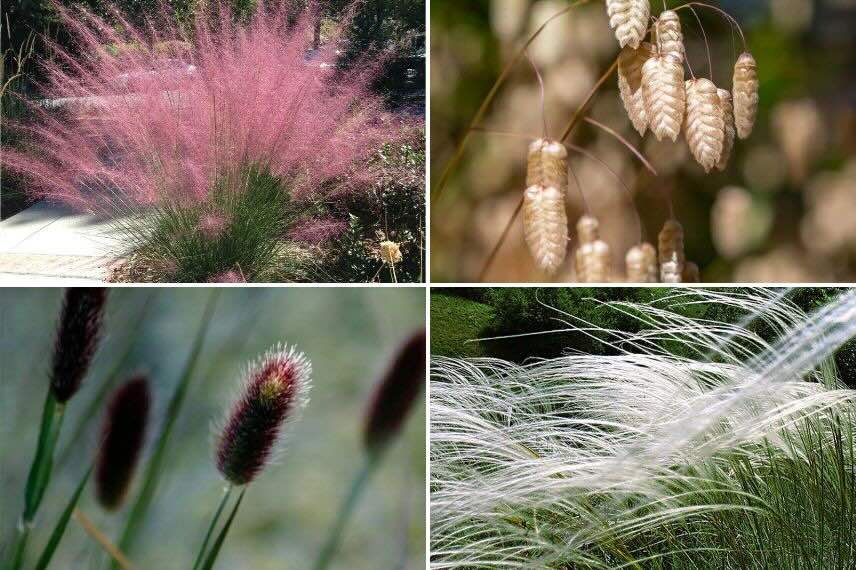
Muhlenbergia capillaris pink, spikelets of Briza maxima, Stipa pulcherrima, Pennisetum thunbergii
Tall grasses for sandy soils
Grasses can sometimes present an impressive silhouette, reaching over 2 metres in height. They will add a lot of volume to a border, a hedge, or even as a specimen plant.
Forget Pampas grasses, which are now listed as invasive exotic species and therefore banned from sale. However, you can turn to:
- the giant feather grass, with a height of 2 metres and a spread of 1 metre;
- the Panicum virgatum ‘Thundercloud’, which has the same dimensions;
- the Ampelodesmos mauritanicus, a Mediterranean native perennial grass, which forms a tussock reaching 2.5 metres in height with a spread of 80 cm.
How to mix grasses in sandy soil?
You can easily pair grasses suited to sandy soils with other plants that tolerate undemanding conditions, such as:
- Mediterranean perennials (lavender, Italian immortelle, Madeira viper’s-bugloss, sea fennel, dusty miller, Stachys byzantina…) ;
- succulents and cacti;
- rock garden plants (houseleeks, sedum…);
- aromatic shrubs (rosemary, thyme, santolina, sage…) ;
- trees (pines, Lambert’s Cypress, palms, Eucalyptus, holm oak, olive tree, amelanchier…);
- shrubs (fig tree, strawberry tree, sea buckthorn, tamarisk, Yucca, myrtle, oleaster, gorse, broom, rockrose, oleander, Pittosporum, Grevillea, Escallonia, Vitex, Albizia, mimosa…);
- undemanding perennials (gaillardia (blanket flower), echinacea (coneflower), Rudbeckia, Coreopsis (tickseed), Achillea (yarrow), Buenos Aires verbena, agave…)
How to improve sandy soil?
To make sandy soil less hostile to certain plants more sensitive than grasses, a few steps can be taken.
- Enrich the growing medium, by incorporating well-rotted manure, well-decomposed compost or potting compost. Add them at planting time or each autumn to improve the soil over the years. This will also help retain water.
- Grow green manures, which will improve the soil structure and nourish it.
- Apply mulch around the base of the plants, to limit natural evaporation and help retain soil moisture.
- Install ollas which allow gradual capillary irrigation in the soil, reducing water losses. These porous irrigation pots will let water infiltrate the soil gradually when it is dry. For more information, see our article Ollas or oyas: an efficient and economical watering system and our tutorial Making a homemade olla to water the garden. These systems are easy to set up in sandy soil. You can also opt for drip irrigation systems.
- Create windbreaks and provide shade, to limit natural drying.
- Subscribe!
- Contents
Comments