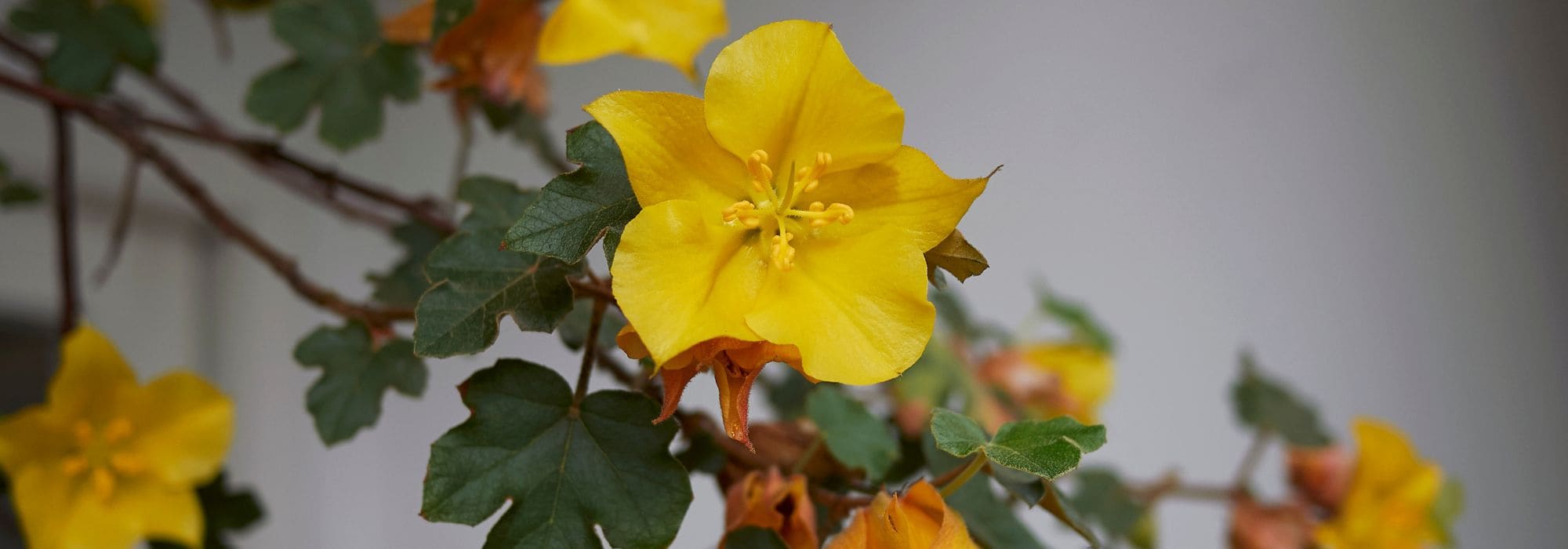
Fremontodendron: planting, pruning and care
Contents
Fremontodendron in a nutshell
- Fremontodendron is a woody shrub particularly attractive for its golden-yellow flowering
- Ideal for training as an espalier against a south- or south-west-facing wall
- Native to North America, particularly California and Arizona, with hardiness down to −12 °C
- Resistant to sea spray and winds, thrives in mild climates such as southern France and Brittany
- Shrub for full sun and poor, sandy, neutral or alkaline soil
A word from our expert
Still rare in cultivation, Fremontodendron, also called Fremontia or Fremont tree, is a shrub with evergreen foliage, particularly notable and valued for its golden-yellow flowering. A colour that can only brighten a garden or courtyard. Although not a climbing plant, Fremontodendron thrives against a sun-warmed wall. Equipped with sarmentous shoots with no clinging mechanism, Fremontodendron will need to be trained as it grows, given its relatively rapid development. Without a trellis it behaves like a shrub that must be regularly pruned to maintain a compact habit. This is, in fact, how it is often grown in North America, along roadsides and motorways.
Plant of family Sterculiaceae (or Malvaceae under current classification), Fremontodendron comprises only two main species: the very floriferous Fremontodendron californicum which produces lemon-yellow flowers throughout summer, and Fremontodendron mexicanum with orange flowers, or rather yellow flushed with red. Several hybrids and cultivars have arisen from crossings between these two species. As for Fremontodendron californicum decumbens, it has a prostrate habit and smaller stature. Fremontia is a shrub that can reach 3 to 5 m.
Preferring full sun and tolerant of wind and sea spray, Fremontodendron is moderately hardy, down to -10 to -12 °C. That is why it does so well on Mediterranean and Atlantic coasts, particularly in Brittany. However it should be protected in winter with a good layer of mulch and, if frosts are expected, horticultural fleece.
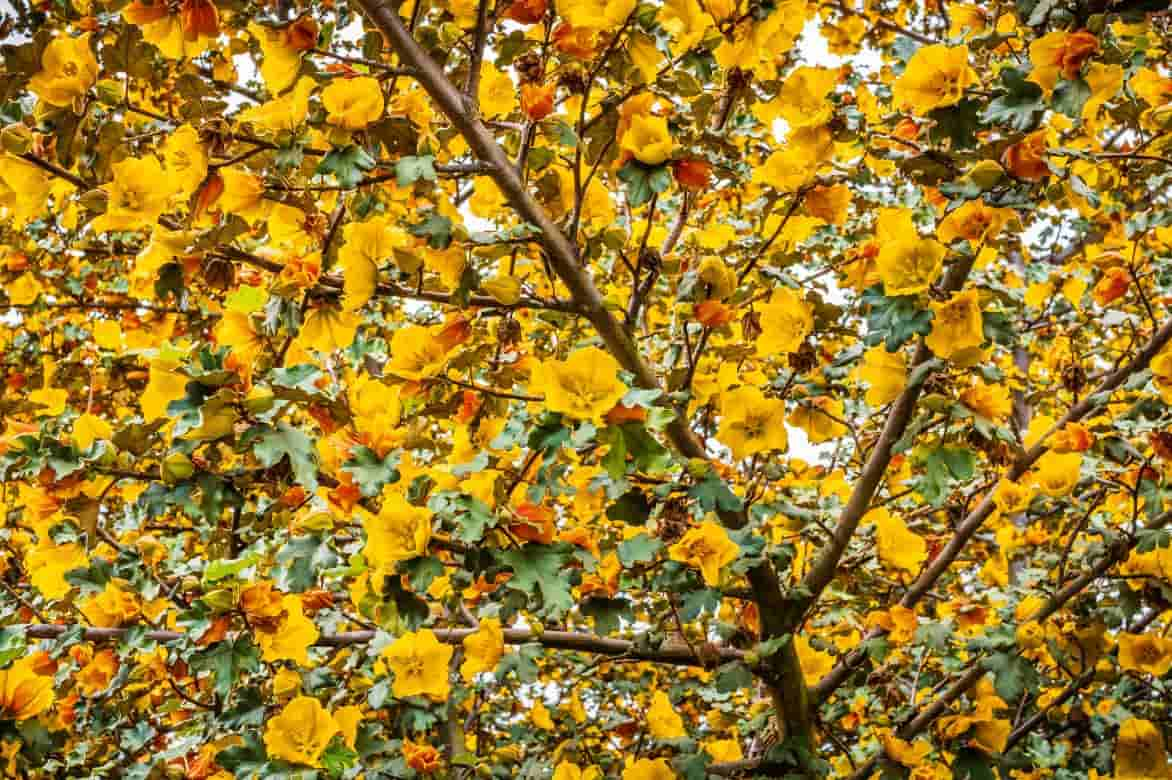
Fremontodendron is a very floriferous shrub

Botany
Botanical data
- Latin name Fremontodendron
- Family Sterculiaceae (or Malvaceae)
- Common name California Fremontia, Fremont tree
- Flowering April–May to July, and in September–October
- Height 3–5 m
- Exposure Sun
- Soil type light, sandy, calcareous, poor
- Hardiness Down to −10 to −12 °C
Fremontodendron is a semi-woody shrub native to North America, especially the warm states of California and Arizona. Because of its hardiness and its tolerance of drought and air pollution, it is often planted along roadsides and busy motorways there. It also grows naturally on embankments, in scrub and maquis. In short, it is not demanding where climate is suitable.
Called Fremontia or Fremont tree, this shrub is placed either in the family Sterculiaceae or, less commonly, in Malvaceae. It takes its name from American general John Charles Frémont (1813–1890), the first Republican presidential candidate in the United States. A staunch opponent of slavery, he was also a great explorer of the American West. During his expeditions, as an enthusiastic botanist, he recorded and collected many plants, including Fremontodendron, which was named in his honour.
The genus Fremontodendron contains only two species, Fremontodendron californicum, the most commonly grown, and Fremontodendron mexicanum, native to north‑west Mexico, listed among California’s disappearing species. The latter produces orange‑yellow flowers.
This evergreen shrub can reach 2–5 m in height with a spread of 2–3 m in our latitudes. In its natural habitat it may grow up to 9 m tall. Growing fairly rapidly, Fremontodendron bears semi‑woody shoots that arch easily and can climb if given a support against a wall. Lacking specialised climbing organs (thorns, suckers, tendrils, etc.) like most climbing plants, Fremontodendron must therefore be trained progressively, for example using stretched wires. If not trained against a wall, it can be grown as a shrub provided it is cut back in the first years so it branches and develops a denser, more upright habit. These shoots are covered with a scaly grey‑brown bark.
Fremontodendron has evergreen foliage, usually dark green above, lighter beneath. The leaves, palmatilobate and alternate, somewhat resembling vine leaves, are nevertheless light brown beneath because of the hairs that cover them. They measure 5–7 cm across. The petiole is also pubescent, as are the young stems.
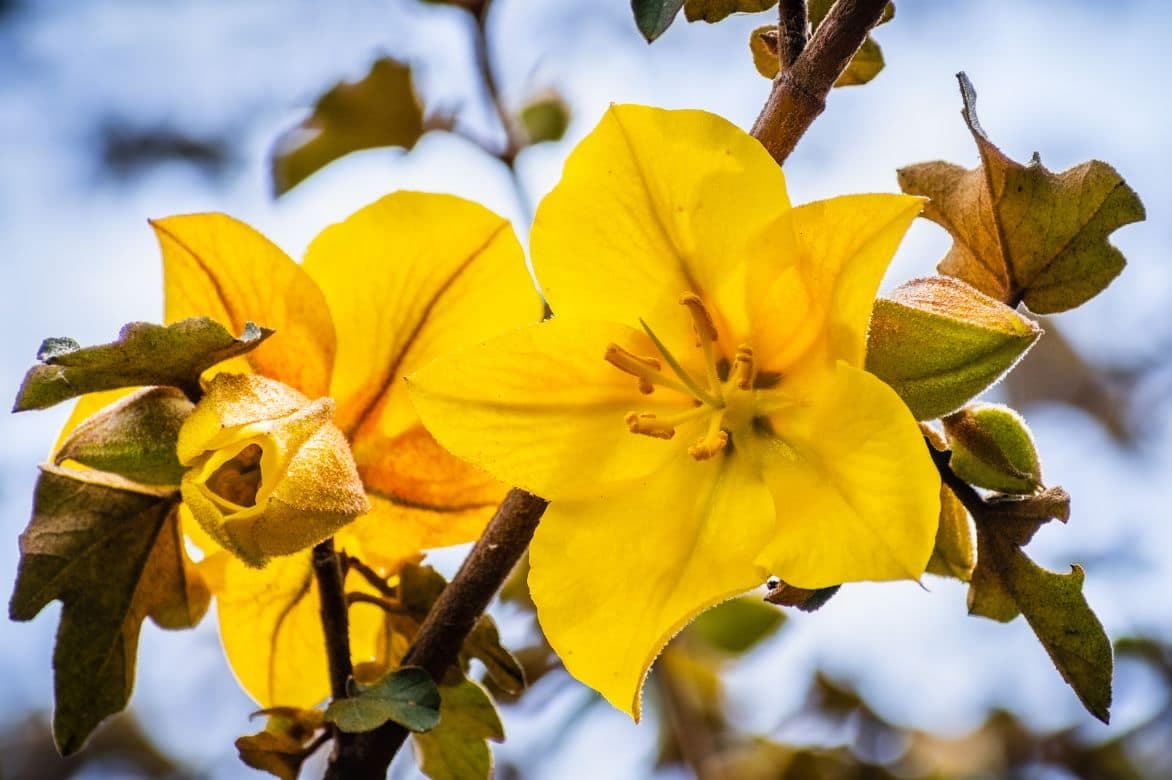
Leaf undersides and flower buds of Fremontodendron are irritating
The flowering is attractive for its bright golden yellow colour, which brightens gardens and adds radiance. Flowers arise from oval, downy buds; they are solitary and axillary. Each forms a flat cup 4–6 cm in diameter, with 5 large obovate sepals of a shiny, waxy appearance, rather rounded with an acute tip that overlap. Five yellow stamens with slightly darker anthers emerge from the flower centre. Flowers generally open from April–May to July; in mild regions they can reappear in September and October. Particularly melliferous and nectariferous, these vivid yellow flowers attract swarms of insects to feed on nectar and pollen. They are also delicately scented.
The flowers develop into downy capsules filled with black seeds. These fruits are enclosed by the sepals.
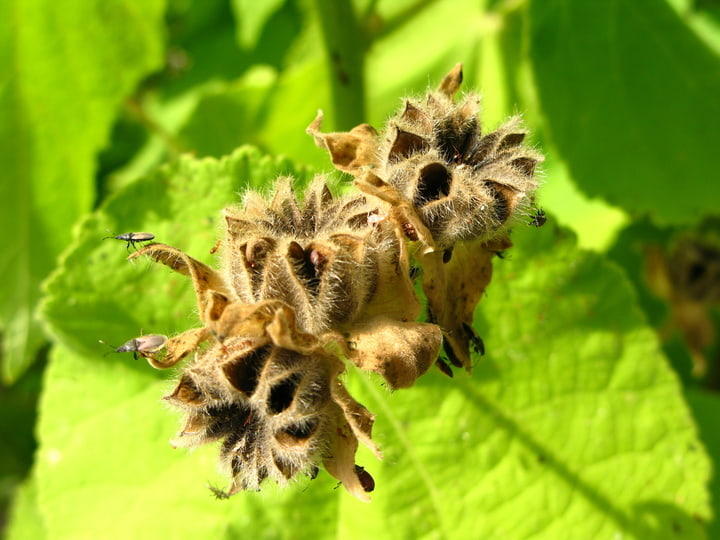
Fremontodendron seed capsules
It should be noted that the hairs covering the foliage, flower buds and young shoots can cause skin, eye and respiratory irritation and contact dermatitis. When pruning Fremontodendron, wearing gloves and long‑sleeved clothing is therefore essential.
Read also
10 climbing plants ideal for fencesOur preferential varieties
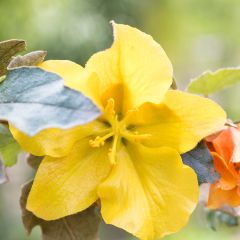
Fremontodendron californicum
- Flowering time July, August
- Height at maturity 6 m
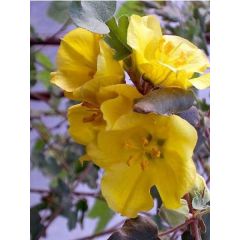
Frémontodendron 'California Glory'
- Flowering time June to November
- Height at maturity 6 m
Planting
Where to plant Fremontodendron?
Due to irritant nature of its leaves, young shoots and flower buds, it is preferable to plant Fremontodendron well away from daily walkways. Likewise, children should be kept away from this otherwise easy-to-grow shrub.
Ideally, if you wish to train it, plant against a south- or south-west-facing wall or fence. It will benefit from the full sun required for development, and its bright yellow flowering will be all the more luminous there. Fit a fairly sturdy fixing system to the wall, made of wire and hooks. If you prefer to grow it as a shrub, it can be planted at the back of a border or as a solitary specimen to showcase its golden-yellow flowers. Fremontodendron can also be grown in a pot or container on a large balcony, terrace or in a patio. Wherever planted, it must above all be sheltered from coldest winds.
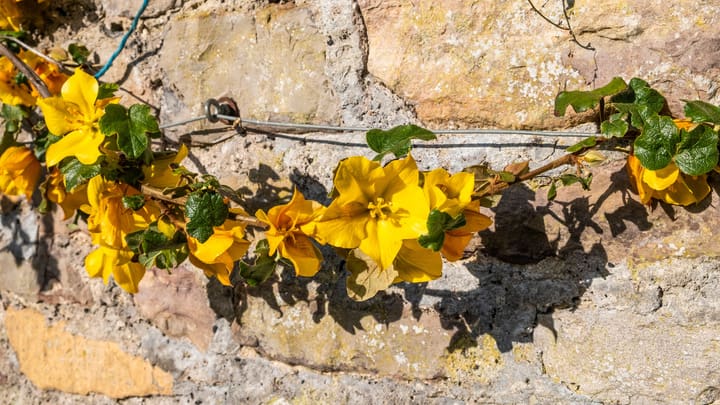
Espalier-trained Fremontodendron
Provide it with a light, ordinary, neutral or alkaline soil, which can be poor, even sandy or stony. The most important thing is excellent drainage, because Fremontodendron above all dislikes waterlogging in winter, which can cause root rot.
Fremontodendron is very drought-tolerant once established, and tolerant of sea spray. Moreover, it has relatively low hardiness. That is why it is particularly suited to Mediterranean seaboard and Atlantic coast; Brittany meets all the conditions.
When to plant Fremontodendron?
Fremontodendron is best planted in spring, between April and May, so it has time to root before winter.
How to plant Fremontodendron?
- Loosen soil thoroughly
- Soak root ball for 15 minutes in a bucket of water to ease removal from pot
- Dig hole twice the size of the root ball
- Place a layer of gravel at bottom of hole to ensure drainage
- Set Fremontodendron into hole
- Optionally add some compost to excavated soil and backfill hole
- Firm soil and water generously.
Growing in a pot is not necessarily easy, but is possible. Provide your Fremontodendron with a well-drained pot with drainage holes and wide enough (at least 50 cm diameter) or a large container, drained by a good layer of gravel and filled with potting compost and sand in equal parts.
Read also
10 climbing plants for mild climatesCare and pruning
Once established, Fremontodendron requires no particular maintenance, being drought-resistant. It is even recommended not to water it at all and therefore to keep it away from automatic watering systems or downpipes. However, for the first two years it will need some water, especially during flowering, but without excess so as not to drown the root system.
Somewhat frost-tender, Fremontodendron may need a good mulch to protect it from cold. Likewise, a horticultural fleece can be used if frost is forecast.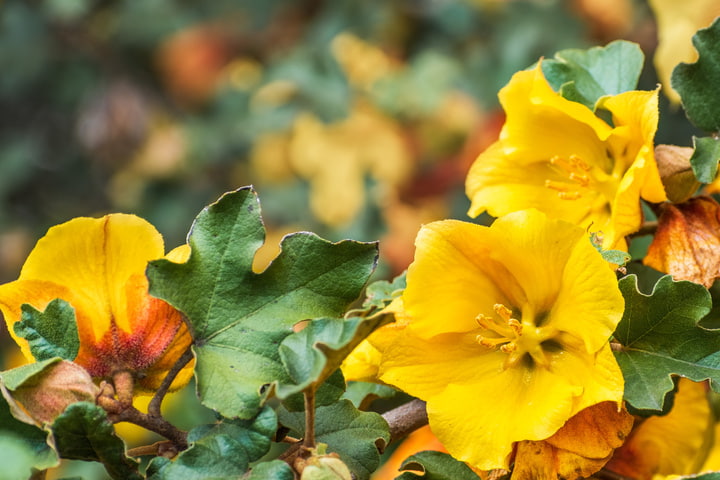
If Fremontodendron is trained as an espalier, it is essential to tie the shoots as they grow. However, pruning is unnecessary, although you can remove damaged or dead branches. If grown as a shrub, pruning becomes essential to allow it to branch from the base. This pruning takes place at end of flowering, around September. Remember to wear gloves and long sleeves when carrying out this operation.
→ Learn more with our tutorial: How to train and prune Fremontodendron?
Fremontodendron is not susceptible to any pests or diseases.
Propagation: propagation by cuttings and sowing
With a fairly short lifespan, Fremontodendron must be propagated to ensure its survival. Two methods, more or less unpredictable, are possible
Propagation by stem cuttings
This propagation by semi-ripe stem cuttings is carried out in summer, between July and September.
- Prepare pots filled with light potting compost and sand
- Take semi-ripe shoots, i.e. current-year, flowerless stems about 15 cm long
- Remove lower leaves, leaving only two
- Plant the cuttings in the substrate
- Firm down with fingers and water with a fine spray without waterlogging the substrate
- Place pots outdoors in shade.
In October, cuttings are placed under a cold frame. In spring, cuttings are potted into pots to grow for a year. They are planted out the following spring.
Seed sowing
- Collect seeds from capsules at end of flowering, i.e. between September and October
- Store them in a fridge or in sand outdoors
- In spring, fill pots with a mix of special seed compost and sand
- Soak seeds in water for 24 hours
- Place seeds on surface and cover with a layer of sieved compost
- Mist
- Place pots in a room at 19 °C
Substrate must remain moist without becoming waterlogged.
Uses and associations
Fremontodendron is a shrub that is easy to train, ideal for growing up a brick wall or along a wooden trellis. Its yellow flowering will look very striking there. It can easily be paired with perennial plants with mauve or violet flowering to plant at its base. Fremontodendron pairs very well with the lavender, Siberian iris and thyme, which tolerate the same growing conditions as it. You can also plant a Pittosporum tenuifolium with yellow‑green foliage such as ‘Gold Star’ or ‘Golden Ball’
More pairing ideas in Éric’s article: associate the Fremontodendron.
- Subscribe!
- Contents
This form is protected by reCAPTCHA - the Google Privacy Policy and Terms of Service apply.

































Comments