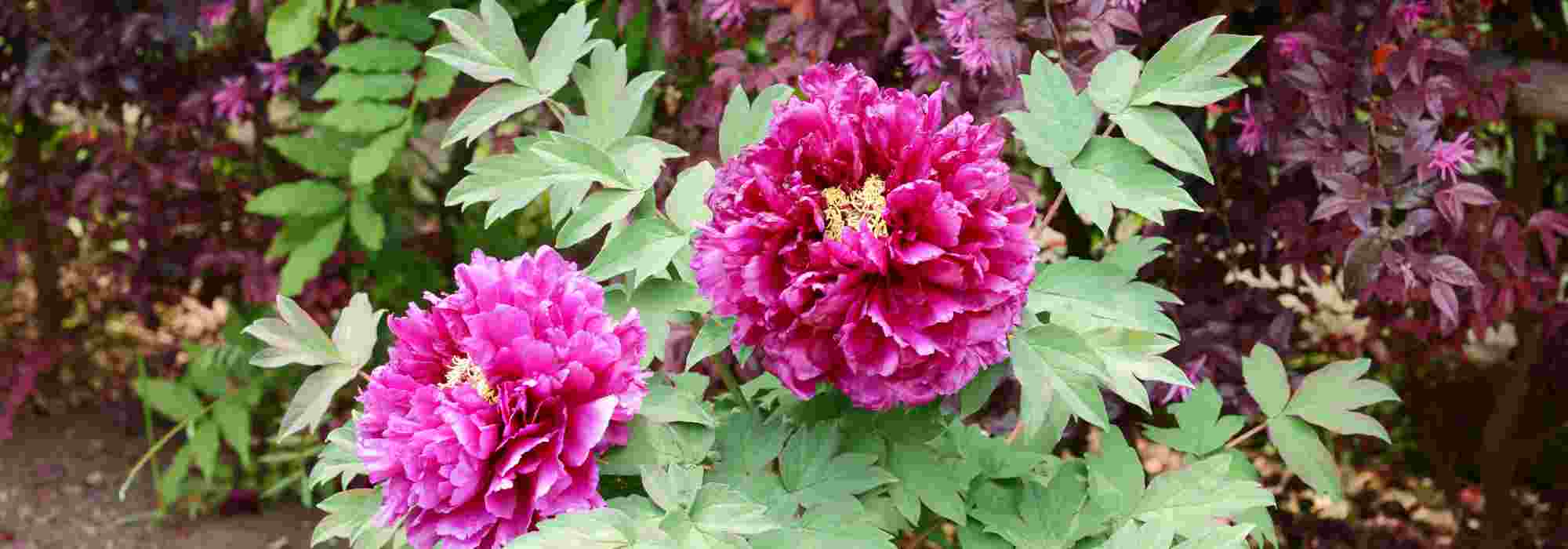
Combining shrub peonies in a border
Our ideas for showcasing tree peonies in the ornamental garden
Contents
With their opulent flowers, tree peonies offer one of spring’s most beautiful displays. Their otherwise ephemeral flowering should be set among other shrubs and perennials in a mixed border to prolong interest over several months.
Whatever your garden’s style, here are several ideas for integrating and combining tree peonies in a mixed border.

In a Japanese-inspired spirit
Thriving in slightly acidic soil (pH between 6 and 7), tree peonies can easily be incorporated into a Japanese-style scene, alongside emblematic shrubs of that style such as Japanese maples, azaleas and small cloud-pruned trees or dwarf pines. The delicacy of their ruffled petals is wonderful in that context, and although native to China, will evoke the Land of the Rising Sun.
Choose a white or pink tree peony to blend it harmoniously with other blooms in this Asian setting. Here, we place a Paeonia suffruticosa ‘Lilac’ next to a medium-sized purple-leaved maple, the Acer palmatum ‘Pung Kill’, and a small dwarf pine. To remain within pink and purple tones, we include a Pieris ‘Katsura’, which will flower slightly earlier with delicate pink blooms. Japanese grasses such as Japanese (forest) grass and ophiopogons are planted at the base for a striking contrast of light green against dark. For a large bed in sun to bright partial shade, also include some rather tall evergreen azaleas, for example the azalea ‘Silvester’ or the elegant ‘Kirin‘.
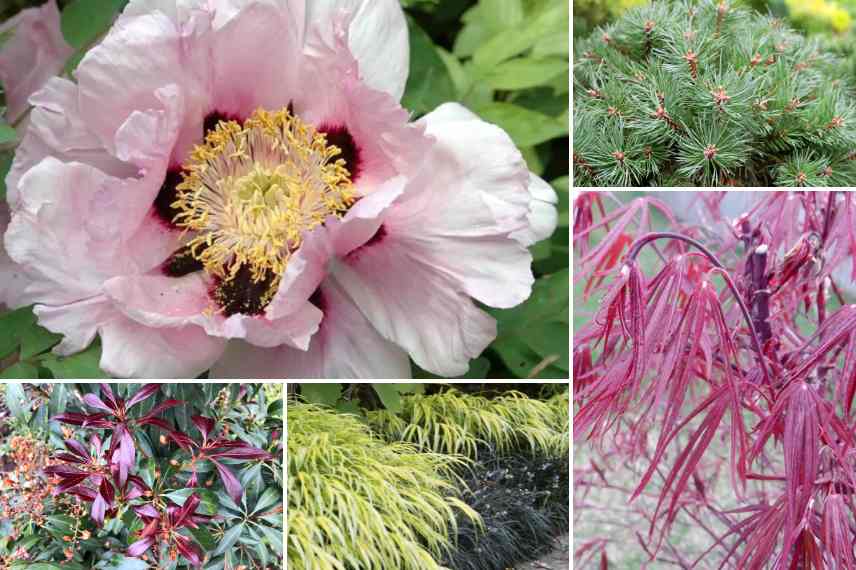
Clockwise from top left: Paeonia suffruticosa ‘Lilac’, Pinus sylvestris ‘Martham’, Acer palmatum ‘Pung Kill’, Japanese (forest) grass and ophiopogons, Pieris ‘Katsura’ (emerging foliage)
With roses
Like herbaceous peonies, tree peonies combine particularly well with roses. As tree peonies are taller, it is worth choosing substantial shrub roses or moderately climbing roses to place behind them.
In this example playing on harmonies of pinks, we set the sublime peonies ‘Lan Bao Shi‘ amid a repeat-flowering rose that blooms until the frosts in pastel tones, the classic ‘Pierre de Ronsard‘, and an abundance of stronger flowers in June–July from the vivid pink of the charming climbing rose ‘Maria Lisa’.
A small butterfly bush will take over the flowering of the peony, for example Buddleja davidii ‘Prince Charming’, with upright raspberry-red panicles and grey foliage that adds softness. Don’t forget some evergreen foliage to keep the border interesting year-round, such as a dwarf Euonymus ‘Pierrolino’, whose cream-variegated foliage will catch the eye.
This border will be planted in a sunny part of the garden.
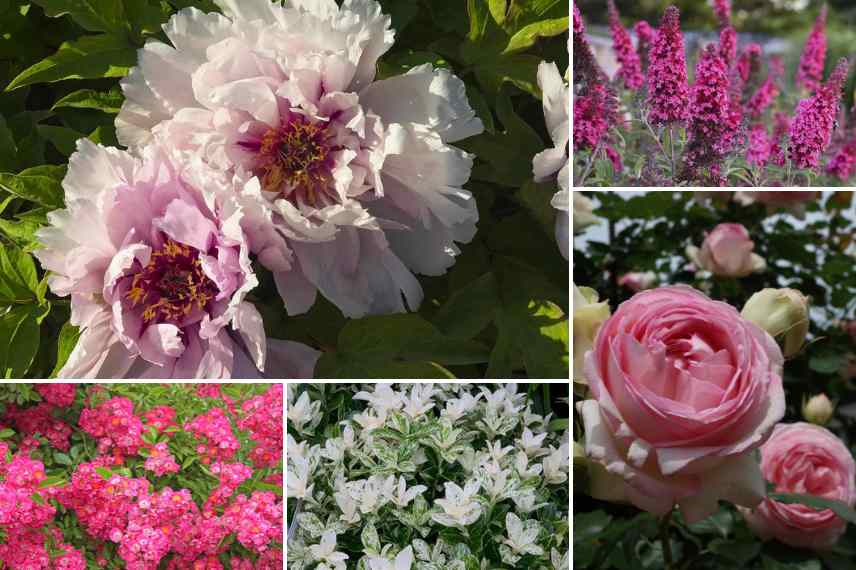
Clockwise from top: Paeonia ‘Lan Bao Chi’, Buddleia ‘Prince Charming’, rose ‘Pierre de Ronsard’, dwarf Euonymus ‘Pierrolino’ and rose ‘Maria Lisa’
In a yellow-and-blue duo
One of the most original tree peonies is undoubtedly Paeonia suffruticosa ‘Lu Mu Ying Yu’, whose green petals surprise as much as they delight! Why not plant it to create a distinctive border, where you can combine yellow and blue along with some green-flowered perennials?
The idea for this border is to pair it with another yellow peony, for example an Itoh peony, which offers some beautiful varieties (‘Bartzella‘, ‘Yellow Crown’) or the tree peony ‘Artemis’, and to complete the border with fast-growing perennials to offset the slow growth of tree peonies.
A vivid blue sage, extremely prolific and generous, Salvia guaranitica will bulk up the border quickly while the tree peonies establish. Yellow and blue lupins ‘Le Chandelier’ will flower shortly afterwards, or even at the same time if the border is in full sun. Finally, some necessary foliage will complete the picture, with a variegated Cornus alba ‘Ivory Halo’, which shines with reddened stems in winter, and some Carex buchananii to bring a warm, golden note.
As with all tree peonies that flower early in spring, it is advisable to add some yellow and green bulbs that will emerge at the same time and at their feet from April: the botanical tulip tukestanica will be perfect planted in drifts to carpet the ground in early spring. Among green-flowered plants, a euphorbia will be ideal, lifting the chartreuse green of ‘Lu Mu Ying Yu’.
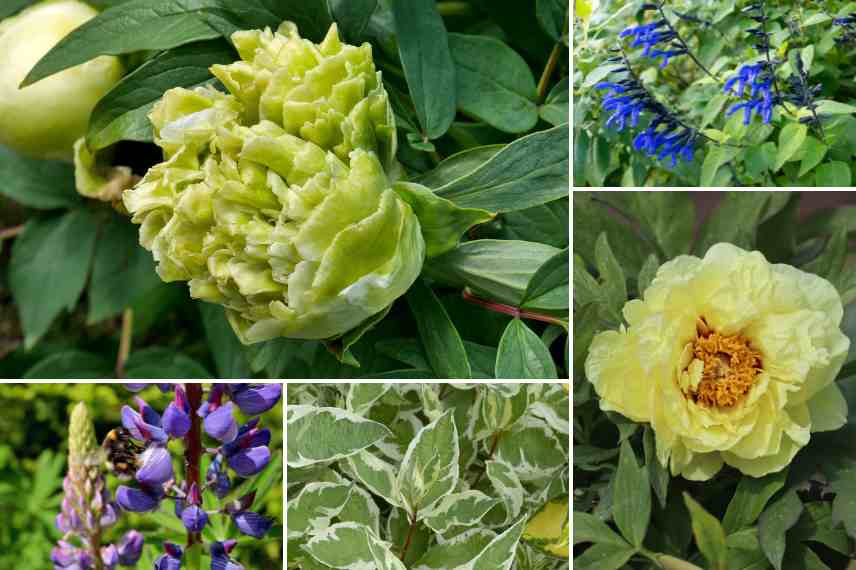
Clockwise from top: tree peony ‘Lu Mu Ying Yu’, Salvia guaranitica, Itoh peony, Cornus alba ‘Ivory Halo’ and blue lupins
Read also
7 great pairing ideas with green flowersIn an English mixed border
Tree peonies are, like their cousins the herbaceous peonies, perfect candidates for a mixed-border, that large English-style border, mixing perennials, shrubs and groundcover. They bring their extraordinary flowering, but also an interesting vertical element since they grow between 1.50 and 2 m in height, often upright. If this border is against a wall, tree peonies can be placed at the back of the planting or in the centre, like other small shrubs.
To complete such a scheme in colours chosen from white to deep purple, many options are available, among them a Deutzia, lupins, salvias for summer, corydalis for spring, and some campanulas ‘Sarastro’. A prolific white-flowering shrub, delightfully romantic, Exochorda racemosa and its many varieties are also welcome. Finally, a bolder splash of colour can be provided by Penstemon ‘Raven’, which will flower in handsome, generous clumps through to autumn. Here too, a rose can be slipped in between these different plants!
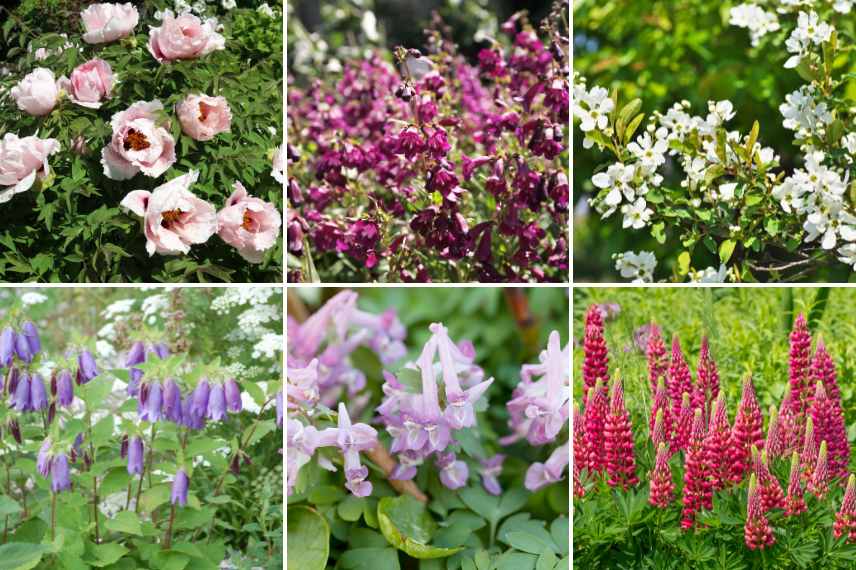
Clockwise from top: Paeonia suffruticosa, Penstemon ‘Raven’, Exochorda racemosa, pink lupins, Corydalis and campanulas ‘Sarastro’
White, a nod to oriental poppies!
White shrub peonies are every bit as lovely as colourful peonies. When speckled with purple at their centre, they imitate some oriental poppies—on an XXL scale! Pairing these two ephemeral beauties is easy, since they share the same growing conditions and flower at the same time. This creates a delightful spring tableau, which can be embroidered with tones from pink to purple.
Here, a rose ‘Blush Noisette‘ pairs with several ‘Royal wedding‘ oriental poppies, but one could just as well use poppies ‘Perry’s White’, and a lush shrub peony. The itoh intersectional peony ‘Cora Louise‘ is also a good option with its large semi-double pinkish-white flowers maculated with purple.
Add a few essential shrubs to extend interest once the huge flowering has finished, for example a viburnum and a smoke tree, a Cotinus coggygria ‘Royal Purple’ with its feathery inflorescences, planted at a distance, together with several medium-sized perennials such as Chinese fountain grass ‘Karley Rose’ and the rosy-white nepeta ‘Dawn to Dusk‘. These will provide the necessary soft-focus note.
My tip: this bed can easily be adapted using pink versions of peony and poppy if you prefer that hue (peony ‘La Sereine’ and oriental poppy ‘Manhattan’, for example).
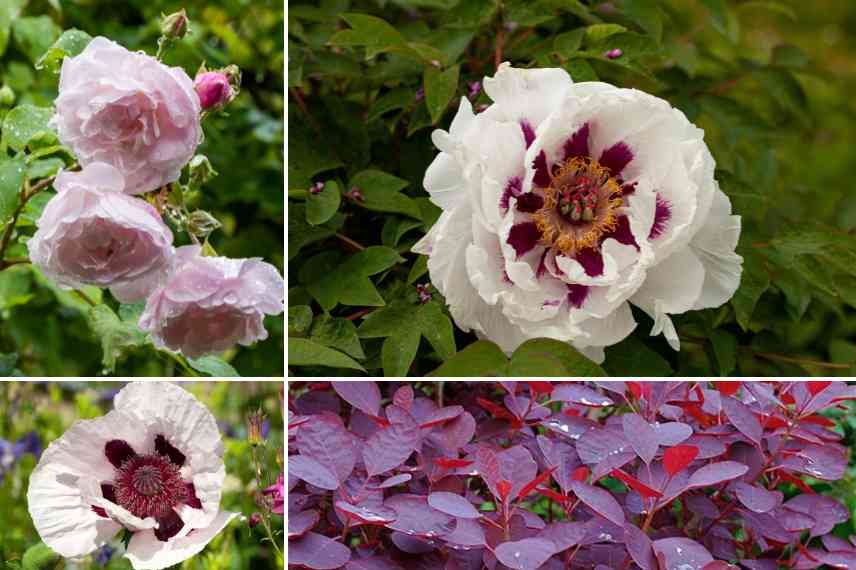
Rose ‘Blush Noisette’, Paeonia suffruticosa, Papaver orientale ‘Royal Wedding’, Cotinus coggyria ‘Royal Purple’
- Subscribe!
- Contents
This form is protected by reCAPTCHA - the Google Privacy Policy and Terms of Service apply.

































Comments