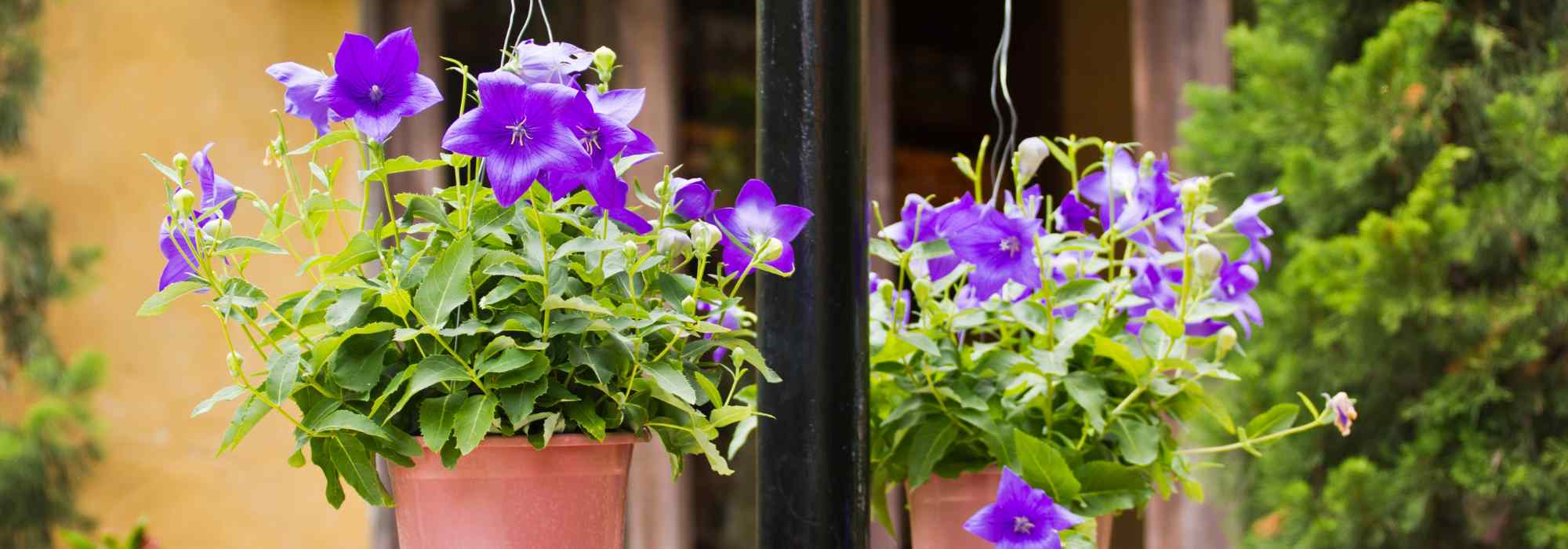
How to grow Platycodon in a pot?
Easily plant and care for this long-flowering, star-shaped perennial
Contents
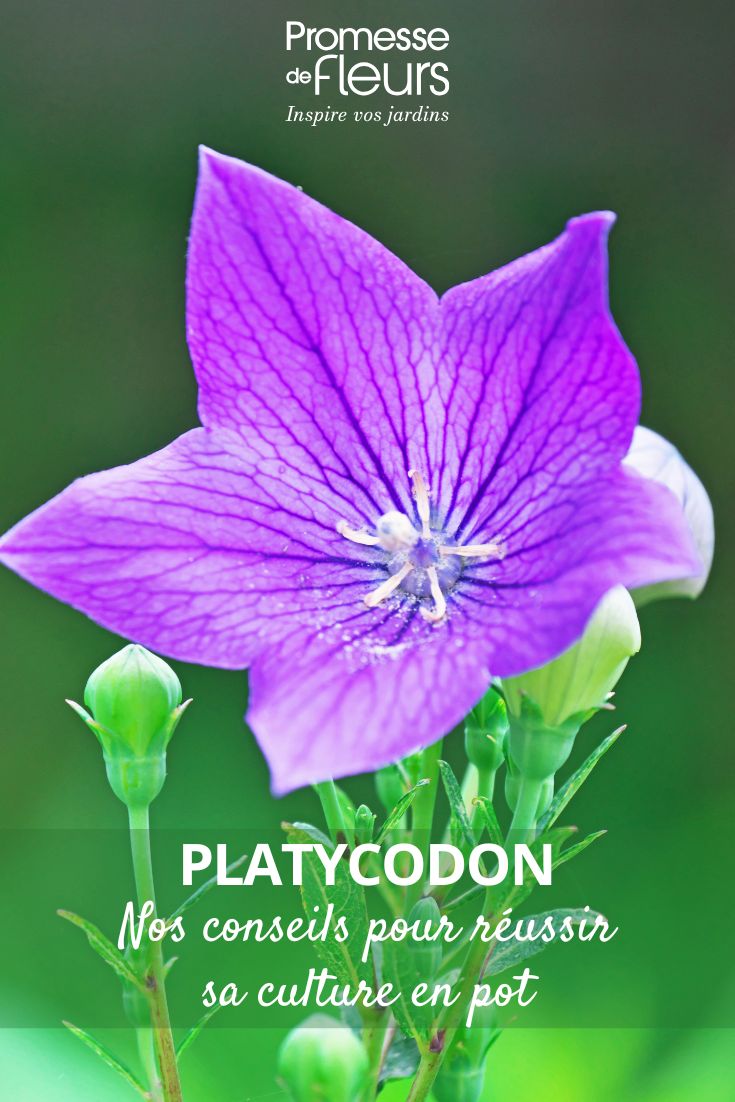
Platycodons are charming perennial plants that flower in summer. They delight with their star-shaped flowers and pastel colours of blue, violet, pink or white. In bud, these flowers resemble small balloons, earning this plant the nickname ‘Balloon Flower’.
From same family as campanula, these perennial plants fit very well into flower beds, borders and cool rockeries, but also in pots. They are perfectly suited to container cultivation, to brighten terraces, balconies and patios.
Don’t forget to include them in bouquets, and on your plates too: flowers and young shoots are edible.
Discover here our tips to successfully grow a Platycodon in a pot, from planting to seasonal care.

Which Platycodon varieties to choose for growing in pots?
Platycodons are modestly sized plants, generally not exceeding 60 cm in height at flowering. All varieties can therefore be grown in pots.
You can choose from:
- Platycodon grandiflorus ‘Mariesii’, with its beautiful deep-blue flowers;
- ‘Fuji White’, which produces large, immaculate, star-shaped flowers;
- ‘Perlmutterschale’, with its delicate pale pink, pearlescent flowers;
- ‘Astra Blue’, with mauve-blue flowers veined with purple.

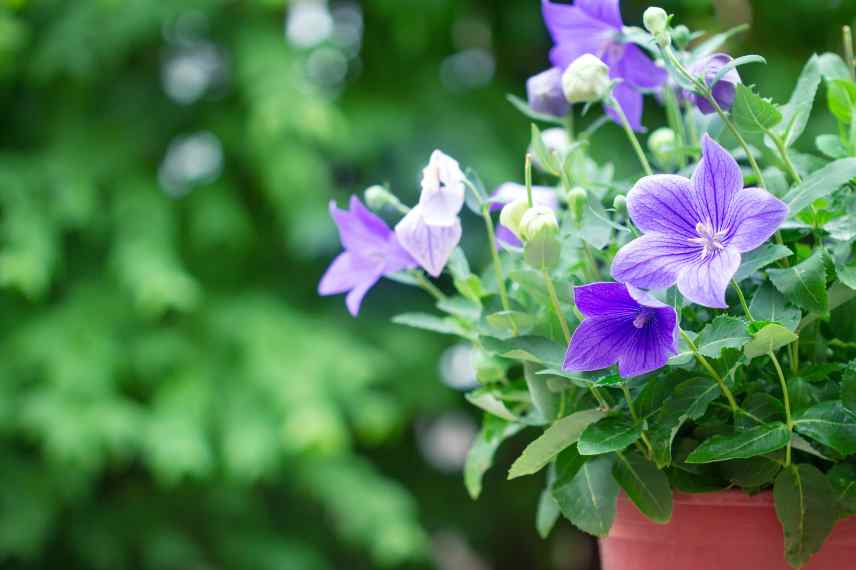
Platycodon ‘Astra Blue’, ‘Fuji White’ and ‘Mariesii’
Read also
Platycodon: planting, growing and careWhen to plant Platycodon in a pot?
Planting Platycodons in pots is best done in spring, between February and April, once last frosts have passed.
In regions with mild winters (short, light frosts), however, it can be carried out from autumn, between September and November.
Planting Platycodon in pots
Container
Platycodon produces semi-tuberous fleshy roots that take up space. Plan therefore for a container deep and wide enough, about 40 cm in all dimensions.
Choose a container with a drainage hole in the base, so that watering or rainwater can drain away without stagnating, which could rot the root system.
As for materials, any can do. Plastic is often considered less attractive but has the advantage of retaining moisture better. Terracotta allows the substrate to breathe more because of its porous nature, but will require more frequent watering.
Substrate
Platycodons grow in rather fertile soils rich in organic matter. They can tolerate calcareous conditions. However, these perennials require a well-drained (light) soil to avoid any stagnant moisture, especially in winter.
You can opt for a ready-made compost, for example for planters and pots or for borders and beds. If you prefer to make your own mix, use :
- 2/3 good-quality horticultural compost or garden soil that is not too heavy (clayey);
- 1/3 river sand or draining elements (clay pebbles, perlite, gravel…);
- 1 to 2 handfuls of mature household compost or well-rotted manure.
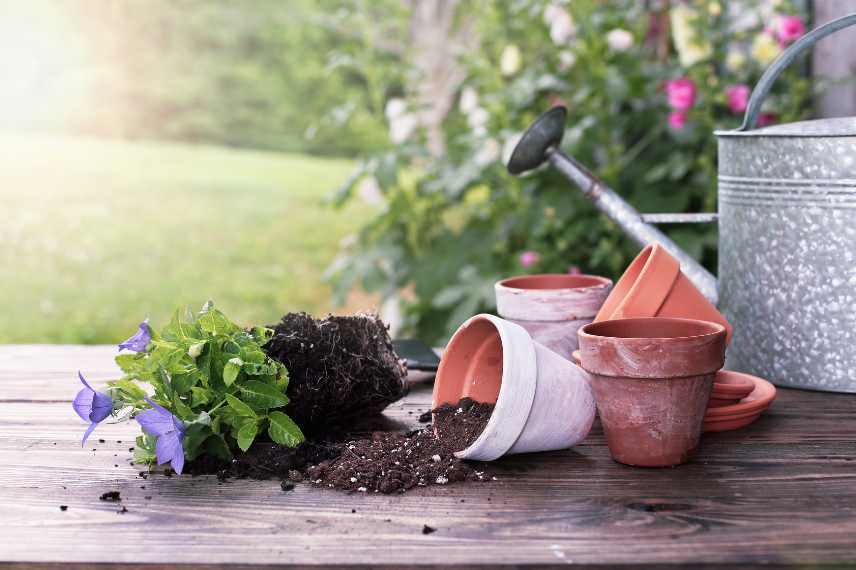
Planting Platycodon in a pot
- Half an hour before planting, rehydrate the rootball of your Platycodon in a container filled with room-temperature water (ideally rainwater). This will make it easier to remove the plant from its pot.
- Place a drainage layer about 3 to 5 cm thick in the bottom of the pot. Use gravel, terracotta shards or clay pebbles.
- Add substrate until it fills half the height of the container.
- Remove your Platycodon from its pot and set it in its new container. Top up with substrate until the rootball is well covered. If planting several Platycodons, space them about 30 cm apart.
- Firm the substrate around the rootball with your fingers to eliminate air pockets.
- Water generously.
- Apply an organic mulch (made of straw, hay, dead leaves, RCW or plant husks…), which will reduce evaporation of watering.
Exposure
Platycodons like sun but will prefer a partly shaded position in the warmest regions. They do not like the scorching sun of mid to late afternoon.
Avoid very windy sites, which can damage flower stems and reduce flowering.
Read also
Growing Campanulas in a potCaring for Platycodon in pots
Platycodons are easy-to-grow plants that require little maintenance. They do demand a little patience, however, as they are slow-establishing perennials that take time to develop their root system before flowering. Don’t be concerned if the plant is slow to restart in spring: it is a fairly late perennial that generally only gets going again around May.
Watering
Platycodons appreciate cool soil that never completely dries out. In these conditions, they can readily tolerate hot summers. So water as soon as the soil is no longer moist at the surface. When grown in pots, watering must be more frequent, as water evaporates faster than in the ground.
In spring and autumn, watering every 10 to 15 days is usually sufficient. In summer, plan on one to two waterings per week, depending on weather conditions.
You can use a saucer or place Platycodon in a cachepot, but make sure to empty them to remove any excess watering or rainwater after about thirty minutes.
In winter, Platycodon strongly dislikes excess moisture. Avoid leaving it in a permanently wet situation in damp regions and reduce watering to a minimum (only when the soil is dry in the top few centimetres).
Feeding
Platycodons are fairly hungry plants that appreciate soil rich in organic matter to flower well. This is especially true in pots, where nutrients tend to be depleted faster than in the ground.
In spring, you can apply fertiliser to promote flowering. You can choose liquid feeds to dilute in the watering water (fast boost effect but must be repeated regularly during the growth period) or solid fertilisers to place in the soil (less intense effect but longer lasting).
In all cases, choose fertilisers richer in potash rather than nitrogen, so foliage does not develop at the expense of flowers. In autumn, you can also add a handful of well‑rotted compost or manure, worked gently into the surface substrate with a fork.
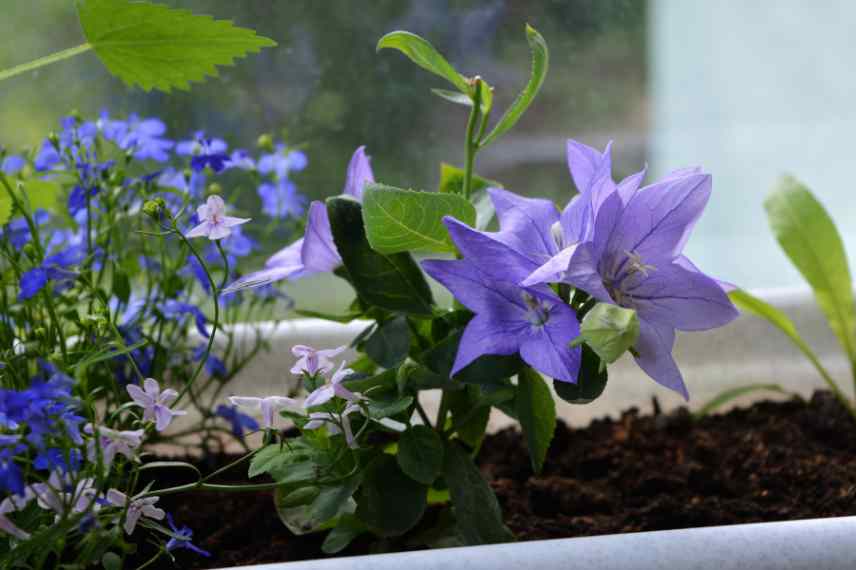
Platycodon grandiflorus and lobelia in a planter
Pruning
During the growing period, pruning is limited to removing spent flowers to encourage production of new buds. However, keep a few flowers if you want to collect seeds for sowing the following year.
In autumn, at the end of flowering, cut back the remaining flower stems. You can also cut the clump back to ground level or leave it until early spring to provide extra winter protection.
Always use cutting tools disinfected with alcohol to reduce the risk of spreading any disease.
Pests and diseases
Platycodons are fairly resistant to diseases.
In spring, slugs and snails may nevertheless feast on the young foliage. Find our control advice in the article Slugs: 7 ways to control them effectively and naturally. You will find various solutions, lethal or non-lethal depending on your preferences, to prevent them from devouring your Platycodons: traps, pellets, repellents, hand-collecting, etc.
Repotting
Once established, Platycodon does not like being moved, transplanted or repotted. Limit yourself therefore to a top‑dressing, replacing the first few centimetres of soil with fresh potting compost.
Propagation
Platycodon can be propagated by division, but the operation is risky. As stated, this perennial does not like to be disturbed. Divide only an ageing clump that no longer flowers well. Carefully remove the rootball from its pot and separate pieces of the clump that already have roots. Replant them quickly in a new container to avoid drying out. Water generously during the first weeks after transplanting, but never allow stagnant moisture.
Platycodon can also be raised from seed.
Overwintering
Platycodon is not an indoor plant: it will be perfectly fine left outside over winter. Very hardy, it can withstand frosts beyond −25°C, making it suitable even for our coolest regions.
Top growth will die back, but roots will have built reserves to ensure a good restart in spring.
- Subscribe!
- Contents
This form is protected by reCAPTCHA - the Google Privacy Policy and Terms of Service apply.

































Comments