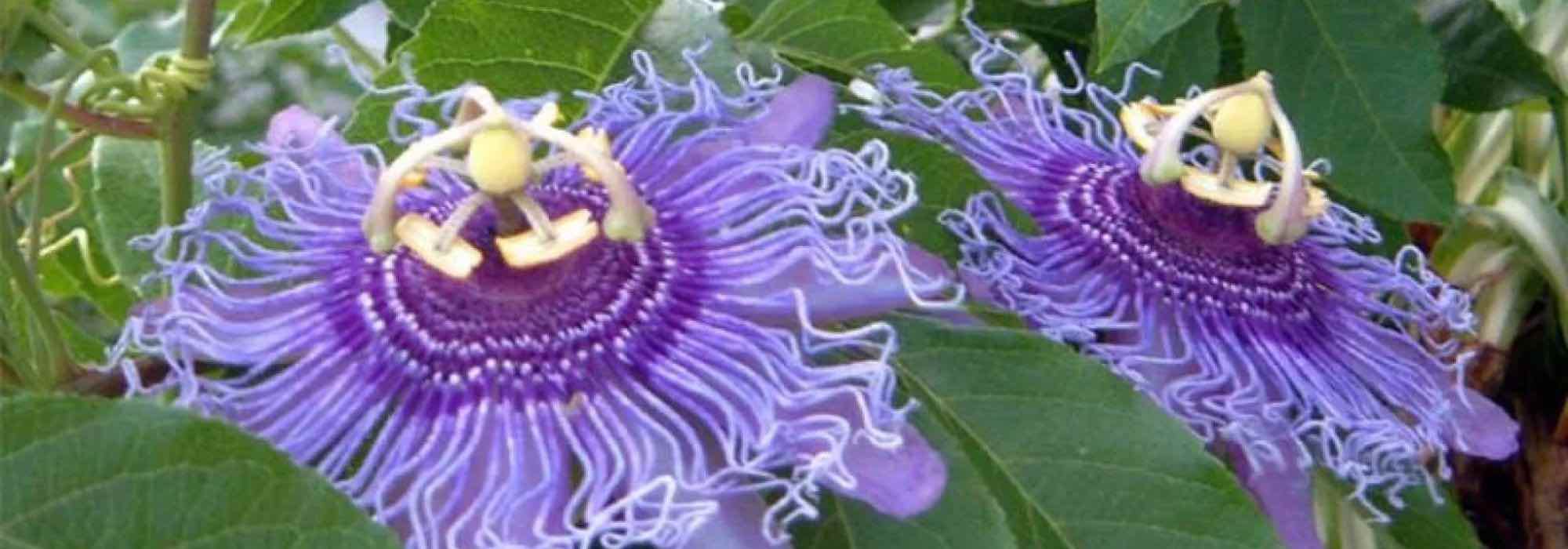
Passion flowers with mauve and violet flowers
Attractive and exotic flowers
Contents
Passion flowers are generous climbing plants with a distinctly exotic appearance. If Passiflora caerulea, or blue passion flower, is the most widely planted and hardiest species in France, many cultivars and species offer a range of colours. Varieties with mauve and violet flowers bring a touch of mystery and elegance to gardens and terraces.
Growing mauve or violet passion flowers is within everyone’s reach. Choose a sunny, sheltered position to encourage abundant flowering. These climbing plants need a support to cling to, such as a trellis or pergola.
In this article, let us explore seven varieties of passion flowers in shades of mauve and violet, each offering its own characteristics and benefits: some purely ornamental, others fruit-bearing, some fragrant and others not, and with varying degrees of hardiness.
Passion flower 'Fata Confetto' - Passiflora x incarnata
Passion flower ‘Fata Confetto’ is a remarkable hybrid derived from Passiflora x incarnata, developed in 2006 by Italian breeder Maurizio Vecchia. This variety, resulting from the cross between Passiflora ‘Guglielmo Betto’ and Passiflora cincinnata ‘Dark Pollen’, stands out for its large, fragrant purple flowers and its yellow-orange, ovoid fruits, which are delicious and sweet when ripe.
‘Fata Confetto’ tolerates temperatures down to -12 °C, but needs protection from cold and damp during its first few years.
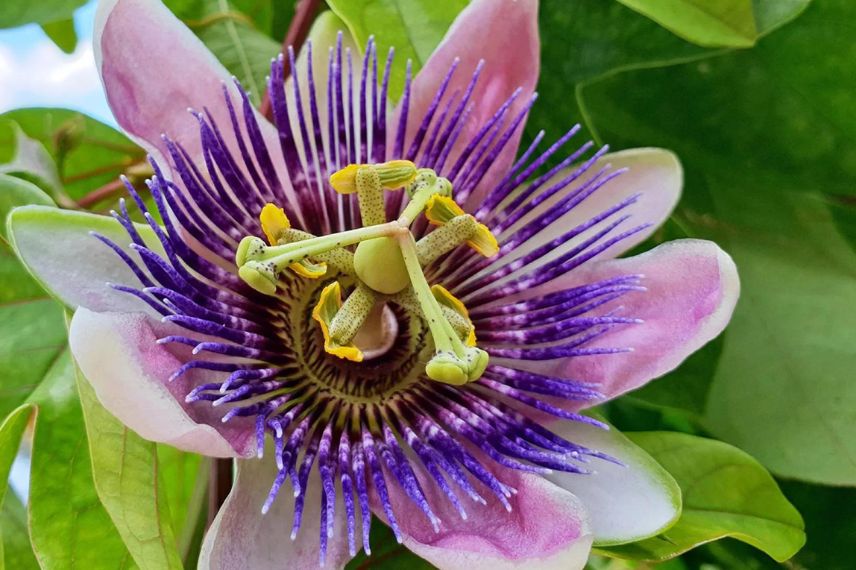
The voluble stems of this passion flower can reach 3 m in height in a single season. They bear glabrous leaves divided into three lobes, medium green with pale yellow veins. Flowering extends from June to October, with each stem able to carry up to 10 flowers measuring 8 cm in diameter. These are pleasantly fragrant and formed of greenish cream-white tepals with a crown of violet, ruffled filaments striped with white. The centre of the flower is occupied by 5 tiger-striped stamens with yellow anthers and 3 styles, also striped mauve.
It is useful for covering walls, fences and other supports. Paired with evergreen or winter-flowering climbers, it helps create a lively display all year round. It adds a touch of whimsy to an evergreen hedge.
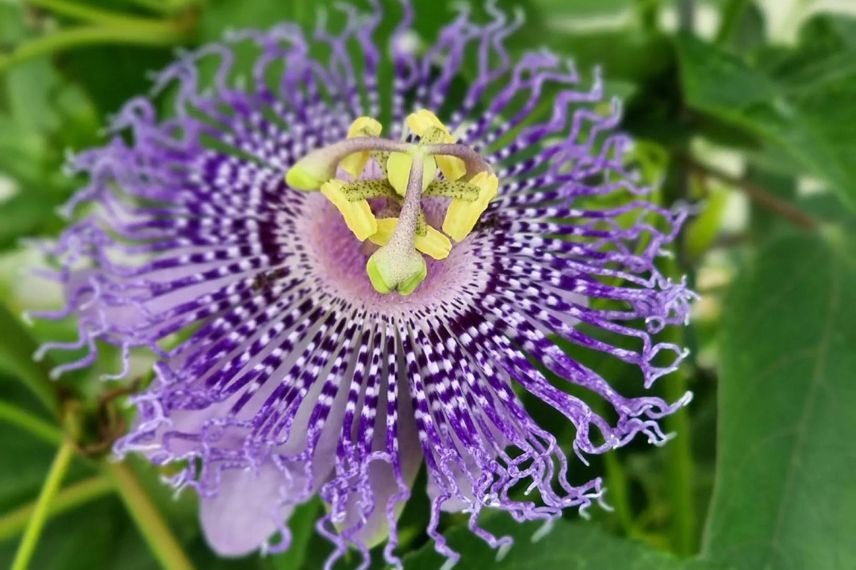
Passion flower - Passiflora incarnata
Passiflora incarnata, or official passion flower, is the species used in herbal medicine for its medicinal properties, in addition to its ornamental qualities. Its pale mauve, pleasantly fragrant flowers, crowned with curled filaments, open from summer to autumn and give rise to green fruits that turn yellow when ripe, and are edible and pleasantly flavoured.
Hardy down to -10 to -12 °C, Passiflora incarnata requires well-drained soil, a warm position in summer for optimum flowering and soil that is not too damp in winter, in other words, very well drained. It clings to its support using tendrils and can reach a height of 3 to 4 metres in a single season. The glabrous, glossy dark green leaves are deciduous in frosty conditions. Flowering sometimes continues until December in favourable climatic conditions.
This voluble liana is ideal for adorning walls, fences and trellises. Passion flower fruits are not only decorative, but also invite you to taste their unique flavour. This passion flower requires a second plant in order to produce fruit.
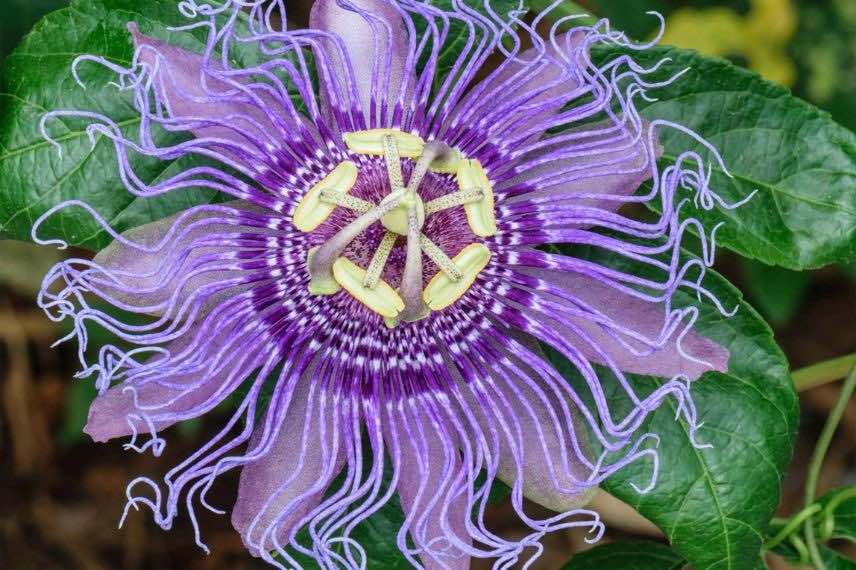
Passion flower 'Violacea' or 'Amethyst' - Passiflora violacea
The Passion flower ‘Violacea‘, also known as P. ‘Amethyst’, is one of the oldest horticultural hybrids of passion flowers, created in 1824 by the French botanist Loiseleur-Deslongchamps. This hybrid, the result of a cross between Passiflora caerulea from South America and the Brazilian Passiflora racemosa, is renowned for its vigour and hardiness. It has received the Royal Horticultural Society’s Award of Garden Merit.
‘Violacea’ stands out for its medium-sized flowers, an intense mauvish purple, with a crown of filaments sometimes striated with white or black and a greenish cream centre, lightly fragrant and occasionally producing a few hollow fruits. It flowers from summer to early autumn, with 5 to 6 cm-diameter flowers that are continuously renewed.
It reaches 4 m in height and spreads to 3 m, attaching itself with tendrils. Its quadrangular stems bear leaves divided into 3 to 5 ovate lobes, glossy dark green and sometimes coppery, and are more or less evergreen. The rare fruits are ovate and orange when ripe, and are often hollow and of no interest.
Easy to grow, Passiflora ‘Violacea’ thrives in light, fairly deep, well-drained soil and appreciates a sunny, sheltered site. Pruning after flowering helps maintain an attractive habit. It is suited to southern and Atlantic regions and to all areas where temperatures do not fall below -8° C.
Passion flower 'Eden'
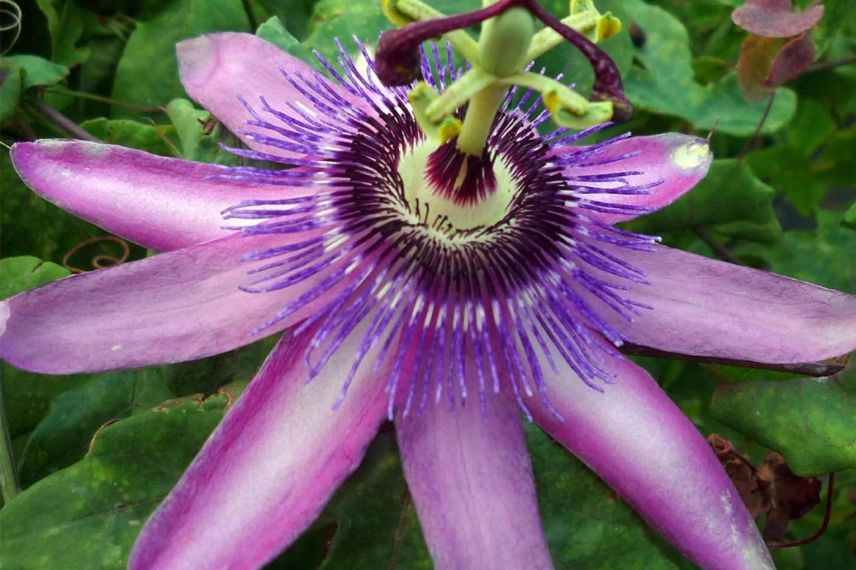
Passiflora ‘Eden’ is an elegant hybrid with mauve-purple flowers. Reaching up to 4 metres in height, it has deeply lobed, glossy dark green leaves that set off its spectacular flowers.
A cross between Passiflora caerulea and P. ‘Amethyst’, ‘Eden’ produces flowers largely inspired by ‘Amethyst’, with bluish filaments around a deep purple centre, and green stamens arranged in a star around three violet-purple stigmas. These impressive flowers, measuring 10 to 15 cm across, bloom from summer to autumn and are followed by decorative, but inedible, orange-yellow fruits.
Moderately hardy, Passiflora ‘Eden’ is suitable for growing in the ground only in the mildest regions. Elsewhere, it is ideal for growing in a container on a terrace or balcony, where it can be sheltered in a cool, bright place over winter. This passion flower can withstand brief periods of frost down to between -5 °C and -8 °C if its crown is well protected.
For growing, Eden prefers neutral to slightly acidic, moist but well-drained soil. It benefits from regular watering in summer, especially in Mediterranean climates. In the ground, it thrives in a sunny, sheltered position and can be trained against fences or trellises to maximise its visual impact. In a container, it can be pruned to control its size.
Passion flower 'Incense'
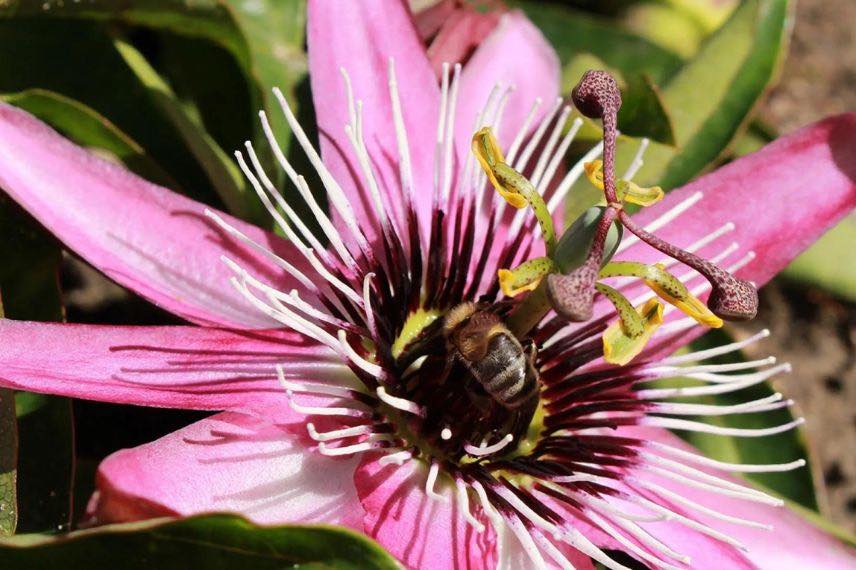
La Passiflora ‘Incense’, bred in Florida, USA, in 1973, is the result of cross-breeding between the cold-hardy Passiflora incarnata and the more tender P. cincinnata, which has contrasting flowers.
The flowers of Passiflora ‘Incense’ are highly fragrant and remarkable for their intense mauve-purple colour, with a strongly contrasting centre and purplish-blue filaments. They open from spring to autumn and attract a myriad of butterflies, creating a lively visual spectacle. The fruits that follow are ovate, green-yellow, edible and particularly fragrant.
This voluble plant can reach up to 5 metres in height, clinging to its support with tendrils. The hardiness of this passion flower allows it to survive temperatures down to -8 °C, although precautions are needed to protect the crown during cold winters.
Despite its hardiness, Passiflora ‘Incense’ may carry a virus which, although not very harmful to it, can affect other, more fragile passion flowers. It is therefore advisable to grow it separately, monitor aphids and disinfect the pruning tools used.
Passion flower 'Purple Passion'
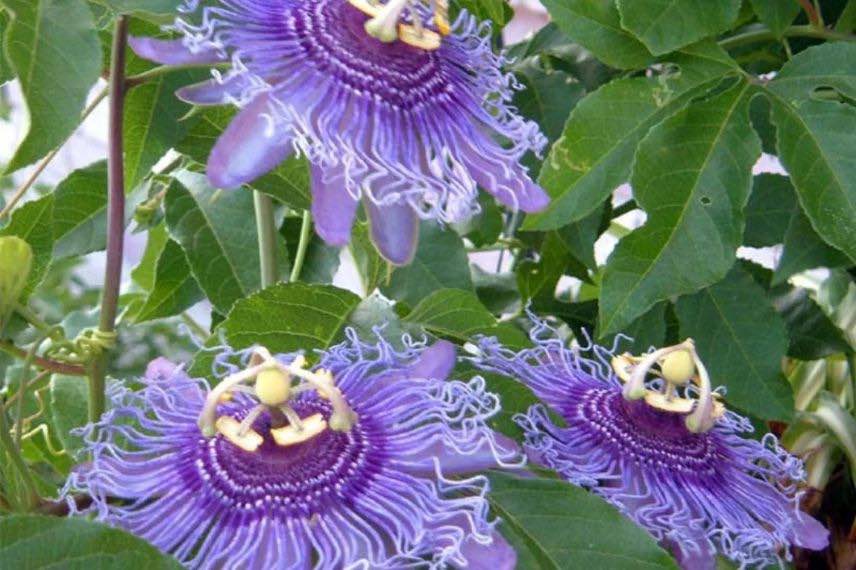
Passiflora ‘Purple Passion’ is a variety introduced to the market in 2009 by Dutch horticulturalists. This climbing plant can reach up to 7 metres in height, making it an ideal solution for concealing an unattractive wire fence or fence.
Its large, intensely mauve flowers, adorned with purple filaments and centred by four green stamens, are slightly scented and measure approximately 6 cm across. Although the oval fruits of this passion flower are edible, they are more notable for their orange colour than their flavour, with reddish flesh that is not very sweet or aromatic.
Mainly suited to southern and Atlantic regions, Passiflora ‘Purple Passion’ can survive temperatures down to -5 °C. It thrives in rich, moist, well-drained soil, in a sunny position sheltered from winds. In cooler climates, it is best grown in a large pot so that it can be brought indoors over winter.
Ideal for adorning walls, fences, wire fences, porches and trellises, Passiflora ‘Purple Passion’ is also an excellent choice for conservatories, where it can spend the winter without damage, bringing an exotic touch and a splash of colour even during the coldest months. Pruning, carried out at the end of flowering, helps maintain an attractive, compact habit.
Passion flower 'Impératrice Eugénie'
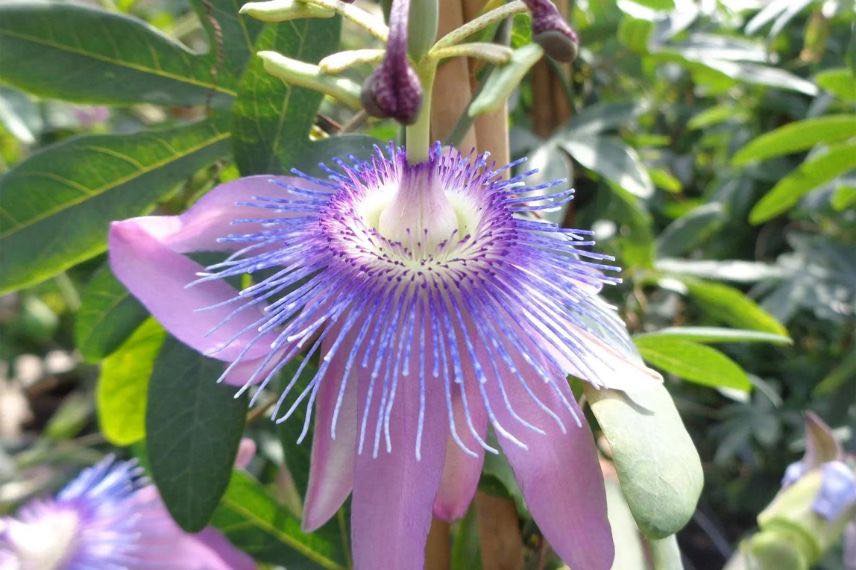
Passiflora x belotii ‘Impératrice Eugénie’, a hybrid between the hardy Passiflora caerulea and the delicate Amazonian Passiflora alata, is a climbing plant that can reach 4 to 5 metres in height when grown on a trellis. It develops trilobed leaves, deciduous to semi-evergreen depending on frost, and above all magnificent flowers in shades of white, pink, mauve and purple. These flowers, 10 to 12 cm in diameter, display a first crown of creamy white sepals, followed by slightly mauve-pink petals and a third crown of purplish-mauve filaments, surrounding yellow stamens and yellow-green stigmas.
Not very hardy, this passion flower only survives in the open ground in the mildest climates, where temperatures rarely fall below -5 °C. In colder regions, it is ideal as a conservatory or greenhouse plant, where it can be grown in a container to control its size.
In mild climates, Passiflora ‘Impératrice Eugénie’ is used to adorn walls, fences and trellises. In cold regions, this passion flower brings an unparalleled exotic touch when protected over winter in an unheated conservatory, providing continuous flowering and attractive foliage throughout the year.
- Subscribe!
- Contents
This form is protected by reCAPTCHA - the Google Privacy Policy and Terms of Service apply.

































Comments