The gypsy moth, a formidable pest for trees
Identification, life cycle and control of this moth and its caterpillars
Contents
Let’s get straight to the point! There is not one bombyx, but many bombyx species. Indeed, the term “bombyx” refers to several species of moths, including the mulberry silkworm, whose caterpillar is used in silk production. We will instead focus on bombyx encountered in our gardens, feared for the damage they can cause. Bombyx disparate, bramble bombyx, brown-bottom and golden-bottom bombyx, livery-patterned bombyx… all these moths share a tendency to give rise to defoliating caterpillars that feed on foliage of many trees and shrubs.
Let’s discover together how to distinguish these different bombyx, the damage they cause, and, above all, how to fight them effectively and naturally to protect plants in our gardens.

Different bombyx species: identification and life cycle
The word “bombyx” is a vernacular term referring to various species of Lepidoptera. These are moths whose caterpillars are polyphagous, meaning they feed on a very wide range of different plants. Needless to say, damage can quickly become severe… because these moths and caterpillars, all bearing more or less dense hairs, are very common in France.
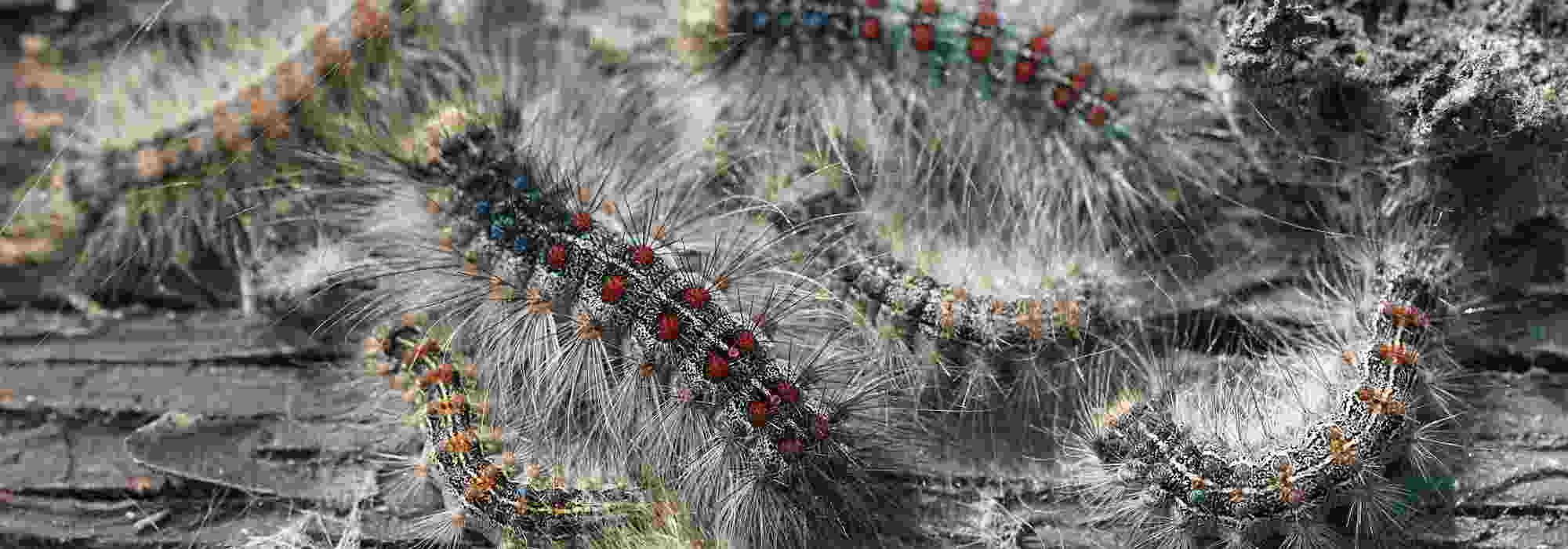
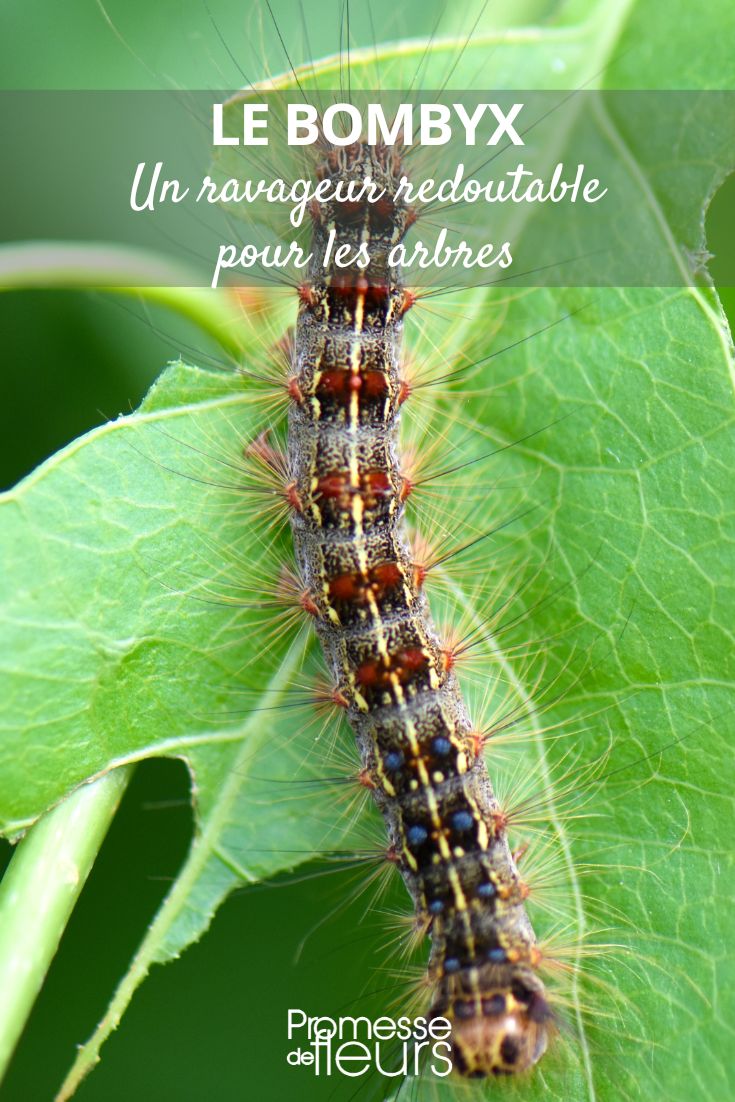
Among bombyx that cause most damage, the spongy moth (Lymantria dispar) ranks first. Adult female is recognisable by white wings speckled with black zigzags; male is brown and has feathery antennae that give it a rabbit-like appearance. Newly hatched caterpillar is black, then develops red warts that in some individuals turn blue, then grey at final larval stage. It also bears two black bands on head. Adult moths fly in July–August; females lay eggs, covered with a hairy felt, on bark of trees where they happen to be. Caterpillars hatch quickly and remain there through autumn and winter. In spring, from mid-May to July, they disperse, carried by wind on silk threads that can reach 7 m in length. Caterpillar then selects host plant where cycle will continue.
Brown-tail moth (Euproctis chrysorrhoea) is another feared bombyx, especially since its caterpillar is classed as urticating. This caterpillar is distinguished by two red warts on top of segments and a row of white streaks. In July, female lays eggs on a tree branch and covers them, too, with a mat of hairs. Once hatched, caterpillars select a leaf to cling to with silk threads throughout winter. In March they emerge, hungry for buds and young shoots.
Yellow-tail moth (Euproctis similis) is less common than previous species, but equally defoliating and urticating. Caterpillar has a black body with an orange-red dorsal line, white markings and other orange-red patterns. Female deposits eggs on underside of a leaf, which hatch very quickly. Caterpillars disperse immediately, spinning a small winter shelter from which they emerge in spring to continue development.
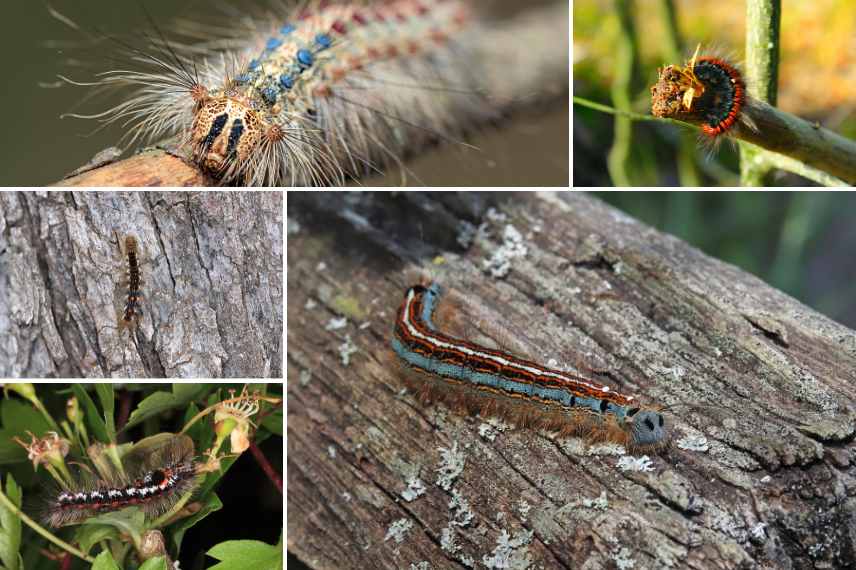
Spongy moth (top left), fox moth (top right), brown-tail and yellow-tail moths and lackey moth (large photo at right)
Fox moth (Macrothylacia rubi) is certainly the largest common caterpillar in France. With black and orange body, it is very hairy and slightly urticating. Between May and June, female lays eggs wherever she can, on a plant stem but also sometimes on a window ledge! Eggs are quite large and beige. Emerging caterpillars disperse in search of food. Secretive during early stages, they are most visible in late summer when seeking shelter for winter and later for pupation — for example on a road, basking in sun!
Last commonly seen bombyx in gardens is lackey moth (Malacosoma neustria), also called ringed bombyx or tree lackey. This non-urticating caterpillar is easy to recognise by blue head marked with two black dots and body streaked with orange, blue and white lines. In August female lays eggs spirally around a stem. After spending autumn and winter protected, caterpillars emerge in early April and spin a communal web. At final larval stage they disperse and spin a small cocoon between two leaves.
Which plants do bombyx favour?
Polyphagous, the various bombyx caterpillars each have their preference! The spongieuses, that is, the caterpillars of bombyx disparate, favour deciduous trees but also feed on conifers. In France, they have a voracious appetite for oaks (Quercus), beech (Fagus sylvatica), chestnut (Castanea sativa), hornbeams (Carpinus) and fruit trees such as apple trees, pear trees, wild and cultivated Prunus. They also attack birches (Betula), alders (Alnus), willows (Salix), lindens (Tilia) and even pines (Pinus) and firs (Abies), spruces (Picea), larches (Larix)… And when populations are high, if food becomes scarce, bombyx disparate turn to herbaceous and shrubby vegetation.
The caterpillars of bombyx de la ronce target plants in the Rosaceae family, starting with brambles (Rubus), but also dog-roses (Rosa canina) and roses (Rosa), blackthorns (Prunus spinosa), cinquefoils (Potentilla), heathers (Erica and Calluna), blueberry (Vaccinium), creeping willow (Salix repens)…
Caterpillars of bombyx cul-brun and bombyx cul-doré are found on fruit trees, hawthorns (Crateagnus), elms (Ulmus), willows (Salix), hazel (Cotinus), strawberry tree (Arbutus unedo), rowan (Sorbus aucuparia)…
Finally, bombyx à livrée have more or less the same targets, with a predilection for fruit trees where nests are found on branches.
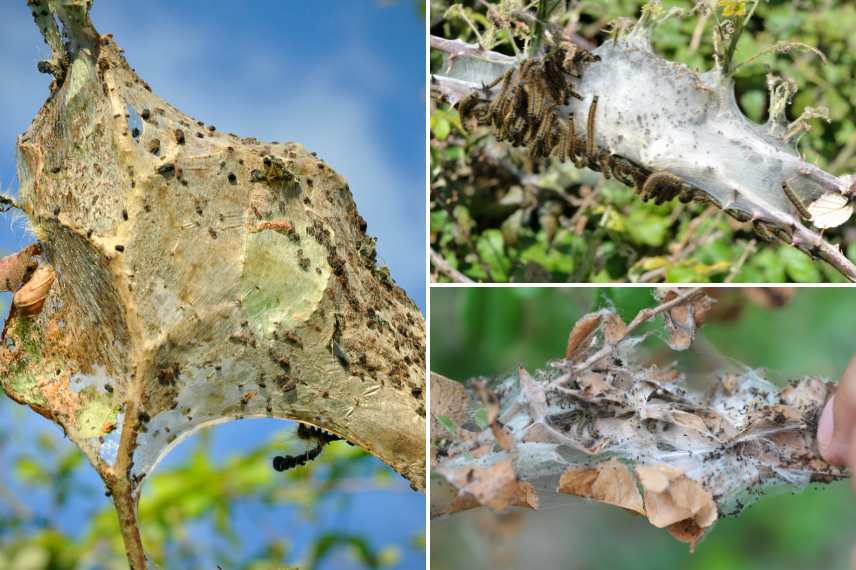
Different cocoons of several bombyx species
Most of these bombyx (apart from bombyx disparate) cause only relatively minor damage to trees. Often, growth is delayed, because after caterpillar attack the tree must regrow its foliage. Fruit production of fruit trees is little affected. By contrast, bombyx disparate is responsible for total defoliation of thousands of hectares of oak, beech and hornbeam woodland in some parts of France in the 2020s. These outbreaks were favoured by drought episodes. According to observations, outbreaks appear to have declined since 2022 in some regions, while increasing elsewhere, for example in Corsica, Gers and Haute-Garonne in spring and summer 2024.
How to fight effectively?
As each of these bombyx have slightly different life cycles, control measures are adapted. However, natural regulation is fairly effective. Indeed, most bombyx have their own predators and parasites. They are thus parasitised by hymenoptera, tachinid diptera, nematodes, certain insects (coleoptera, bugs, ants…), viruses, fungi and bacteria.
In terms of predators, bombyx also pay a heavy toll. Although covered in hairs, bombyx caterpillars attract the attention of birds. Thus, the tits and goldcrests enjoy feasting on disparate bombyx caterpillars, as do cowslip and the great spotted woodpecker. By contrast, the urticating properties of bombyx cul-brun and bombyx cul-doré deter insectivorous birds. As for the caterpillars of the bramble bombyx, they are mostly crushed on roads when searching for a winter refuge. Promoting biodiversity in your garden thus helps prevent these bombyx attacks.
In private gardens, the disparate bombyx is the one to fear most. And the best way to control it is to destroy this year’s egg masses, which are very visible on tree trunks. Wearing gloves, simply scrape off these masses and burn them. The other biological control method involves using a specific treatment based on Bacillus thuriengiensis, which proves effective against the various larval stages.
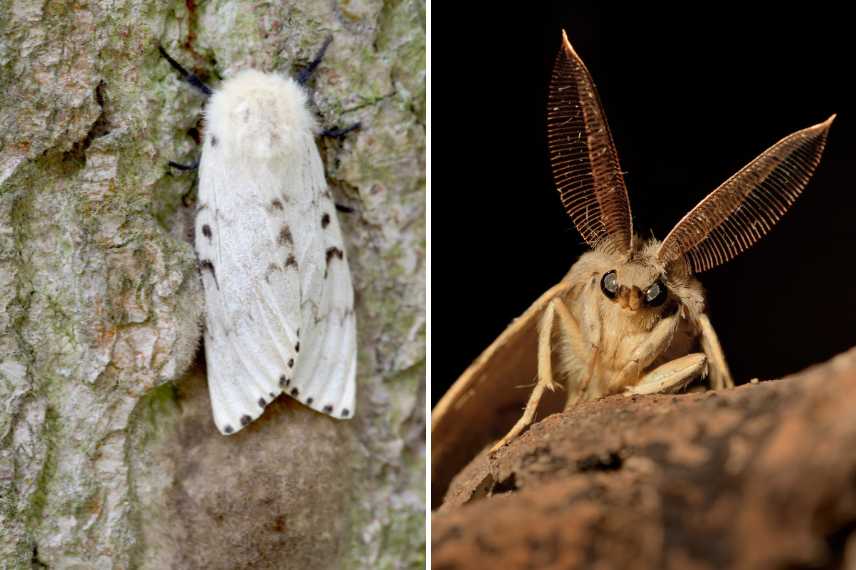
Female and male imagos of disparate bombyx, flight visible from mid-July to mid-August
Finally, there are sexual pheromone trapping systems that can be set during the adults’ flight between mid-July and mid-August.
Further reading :
- Subscribe!
- Contents
This form is protected by reCAPTCHA - the Google Privacy Policy and Terms of Service apply.

































Comments