Carlina acanthifolia - Carline Thistle
Carlina acanthifolia - Carline Thistle
Carlina acanthifolia - Carline Thistle
Carlina acanthifolia - Carline Thistle
Carlina acanthifolia - Carline Thistle
Carlina acanthifolia - Carline Thistle
Carlina acanthifolia - Carline Thistle
Carlina acanthifolia
Carline Thistle, Acanthus-leaved Carline Thistle
Back-to-school special offer!
Get €10 off for every €50 you spend! And get up to €40 off on a single order.
How does it work?
1. Shop your favourites
Add your favourite plants to your basket. For every €50 you spend (excluding delivery charges, store credit and the plastic-free option), you’ll receive a €10 voucher.
€50 spent = €10 voucher
€100 spent = €20 voucher
€150 spent = €30 voucher
€200 spent = €40 voucher
2. Place your order
Once your basket reaches one of the spending thresholds, place your order. You can even choose your delivery date!
3. Receive your voucher
As soon as your order has been shipped, you’ll receive an email containing your personal voucher code and its value.
4. Use it on your next order
Your voucher is valid for 90 days from the date you receive it. It can be used once only, on a new order worth at least the value of the voucher, excluding delivery charges.
Please note: Vouchers can be combined with other offers, but cannot be split or refunded.
Why not try an alternative variety in stock?
View all →
Available in 1 sizes
This plant carries a 12 months recovery warranty
More information
We guarantee the quality of our plants for a full growing cycle, and will replace at our expense any plant that fails to recover under normal climatic and planting conditions.
Would this plant suit my garden?
Set up your Plantfit profile →
Description
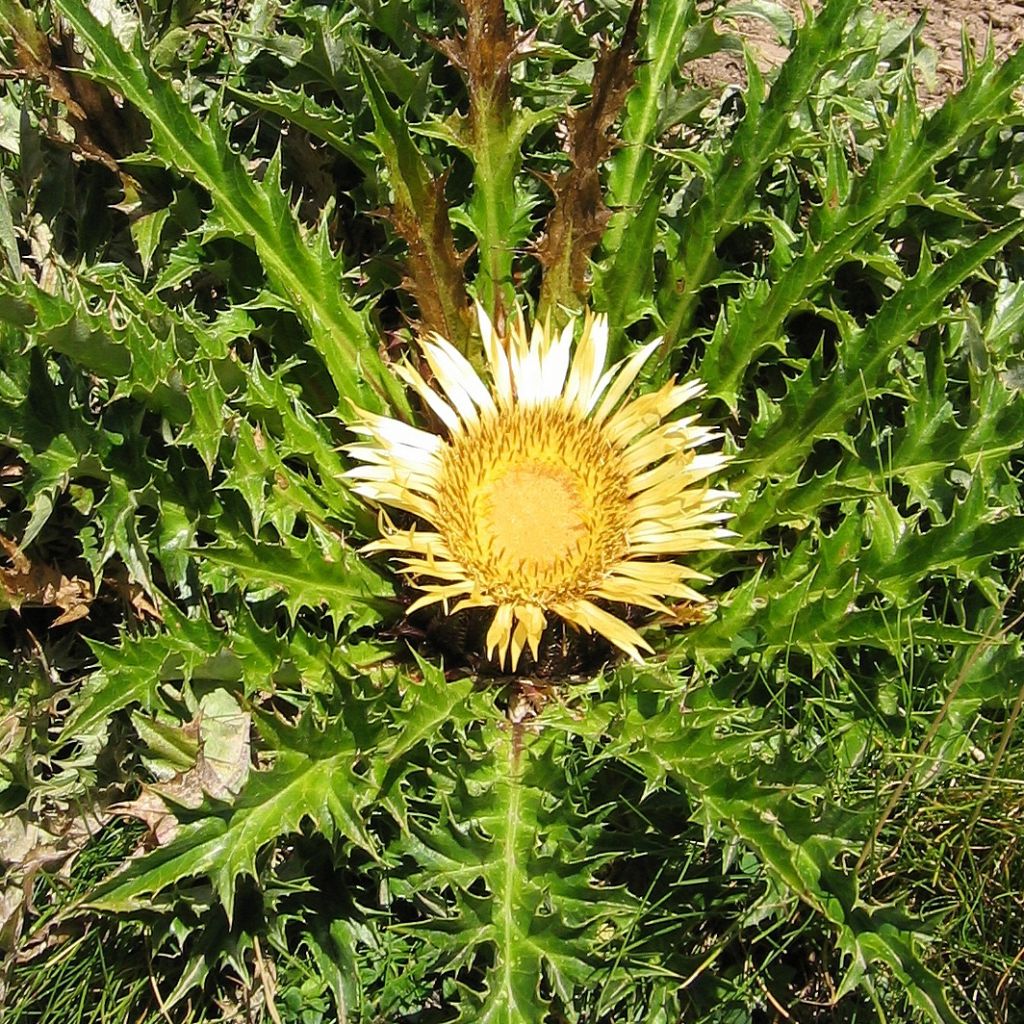
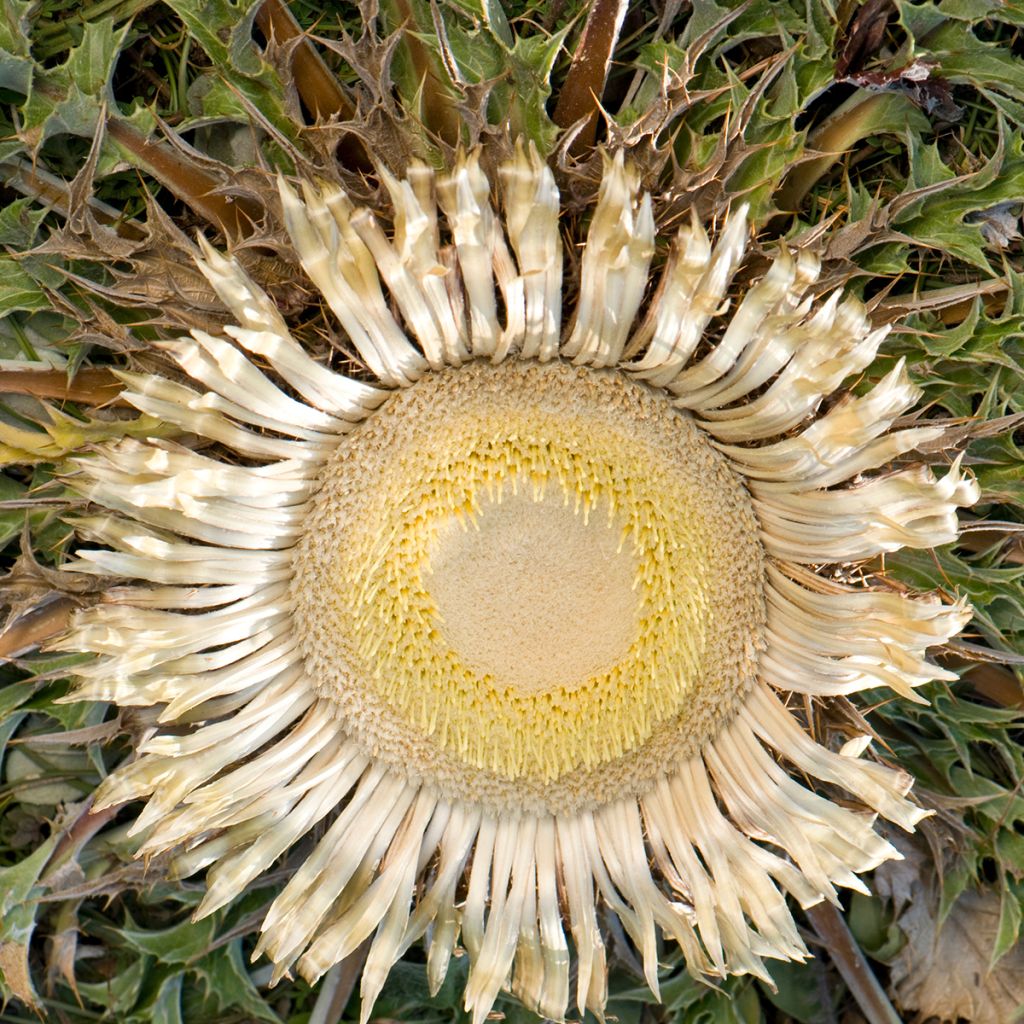
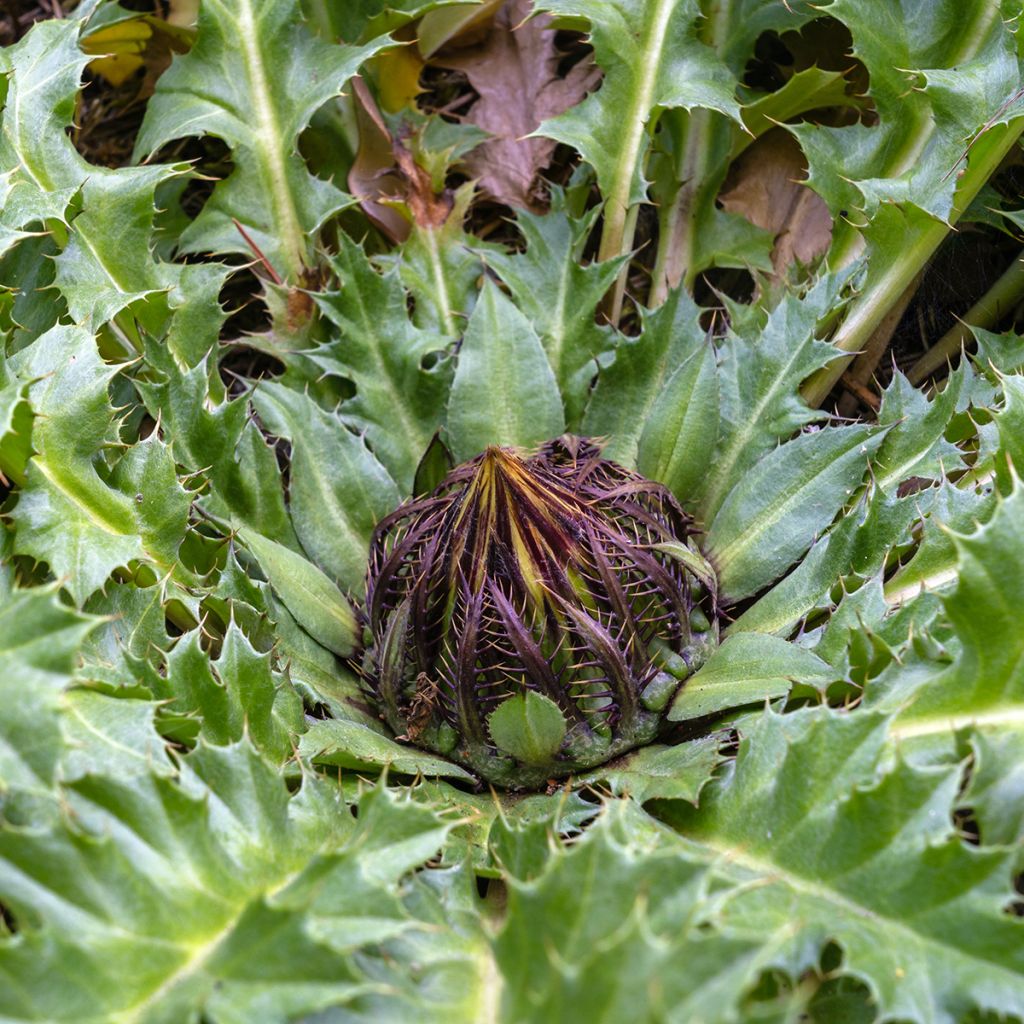
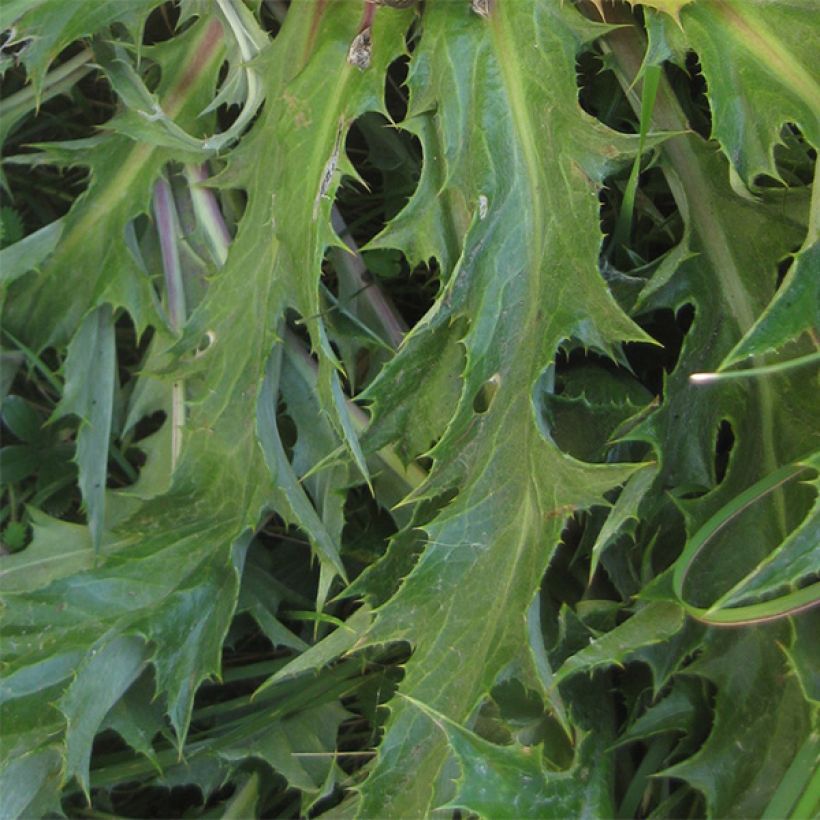
Carlina acanthifolia, the acanthus-leaved carline, is one of the most beautiful plants for dry rock gardens for enthusiasts of graphic flowers on poor soil. Its spiny rosette, pressed flat to the ground, produces in summer a large, straw-yellow to golden head adorned with silvery bracts. Sometimes called cardabelle or sun-thistle, this beautiful species from the southern mountains is both very hardy and drought-tolerant.
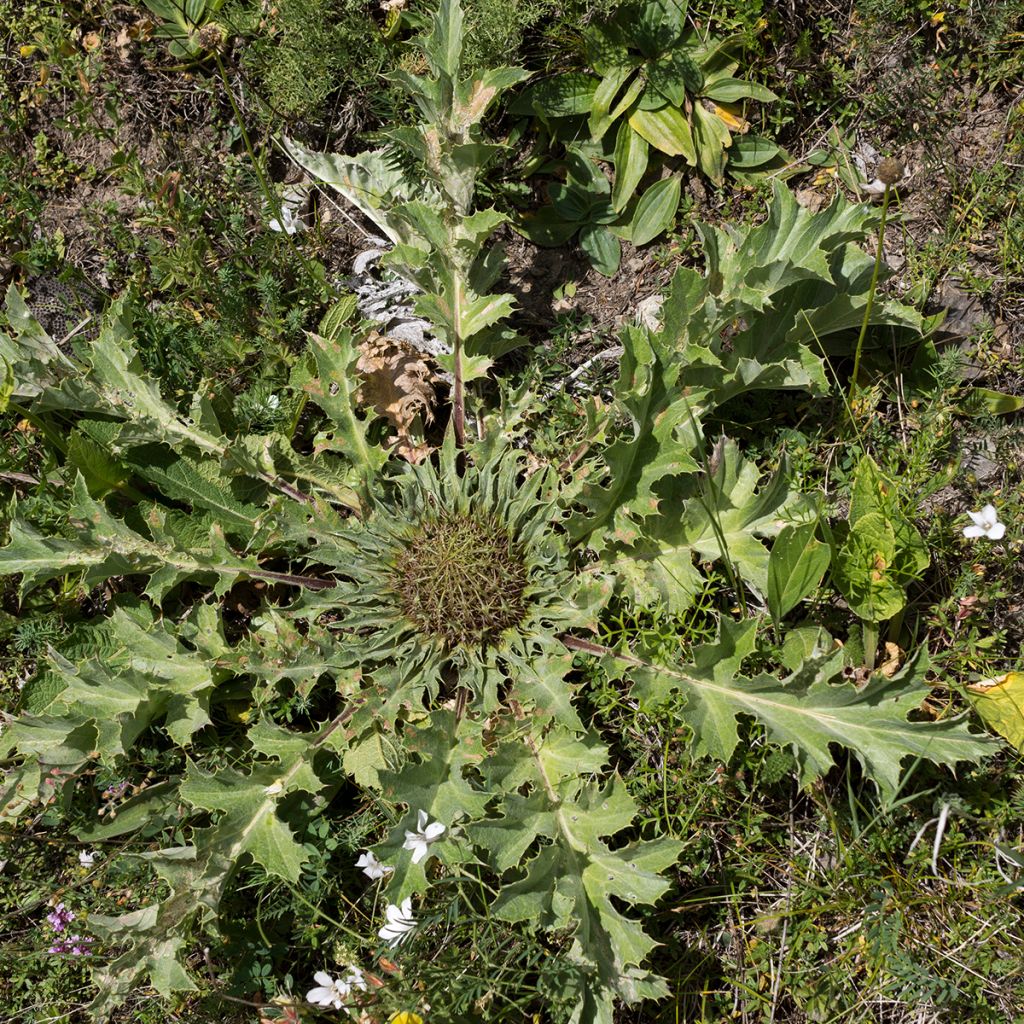
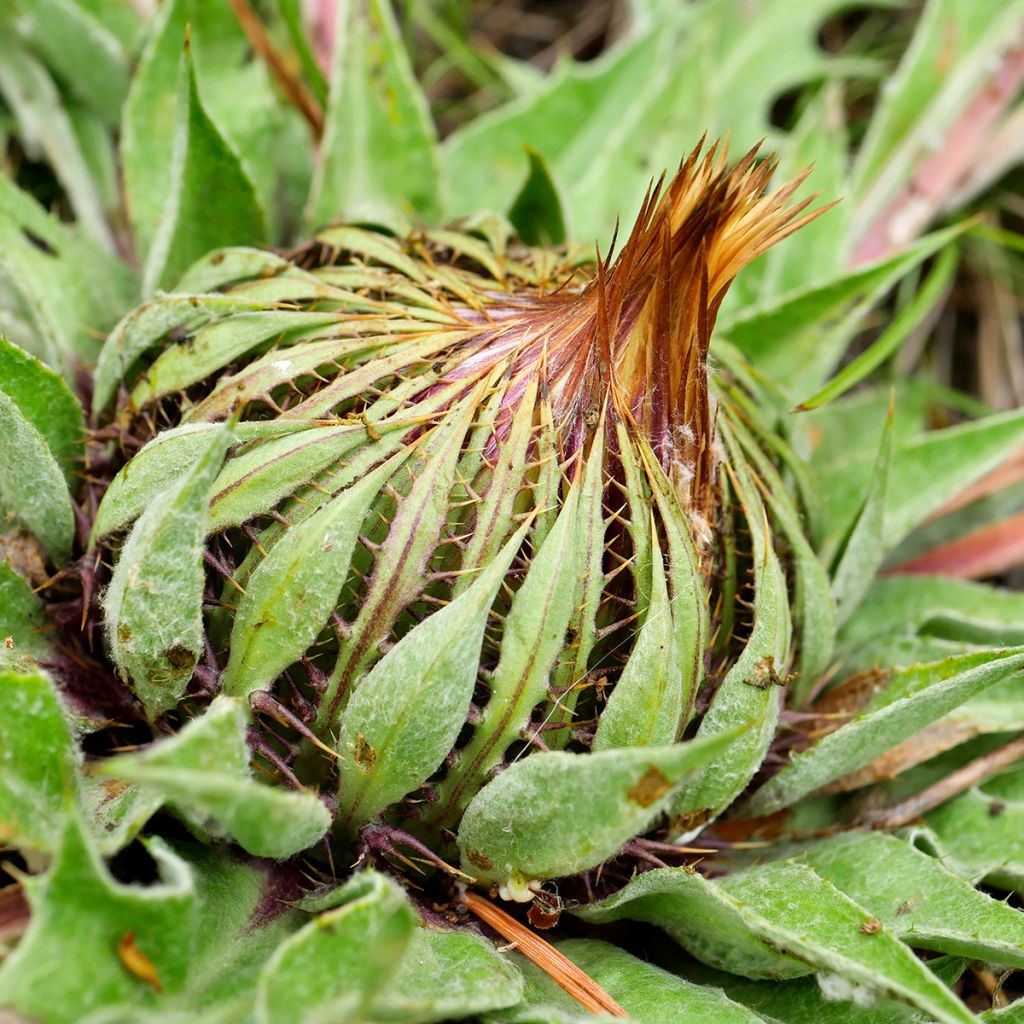
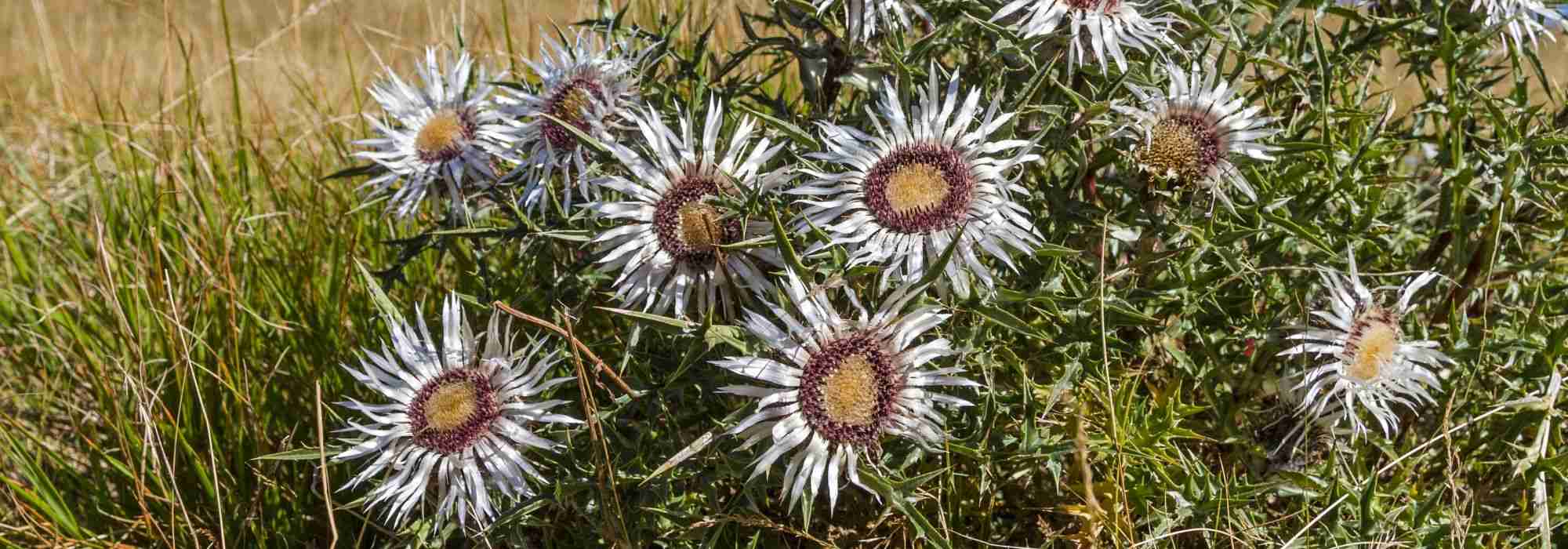
This wild plant belongs to the Asteraceae family. Its most commonly used vernacular names are acanthus-leaved carline, cardabelle, sun-thistle, chardousse and shepherd's barometer. Its main botanical synonyms are Carlina acanthifolia var. argentea, Carlina chardousse and Chromatolepis magna. It is a short-lived perennial, more or less semelparous: it can devote one or more seasons to forming its rosette, flower, then disappear after producing its seeds. In a suitable soil, a few seedlings can ensure its continuity. It grows naturally in dry lawns, rocky meadows, the Causses, open slopes and calcareous soils of mountains or mid-altitude. It is found in Europe, particularly in France, Spain, Italy and further east to the Balkans and Ukraine. This plant does not exceed 5 to 10 cm in height, but its rosette can spread 30 to 40 cm. The leaves are large, deeply cut, tough, spiny on the lobes, of a grey-green to whitish colour, lighter on the underside. They are arranged in a circle, pressed flat to the ground, and remain decorative for a good part of the year. Flowering occurs from July to September. The inflorescence is a solitary head, stemless, measuring 10 to 15 cm in diameter. What one first takes for petals corresponds to the inner bracts of the involucre, long, radiating, pale yellow, straw-yellow or golden. In the centre, the small tubular flowers form a dense disc, visited by bees and butterflies. The fruits are achenes with an egret that will be dispersed by the wind. The carline develops a taproot well adapted to drought, but which tolerates transplanting poorly.
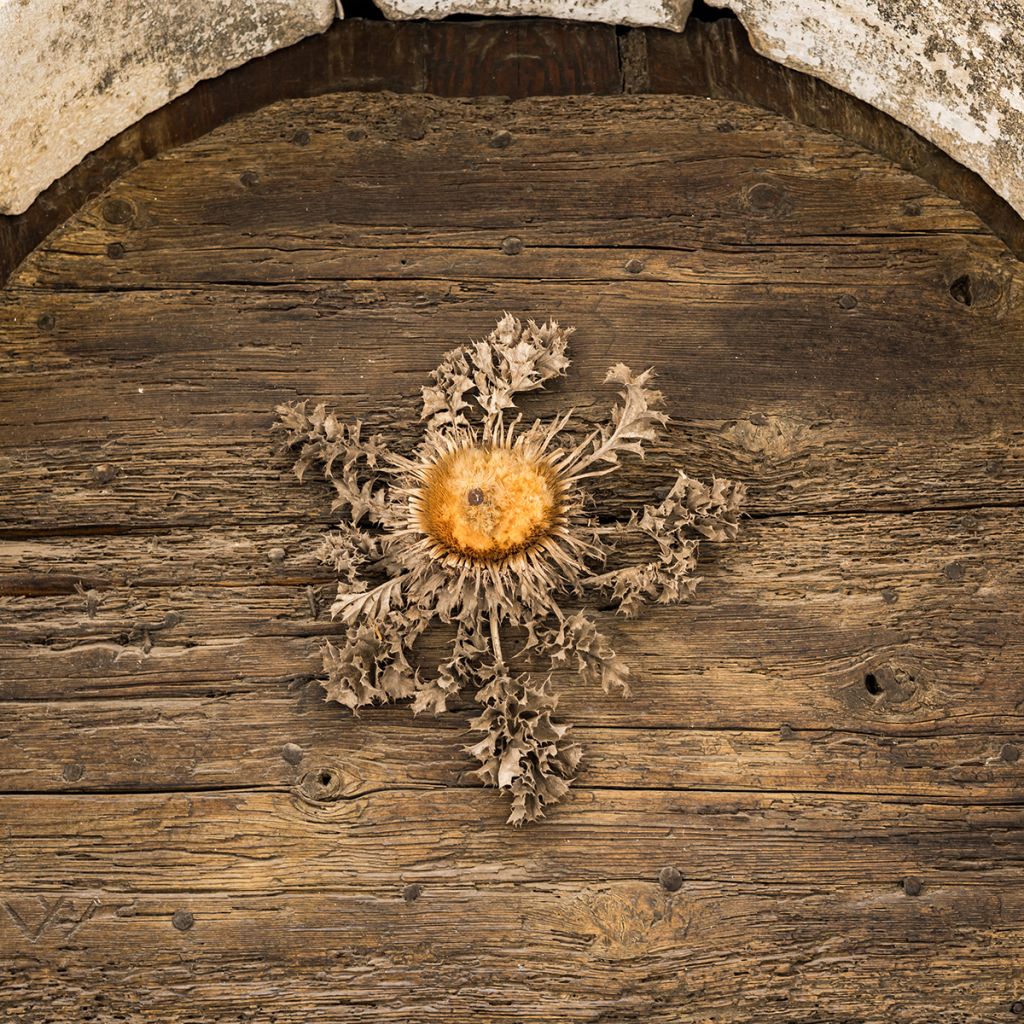
The cardabelle is linked to a well-known tradition of the Causses: its dry head was fixed on doors, both as a good luck charm and as a natural barometer, because it closes when the air becomes humid. Plants observed in the wild should not be picked: this species is protected or regulated in several French regions.
In the garden, plant this carline in full sun, among stones, in a stony, calcareous soil that dries quickly after rain. It is used alone or in small groups, as its rosette cannot tolerate competition from overly spreading perennials. You can pair it with other dry-ground plants such as the low-growing Teucrium ackermannii , the Festuca glauca ‘Elijah Blue’ which forms small blue tufts around it, the Santolina ‘Lemon Fizz’ , and thistles from Echinops (azure balls).
Carlina acanthifolia - Carline Thistle in pictures

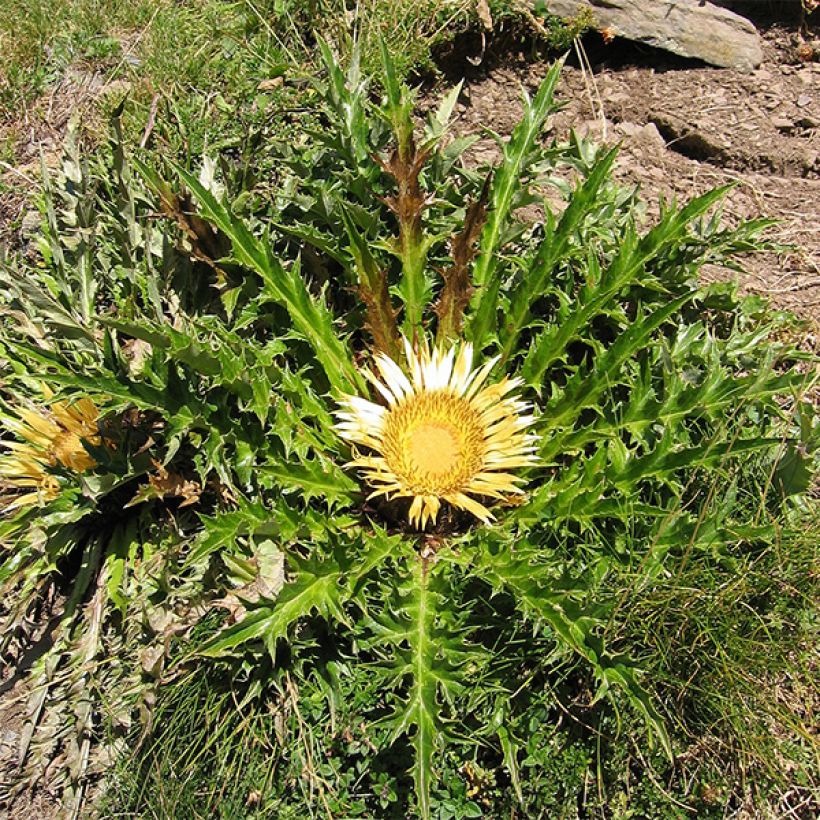
Flowering
Foliage
Plant habit
Botanical data
Carlina
acanthifolia
Asteraceae
Carline Thistle, Acanthus-leaved Carline Thistle
Carlina acanthifolia var. argentea, Carlina chardousse, Chromatolepis magna
Central Europe, Southern Europe
Planting and care
Plant Carlina acanthifolia in spring or early autumn, in full sun, in a warm and open position. It requires poor to moderately fertile soil, very well-drained, preferably calcareous, stony or sandy. In clay soil, plant it on a mound, in a raised rock garden, or in a mix heavily enriched with gravel, as stagnant moisture in winter causes the collar to rot. Avoid applications of rich compost, fertilisers, and thick organic mulches. Water only at planting, then for a few weeks if the weather remains dry. Once established, it tolerates drought very well and requires almost no care. Do not move an established plant: its taproot breaks easily. The dry head can remain in place for several months; cut it off when it deteriorates or let it mature if you wish to encourage some spontaneous seedlings.
Planting period
Intended location
Care
Planting & care advice
-
-
-
-
-

-

-

-

This item has not been reviewed yet - be the first to leave a review about it.
Recently viewed products
Haven't found what you were looking for?
Hardiness is the lowest winter temperature a plant can endure without suffering serious damage or even dying. However, hardiness is affected by location (a sheltered area, such as a patio), protection (winter cover) and soil type (hardiness is improved by well-drained soil).

The flowering period indicated on our website applies to countries and regions located in USDA zone 8 (France, the United Kingdom, Ireland, the Netherlands, etc.)
It will vary according to where you live:- In zones 9 to 10 (Italy, Spain, Greece, etc.), flowering will occur about 2 to 4 weeks earlier.
- In zones 6 to 7 (Germany, Poland, Slovenia, and lower mountainous regions), flowering will be delayed by 2 to 3 weeks.
- In zone 5 (Central Europe, Scandinavia), blooming will be delayed by 3 to 5 weeks.
In temperate climates, pruning of spring-flowering shrubs (forsythia, spireas, etc.) should be done just after flowering.
Pruning of summer-flowering shrubs (Indian Lilac, Perovskia, etc.) can be done in winter or spring.
In cold regions as well as with frost-sensitive plants, avoid pruning too early when severe frosts may still occur.
The planting period indicated on our website applies to countries and regions located in USDA zone 8 (France, United Kingdom, Ireland, Netherlands).
It will vary according to where you live:
- In Mediterranean zones (Marseille, Madrid, Milan, etc.), autumn and winter are the best planting periods.
- In continental zones (Strasbourg, Munich, Vienna, etc.), delay planting by 2 to 3 weeks in spring and bring it forward by 2 to 4 weeks in autumn.
- In mountainous regions (the Alps, Pyrenees, Carpathians, etc.), it is best to plant in late spring (May-June) or late summer (August-September).
The harvesting period indicated on our website applies to countries and regions in USDA zone 8 (France, England, Ireland, the Netherlands).
In colder areas (Scandinavia, Poland, Austria...) fruit and vegetable harvests are likely to be delayed by 3-4 weeks.
In warmer areas (Italy, Spain, Greece, etc.), harvesting will probably take place earlier, depending on weather conditions.
The sowing periods indicated on our website apply to countries and regions within USDA Zone 8 (France, UK, Ireland, Netherlands).
In colder areas (Scandinavia, Poland, Austria...), delay any outdoor sowing by 3-4 weeks, or sow under glass.
In warmer climes (Italy, Spain, Greece, etc.), bring outdoor sowing forward by a few weeks.
Shipping country and language
Your country of residence may be:
Your country of residence is:
For a better user experience on our website, you can select:
Your shipping country:
-
 Austria
-
 Belgium
-
 Bosnia & Herzegovina
-
 Bulgaria
-
 Croatia
-
 Cyprus
-
 Czechia
-
 Denmark
-
 Estonia
-
 Finland
-
 France
-
 Germany
-
 Greece
-
 Hungary
-
 Iceland
-
 Ireland
-
 Italy
Italy
-
 Latvia
-
 Liechtenstein
-
 Lithuania
-
 Luxembourg
-
 Malta
Malta
-
 Netherlands
-
 Poland
-
 Portugal
-
 Romania
-
 Serbia
-
 Slovakia
-
 Slovenia
-
 Spain
Spain
-
 Sweden
-
 Switzerland
Language:
-
French
-
 English
-
Spanish
-
Italian
-
German
-
Portuguese
-
Dutch
-
Finnish
My Account
Hello
My wish lists
My cart
Log in / Register
Existing customer?
This form is protected by reCAPTCHA - the Google Privacy Policy and Terms of Service apply.
New customer?
Create an account to track your orders, access our customer service and, if you wish, make the most of our upcoming offers.