


Fragrant hyacinth varieties to discover
Our tips for the garden and home
Contents
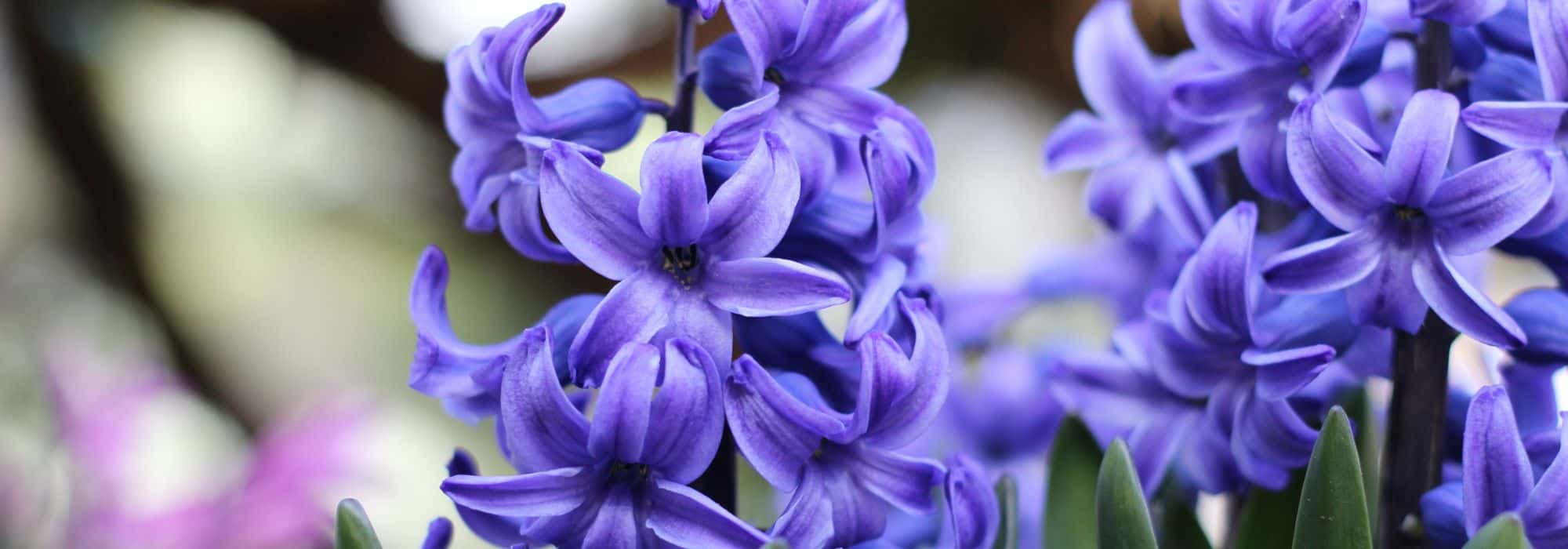
Hyacinths are among the most popular bulbs for their generous flowering and enchanting fragrance. They are equally at home indoors in the heart of winter as in the garden’s spring borders. Certain varieties boast a powerful fragrance, while others, more natural like the wild hyacinth, captivate with their understated charm. Discover our selection of hyacinth bulbs that smell wonderful and our tips for making the most of their fragrance.

Scented hyacinth varieties
Horticultural varieties of fragranthyacinths
Scented hyacinths that we admire indoors at Christmas and those that flower naturally in the garden in spring belong to the same horticultural varieties.
Everything depends on cultivation: forced in pots and placed indoors, they become the famous Christmas hyacinths, diffusing their fragrance at the heart of winter; planted in the ground in autumn, they develop in the garden as soon as good weather returns in spring.
All hyacinths are more or less scented, but some varieties stand out for a stronger fragrance. In general, the blue or violet hyacinths emit a more powerful scent, while the white and yellow ones offer a softer and lighter fragrance.
Thus, the hyacinth ‘Delft Blue’, with lavender-blue flowers, is renowned for its rich fragrance, while ‘Carnegie’, white and elegant, is seduced by its more subtle fragrance.
The hyacinth ‘Fondant‘, with bright pink flowering, combines brilliance and fragrance, while ‘Woodstock’, a deep purple colour, impresses with its lasting fragrance.
For a more delicate ambience, ‘City of Haarlem’ brightens spring scenes with its pale yellow flowers, and ‘Blue Pearl’, blue-violet, combines vibrant colour with a generous fragrance.
Note: At Promesse de fleurs, we offer bulbs to plant hyacinths in the garden to enjoy their spring flowering, but also the bulbs prepared for forcing that perfume the house from winter.
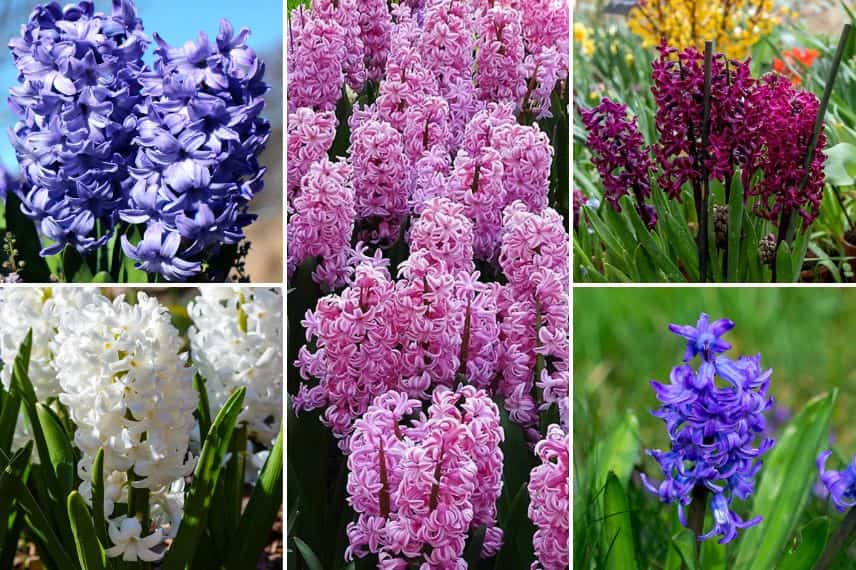
On the left: Delft Blue hyacinths and Carnegie; in the middle: Fondant hyacinth; on the right: Woodstock and Blue Pearl.
The wild hyacinth
Less well known, but just as charming, the wild hyacinth, also called bluebell (Hyacinthoides non-scripta), delights with its simplicity and light, delicate scent. It grows naturally in light woodlands, forming extensive blue carpets in spring. It is finer and more slender than the horticultural varieties, but brings a natural, rustic atmosphere to the garden. Its presence also supports biodiversity, attracting the early pollinators of spring.

wild hyacinth (Scille Nutans)
Read also
Hyacinth: planting, growing and carePlanting fragrant hyacinths
In open ground
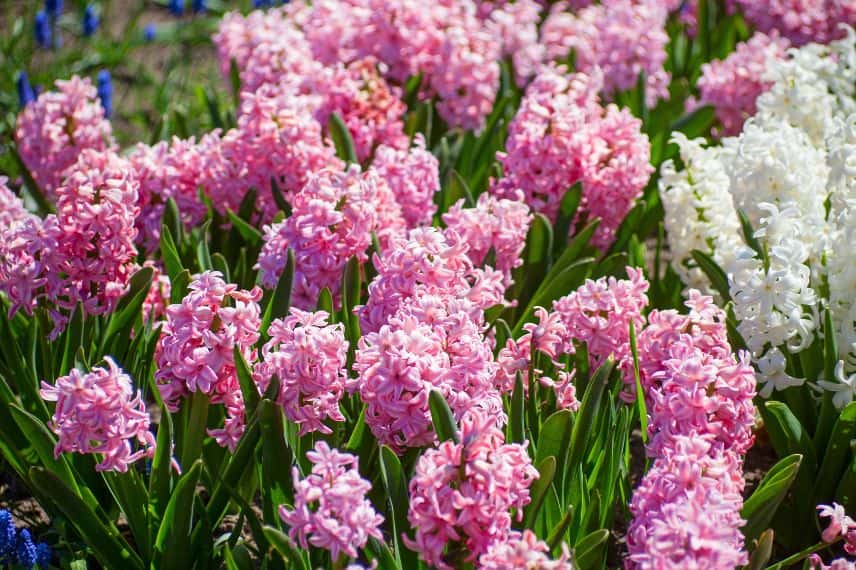
To enjoy their flowering, fragrant hyacinth bulbs are planted in autumn, in light, well-drained soil, at a depth equal to twice their height. It is advisable to install them in groups of 7 to 15 bulbs, spaced 10 cm apart, to create a lovely effect.
You can mix well-rotted compost into the soil at planting or apply a potassium-rich fertiliser (special bulb fertiliser), then refresh with a light application at the start of flowering and just after flowering, while the foliage remains green.
In pots, indoors
For indoor hyacinths, choose forced bulbs, i.e., already prepared to flower earlier.
- Choose a container with drainage holes at the bottom and lay a layer of clay pebbles.
- Then fill the pot with bulb compost or a good universal potting compost lightened with a little sand.
- Bury the hyacinth so that the top of the bulb is flush with the surface, with 4–5 cm of substrate underneath.
Astuce : For a nice effect, plant 3 to 5 bulbs in a container of 12–14 cm in diameter and 5 to 7 bulbs in 18–20 cm, spacing them slightly so that the spikes touch at flowering. - Water sparingly.
- Place the pot, if possible, in a cool room at 10–15 °C until the shoots appear. Then move it to a bright room at around 18–20 °C to enjoy fragrant blooms.
- Use a liquid fertiliser for flowering plants every two weeks, from the appearance of the flower buds until the leaves yellow.

Advice and tips
To make the most of the fragrance
To make the most of the enchanting fragrance of scented hyacinths, the ideal is to place them near busy spots in the garden or close to a terrace. Pair hyacinths with tulips or narcissi to create harmonious displays and enhance visual and olfactory impact.
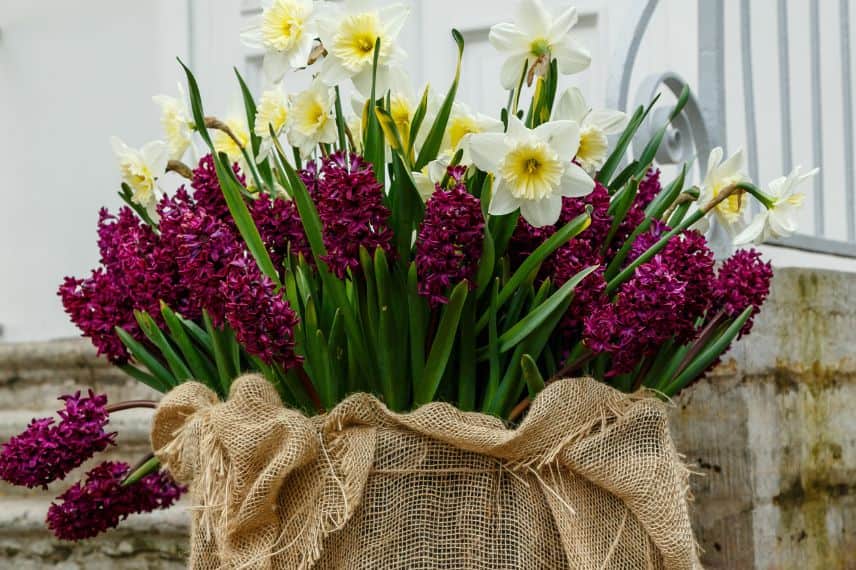
Indoors, a Christmas hyacinth placed on a table or windowsill releases its fragrance throughout the room. Scented hyacinths pair very well with hyacinths of other colours, with Muscari, with dwarf narcissi or decorative foliage such as the ivy to create an elegant, fragrant container planting.
After flowering
- Keep the potting medium slightly moist for 3 to 4 weeks to help the bulb rebuild its reserves, then stop all watering as soon as the foliage yellows.
- Once the foliage has completely withered, bulbs grown in pots indoors can be dug up, dried and stored in a dry, cool place. Replant in the garden the following autumn.
- In the open ground, scented hyacinth bulbs can simply stay in place, provided the soil is well-drained.
- Wild hyacinths, on the other hand, stay in place to naturalise easily and spread spontaneously, offering a renewed display each spring with little effort.
- Subscribe!
- Contents
Comments