


How to plant crocuses in a lawn?
All our tips for natural flowering
Contents
Planting crocuses in a lawn is a simple gesture that transforms the early days of spring into a moment of renewal. From the end of winter, the crocuses’ flowering brightens the lawn with shades of yellow, white or purple. Easy to grow, these small bulbous flowers take hold in the garden for good, in a rock garden or even in pots. Whether they are (primarily) spring crocuses or (less commonly) autumn crocuses, their understated beauty does not go unnoticed. Here are all our tips for planting crocuses in a lawn and ensuring their naturalisation year after year.

When to plant crocuses?
The ideal time to plant crocuses varies by species:
- The spring crocus, the most common in gardens, are planted in autumn, from September to November. This gives the crocus bulb time to develop and to flower as early as February or March, depending on climate.
- The autumn crocus, such as Crocus speciosus or Crocus sativus (saffron), are planted in summer, from July to early September, to flower at the start of the season.
Note: avoid planting during frosts to ensure good establishment of your crocus bulbs.

Read also
Crocus: how to plant them?Where to plant crocuses?
Crocuses prefer sunny exposure, essential for flowering. They can be easily planted in a sunny lawn, provided light is sufficient.
They also prefer light, well-drained soil, even if poor and stony. In heavy or clay soils, drainage should be improved by adding coarse sand, gravel or pozzolana to facilitate water drainage. Dry soil in summer suits them perfectly, as the bulbs are then in dormancy.
Avoid overly damp locations, regularly watered (automatic irrigation…) or too heavily trafficked, which could damage the bulbs and their foliage.
Which crocus varieties should I choose?
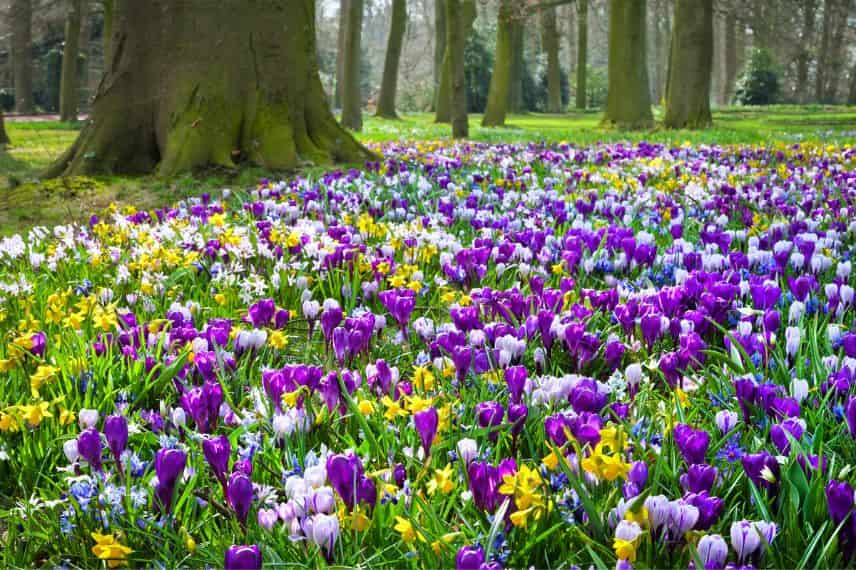
When planting crocuses in a lawn, it is advisable to choose spring crocuses, as they flower early, before the lawn really starts to grow again — which prevents mowing or trampling in summer from compromising the flowering of the bulbs. Among the varieties, here are a few particularly well-suited examples:
- The yellow crocus (Crocus chrysanthus ‘Fuscotinctus’) : an early variety, with golden, compact flowers, excellent for a carpet-like flowering display as spring arrives.
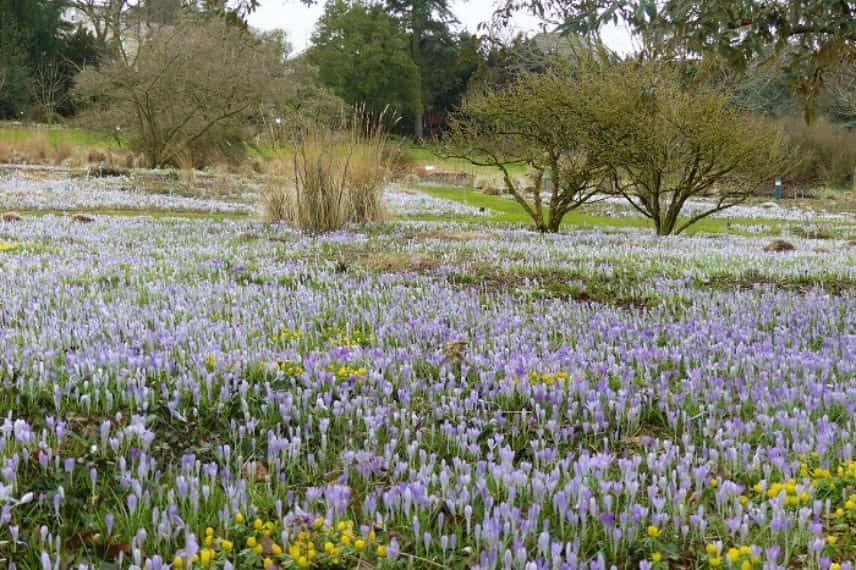
- The wild crocus (Crocus tommasinianus) : small in size, very early lavender-coloured flowers, ideal for naturalising a lawn. Its flowering often appears from the end of winter, and its discreet habit makes mowing safe a few weeks later. One of the few varieties to flower even in light partial shade.
- The “Crocus en herbe” collection (Crocus vernus, varieties such as ‘Pickwick’ or ‘Flower Record’, ‘Grand Master’) : these spring “giant” crocuses produce large flowers, in blue-violet shades, visible in the lawn from February–March.
- The “100 Large Mammoth-Flower Crocus” collection (Crocus vernus) : this mix of spring crocuses combines different shades, ranging from white to blue-violet, including yellow. It helps to achieve a dense and varied flowering quickly, ideal for covering a larger area of lawn with a striking visual effect.
→ Also discover our full selection of spring crocus.
Read also
Mass planting of bulbs: why and how?How do you plant crocuses in the lawn?
To plant your crocus bulbs, follow these steps:
- Scatter your crocus bulbs over the lawn, keeping about ten centimetres apart. If you prefer a more spontaneous effect, drop the bulbs onto the lawn and plant them where they landed.
- Use a bulb planter to make a hole 10 cm deep, cutting into the lawn as you go. Tip: If your soil is heavy, improve drainage by adding a little coarse sand or gravel to the bottom of the hole. This helps prevent the crocus bulbs from rotting.
- Place each bulb at a depth of 8 to 10 cm, with the pointed end upwards. Fill the hole with garden soil and replace the turf, then firm gently.
- No need to water after planting (unless the soil is very dry). Going forward, autumn’s natural moisture will suffice. The crocuses will flower from March.
Tips and tricks for naturalising crocuses.
Once well established, spring crocuses can multiply year after year, until forming a true carpet of flowers. Here are a few tips to encourage their naturalisation in a lawn:
- Set aside a neglected patch of the lawn, with minimal watering and without regular foot traffic.
- Plant in large numbers, in dense clumps, to achieve a more natural look and encourage their spread.
- Choose varieties suited to naturalisation, such as the Crocus tommasinianus or the Crocus chrysanthus, which readily self-seed.
- Don’t mow too early in spring, especially during the first flowering: it’s best to wait until the crocus foliage has completely yellowed before mowing. This allows the bulbs to recover for the following year.
- Let some flowers go to seed, especially in the less accessible corners, to encourage natural dispersal.
- Subscribe!
- Contents
Comments