


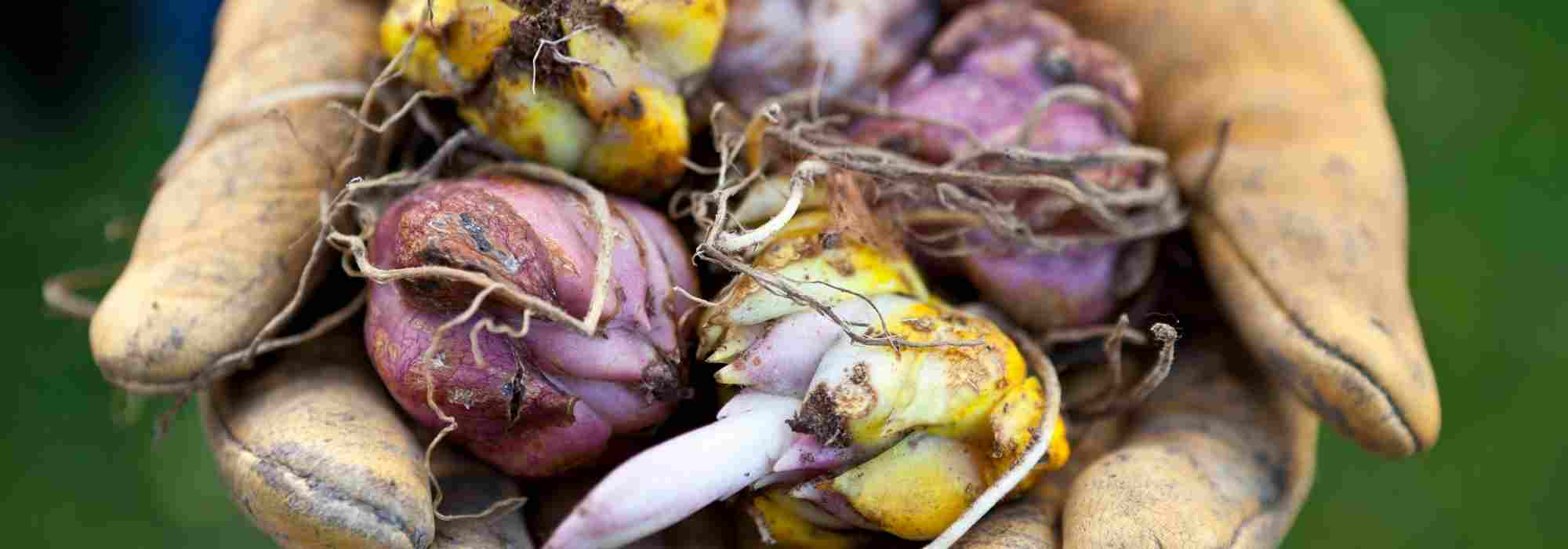
7 spring bulbs with purple flowers to have in the garden
Very elegant bulbous plants to incorporate into your borders, beds and rockeries
Contents
Spring bulbs are essential for getting through winter. With their emerging flowering, which often braves the cold, sometimes snow, these bulbous plants delight us and brighten the greyness that still lingers. And this continues right up to the gates of summer with its procession of colourful flowers. While spring bulbs offer a wide palette of colours, purple may be the least represented. Yet it is a shade that displays real depth, true elegance, even a touch of sophistication. Ideal in small clumps, purple pairs very well with white, yellow or orange, colours widely found among spring bulbs. A spring display of stunning beauty!
Discover our selection of seven spring bulbs that offer purple flowering displays of great richness.

Purple tulips, majesty allied with elegance
It’s impossible to discuss spring bulbs without mentioning tulips. Not to mention that there are a multitude of species and varieties to stagger flowering and vary the shapes of the flowers. Choosing purple-flowered tulips is, in a sense, adding a touch of depth, elegance and mystery to your garden. Indeed, as the colour of royalty, purple lends tulips, elegant by nature, a timeless charm and a grace almost divine.
Among the prettiest purple tulip varieties, one can hardly overlook the early-double tulip ‘Alison Bradley‘. From April onwards, it bears double flowers, perched on short but sturdy stems, between purple and violet, a nuanced colour with hints of red or magenta. In the same category of early-doubles, the variety ‘Black Hero‘, a peony-flowered tulip, stands out for its dark purple flowering, almost black. A colour all the more striking because its flowers are large.
In comparison, the variety ‘Continental Triumph’ appears much more modest with its single flowers. Yet it makes its presence felt with its purple corollas with black reflections, and its tall stems of 45 cm, which allow it to sit at the back of the border.
To add a touch of originality, two varieties stand out: ‘Purple Crystal‘ produces dentate-edged flowers in a stunning wine-purple, and ‘Sarah Raven’ offers a lily-flowering bloom, giving it a star-like appearance.
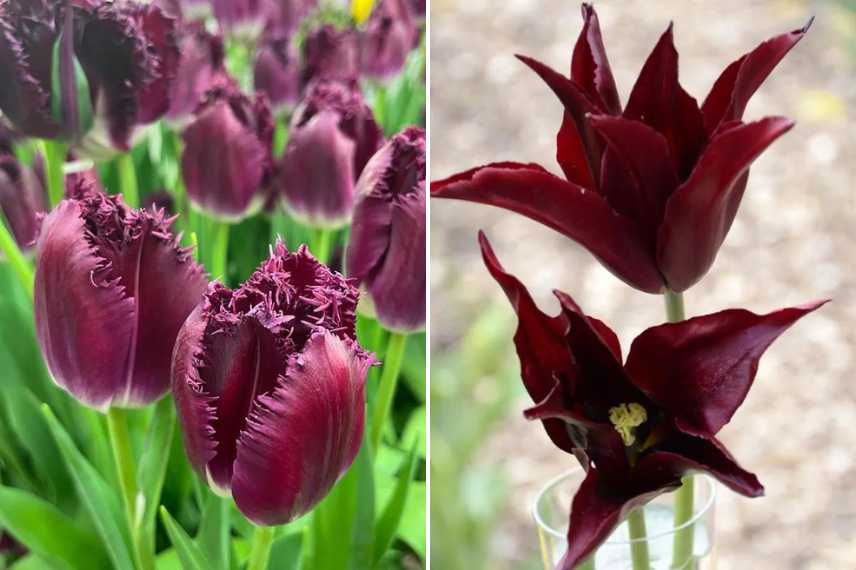
The Purple Crystal and Sarah Raven tulips
Ornamental alliums, globular flowers.
Perched on tall stems, ornamental alliums find their place in a modern garden. Nevertheless, their rounded flowers can thrive just as well elsewhere. If their flowering umbels are most often tinted white, pink or purple, purple is also represented among ornamental alliums, bulbous plants in the Amaryllidaceae family. Very architectural, the stems bearing the globose inflorescences add verticality to the garden while the flowers lend roundness.
Among ornamental alliums with purple flowering, Allium aflatunense ‘Purple Sensation stands out for the intensity of its colour. From May onwards, the perfectly round inflorescences, composed of a multitude of small star-shaped flowers, open to purplish-violaceous. In the same vein, the Allium atropurpureum makes its mark with its wildflower-like appearance. Its inflorescences, slightly smaller and less round than those of the other varieties, nevertheless offer real interest due to their purplish-red colour nuanced with hints of black.
The species Allium sphaerocephalon, often called round-headed garlic, offers a profusion of charming pom-poms, clad in a purplish-pink that tends toward garnet red. These flowers, smaller than average, reinforce its wild and natural look.
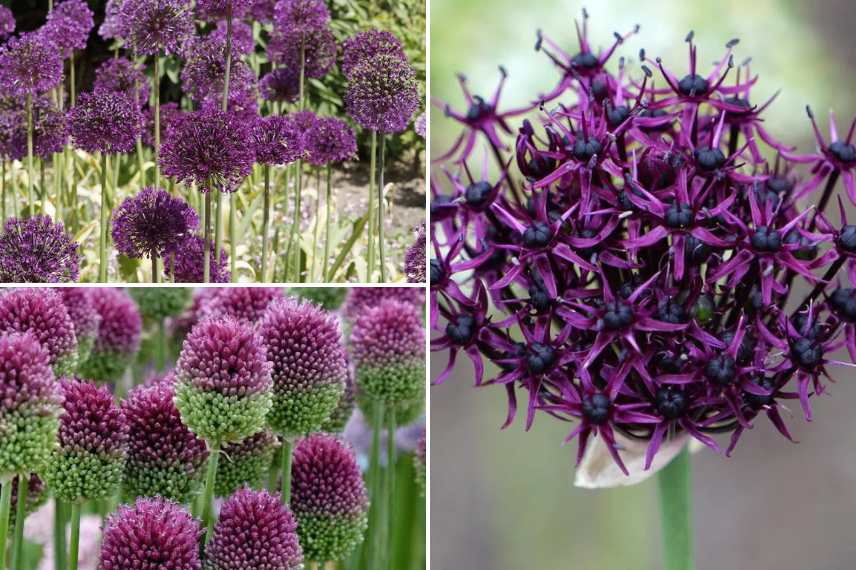
Three ornamental allium varieties with purple flowers: Allium aflatunense ‘Purple Sensation, Allium sphaerocephalon, and Allium atropurpureum
Woodstock hyacinth, unique and original
Few hyacinths display a purple colour. That said, the variety ‘Woodstock’ is a real rarity with its star-shaped florets that display a splendid pink-purple colour, intensified by a darker centre. An enchanting colour that gives it distinctive character, even a certain uniqueness. This Oriental hyacinth variety produces very dense spikes, composed of small star-shaped flowers with a waxy, thick appearance. The flowering lasts two to three weeks, from March to April.
Far from merely offering an unusual colour, this hyacinth variety goes beyond by perfuming the garden with a delicate fragrance, as captivating as its colour.
Paired with yellow-orange flowering tulips, this hyacinth should be a real standout in your garden.
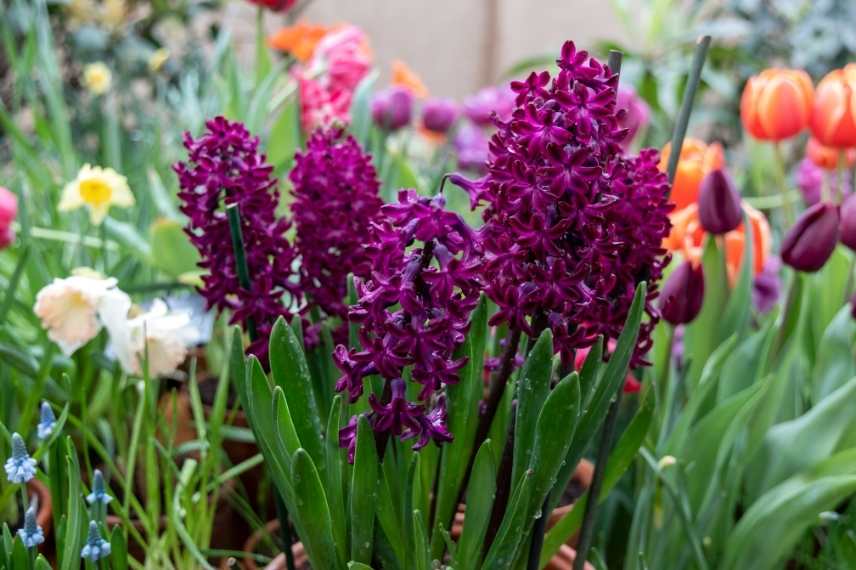
The Woodstock hyacinth
Read also
Planting spring bulbs lateReticulate irises, with delicate flowering.
Bulbous plant in the Iridaceae family, iris réticulé (Iris reticulata) is certainly less spectacular than the tall Iris germanica. Yet it largely holds its own with its long, upright stems on which wonderful flowers bloom, composed of six tepals, of which the inner three are erect. The three outer tepals are always punctate with yellow or white. This is also the case with the variety ‘Rejoice’ with its delicate flowers, from an intense violet to a dark purple, whose lips are maculated with white spots and a central band of golden yellow. This flowering is very slightly scented.
The variety ‘Pauline’ closely resembles the variety ‘Rejoice’ in the purplish‑violet colour of its flowers. However, it is distinguished by white maculations that punctuate the lips of the tepals, edged with a very deep ink‑blue. A tiny hint of yellow can be seen on the tepals. This variety shows extraordinary grace.
Finally, let us finish with a real safe bet: the variety ‘Spot On’. This reticulate iris produces flowers of great originality. Much thinner than those of other irises, the flowers of ‘Spot On’ are predominantly purple, but the horizontal sepals are maculated with white, with a black tip and indigo blue striations. Particularly early, this reticulate iris flowers from February.
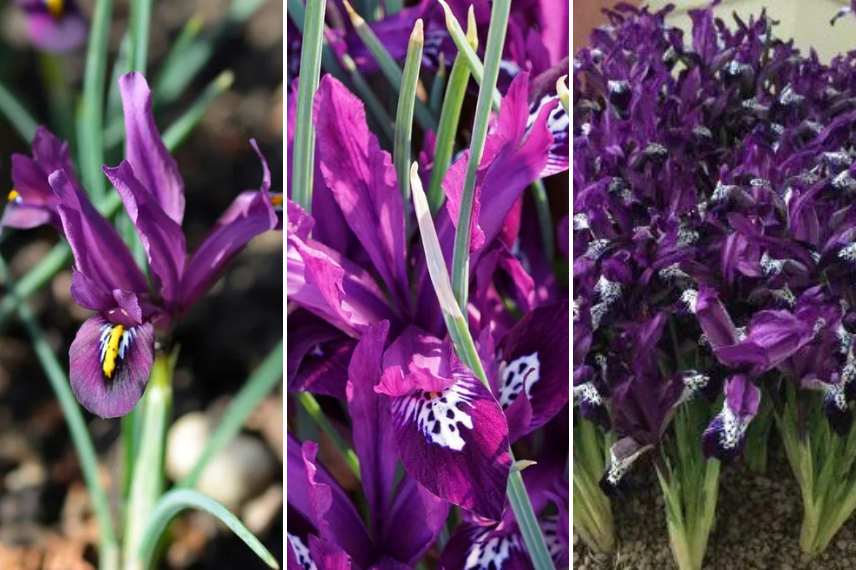
Three reticulate iris varieties: ‘Rejoice’, ‘Pauline’ and ‘Spot On’
Asiatic lily, a royal flower
Asiatic lilies proudly display themselves in florists’ shop windows, but they can thrive perfectly well in gardens where their exuberant and fragrant flowers work wonders. Moreover, they offer colours often extraordinary, among which purple holds a special place for its rarity. Admittedly, the Asian lily isn’t strictly a spring bulb, since its flowers bloom in June and July, but their presence in the garden more than offsets any objections.
Among the most remarkable varieties, l’hybrid ’Mapira’ draws all eyes with its large flowers whose petals are of a rich and deep burgundy purple, enhanced by a black centre and dark pink stamens, dusted with orange pollen. Measuring around 10 cm across, these satin flowers, supported by sturdy stems, emit a suave fragrance. This easy-care lily naturalises very quickly.
Also endowed with sumptuous flowers, the variety ‘Royal Kiss’ is equally elegant. Quite regal too! This hybrid offers very dark flowers, but which, in the sun, reveal their true nature. They actually bloom in a dark purplish-red, punctuated with black and plum reflections, and a brick-red hue at the heart. When fully open, these flowers reveal purple stamens, dusted with yellow-orange pollen. These flowers are only faintly scented, but their beauty more than compensates for this lack of fragrance.
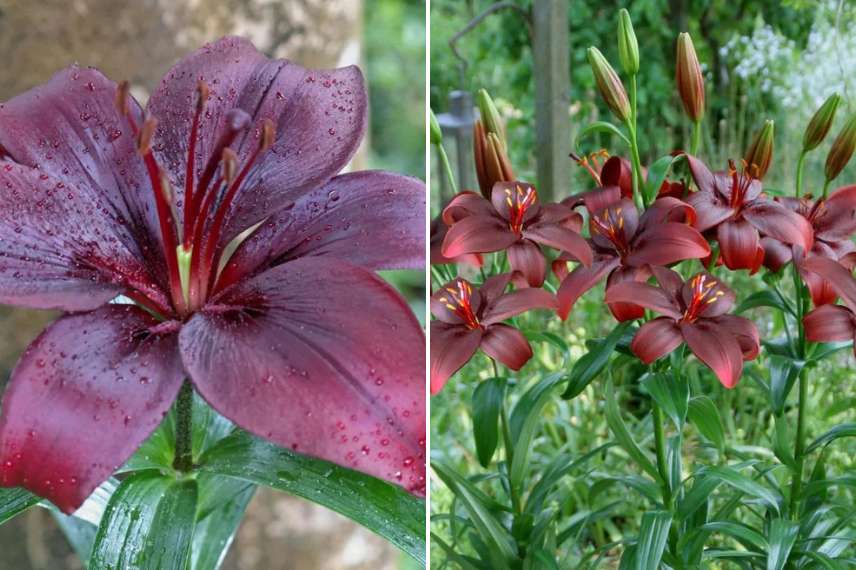
The Mapira and Royal Kiss varieties
Bulbous corydalis, a plant for partial shade
Bulbous Corydalis (Corydalis) grow quite naturally from a bulb, unlike other Corydalis. Fairly vigorous, they spread quickly to form pretty carpets in partial shade or even in shade, in woodland understorey. Growing to 15–20 cm tall, they offer finely cut foliage, quite close to that of columbines, in a lovely grey-green colour. As for the tubular flowers, curiously furnished with an erect spur, they are borne in clusters and display purple, pink, red and white. This is why purple is present in Corydalis, through hybridisation.
And the best representative is undoubtedly the variety ‘Purple Bird‘ which produces numerous flowers, grouped in compact and erect clusters, with an elegant purple colour, punctuated by a white throat. These small flowers are followed by capsule-shaped fruits. The flowers open from March to April, and, in summer, the foliage disappears.
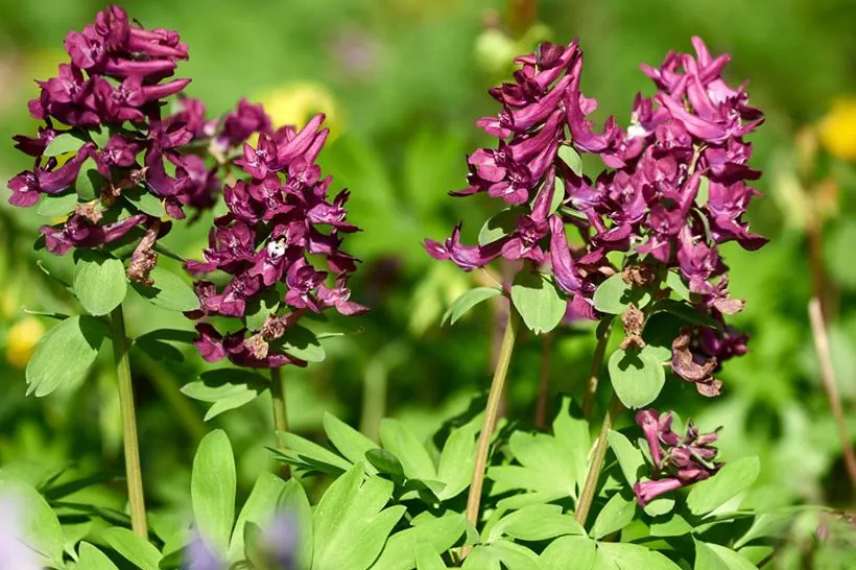 The bulbous Corydalis variety ‘Purple Bird’
Florist's ranunculus
The florist’s ranunculus (Ranunculus asiaticus) display blooms with a refined appearance. These flowers are very double, composed of a profusion of tightly packed petals with great delicacy, forming a very colourful ball. Rather plump, these flowers look all frilly in the heart of spring, between March and May. Ideal for borders or pots, florist’s ranunculus offer a compact, upright habit. Their drawback lies in their limited hardiness, but this is easily forgiven in light of their abundant flowering.
Among ranunculus, a hybrid bears magnificent double purple flowers. This is the charming variety ‘Vortex F1 Purple’ with relatively early spring flowering. This variety produces a profusion of cup-shaped flowers that are very full, with diaphanous petals tinted with a purple-violet gradient, sprinkled with pink to mauve reflections.
As for the variety ‘Pauline Violet’, in May–June, it bears splendid flowers 3 to 5 cm in diameter with a very deep purple-violet colour. A marvel to grow in the ground in mild-climate regions, or in pots elsewhere.
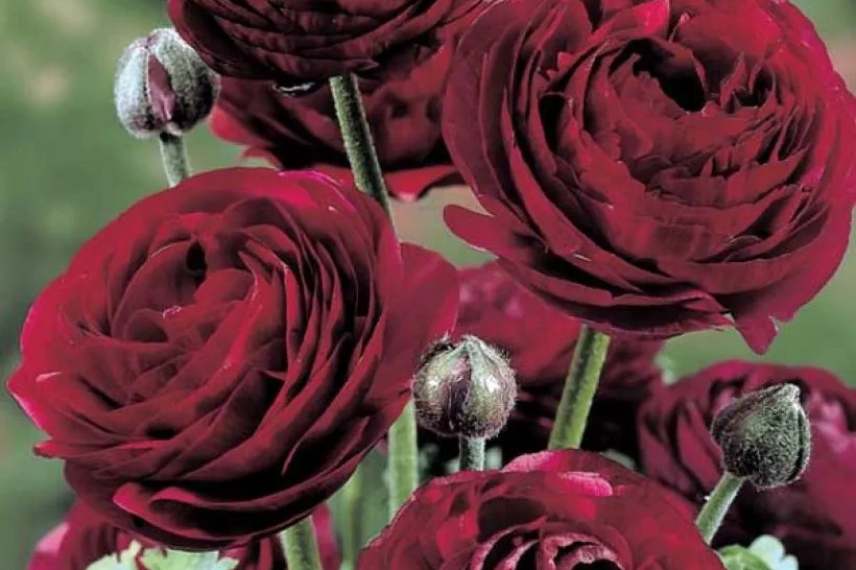
The splendid florist’s ranunculus ‘Pauline Violet’
- Subscribe!
- Contents
Comments