Conifers in the garden: try natural combinations for winter!
Their strengths to elevate this season
Contents
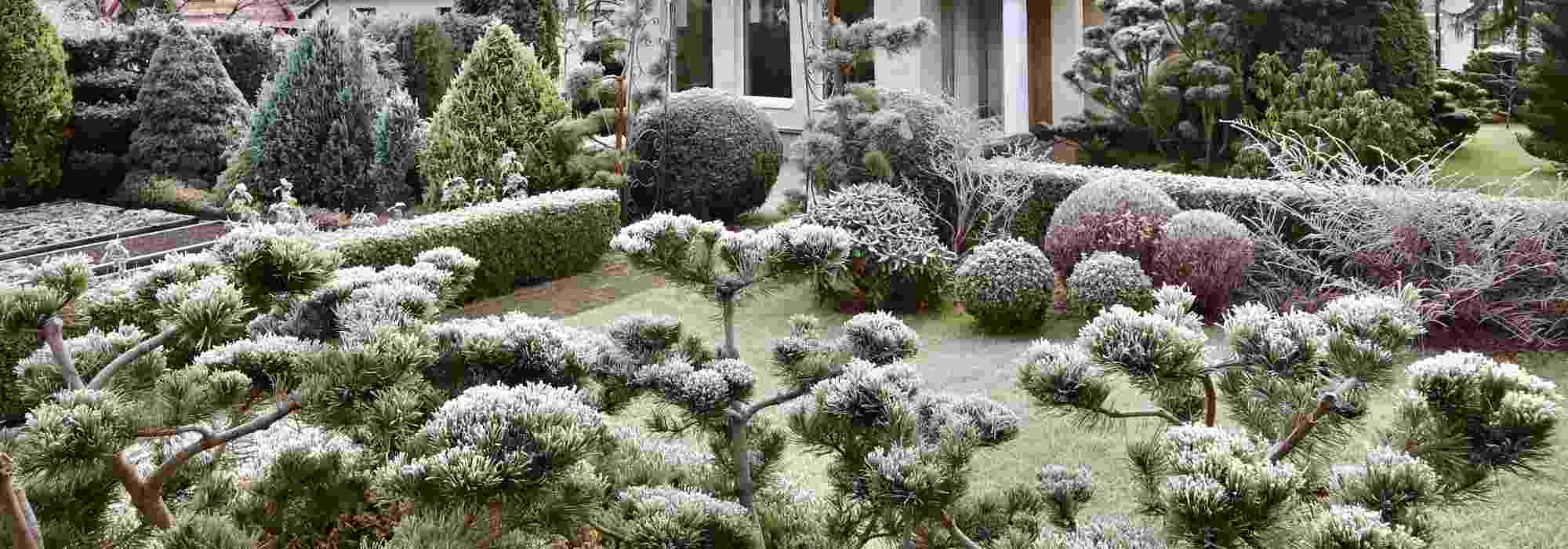
Dusted with snow or radiant in full sun, conifers are unrivalled at transforming the garden in winter, when other plants are resting. Paired with a few flowering plants and plants with berries or decorative foliage, they create stunning colourful displays. To achieve the effect, consider all the distinctive conifers, whether for their habit or their colouring, and bold colour combinations to properly brighten the cold season.
Not sure how to combine them well? Here are five ideas to showcase the garden in winter, with a very natural feel, proving that firs, pines and other Podocarpus have a role to play this season. No doubt you’ll change your mind about using conifers in the garden!

In a rockery
Dwarf conifers are ideal allies for creating colourful rockeries. By choosing dwarf species such as Pinus mugo, and playing with blue-grey or golden tones, they prove ideal companions for a small, low-maintenance border, as they often form a dense cover.
An example here brings together Pinus mugo ‘Mops’ and Chamaecyparis obtusa ‘Nana Gracilis’ with some evergreen perennials and grasses: Heuchera ‘Amethyst Mist’ with grey and purple foliage, and a few fescues planted in odd numbers to create a blue-toned clump. A long flowering period is essential to bring back pink or red tones, easily achieved with Erica x darleyensis ‘Kramer’s Rote‘, one of the brightest in mid-winter. Complete with a few spring bulbs to extend the effect of this colourful bed.
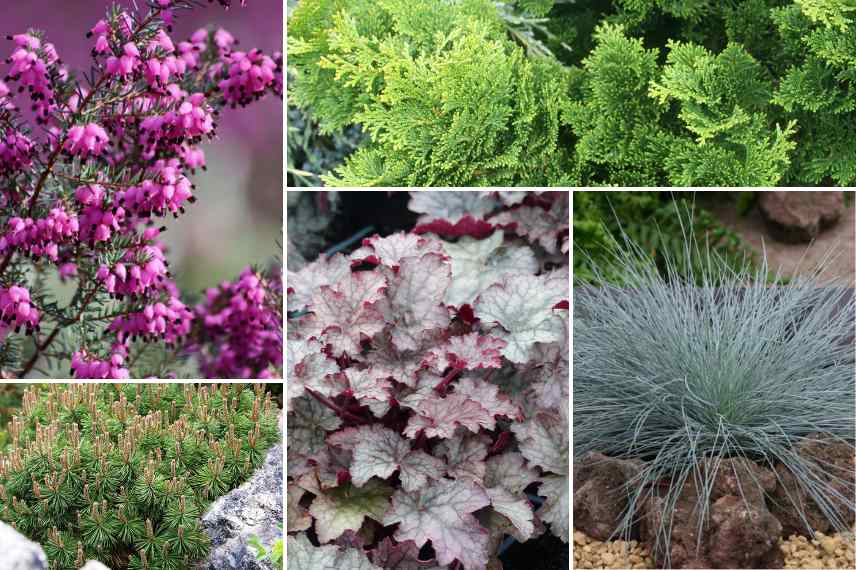
Winter heath ‘Kramer’s Rote’, Chamaecyparis obtusa ‘Nana Gracilis’, Pinus mugo ‘Mops’, Heuchera ‘Amethyst Mist’ and blue fescue
Read also
3 ideas for beautiful winter flower bedsIn a large, sunlit mixed border
Conifers assert themselves as centrepieces in large borders, where their stature and evergreen nature provide an essential structure. To create a harmonious picture in cheerful blue-and-yellow tones, pair, for example, Abies koreana ‘Kohouts’, whose scales look as if dusted with snow and which bears purple cones, with Malus ‘Sparkling Sprite’, whose yellow fruits catch the eye well into winter. The contrast between the bluish green of the fir and the vivid yellow of the ornamental apples is perfect, especially in low winter light. At its base, a Bergenia ‘Ice Queen’ will flower at the same time in spring in creamy and green tones, lending a very fresh note.
To add a touch of softness, include some Carex oshimensis, whose fine arched leaves dance in the winter breeze. Their golden or coppery sheens, depending on the variety, harmonise beautifully with the warm hues of bark and twigs. At the base, plant Iris unguicularis in drifts. Their delicate flowers bloom very early, bringing a fresh note.
Finally, to extend the border’s interest into mid-winter, plant a Hamamelis mollis, the species widely favoured for its yellow thread-like flowers that open in the depths of the cold season. This mix of textures, colours and fragrances transforms the large border into a living stage, where each plant plays its part with elegance without ever upstaging the others. In autumn it will become a spectacular shrub, once again harmonising with the Korean fir.
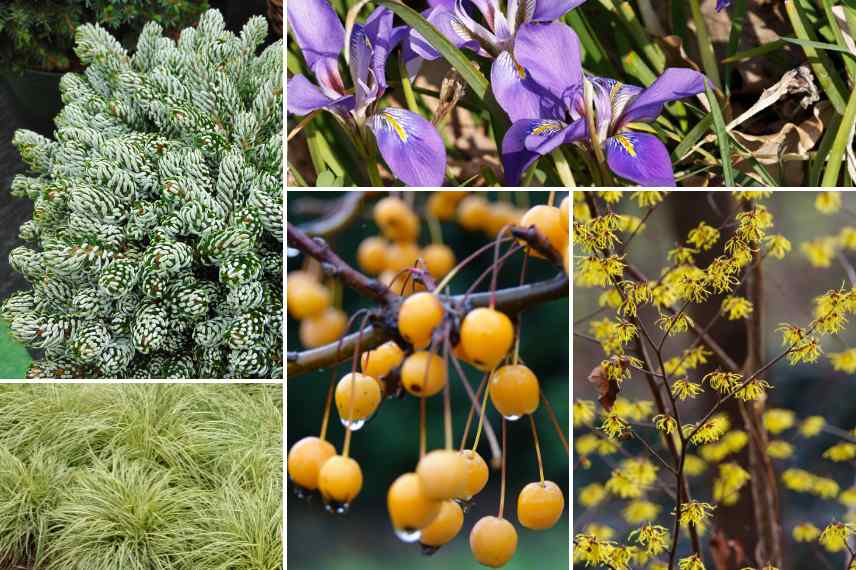
Abies koreana ‘Kohouts’, Algerian iris, Carex oshimensis, Malus ‘Sparkling Sprite’ and Hamamelis mollis
In a winter garden
Winter gardens are fashionable and that’s just as well. People love their glow and their unique way of warming the days of the so‑called bleak season. Conifers play a major role here, as do bark and reddening branches. They of course bring evergreen presence, and are often chosen for contrasting colour or a distinctive silhouette. It’s a lovely way to introduce them naturally into the garden.
A Japanese Hinoki false cypress (Chamaecyparis obtusa ‘Contorta’), whose foliage turns bronze in the cold, is a unique conifer whose twisted habit works wonders in this kind of scene. Its slow growth also makes it suitable for a small garden where you want to create this sort of winter colour.
Invite another conifer into a large bed, for example a blue‑foliaged species (Juniperus are magical!). They will sit alongside the bare, reddened branches of dogwood valued for its decorative stems, the supple, luminous foliage of Carex testacea ‘Prairie Fire’, and the warm‑toned foliage of Libertia ixioides ‘Taupo Sunset’. Ideally add a tree with beautiful bark, such as an Acer griseum or a birch. Don’t forget a few flowers, like snowdrops, and perhaps a traditional Camellia ‘Cinnamon Cindy’ with white flowers or a Stachyrus praecox with very delicate pale yellow flowers.
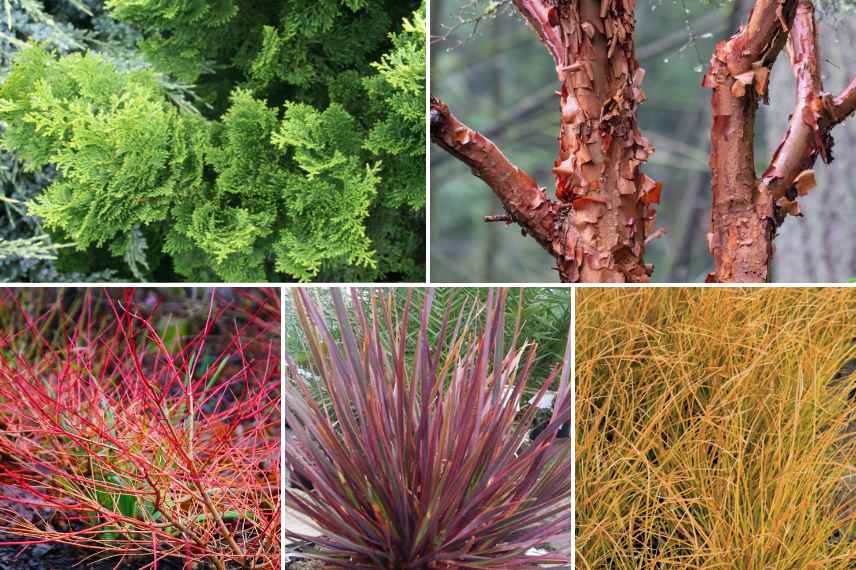
Chamaecyparis obtusa ‘Contorta’, Acer grisum, dogwood, Libertia ixiodes ‘Taupo Sunset’ and Carex testacea ‘Prairie Fire’
Read also
The Winter gardenChristmas magic!
To go even further with originality, dare to create a bed that recreates Christmas magic by adopting its colour code: green, white, red!
Design a bed in which the red and white fruiting of selected plants will create a genuine Christmas illusion while remaining entirely natural, featuring shade‑woodland shrubs.
A yew (Taxus baccata) whose arils redden early is ideal… if they stay on the tree long enough before birds eat them. Otherwise opt for a Juniperus, a spruce or a weeping conifer for added originality. Surround it with shrubs celebrated for their winter colour, including a useful ornamental bramble, Rubus tibetanus ‘Silver Fern’, which reveals its fairy‑like white stems in mid‑winter. To emphasise the white touch, include Symphoricarpos ‘Albus’ (the charming snowberry with its small white berries), semi‑evergreen in mild regions, and silvery evergreen foliage such as a cerastium used as a groundcover. Garrya eliptica, with its similarly silvery aspect, can easily join these plants to maintain the white theme. Also consider planting a few sprightly hellebores, such as oriental hellebore ‘Red’.
The red berries of Cotoneaster lacteus and holly complete the scene and suggest Father Christmas is about to arrive in the garden!
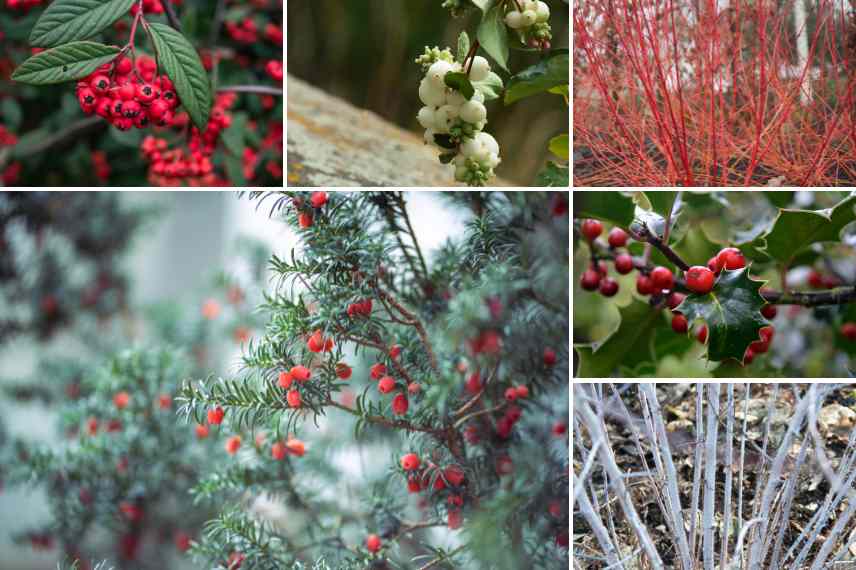
Cotoneaster lacteus, Symphoricarpos, decorative‑stem dogwood, holly and ornamental bramble ‘Silver Fern’
In a 100% foliage scene
By surrounding a conifer with shrubs or plants whose main interest is foliage, you create a truly natural, tasteful setting that showcases the beauty of each species when chosen wisely.
In this last example, we prioritise the graphic effect of each plant as much as its striking winter colouring. This type of combination, made up of evergreen foliage (Miscanthus remaining an almost year-round presence), will be just as attractive in other seasons.
A Pinus mugo — still a favourite — such as the variety ‘Ophir‘ keeps company with a Phormium ‘Sundower‘ and a Yucca rigida ‘Blue Sentry’, which together provide a rather unusual exotic note. A purple colouring is provided by a Pittosporum ‘Tom Thumb’ or a Dodonea in the most sheltered areas. This harmonises nicely with the Phormium’s foliage.
Miscanthus sinensis join them, the light that passes through them making their broom-like inflorescences gleam.
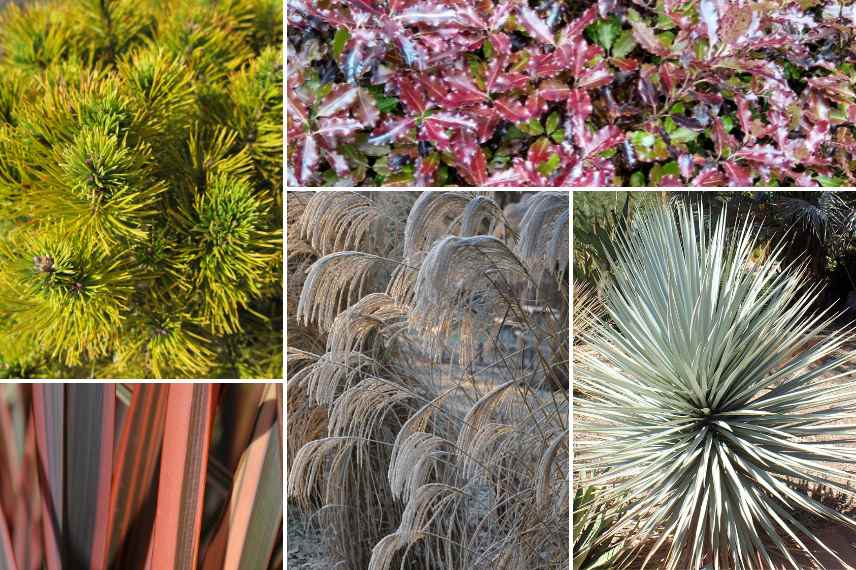
Pinus mugo ‘Ophir’, Pittosporum ‘Tom Thumb’, Phormium Sundower, Miscanthus sinensis, and Yucca rigida ‘Blue Sentry’ (© wikimedia-KrzysztofZiarnek)
- Subscribe!
- Contents
This form is protected by reCAPTCHA - the Google Privacy Policy and Terms of Service apply.

































Comments