By continually enlarging the beds, lawned areas have shrunk year after year to almost nothing. Mowing time has been cut by two-thirds, much to the delight of my husband, who is tasked with it. That said, even though lawn area is now fairly modest, I dream of a manual mower. And incidentally, I dream that my whole village will adopt the push reel mower and the good old scythe at the same time... No more noise, no more smells... yes, I know, one can always dream! Here are my five excellent reasons to adopt a manual mower.
Manual mower is economical
I'll give you a sensational morsel to chew on: the manual mower is economical! Amazing, isn't it? More seriously, the fact that it consumes neither non-renewable fossil fuels nor electricity is a major advantage in my book. Like any garden tool, the push mower requires an initial outlay but, for models of equivalent quality, it works out cheaper than a motorised mower. But what I really see personally is undeniable long-term savings and complete independence from oil. The only energy expended will be a bar of dark chocolate with candied orange peel eaten shortly beforehand. One needs to build up strength!
Finally, maintenance cost is negligible and lifespan longer than other mowers.
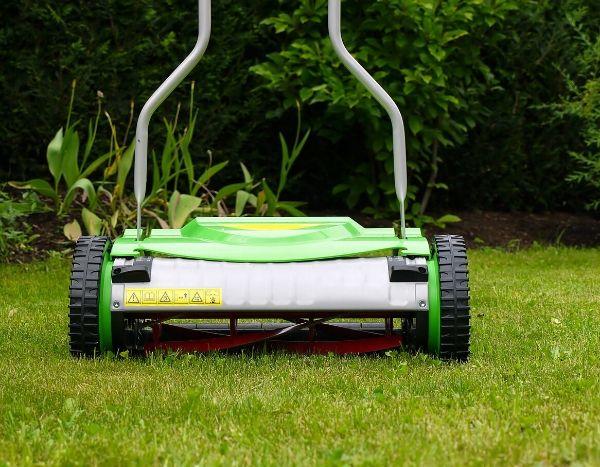
New manual mowers are light and manoeuvrable
It remains a practical, light and easily manoeuvrable tool, without compromising on performance. No need to dislocate an shoulder to start it, nor a cable or extension lead to power it! Cut quality is also excellent. All thanks to its helical system, a cylinder fitted with blades that draw in grass blades to slice them cleanly rather than shredding them. Incidentally, the English have understood the advantages of this device and if you're wondering, the famous English mower is a reel mower (although depending on model they can be manual, petrol or electric)! No need to thank me, it's free! Also note that the more regularly you mow, the more attractive the result.
I'd add that it is compact and tucks away easily in a small corner of the garage or garden shed.
Manual mower is eco-friendly
No petrol, so no pollution and no nasty smells, QED! As I said earlier, the only energy used is human energy. The manual mower does not draw on fossil fuels or electricity. Furthermore, no fuel means no pollutant emissions and therefore no harmful impact on nature's balance and, by extension, on human health. Yes, the consumption of a single mower may seem negligible. But scale that up globally... enough to give you cold sweats!
Manual mower requires little maintenance
Indeed, there are only two things to do to maintain it:
- give the cylinder a blast with a jet of water (or a soft brush if necessary), every 4–5 mows at least;
- grease the drive chain from time to time, like on a bike, and that's it.
Forget engine oil changes, petrol or replacing spark plugs. The system is so simplified that the mechanism is child's play to replace or repair. As for sharpening, again no problem since it happens automatically. To explain: the blades sharpen naturally each time they rotate, wearing against the counter-blade. There is simply a small adjustment to make if needed by tightening the counter-blade towards the reel.

Manual mower is quiet
I've saved the best till last. Since it has no engine, the manual mower is quiet — no more noise pollution, bliss! It's thus possible to mow early morning, late evening, on Sundays, bank holidays, in the middle of the night by moonlight or with a head torch. In the latter case, your neighbours might start looking at you a little differently, but that's a minor detail, isn't it?
I can't help thinking of garden wildlife too. Indeed, noise from our motorised machines disrupts wildlife as a whole. Studies have shown that noise pollution interferes with birds' communication and even with pollination, for example.
In conclusion, the manual mower is, in my view, an excellent alternative for small gardens. It is economical, environmentally friendly and durable, while not compromising on efficiency, provided it is used under the right conditions, of course.


































Comments