Sowing beans is always fairly late for us and takes place in June. Partly because I time it so first harvests coincide with our return from holiday… (sowing date + about 60 days) and partly because I need time to build the structures that will support them.
In fact, I favour climbing beans (pole beans) over dwarf beans, which are quicker to sow and easy to grow. So why go to all that trouble? Because climbing beans have other advantages, of course!
Climbing beans: an ornamental crop
The first reason I grow pole beans is vanity! Our vegetable garden is visible from the terrace (very handy for giving the beds a quick hoe while chatting to those lounging on the sunloungers…) so it needs to be ornamental. Tall bamboo canes or steel reinforcing bars, set up as teepees or Canadian tents, immediately create beautiful vertical lines. Once the beans are well developed, the structure disappears under the luxuriant foliage, giving the garden a slightly jungle-like feel that I quite like. And that doesn’t even take into account their pretty flowering!
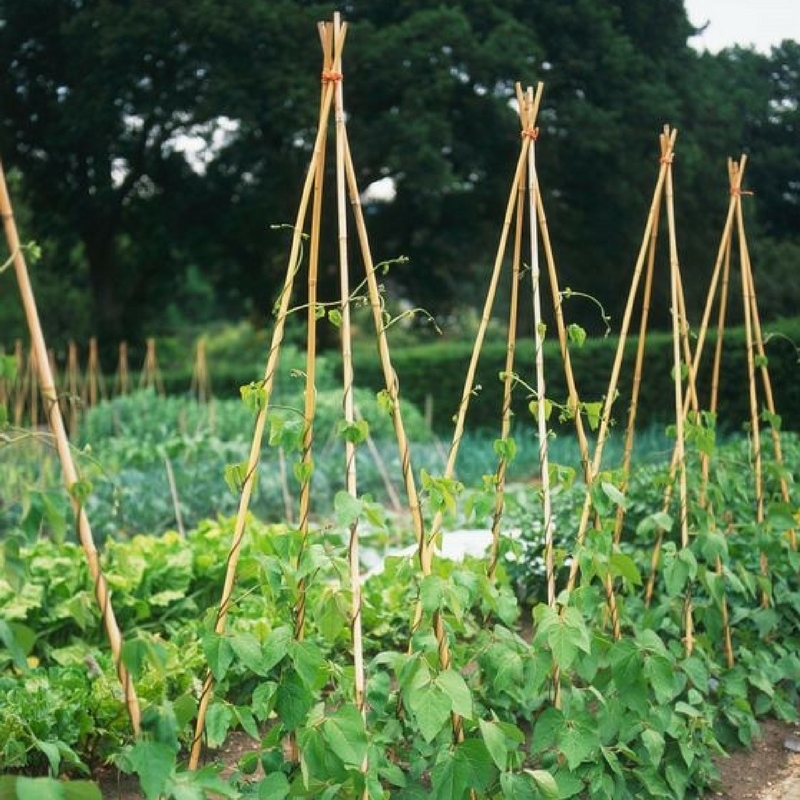
A teepee installation - Source: Pinterest
A space-saving crop
The second advantage is that this crop occupies very little ground space since the plants grow vertically. If you plant them in a single south-facing row, climbing beans also have the advantage of providing welcome shade to other vegetables, such as lettuces, which dislike high heat.
They are also very easy to grow in a small garden and even in a pot on a terrace or balcony, since the supports can be propped against a wall or a fence.
Abundant harvests
The third benefit is the high productivity of this type of bean. Indeed, relative to ground area they give good yields, around 2 to 2.5 kilos per m2 (compared with only 1 to 1.5 kilos per m2 for dwarf beans), on average.
Easier harvesting
Ease of harvesting is the fourth advantage: no more bending down and stooping along the row to pick them: they’re within reach. You may have to stretch occasionally but it’s nothing insurmountable, even if your supports reach three metres high, and here’s why:
Great flexibility!
The final asset of pole beans is their flexibility… not in climbing the supports but in being harvested late. As mentioned above, many varieties, such as Mélissa, Blauhilde, Phénomène, can be eaten both as mange-tout and as shelled beans.
Put away the stepladder because the principle is simple: pick young and eat whole whatever is within reach and leave the high-up pods to mature. At the end of the season, take down the structure and gather everything that remains to eat as shelled beans, fresh or dried.
Finally, note that climbing beans can be added to flower beds and even planted in the middle of the lawn, combining the useful with the pleasant by turning into a little den for children.
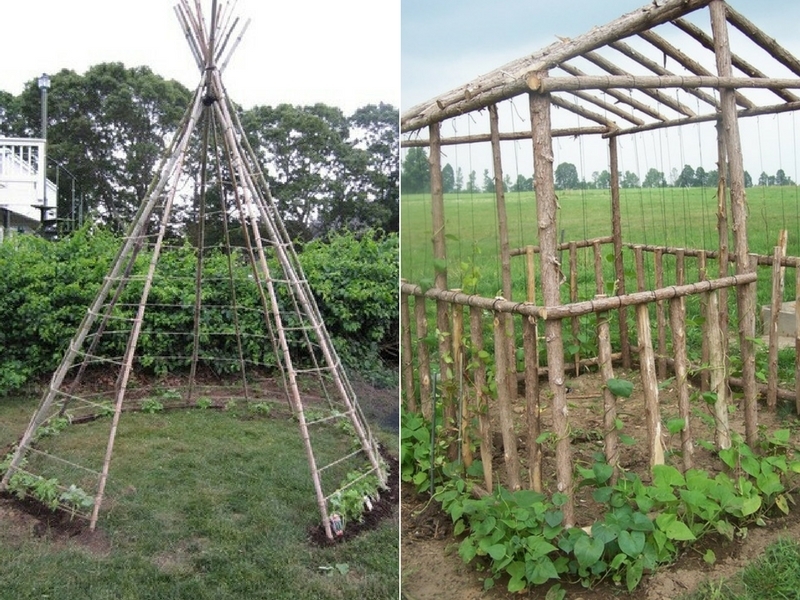
Two playful structures - Source: Pinterest


































Comments