I'd love to, but I can't…
That is the refrain,
of gardeners without a garden.
Having lived for a long time in hostile surroundings — by which I mean the city — I sympathise. Yet, solutions for garden without a garden are plentiful and all it takes is a balcony, a terrace or even a sunlit courtyard to create a real oasis! Among the many techniques used in urban agriculture, one stands out for both its effectiveness and its flexibility of use: growing in bags.
Why grow in bags?
Bag growing, or "jardi-sac", has several advantages :
- bags are light, can be delivered by post without difficulty, like an order from Promesse de Fleurs ;-), and easy to set up,
- they come in a wide range of sizes, are suited to small spaces and can accommodate bulky crops (while bag-grown potatoes are a classic, you can also grow all vegetables, including the most cumbersome such as rhubarb, artichokes and even fruit trees),
- the material they're made from, breathable and permeable, allows excellent root development, prevents root circling while letting excess water drain away freely,
- durable, bags withstand both high heat and severe frost (unlike terracotta pots) and have a long service life.
Which types of bags to choose?
Growing bags are readily available, and among the many products—whose quality and appearance can vary greatly—two brands really stand out : Bacsac and Smartpots.
- Bacsac is a French company, founded in 2009. It has developed a wide range of products designed for urban gardens. Its collection comes in every shape: from the round XXL bag of 930 litres to the 16-cell square vegetable planter, via hanging bags with integrated support (clever!) and small 10-litre bags which, when assembled, allow creation of green walls. These bags are offered in many colourways, adding a stylish, decorative touch to balconies and terraces.
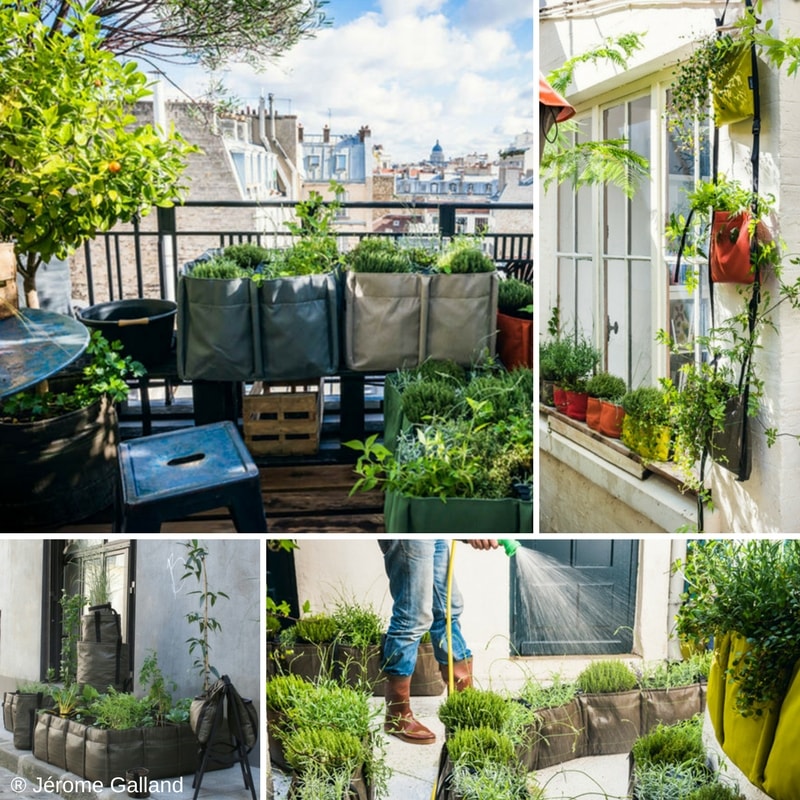
- The Smartpots are made in the USA. While their design is simpler, they are also manufactured from high-quality geotextile and come in an impressive range of sizes suitable for dressing a railing, a wall, a narrow passage and even creating instant gardens. Less "technical", their price is also lower. Note that these bags are used in Canada by Urbainculteurs in the majority of their soilless projects, which is also a mark of quality.
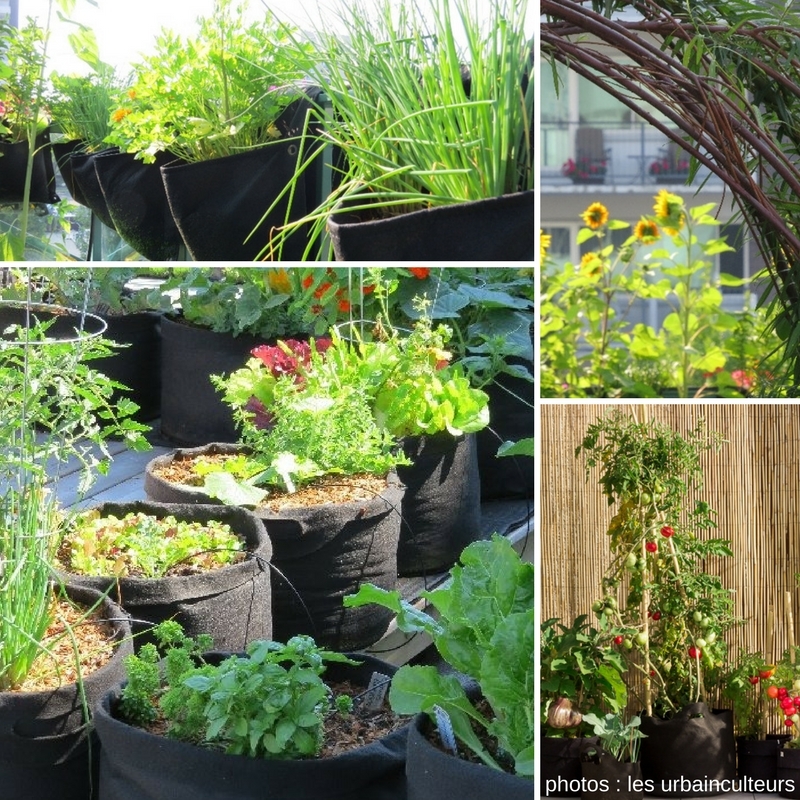
It is also possible to make your own growing bags, as members of « Potage toit » did when they installed an enormous edible garden on the roof of Royal Library Albert 1er in Brussels (you'll find the tutorial on their site under "Documents and guides").
Conditions for success
While using suitable containers is important, to maximise chances of success follow a few precautions:
- choose a well-exposed spot so plants can receive at least 6 hours of sun per day,
- use a quality potting mix (avoid the cheapest options) and remember to feed regularly (a worm composter or a compost bag allow you to make your own natural fertiliser while recycling kitchen waste),
- monitor watering, because mixes in pots or bags dry out quickly.
So, city dwellers, what do you think? What will you be doing this year? A mini vegetable patch? Some herbs and a few edible flowers? A dwarf fruit tree? A lovely selection of berries?
Further reading :
Great urban agriculture projects: www.urbainculteurs.org and www.potage-toit.be

































Comments