Growing carrots is deadly boring. Where's thrill of digging up a root the size of a toothpick or a fossilised beetroot? If you're fed up with neighbours flaunting perfectly straight harvests and turnips like showroom models, welcome: this is sanctuary of deliberate failure.
This "zero-success" guide explores art of veg-patch sabotage. By dissecting every fatal mistake — from concrete-like soil to erratic watering — we'll highlight, by way of contrast, real soil needs, importance of thinning and moisture management.
Prepare soil fit for a car park
If you want root vegetables to suffer, treat veg patch like motorway construction site. Golden rule? Do not loosen soil under any circumstances. Leave it compacted, ideally with consistency of sun-dried breeze block.
The more stones, weed roots and hard clods, the better the challenge for your carrots and parsnips. Consider every obstacle a test of strength for your patch.
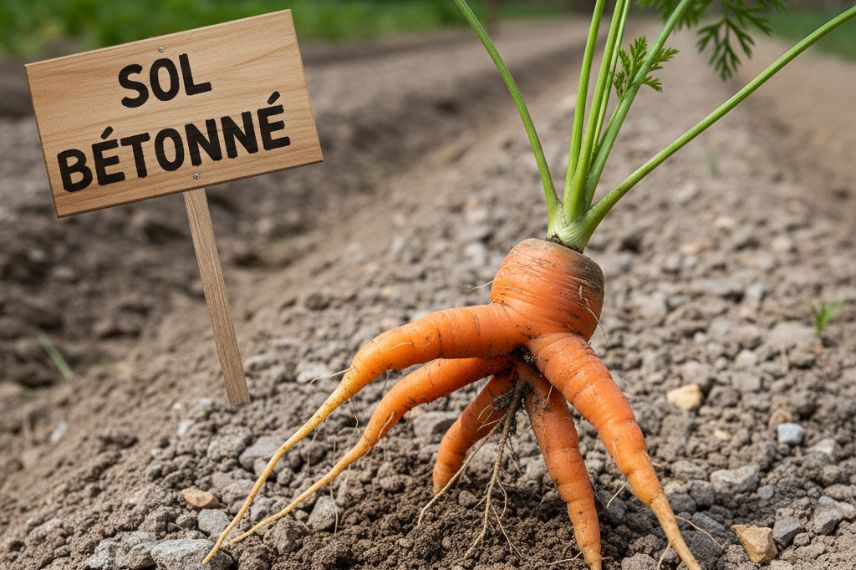
- Desired effect: the "Alien Carrot". Hitting a stone or a dense clod makes root split, fork or curl back on itself. Result? Forked carrots that look like extraterrestrial creatures with too many legs. Terrifying, unsellable, perfect.
- Why it fails: root seeks path of least resistance. If it must muscle through concrete, it either exhausts itself or deforms completely.
Real advice (for those who actually want to eat)
To avoid this fiasco, serious gardeners favour loose, deep soil. Before sowing, fork over soil to aerate without inverting. Ideal is a well-draining substrate: mix of fine soil and sand. The fewer obstacles, the straighter root will grow to success.
Sow as if throwing confetti
Gardening is solitary pastime, so why deny same solitude to vegetables? For exemplary failure, forget Swiss precision. Grab seed packet and empty it in one sharp shake over 10 cm². Close quarters is conviviality! The tighter they are, the more they'll have to tell each other jokes while waiting to wither.
And above all, once seedlings appear, resist temptation to thin out. Why choose who gets to live? Let jungle law take its course.
- Desired effect: fighting for every millimetre of soil and every sunbeam, your carrots and radishes will remain mere wires. Expect threadlike, tangled roots utterly ridiculous on plate.
- Why it fails: without space, root cannot widen. It wastes energy in fierce competition for nutrients, producing harvest that looks more like bowl of vermicelli than vegetables.
Real advice (for those who actually want to eat)
To harvest anything but disappointment, respect each plant's living space. Spacing rule is simple: a radish needs 3 cm to flourish, while a carrot requires at least 8 cm from neighbour to become fleshy.
Water... or don't, be guided by mood
Secret to inedible harvest? Apply emotional instability to watering. Don't be that dull gardener who checks moisture every evening. Instead practise thermal and water shock method.
Wait until soil resembles Death Valley, with cracks wide enough to lose keys. Once carrot plants are begging on their knees, go big: trigger biblical flood with hose. Move from Sahara to Atlantic in under two minutes.
- Desired effect: after sudden influx of water following long drought, root cells swell too quickly and... skin splits. Results are cracked, scarred vegetables and, for radishes, flavour so sharp it could fuel a rocket.
- Why it fails: lack of water makes root fibrous and hard (the famed "wood"), while sudden excess causes fissures that invite disease and pests.
Real advice (for those who actually want to eat)
Key to tender, sweet root is consistency. To avoid water stress, better to water moderately but regularly than to drown weekly. Good mulch also helps maintain steady moisture without turning patch into marsh.
Overdoing nitrogen
Want root vegetables? Narrow-minded idea! Aim for jungle instead. Use ultimate weapon: fresh manure spread generously just before sowing. The smell alone boosts chances of sabotaging harvest.
Message to plant is clear: "Forget what's underground, put all energy into leaves!"
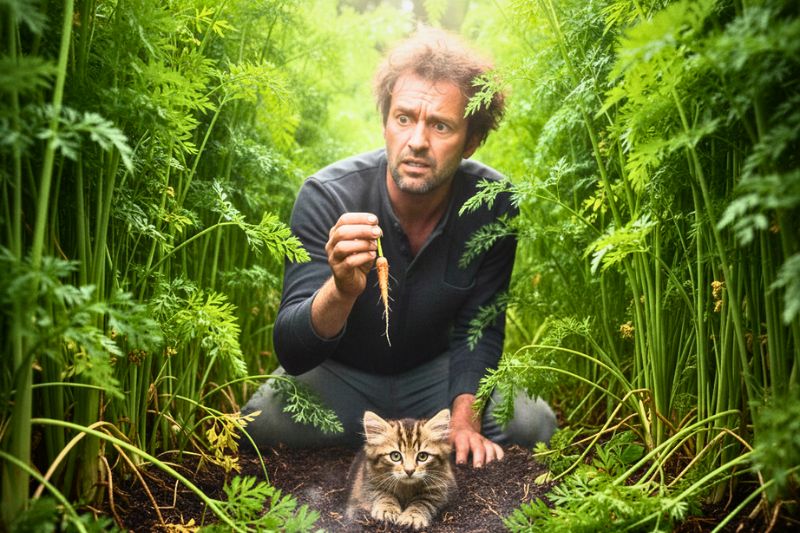
- Desired effect: carrot tops a metre high, so dense a cat could hide in them. But at harvest suspense collapses: dangling from that royal mop is tiny, hairy root, puny and disappointing.
- Why it fails: nitrogen fuels foliage. In excess (especially fresh), it burns young roots and encourages plant to show off above ground. Fresh manure also attracts carrot fly like magnet. Double failure, winning combo!
Real advice (for those who actually want to eat)
Root vegetables are thrifty creatures that hate direct nitrogen. To succeed, they need potassium (for root development) and phosphorus. Ideally sow into soil that received well-rotted compost previous year. This is known as "second cropping": let hungry crops (tomatoes, squashes) deplete nitrogen in year N, then sow roots in year N+1.
Summary of "worst practices" vs reality
| Action | Worst practices (Failure) | Reality (Success) |
|---|---|---|
| Soil | Compacted, clayey, stony soil. | Deep, light, loose soil. |
| Sowing | Packet emptied in bulk, no thinning. | Row sowing and respecting distances. |
| Water | Alternating desert / sudden flooding. | Stable, regular moisture. |
| Fertiliser | Fresh manure (too much nitrogen). | Well-rotted compost (potash & phosphorus). |

































Comments