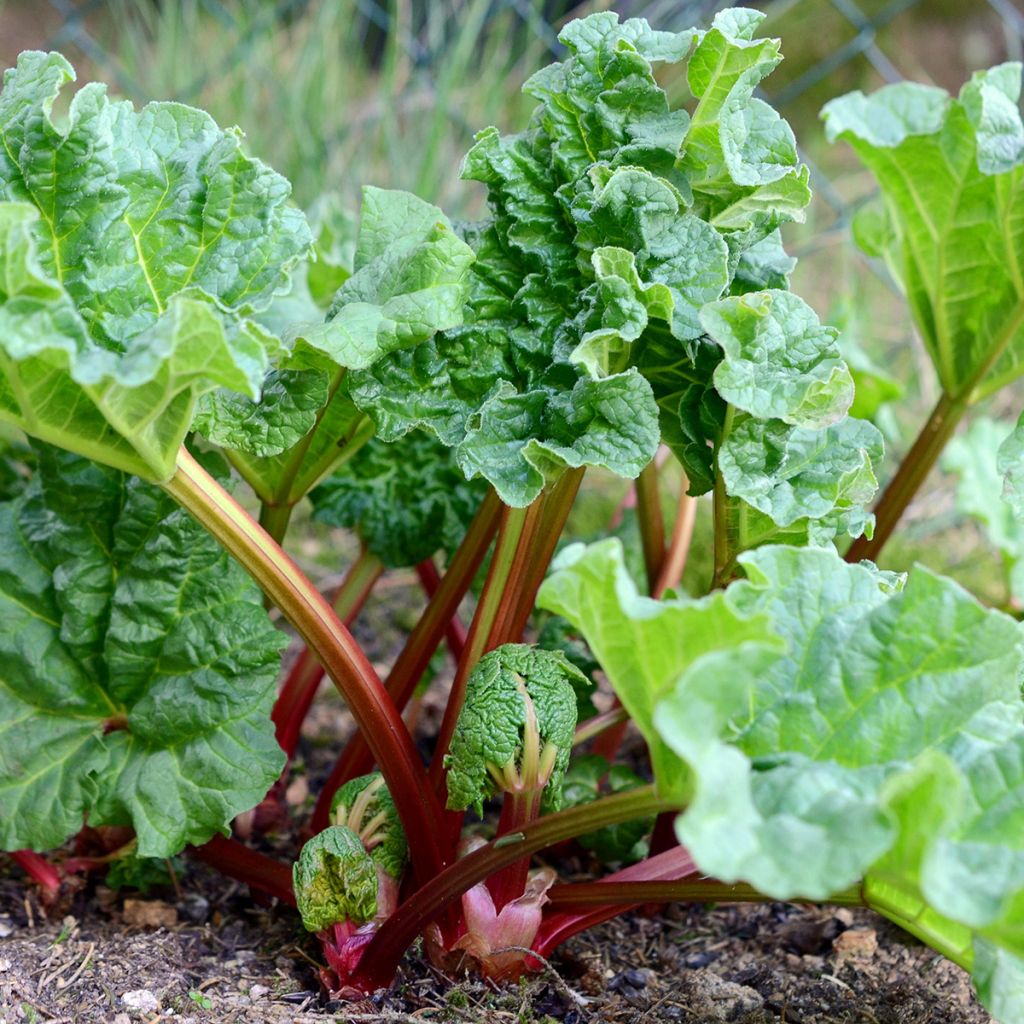
Rheum Holsteiner Blut - Rhubarb
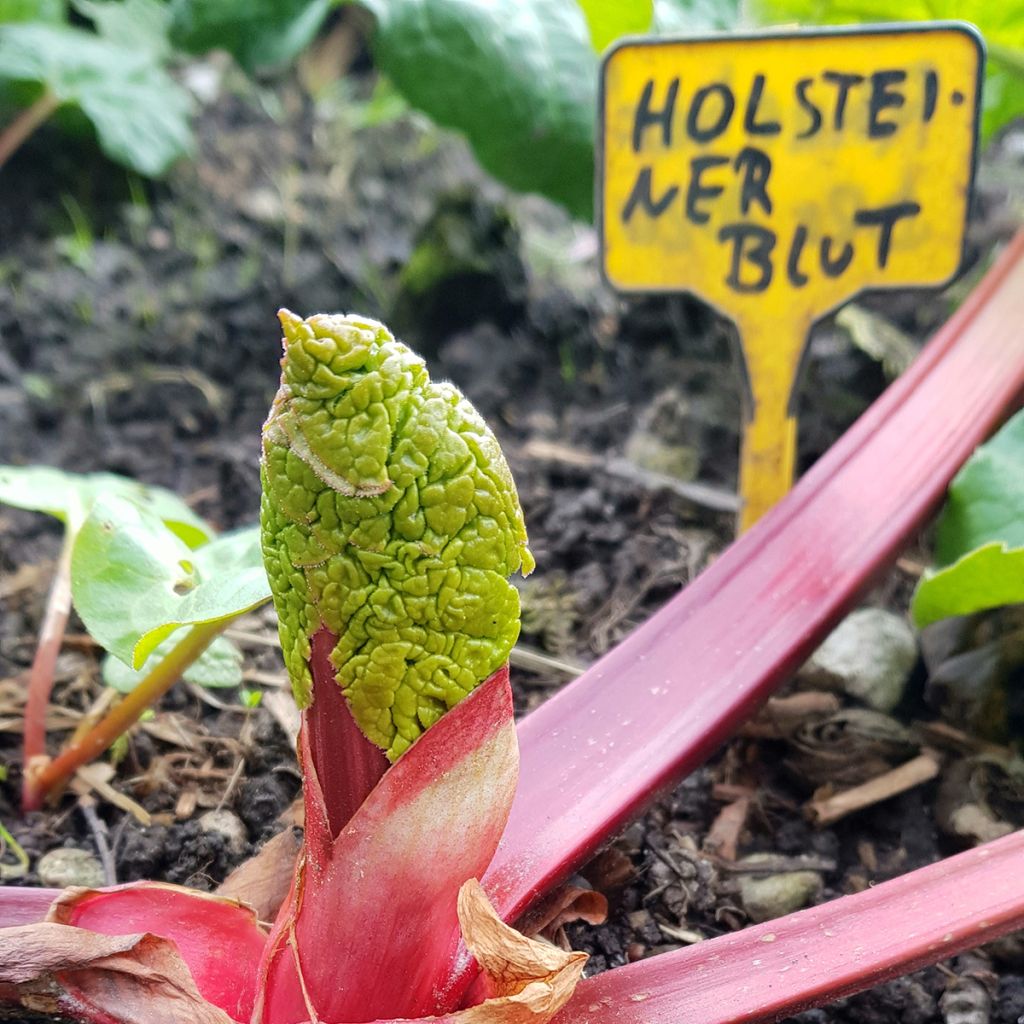
Rheum Holsteiner Blut - Rhubarb
Rheum Holsteiner Blut - Rhubarb
Rheum Holsteiner Blut
Rhubarb
Back-to-school special offer!
Get €10 off for every €50 you spend! And get up to €40 off on a single order.
How does it work?
1. Shop your favourites
Add your favourite plants to your basket. For every €50 you spend (excluding delivery charges, store credit and the plastic-free option), you’ll receive a €10 voucher.
€50 spent = €10 voucher
€100 spent = €20 voucher
€150 spent = €30 voucher
€200 spent = €40 voucher
2. Place your order
Once your basket reaches one of the spending thresholds, place your order. You can even choose your delivery date!
3. Receive your voucher
As soon as your order has been shipped, you’ll receive an email containing your personal voucher code and its value.
4. Use it on your next order
Your voucher is valid for 90 days from the date you receive it. It can be used once only, on a new order worth at least the value of the voucher, excluding delivery charges.
Please note: Vouchers can be combined with other offers, but cannot be split or refunded.
Why not try an alternative variety in stock?
View all →
Available in 1 sizes
Available in 1 sizes
Available in 1 sizes
Available in 1 sizes
Available in 1 sizes
Available in 1 sizes
This plant carries a 6 months recovery warranty
More information
We guarantee the quality of our plants for a full growing cycle, and will replace at our expense any plant that fails to recover under normal climatic and planting conditions.
Description
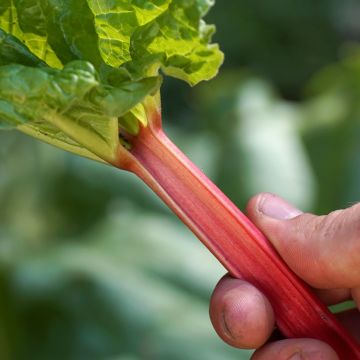
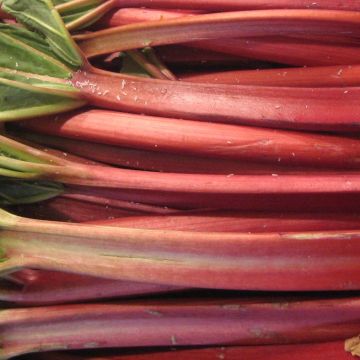
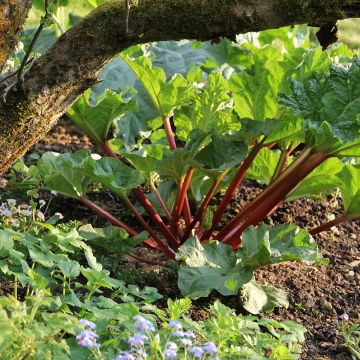
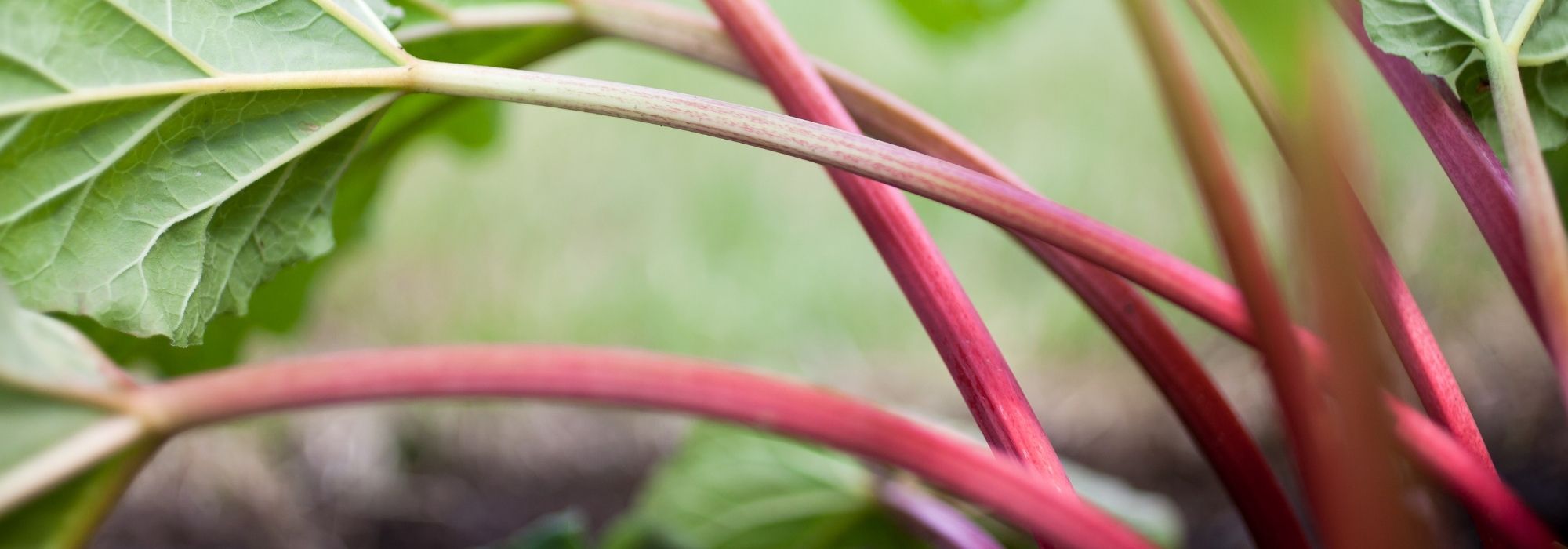
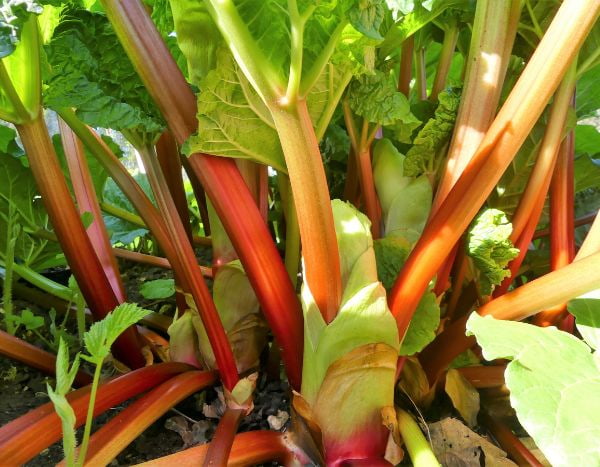
Rhubarb 'Holsteiner Blut' or Holstein Red Rhubarb is characterised by its long, well-coloured petioles, prized for use in compotes, tarts and jams. This mid- to late-season variety can be harvested from late May. This perennial forms an architectural clump of leaves that can also find a place in an exotic-looking border. It is not hard to grow, provided it is given a deep, rich, moist soil and a sunny but not scorching exposure.
Belonging to the Polygonaceae family, culinary rhubarbs are the result of ancient hybridisations between Asian species of the genus Rheum; they are European selections made from plants introduced from Siberia and China in the 17th and 18th centuries.
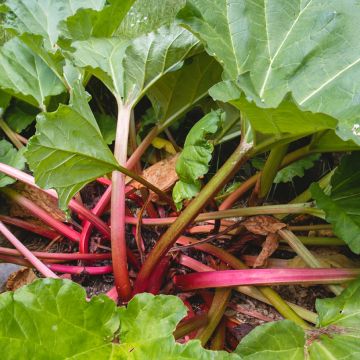
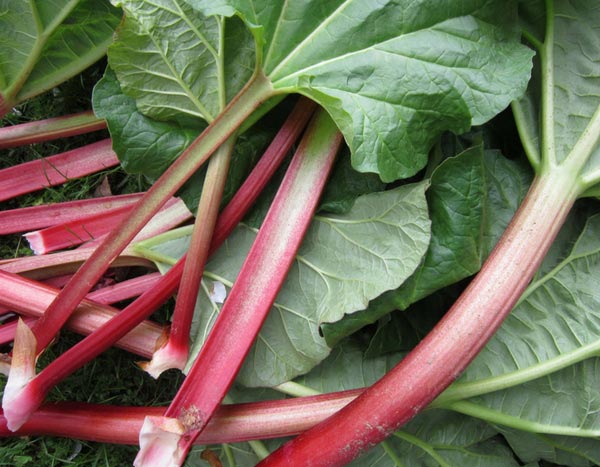
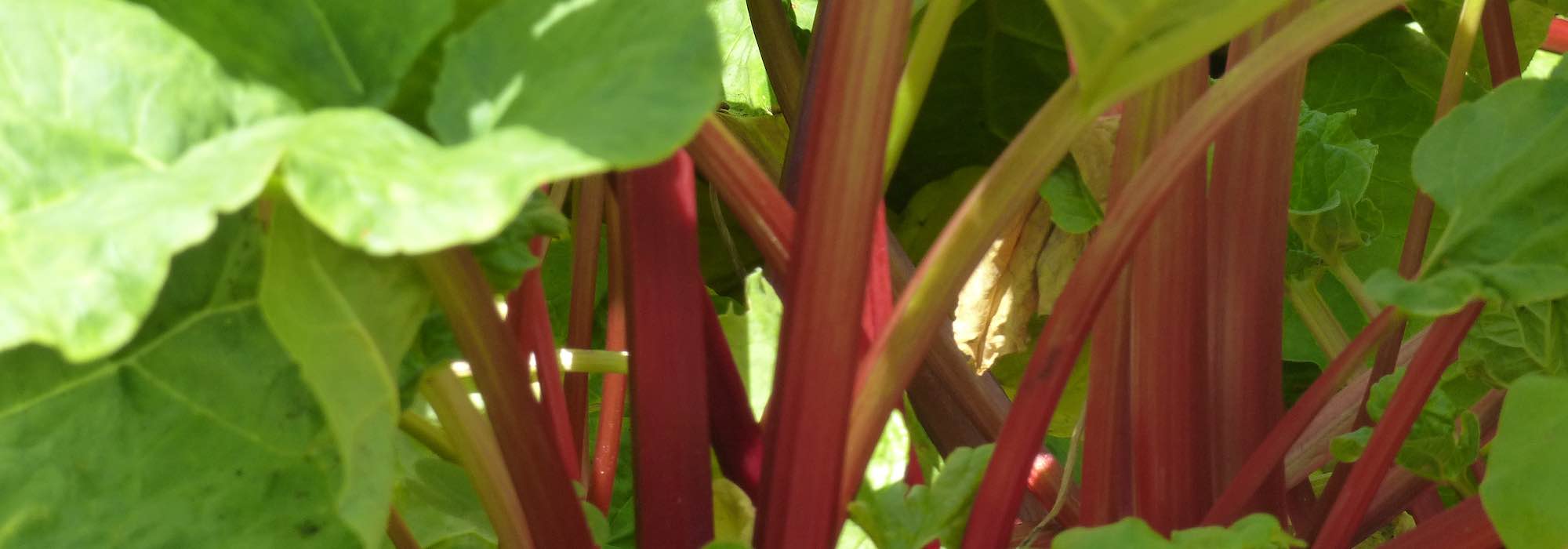
'Holsteiner Blut' is an old German cultivar, its name meaning "blood of Holstein", alluding to the deep red colour of the stalks; it is considered a traditional selection in Nordic collections. This plant is a rhizomatous herbaceous perennial from which fleshy roots and a crown of large buds emerge; it forms a broad rosette, its growth is rapid, and it reaches mature dimensions within 2 to 5 years. In open ground, the clump commonly reaches 1 to 1.50 m in width and 1 to 1.50 m in height when in flower; remove the flower stalks to encourage stalk production. The medium green deciduous leaves are very large, heart-shaped to triangular, puckered, borne on thick, streaked stalks, a vivid red for a good length; their flesh is green to pinkish. If allowed, it will flower from May to June in branched panicles of small greenish to whitish flowers.
Long grown as a medicinal plant for its roots, rhubarb stalks have only been eaten since the 18th century onwards.
The red petioles of 'Holsteiner Blut' can mainly be harvested from late May to early June, on well-established plants. This selection is hardy down to -20°C; culinary rhubarb is generally very hardy even in cold zones.
Cultivation: plant rhubarb in a deep, humus-rich, moist but well-drained, neutral to slightly acidic soil and in non-scorching sun. It appreciates applications of mature compost in spring, and a summer mulch helps maintain soil moisture.
Harvest this 'Holsteiner Blut' rhubarb in spring and early summer. Gently pull the stems, twisting them at the base to avoid injuring the crown. Do not cut the stems! Wait at least two years until the young plant is well established, for your first harvest.
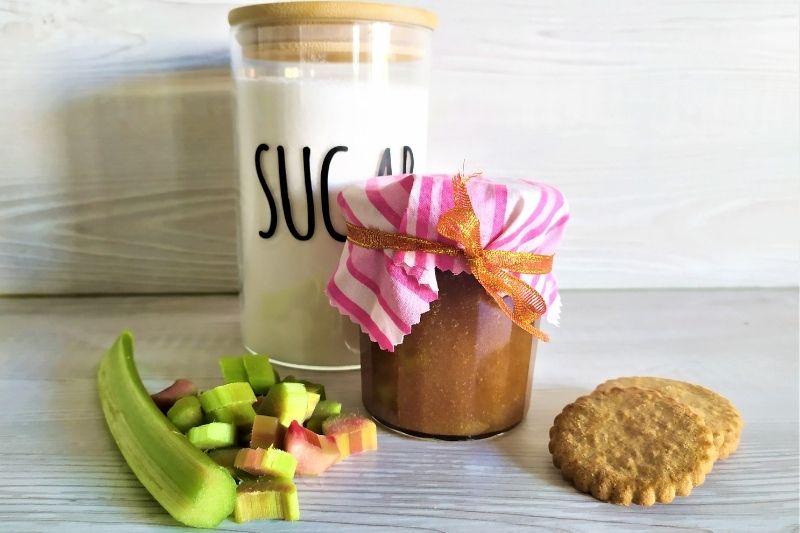
In the kitchen, rhubarb is eaten cooked. It is the queen of tarts, compotes, jams and chutneys. The stalks, once peeled and chopped, add a tangy touch to desserts and pair well with strawberries, apples or even ginger in sweet or savoury dishes.
Rhubarb has appetising, astringent, refreshing properties and contains vitamins (B, C) and minerals (calcium, magnesium, iron). But beware, its leaves are rich in oxalic acid and are not edible.
Storage: Rhubarb stalks keep for a few days in the refrigerator's vegetable drawer or for a few months, cut into chunks, in the freezer.
Plant 'Holsteiner Blut' in a bed, near the soft fruit patch, for easy harvesting. In an edible and ornamental garden, pair it with lush perennials like Rheum palmatum. For garden rhubarbs, combine it with 'Victoria', 'Valentine' or 'Canada Red' to spread out the harvests.
The gardener's little tip: Rhubarb leaves are toxic, but can be used to prepare a liquid manure which is repellent to aphids.
Harvest
Plant habit
Foliage
Botanical data
Rheum
Holsteiner Blut
Polygonaceae
Rhubarb
Rheum × hybridum ‘Holsteiner Blut’
Cultivar or hybrid
Perennial
Planting and care
Rhubarb 'Holsteiner Blut' thrives best in deep, moist, fertile soil and a humid (even cold) climate. Therefore, plant it in rich or previously enriched soil (3 to 4 kg of compost per m²), in sun or partial shade, ensuring you leave enough space for its development, at least 1 m², or even 1.5 m².
Plant in spring in cool regions (from March to June) and in autumn in mild climates, from September to November. Loosen the soil deeply and add well-rotted compost. Space the young plants 1 m apart in the row and 1.50 m between rows. Dig a hole (3 times the volume of the root ball), place the root ball and cover with soil. Firm well and water copiously.
Remove the flowering stems before they develop to encourage leaf growth. During cultivation, water regularly, especially in hot weather. Apply a mulch at the base to retain moisture in summer. Hoe and weed frequently.
Rhubarb is generous, but it is greedy: an annual application of compost in spring is highly recommended.
Cultivation
Care
Intended location
Planting & care advice
This item has not been reviewed yet - be the first to leave a review about it.
Recently viewed products
Haven't found what you were looking for?
Hardiness is the lowest winter temperature a plant can endure without suffering serious damage or even dying. However, hardiness is affected by location (a sheltered area, such as a patio), protection (winter cover) and soil type (hardiness is improved by well-drained soil).

The flowering period indicated on our website applies to countries and regions located in USDA zone 8 (France, the United Kingdom, Ireland, the Netherlands, etc.)
It will vary according to where you live:- In zones 9 to 10 (Italy, Spain, Greece, etc.), flowering will occur about 2 to 4 weeks earlier.
- In zones 6 to 7 (Germany, Poland, Slovenia, and lower mountainous regions), flowering will be delayed by 2 to 3 weeks.
- In zone 5 (Central Europe, Scandinavia), blooming will be delayed by 3 to 5 weeks.
In temperate climates, pruning of spring-flowering shrubs (forsythia, spireas, etc.) should be done just after flowering.
Pruning of summer-flowering shrubs (Indian Lilac, Perovskia, etc.) can be done in winter or spring.
In cold regions as well as with frost-sensitive plants, avoid pruning too early when severe frosts may still occur.
The planting period indicated on our website applies to countries and regions located in USDA zone 8 (France, United Kingdom, Ireland, Netherlands).
It will vary according to where you live:
- In Mediterranean zones (Marseille, Madrid, Milan, etc.), autumn and winter are the best planting periods.
- In continental zones (Strasbourg, Munich, Vienna, etc.), delay planting by 2 to 3 weeks in spring and bring it forward by 2 to 4 weeks in autumn.
- In mountainous regions (the Alps, Pyrenees, Carpathians, etc.), it is best to plant in late spring (May-June) or late summer (August-September).
The harvesting period indicated on our website applies to countries and regions in USDA zone 8 (France, England, Ireland, the Netherlands).
In colder areas (Scandinavia, Poland, Austria...) fruit and vegetable harvests are likely to be delayed by 3-4 weeks.
In warmer areas (Italy, Spain, Greece, etc.), harvesting will probably take place earlier, depending on weather conditions.
The sowing periods indicated on our website apply to countries and regions within USDA Zone 8 (France, UK, Ireland, Netherlands).
In colder areas (Scandinavia, Poland, Austria...), delay any outdoor sowing by 3-4 weeks, or sow under glass.
In warmer climes (Italy, Spain, Greece, etc.), bring outdoor sowing forward by a few weeks.
Shipping country and language
Your country of residence may be:
Your country of residence is:
For a better user experience on our website, you can select:
Your shipping country:
-
 Austria
-
 Belgium
-
 Bosnia & Herzegovina
-
 Bulgaria
-
 Croatia
-
 Cyprus
-
 Czechia
-
 Denmark
-
 Estonia
-
 Finland
-
 France
-
 Germany
-
 Greece
-
 Hungary
-
 Iceland
-
 Ireland
-
 Italy
Italy
-
 Latvia
-
 Liechtenstein
-
 Lithuania
-
 Luxembourg
-
 Malta
Malta
-
 Netherlands
-
 Poland
-
 Portugal
-
 Romania
-
 Serbia
-
 Slovakia
-
 Slovenia
-
 Spain
Spain
-
 Sweden
-
 Switzerland
Language:
-
French
-
 English
-
Spanish
-
Italian
-
German
-
Portuguese
-
Dutch
-
Finnish
My Account
Hello
My wish lists
My cart
Log in / Register
Existing customer?
This form is protected by reCAPTCHA - the Google Privacy Policy and Terms of Service apply.
New customer?
Create an account to track your orders, access our customer service and, if you wish, make the most of our upcoming offers.