Liquidambar, American sweetgum : planting, pruning, care
Contents
Liquidambar in a nutshell
- Liquidambar is one of the most beautiful ornamental trees
- Unique in autumn for its colourful, glowing foliage
- Easy to grow, it only requires fresh, non-calcareous soil and a prime spot
- Hardy, disease-resistant and requires very little care
- Majestic, ideal as a solitary specimen in parks or large gardens, while dwarf Liquidambar will delight shrub enthusiasts in smaller spaces!
A word from our expert
Liquidambar is without doubt one of the most beautiful ornamental trees for the garden. It is often used in public spaces as a street tree, but this majestic species also deserves a prime place in the garden where its graceful silhouette can show off to best effect.
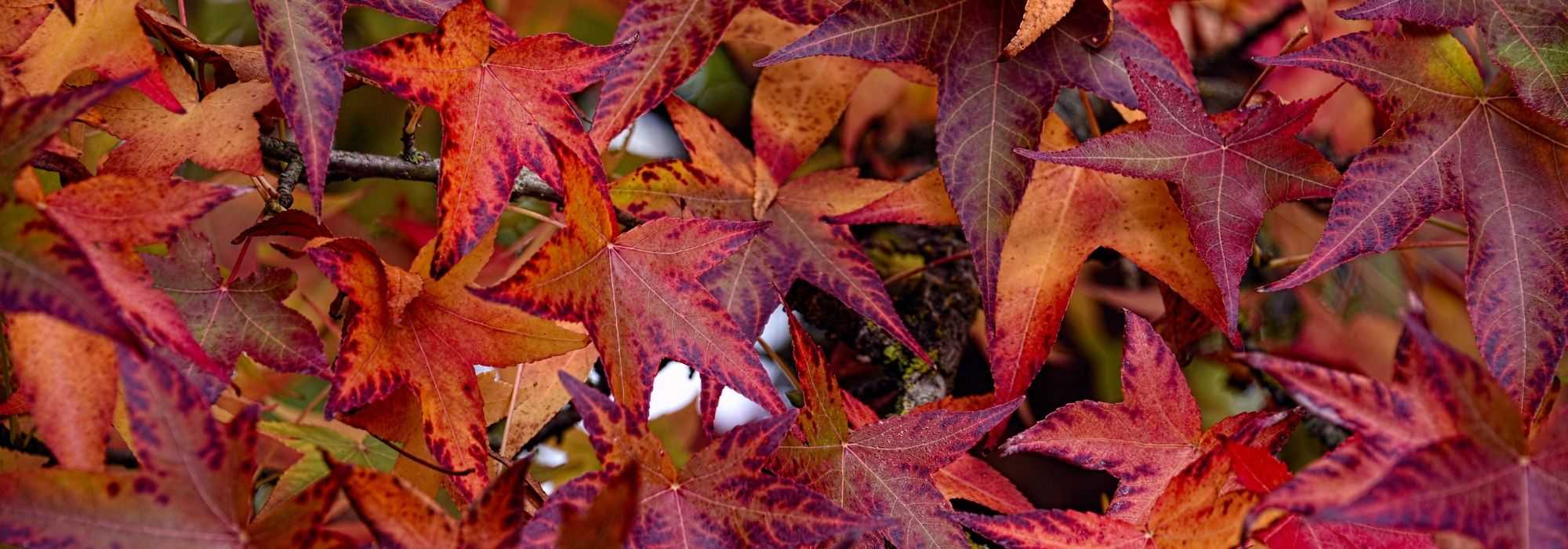
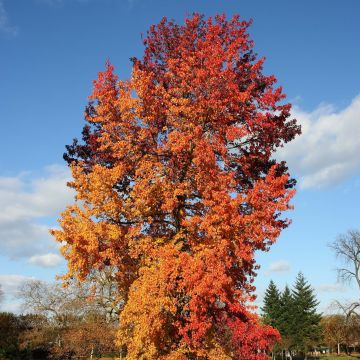
Its main asset is its deciduous foliage, which guarantees a spectacular autumn display by turning gold, coppery and purplish-red, warm, spicy shades that set the garden alight as the days shorten. Winter reveals its precious wood and a beautiful, attractively ridged bark that has real charm, while spring and summer bring green foliage, sometimes splashed with yellow.
While the largest specimens, such as Liquidambar styraciflua, more commonly known as “American sweetgum”, can reach 20 m in height, there are also species such as Liquidambar orientalis and many cultivars of more modest dimensions that rarely exceed 10 m. If you love liquidambar but find it too large for your space, know that there is a dwarf liquidambar, Liquidambar styraciflua ‘Gum Ball’, a variety not exceeding 3 m in any direction which will be much better suited to smaller gardens.
Hardy and easy to grow, Liquidambar thrives in sun and requires little attention once well established.
With its pyramidal habit, it makes a striking focal point as a solitary specimen on a lawn, in a well-open spot, or in a row along a long avenue.
Discover without delay liquidambar, this tree with dazzling autumn foliage suited to both large and small gardens.

Description and botany
Botanical data
- Latin name Liquidambar
- Family Hamamelidaceae
- Common name Liquidambar, American sweetgum
- Flowering April-May
- Height 3 to 10 m and more
- Exposure Sun
- Soil type Clayey, moist
- Hardiness -20°C
The Liquidambar is a deciduous tree in the Hamamelidaceae family, like Hamamelis and Parrotia. The genus comprises four tree species native to temperate forests and riverbanks in America, Turkey and Asia.
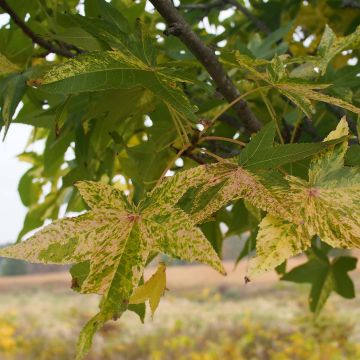
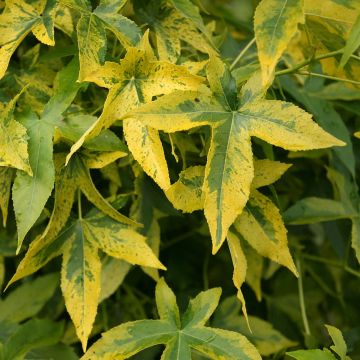
The Liquidambar styraciflua, also called “American sweetgum”, is the best-known species. It is available in a wide range of cultivars selected for habit, more compact dimensions, leaf shape and colour, such as ‘Gum Ball’, a dwarf variety not exceeding 3 m, ‘Golden Sun’ with pale yellow foliage in spring turning green in summer, or ‘Aurea’ with green foliage speckled with yellow.
The Liquidambar orientalis, “Oriental liquidambar” or “Styrax of the Levant”, native to Turkey, the Liquidambar acalycina or “Chinese liquidambar”, both smaller than their American cousin, and the Liquidambar formosana from Taiwan, whose foliage is equally spectacularly coloured in autumn, complete the genus.
In its natural habitat, the sweetgum can reach up to 40 m in height, but in our regions it will seldom exceed about 20 m on average with a spread of 3 to 5 m. Growth is slow in the first years then fairly rapid thereafter. It fairly quickly forms an imposing specimen. New varieties offer more modest dimensions, rarely exceeding 10 m in height and 3–4 m wide after 10 years. It displays a very good longevity of around 150 years.
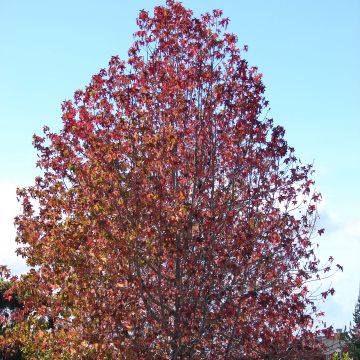
Slender or columnar, conical or pyramidal, more rarely globose (‘Gum Ball’) or rounded, Liquidambar’s habit varies considerably with species and cultivars. Most often however it adopts a pyramidal silhouette, sometimes quite irregular, which rounds with age.
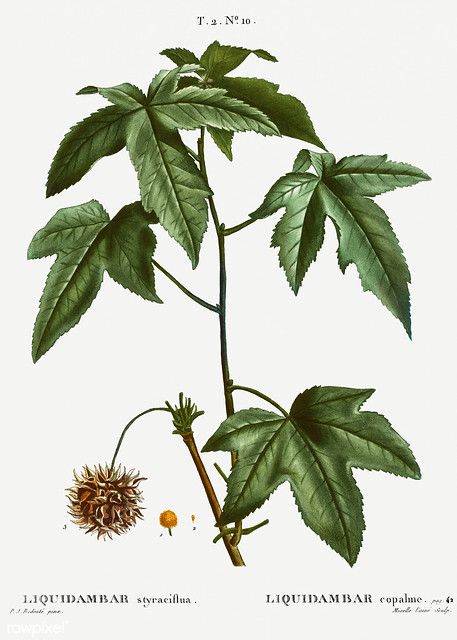
Liquidambar styraciflua – botanical illustration by P.J. Redouté
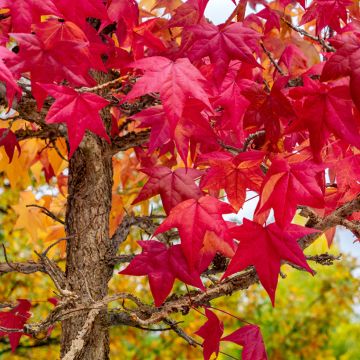
On a powerful taproot, this fine tree develops a very upright trunk with corky bark, dark grey turning brown-red and fissuring with age. Young shoots show ridges that become corky outgrowths as they age. Its timber is prized and resembles walnut so closely that Liquidambar was commonly nicknamed the “satin walnut”. Its bark gives off a cinnamon scent and exudes a resin, styrax or copal, sometimes called “white Peru balsam”, which earned the tree its name liquidambar — meaning “liquid” and “amber” — in reference to this balsamic, aromatic amber-coloured sap that flows when the bark is cut.
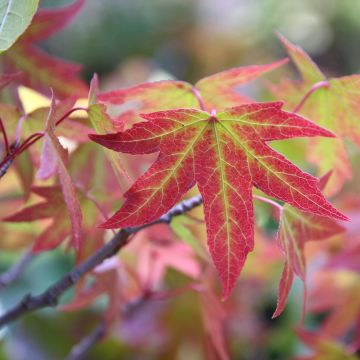
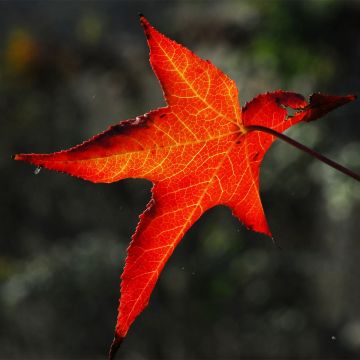
Liquidambar is particularly valued for its elegant deciduous foliage that dons sumptuous hues, filling the garden with warm, spicy tones as days shorten in autumn. The foliage consists of large palmate leaves, divided into 3 to 7 triangular or rounded lobes (Liquidambar styraciflua ‘Rotundiloba’), more or less notched, resembling maple leaves except that sweetgum leaves are arranged alternately on the shoots rather than oppositely. 10 to 18 cm wide, with a finely toothed margin, they are pubescent, bristly with reddish hairs on the underside of the lamina.
This ample palmate foliage releases a turpentine scent when crushed.
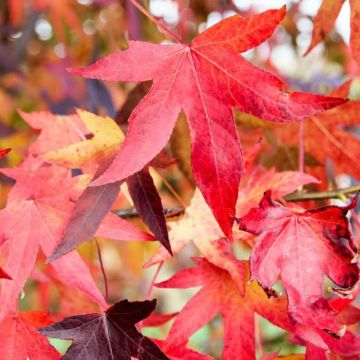
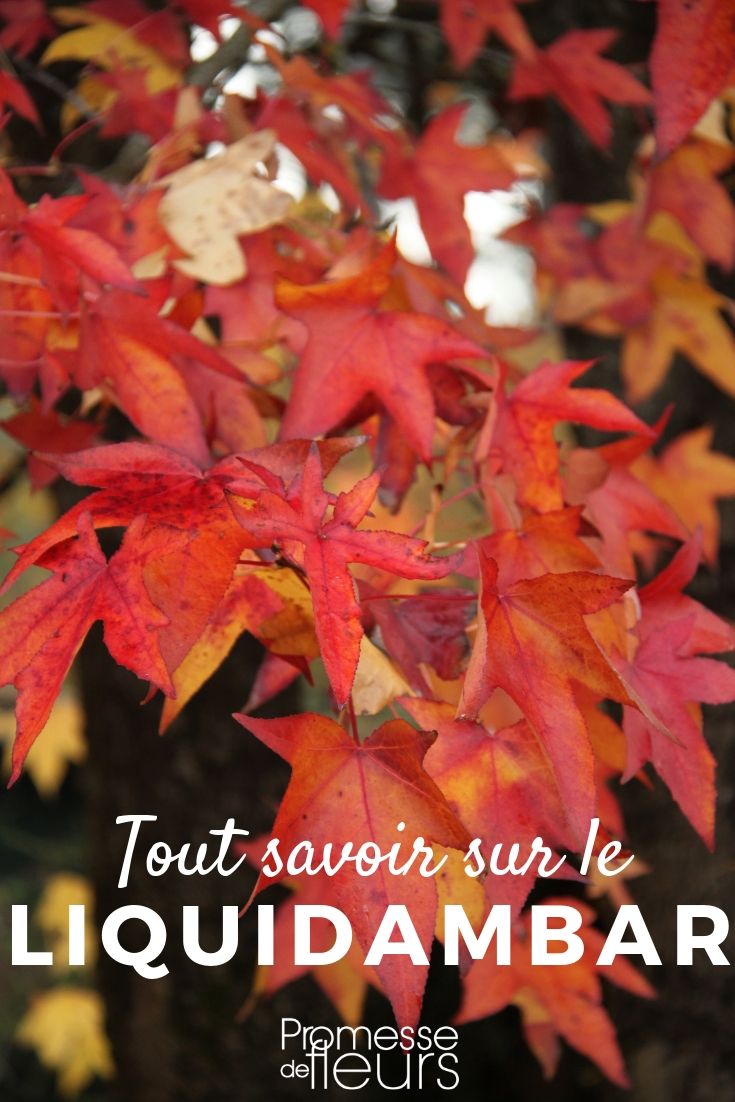
As with many members of the Hamamelidaceae, Liquidambar develops magnificently coloured foliage in autumn. From pale green to glossy dark green, sometimes vivid green speckled and splashed with yellow or cream-margined grey from spring to summer, the leaves take on flamboyant shades in autumn: gold, orange, ochre-yellow, coppery, crimson to garnet red and pinkish‑purple, the intensity varying with cultivar and growing conditions.
Flowering of the sweetgum is inconspicuous. In spring, in April, small green-yellow apetalous unisexual flowers appear. Sweetgum is a monoecious species: male and female flowers occur on the same tree. They take the form of erect catkins in spikes 5 to 7.5 cm long or of spiny, pendulous glomerules 1 to 3 cm in diameter depending on whether they are male or female.
Only after about 25 years of cultivation do the female flowers, bristling with green points, develop into fruits, brown spherical capsules 2.5 to 3.4 cm in diameter that release small winged seeds resembling maple samaras. They remain attached to the twigs by a long stalk well into winter.
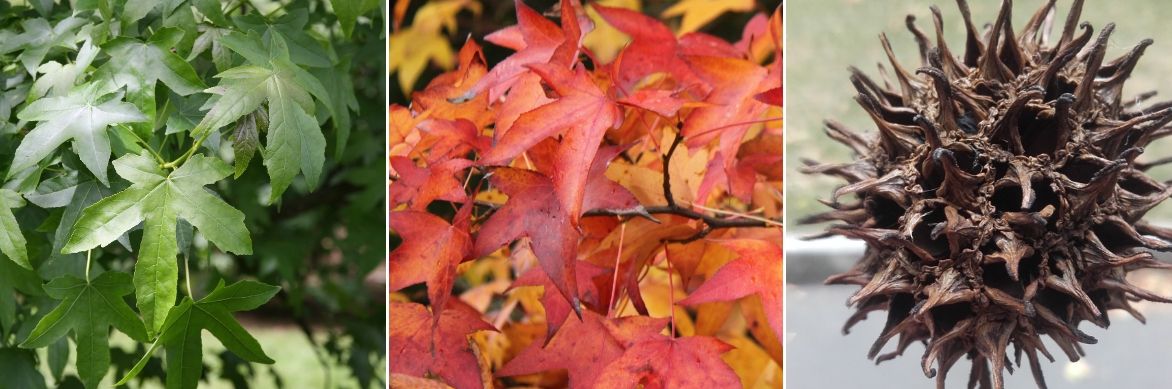
Liquidambar styraciflua: foliage green then flamboyant in autumn and its fruit
Very hardy, Liquidambar withstands winter cold down to -15 to -20 °C, sometimes even lower. It thrives in full sun and shows its best colours in non-calcareous (slightly acidic), deep, heavy (clayey), rich and moist soil. It is an accommodating tree that tolerates temporarily waterlogged soils and even sea spray and pollution.
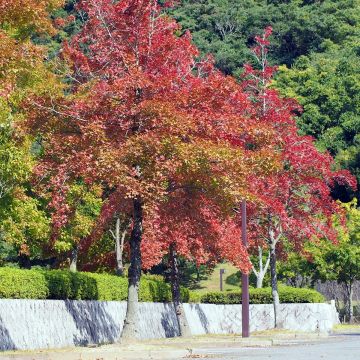
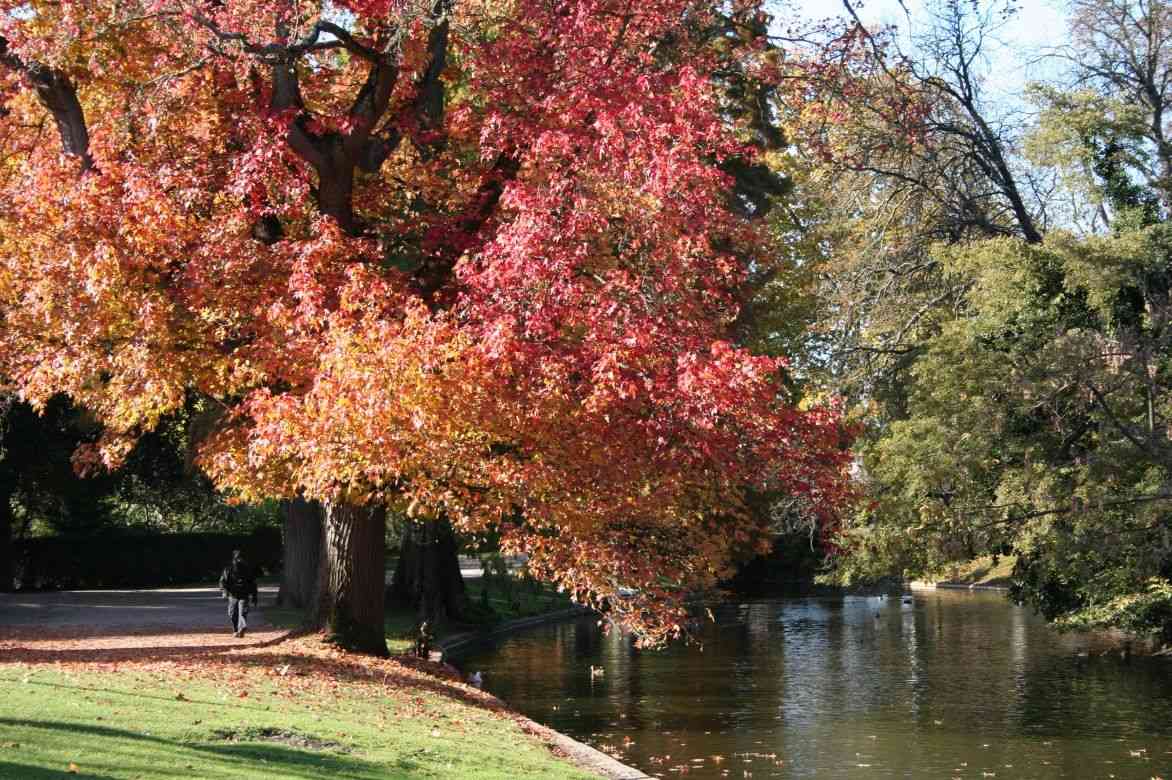
Plant as a specimen on a large lawn in a park or a generously sized garden, near a pond, in alignment along a long avenue or as a boundary tree in a seaside garden.
The resin, styrax or copal exuded by Liquidambar can be burned as incense and is highly prized for dermatological and anti-stress properties and its ability to help respiratory ailments. Egyptians used it to embalm mummies, while Native Americans chewed it as a form of chewing gum. In the 19th century, when Liquidambar was introduced to Europe, copal resin was used in the preparation of milks and beauty balms. This fragrant gum also serves as a perfume fixative and is much used by perfumers.
Finally, Liquidambar’s fragrant, valuable wood was highly prized in cabinetmaking.
Main species and varieties
There are now many cultivars of Liquidambar styraciflua, species most commonly cultivated in gardens, selected for their habit, the colour of their foliage and their reduced growth compared with the typical species. For example, the impressive size of this tree has been happily reimagined in the more compact form of the ‘Gum Ball’ cultivar, which finally allows Liquidambar to fit into smaller gardens.
Most popular
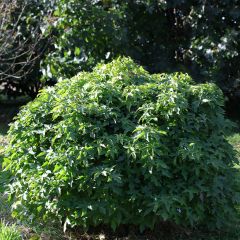
Liquidambar styraciflua Gum Ball - American Sweetgum
- Flowering time May
- Height at maturity 3 m
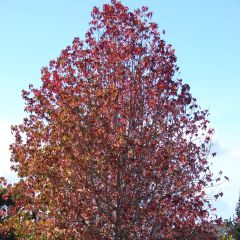
Liquidambar styraciflua - American Sweetgum
- Flowering time May
- Height at maturity 20 m
Our favourites
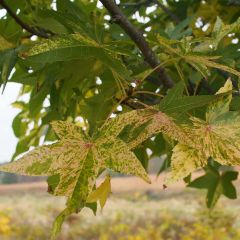
Liquidambar styraciflua Aurea - American Sweetgum
- Flowering time May
- Height at maturity 9 m
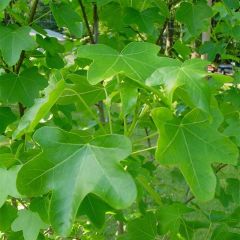
Liquidambar styraciflua Rotundiloba - American Sweetgum
- Flowering time May
- Height at maturity 18 m
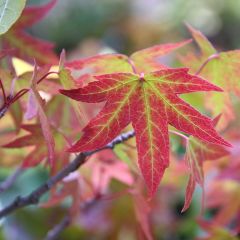
Liquidambar styraciflua Worplesdon - American Sweetgum
- Flowering time May
- Height at maturity 12 m
Discover other Liquidambar - Sweetgum
View all →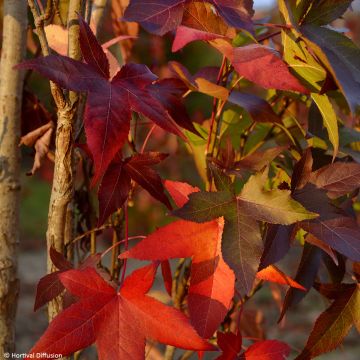
Available in 1 sizes
Available in 1 sizes
Available in 1 sizes
Available in 2 sizes
Available in 1 sizes
Available in 4 sizes
Available in 2 sizes
Available in 1 sizes
Available in 1 sizes
Available in 1 sizes
Planting Liquidambar
Where to plant?
Liquidambar has good hardiness down to -15°-20°C, allowing planting in all regions. However, in areas with long winters, provide a well-sheltered position as late frosts can damage its aments. Native to wet areas and quite tolerant of sea spray, it will appreciate rainy coastal climates.
It needs maximum light to develop splendid autumn colours.
It establishes easily in full sun, which will enhance its sumptuous autumn colours. It likes heavy, cool soils. It requires clay or clay–loam soil, rich, deep, free-draining in winter, cool, even moist, as it needs a certain soil moisture to thrive. Its root can tolerate temporary immersion while nevertheless disliking boggy ground!
It prefers rather acidic soil, in any case not calcareous. While sensitive to lime, this tree is tolerant of urban pollution, making it a good candidate for city gardens.
Its taproot copes poorly with transplanting, so consider the planting site carefully before planting because once well established it will grow about 40–50 cm per year. Give it plenty of space as at maturity the largest sweetgums reach 20–22 m in height on average with a 7 m spread.
To best enjoy its remarkable autumn display and elegant silhouette, reserve a well-open spot in the garden for this tree.
Its size makes it a magnificent specimen planted alone on a large lawn in a spacious park or large garden, as an avenue tree to line an approach majestically or to grace a water feature where it can be reflected.
In a garden where space is limited, to fill out a shrub clump or a free-form hedge, prefer a dwarf American sweetgum variety, such as Liquidambar styraciflua ‘Gum Ball’ which will not exceed 3 m in any direction.
When to plant?
Plant the liquidambar or sweetgum preferably in autumn, from September to November to encourage root establishment before winter. Container-grown specimens can also be planted in spring, from February to April, avoiding frosty periods or very hot spells.
How to plant?
On very calcareous soil, we recommend adding heather soil at planting. Once established, do not move the Liquidambar as its root will tolerate transplanting very poorly. Allow sufficient space — at least 5–8 m distance from another tree, 3–5 m for cultivars with reduced growth. You can also plant in groups of 3 or 5 to create a truly majestic grove.
For planting your sweetgum:
- Start by digging a wide hole at least three times the volume of the rootball
- Spread gravel at the bottom of the hole to improve drainage
- Backfill with a mix of half garden soil and half potting compost; add heather soil if ground is chalky
- Add well-rotted compost
- Plant tree with collar at soil level
- Stake if necessary
- Firm soil and water regularly until established and for the first few years
- Mulch to keep the rootzone cool during hot periods
For successful planting, see our video on how to plant a tree.
Care and pruning of Liquidambar
Liquidambar requires very little maintenance and grows without any particular care.
During the first years, it requires regular watering. In summer, monitor its water needs and water generously in dry weather. Once well established, it will be content with water from the sky!
A good mulch in summer will help keep soil cool and in winter will protect young trees from severe frosts.
Each spring, amend soil with a good organic fertiliser such as farmyard manure or compost.
Pruning is neither necessary nor recommended. In autumn or late winter, you may intervene only to remove dead, dry or damaged wood. Between mid-August and end of September, prune lightly misplaced or surplus branches.
When established in suitable conditions, Liquidambar is largely unaffected by disease.
Multiplication
The Sweetgum can be propagated by seed (a very long process; germination can take up to 2 years), by division of suckers, by propagation by cuttings (quite erratic) and by layering.
By separating suckers
This is probably the simplest propagation method. Some sweetgums tend to produce suckers around the parent plant. In autumn, separate the suckers with a spade, cutting the root as close as possible to the main trunk. Replant these young plants straight away into fresh soil.
By layering
Layering of Liquidambar is simple and produces a new young plant identical to the parent plant; however root development is very slow.
- In autumn, bend down one of the lower branches to the base of the tree
- Remove the leaves from that section of the stem and nick the bark for a few centimetres
- Dig a furrow close to the parent plant
- Bend the branch into the furrow and bury part of it so it will root
- Backfill the furrow and secure the layer with metal hooks
- Raise the tip and stake the above-ground section
- You can separate the layer from the parent plant and plant it out when it has developed enough roots
Taking cuttings of Liquidambar
- In autumn–winter, using pruning shear, take hardwood cuttings about 20 cm long
- Remove the lower leaves from the stem
- Plant the cuttings in pots in a mixture of sand, turf and moist soil
- Keep the substrate moist until rooting
- Establishment is slow and can take several years
- Once well rooted, repot them individually into pots filled with compost and plant out the following autumn
Companion plants for American sweetgum
American sweetgum requires plenty of space; it is a species that stands alone and will be remarkable as a majestic punctuation in the centre of a lawn in a large garden. It remains easy to pair, however, with other plants that enjoy the same cool conditions and deep soils. Resistant to both pollution and sea spray, its presence is equally at home in a city garden or in seaside gardens, where it can accentuate an avenue. With its coloured foliage, it is indispensable for creating magnificent autumnal ambience.
To compose a symphony of spicy tones, plant it near other trees and shrubs with coloured autumn foliage such as Ginkgo Biloba, Acer or Japanese maples, Cornus, birches and witch-hazel.
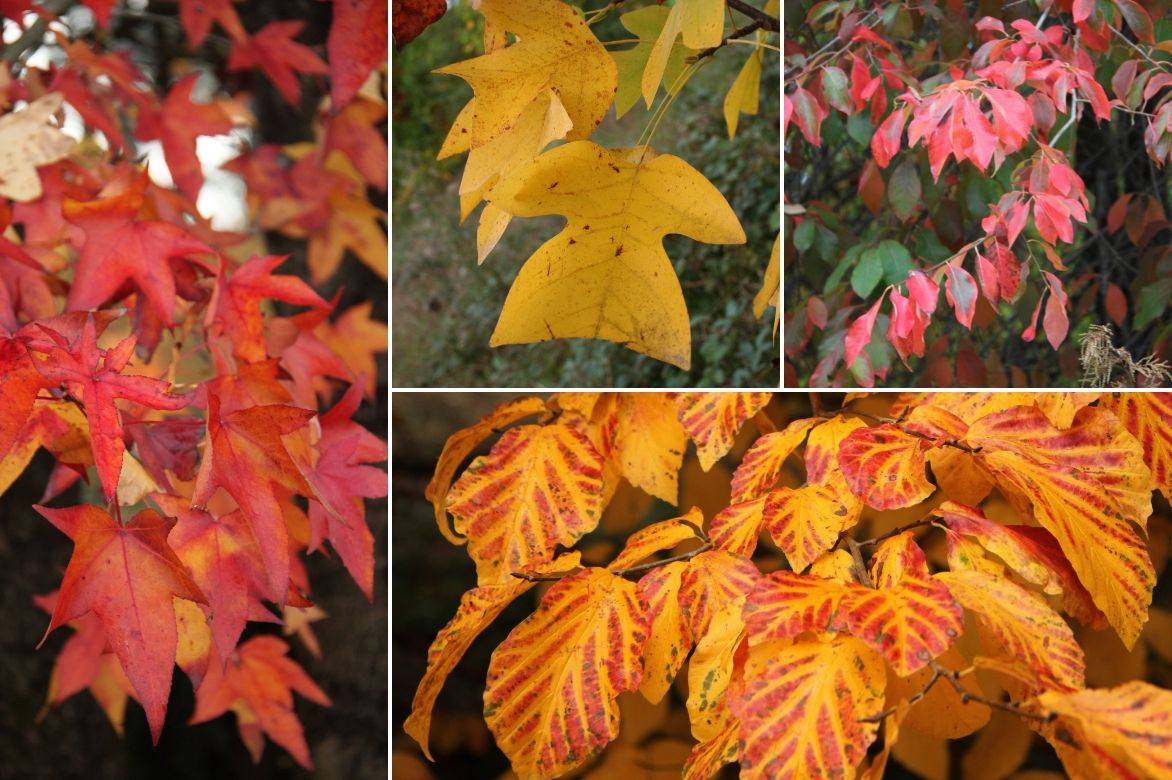
An example of an autumnal group planting: Liquidambar styraciflua, Liriodendron tulipifera, Nyssa sylvatica and Parrotia persica
You will create a dazzling grove in autumn by pairing it with a tulip tree (Liriodendron tulipifera), Oxydendron arboreum, Parrotia persica and black tupelo, which also adopt sumptuous autumnal tones.
This tree, appreciating acidic soils, can serve as a backdrop for a mix of heather soil shrubs such as small rhododendrons, hydrangeas and Chinese azaleas.
For full effect, plant it against a permanent green background of conifers such as Pinus peuce (Macedonian pine), Taxodium distichum or bald cypress, or Metasequoia glyptostroboides ‘Gold Rush’.
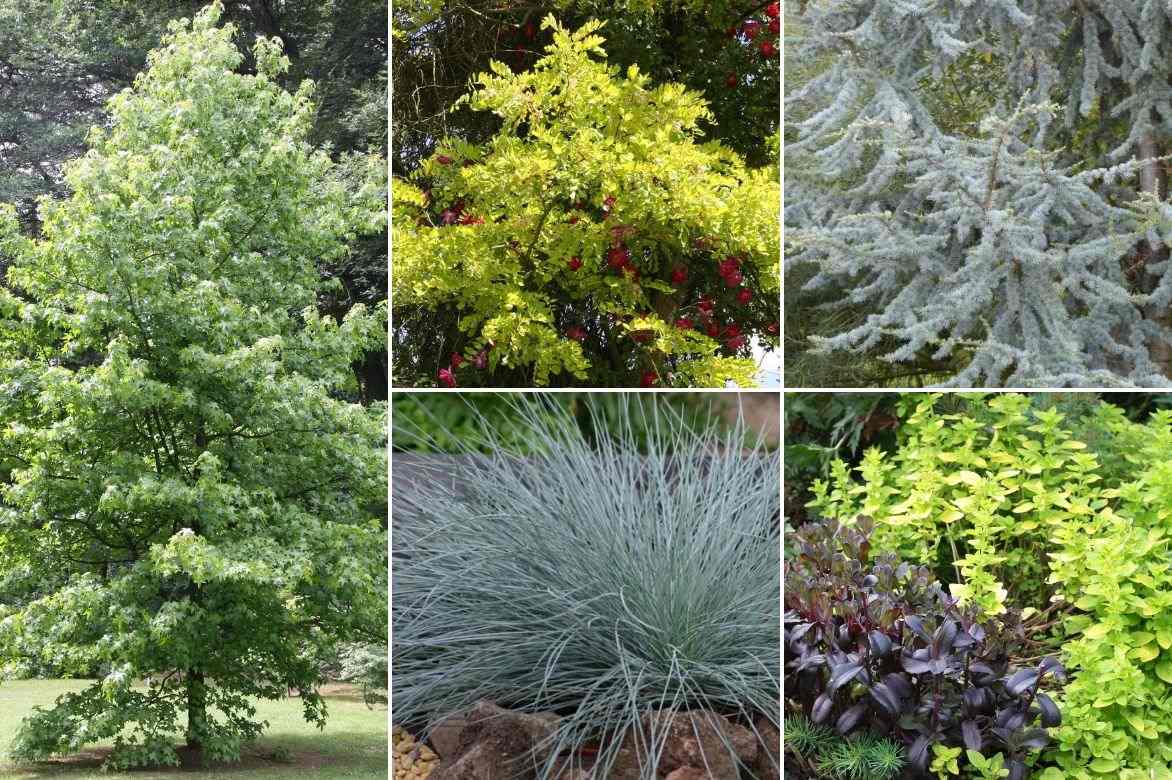
An association idea: Liquidambar styraciflua (or the superb variety ‘Worplesdon’), Robinia pseudoacacia ‘Frisia’ on which you could train a rambling rose such as ‘American Pillar’ or ‘Maria Lisa’, Cedrus libani ‘Atlantica ‘Glauca’, Festuca ‘Intense Blue’, Sedum ‘José Aubergine’ and Origanum vulgare ‘Aureum’
In spring and summer, set off its bright green foliage with spring bulbs in acid-green/white tones such as daffodils, Dutch irises, wood anemones, botanical tulips and train a Clematis montana to climb and complete the springtime enchantment.
Carpet its base with a few evergreen groundcover perennials such as creeping bugles or heucheras with sumptuous brick-red or purplish-red evergreen leaves, scarlet bidibid, a variegated ivy, hardy geraniums or a sweet violet to keep its roots cool.
Smaller sweetgums will easily coexist with a purple hazel, a dwarf Japanese maple, Ginkgo Biloba ‘Blagon’, Toona sinensis ‘Flamingo’ or Chinese mahogany.
Useful resources
- If you want to create a grove of trees and shrubs with spectacular autumn foliage, discover our collection of shrubs with coloured autumn foliage
- Subscribe!
- Contents
This form is protected by reCAPTCHA - the Google Privacy Policy and Terms of Service apply.

































Comments