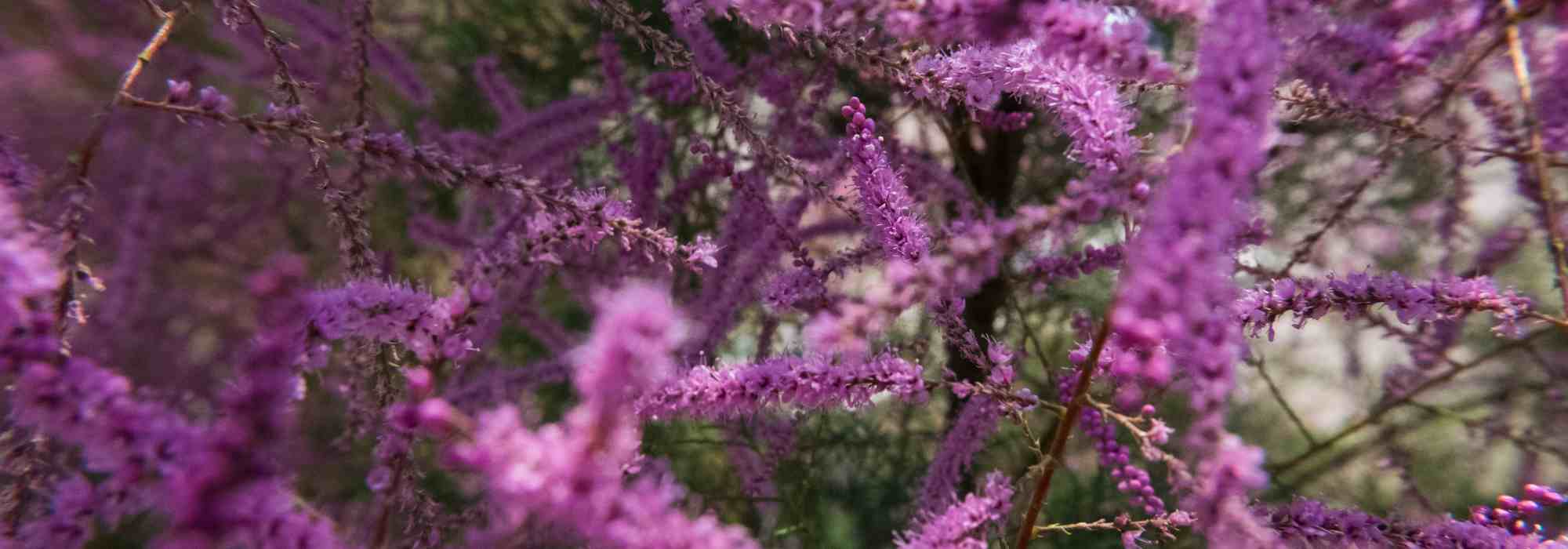
5 lovely pairing ideas with tamarisk
Our tips and ideas for incorporating tamarisk into a garden
Contents
Often seen in seaside gardens because it withstands both salt spray and wind, Tamarisk is one of those shrubs that were widely used in the 1970s and 1980s, then fell somewhat out of favour. Yet it still has charm with its supple, arching habit, its flowering and its very light bluish foliage.
More or less pink depending on species and variety, Tamarisk proves an ideal shrub to plant in poor soils. We give you a few ideas to help integrate one already in your garden, or to plant one.

In a seaside garden
The protected Atlantic coast and the Côte d’Azur are ideal playgrounds for tamarisks. They are the first to come to mind when tamarisks are mentioned. Whether spring- or summer-flowering, they all thrive in sandy soils and can even serve as windbreaks in these regions. Use an already well-established tamarisk, or plant one here, preferably at the edge of the garden, as a hedge for example or in a large shrub border.
In a sun-exposed garden not subject to winter frosts, it can be paired with a very exotic tree that perfectly complements the tamarisk’s lightness, the Filao (Casuarina equisetifolia). It evokes a pine and will fit very well into a large garden open to the sea. An eucalyptus, with its greyish evergreen foliage, is also worth choosing for its incomparable bark. Introduce some unusual blooms such as the bottlebrush, chosen in vivid pink or pale yellow to mix things up a little (Callistemon citrinus suits any colour). Also pair in this scene an Escallonia with pink flowers and a handsome palm that will evoke distant horizons. Finally, rely on the exotic appeal of the Madeira geranium (Geranium maderense), as ornamental for its massed flowering as for its dissected foliage, which should be planted in soil that remains cool.
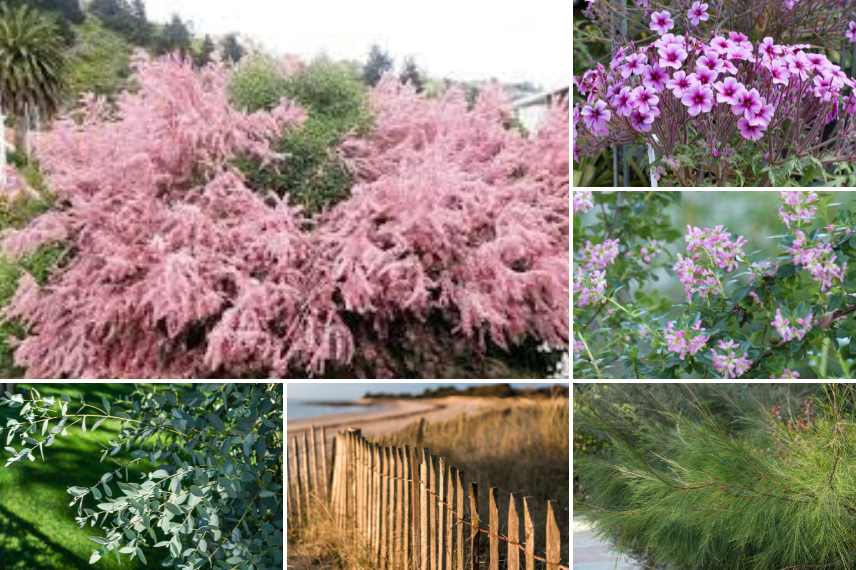
Tamarisk and palm, Geranium maderense, Escallonia ‘Apple Blossom’, Eucalyptus and Casuarina equisetifolia
Read also
Tamarisk: planting, pruning and careIn a naturalistic garden
With its naturally arching habit and feathery foliage, tamarisk is well suited to naturalistic areas of the garden. In the middle of a meadow, or in a large bed, it even pairs wonderfully with handsome pastel-toned perennials and the soft movement of ornamental grasses. It can also be used in mixes within a hedge or to define a large garden.
A spring-flowering tamarisk such as Tamaris parviflora will thus blend its airy character with the graphic form of Echinops ritro, with silvery-grey foliage and vivid blue, ball-shaped spiky flowers. Plant around it ornamental grasses that mature in autumn, such as Schizachyrium scoparium (it will take on reddish-brown tones in late summer) and Miscanthus sinensis ‘Gracillimus’. Their autumn flowering in reddened spikes will echo the tamarisk’s buds that appeared a few months earlier. The tall, elegant habit of Veronicastrum, the tousled look of bright pink monardas and the sunny beauty of coneflowers are other highly ornamental floral pairings to accompany tamarisk long after it has finished flowering. Finally, one or two shrubs will bulk out this natural scene, perhaps a single-flowered blue Hibiscus syriacus positioned at the back of the border. This long blue flowering will add depth.
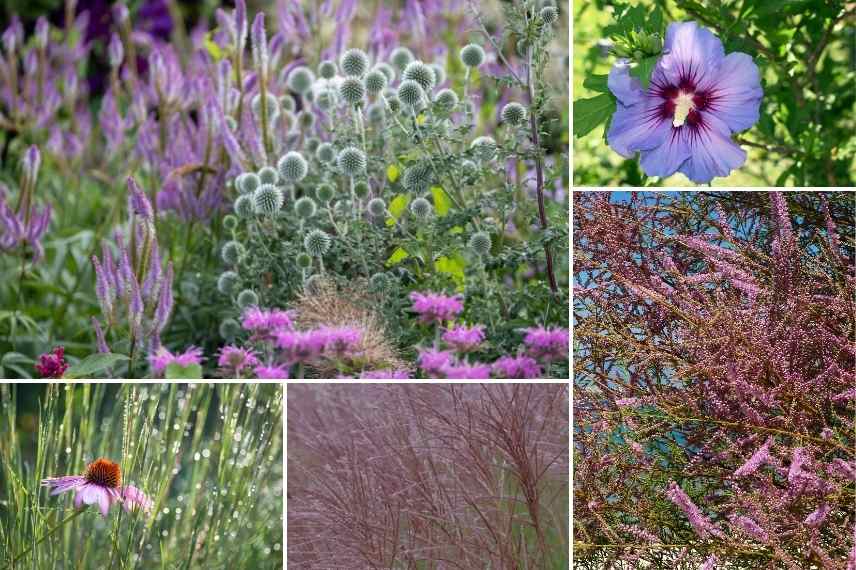
Echinops ritro, Veronicastrum and monardas, Hibiscus syriacus, purple coneflower and Schizachyrium scoparium, Miscanthus sinensis ‘Gracillimus’ make good company for a Tamarix parviflora.
In a pink garden
All tamaris are pink (except variety ‘Hulsdonk White’), the intensity varying with species and cultivated varieties.
Pink monochrome garden lends itself obviously to feathery blooms, bringing their unique texture for a few weeks, the flower buds and reddish branches of a darker hue extend this airy effect in the garden from April onwards depending on species. Here plant a tamarisk in a large border alongside low-growing plants that flower at the same time or afterwards to extend the display, in a palette ranging from candy-pink to purple.
Also pair it with two handsome shrubs that show it off particularly well: a Leptospermum that will flower before it or at the same time in mild climates because this superb shrub is tender (ideally by the sea as it tolerates sea spray well), and a smoke tree quite hardy in turn, which will flower later. The second shrub, known as Cotinus coggygria in Latin, is a delight, its flowering among the most airy. A purple-leaved variety such as ‘Grace‘ or ‘Royal Purple‘ will add some contrast and blend perfectly into a pink garden. Complete with handsome perennials. Here we choose Liatris spicata for a mauve note, pink oenotheras and bicolour Asters ‘Prince’.
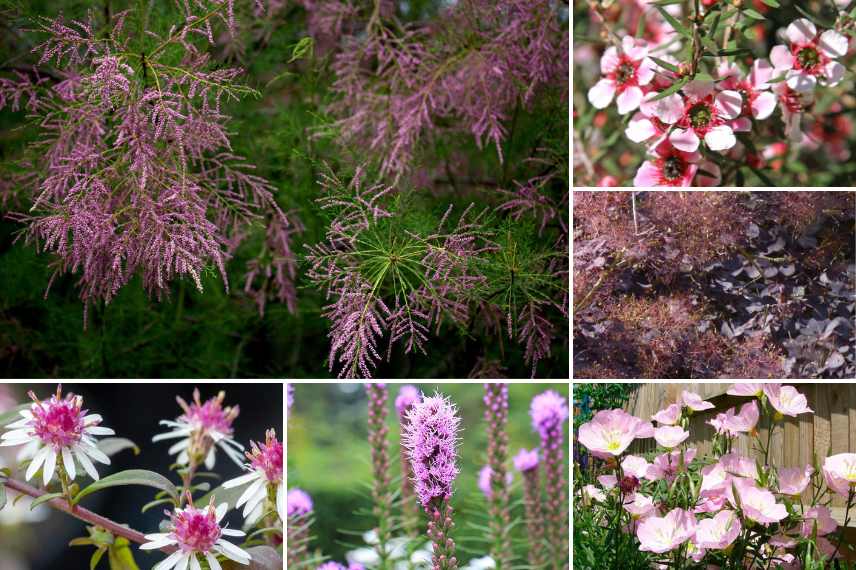
Tamaris tetrandra, Leptospermum scoparium ‘Coral Candy’, Cotinus coggygria ‘Grace’, Aster lateriflorus ‘Prince’, Liatris spicata and Oenothera speciosa ‘Twilight’.
Read also
How to prune tamarisk?In a melliferous garden
Tamarisks attract bees, butterflies and bumblebees. Why not take advantage of this to include one in a garden where biodiversity is particularly sought, or near beehives?
Le Tamarix ramosissima is the most melliferous among tamarisks. It can be paired with a multitude of plants, depending on desired style and climate, favouring species over horticultural varieties. Soil should again be rather sandy and poor. Some pointillist flowerings such as purple toadflax, Moroccan toadflax and limonium work really well with the very airy habit of the tamarisk. They have the advantage of attracting pollinators, bees and some butterflies. The same applies to shrubs tolerating the same growing conditions as the tamarisk (exposure and soil), such as Cistus salviifolius or Cistus albidus, as well as the chaste tree (Vitex agnus castus) with magnificent bluish‑purple panicles if the species is chosen. Finally, a generous mass of Achillea in bright tones or as groundcover with Achillea crithmifolia lifts a panicle display while enriching the garden with their melliferous qualities. Do not forget the expected spring flowering of a hawthorn, or a weeping-form Buddleia alternifolia, which also suit this country-style setting.
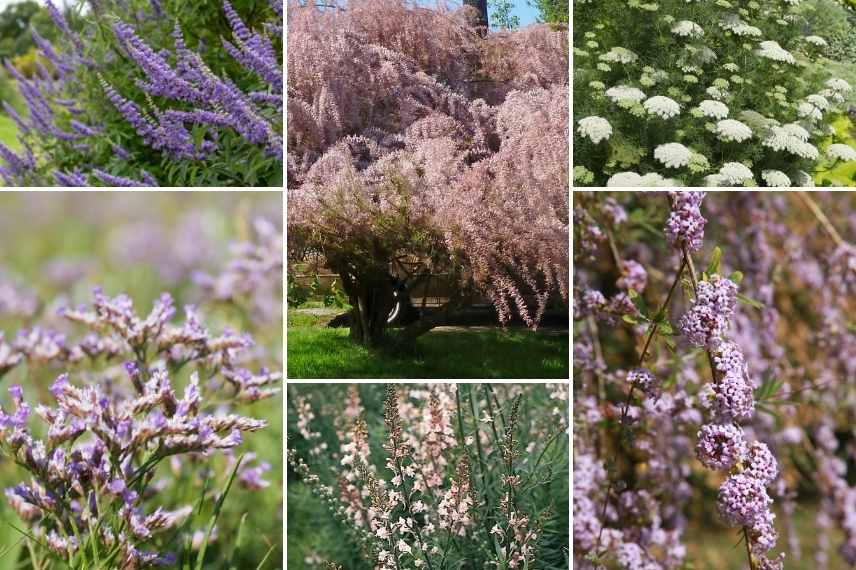
At top centre, Tamarix ramosissima, surrounded (from left to right) by: Vitex Agnus Castus, Achillea crithmifolium, Limonium vulgare, purple toadflax and Buddleia alternifolia.
In a sandy garden
A sand garden is one of the latest trends developed by landscapers to rethink our gardens in the era of climate change. Planting vegetation in sand answers the need to create spaces that are both attractive, resilient and water-wise, able to cope with increasingly dry summers and poor soils. It is, in fact, the tamarisk’s preferred habitat!
In sandy soil, pairing tamarisk and lavenders is an obvious choice. Lavandula stoechas, with violet spikes that will converse with the pink of spring tamarisks, and creeping rosemary as a scented groundcover will be the stars of this sand garden. A few rounded clumps of santolinas will add a silvery note, while the blue perovskias will prolong the summer flowering. At the edges, agaves or Euphorbia characias will structure the space with their graphic silhouettes.
This restrained, hardy palette also benefits from minimal maintenance, perfect for a holiday home garden!
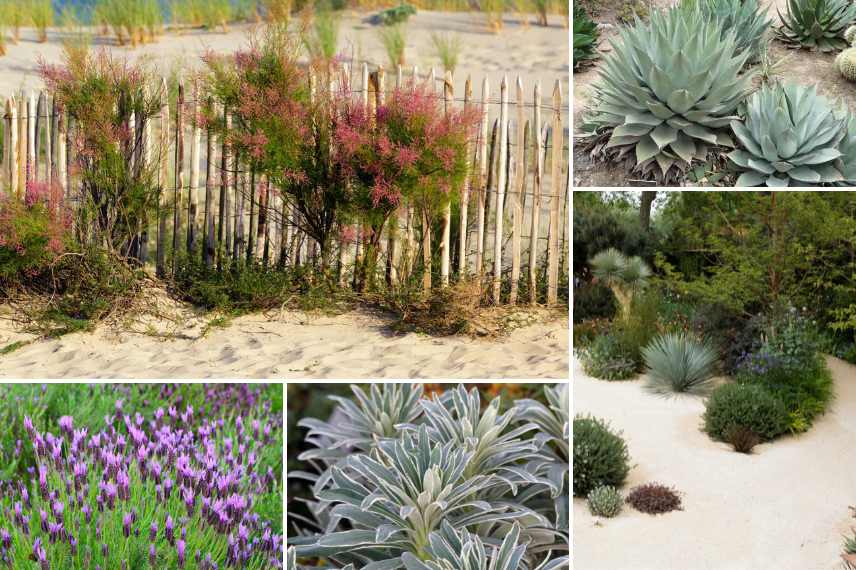
Tamaris, Lavandula stoechas, Euphorbia ‘Glacier Blue’, Agave havardiana, and spiral of shrubs in a sand garden (Yucca, Pinus mugo, Aeonium, Westringia fruticosa).
- Subscribe!
- Contents
This form is protected by reCAPTCHA - the Google Privacy Policy and Terms of Service apply.

































Comments