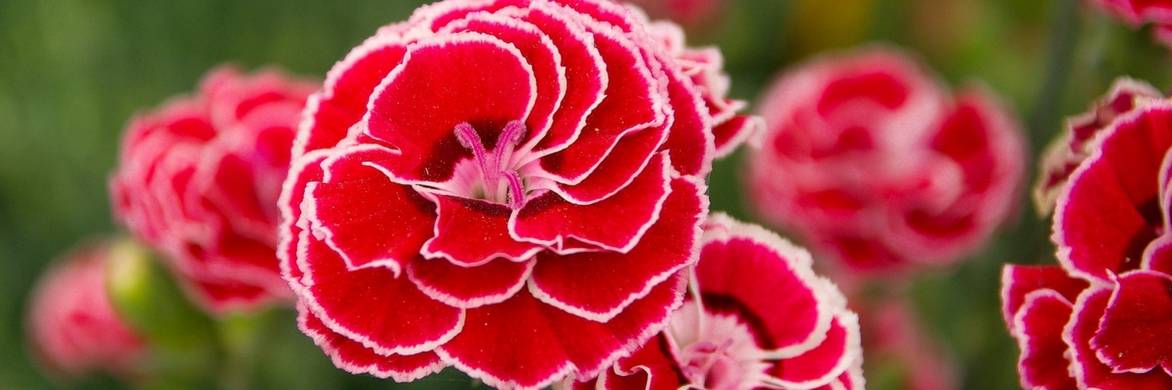
Carnation: planting, care and sowing tips
Contents
Dianthus in a nutshell
- Whether perennial or annual, carnation is a floriferous, highly fragrant plant
- Its single or double flowers, in a wide range of colours, exude an intense clove scent
- An emblematic plant of dry, natural gardens, it blooms equally well in borders and pots, from spring through late summer
- It is king of cut flowers and country cut flower arrangements
- Easy and undemanding, it grows in full sun in all well-drained soils, even lime-bearing ones
A word from our expert
With its precious flowers and sweet, spicy fragrance, whether florist’s carnation or Chabaud, miniature carnation, sweet william or rock pink, the Dianthus is a staple of traditional and wild gardens. This timeless emblem of our grandmothers’ gardens, of simple beauty, has its place in every garden. It settles in naturalistic gardens as well as vegetable gardens for its cut flowers, summer flower beds and abundant mixed borders. Easy to grow, hardy and versatile, its bucolic charm lightens perennial beds. Dwarf varieties flower on rockeries or sunny banks and in planters, bringing poetry, mystery and lightness. Single-coloured or bi-coloured, subtle or fiery, flowering cushion or bushy perennial, Dianthus belongs to a very heterogeneous family with a wide range of colours and sizes, offering gardeners endless choice. Ruby red, lavender pink, pure white or primrose yellow, its single or very double flowers, resembling fringed pompons or delicate inflorescences, flower from spring to late summer, sometimes without interruption, and create charming country cut flower arrangements.
From sweet william to China pink, via miniature carnation and Carthusian pink, discover among our collections the different species of carnations we offer.

Botany
Botanical data
- Latin name Dianthus
- Family Caryophyllaceae
- Common name Pinks
- Flowering April–May to autumn
- Height 0.2 to 80 cm
- Exposure Sun
- Soil type Stony, chalky, neutral
- Hardiness -15°C for tall species, down to -20°C for dwarf pinks
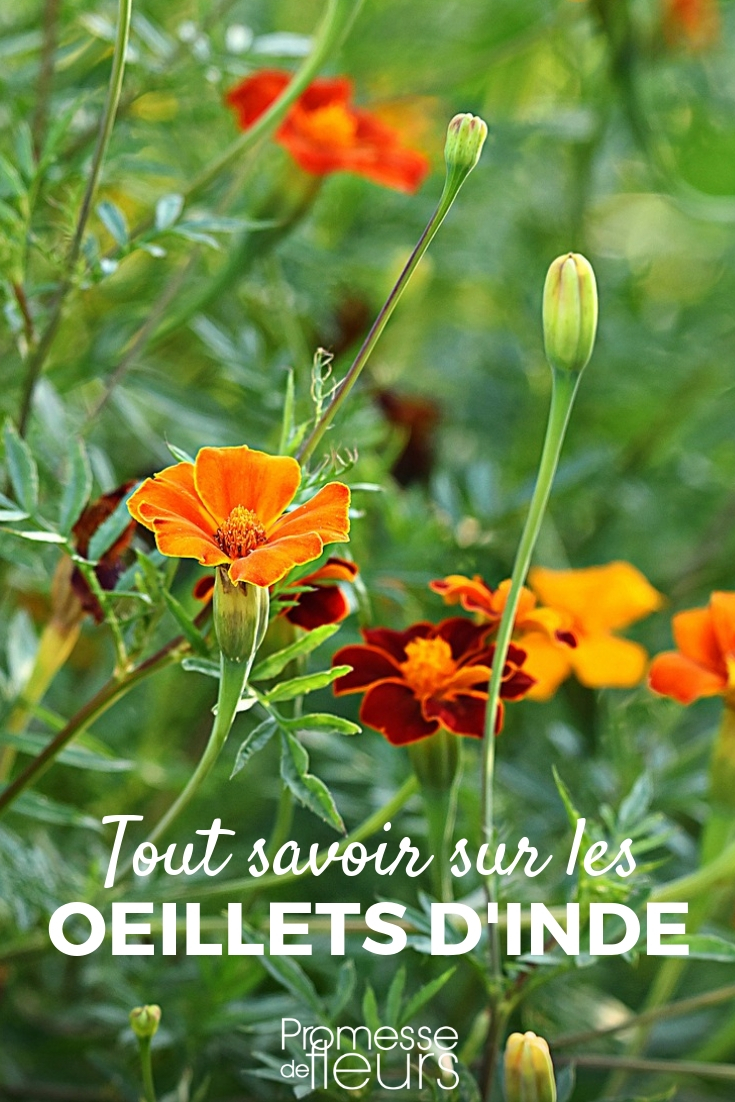
Native to mountains and dry grasslands of Asia and Europe, pinks or Dianthus, which means “flower of God”, are part of the very large family Caryophyllaceae. Some species, such as the Chartreuse pink, occur naturally in France on chalk grasslands, rocky slopes and in open woodland. Although pinks bear a superficial resemblance to the French marigold (Tagete), the two are not in the same botanical family. The genus Dianthus includes around 300 perennial species, among them florist’s carnations (re-blooming or not), cottage pinks (Dianthus plumarius) old and modern, re-blooming or not, rockery pinks, annuals such as China pink (Dianthus chinensis) and biennials like the well-known Dianthus barbatus or sweet william. Not to mention the thousands of horticultural cultivars produced through successive hybridisations! This family includes tall and low-growing species, offering a wide variety of sizes, shapes and colours.
All develop from a branched, sometimes woody crown that spreads over the years by underground buds to form dense, very floriferous clumps, each node branching.
If growth of pinks is relatively fast, longevity varies with soil type: in poor, free-draining soils they can live for several decades but only a few years in rich soils. Nevertheless, they can persist for a long time in a garden.
Indeed, some, such as sweet william, self-seed when faded flowers are not removed. Propagation by cuttings allows production of new plants each year and ensures continuation of this short-lived perennial!
The habit of Dianthus varies with species: airy and rounded, compact for some, forming turf-like cushions for others, or producing tall stems that arch under the weight of the flowers. The largest pinks can reach about a metre, intermediate species 30–60 cm high with similar spread, while dwarf pinks rarely exceed 10–20 cm.
Stems are very short and dense in mat-forming or tufted species, but longer and stiffer or more slender in herbaceous perennials used in borders, sometimes requiring discreet staking. Leaves (dwarf pink leaves 1–5 cm long, others 5–13 cm) of all species and cultivars of Dianthus are opposite, lanceolate or linear, usually pointed and often grey-blue or grey-green. Dianthus barbatus has more vigorous foliage, mid green to dark bronze-green. The fine, silvery foliage of many Dianthus adds further charm to the plant. Evergreen in many perennials, it remains attractive even in winter, forming neat bushy clumps from which the flowers emerge in the warmer months, the main attraction of this herbaceous perennial.
Whether perennial or annual, from April to September depending on variety, and sometimes until the frosts, Dianthus offers generous, often scented flowering.
Pinks may bear single flowers or many blooms per stem. Flowering stems rise from 20 cm to 1 m and carry large flower buds opening into small solitary flowers (1–13 cm diameter) or clustered close together in umbels or terminal cymes up to 15 cm across. In Dianthus barbatus they form dense clusters of small simple carnations. Each pink flower has a tubular base enclosing the calyx. Flower form is highly variable: single with 5 petals, semi-double or very double with 50–60 petals or more, sometimes frilly like a lace pompom. Petals may be rounded, crumpled, bearded, delicately cut or deeply fringed. Flowers of Dianthus superbus (superb pink) are notable for five petals cut into narrow, unequal laciniae giving a tousled appearance to the inflorescences. Colours range from pure white to ruby red, cream to yellow and every shade of pink, from pearly to deep violet. Sometimes bicoloured, flowers may display more or less contrast. Pinks vary in petal patterning: plain, bicoloured, edged with a fine rim, fanciful with streaks or speckles contrasting with the ground colour, or shaded where the petal eye echoes the edge colour.
Old-fashioned cottage pinks (Dianthus plumarius) have a fairly brief flowering period, usually in June or mid-summer for two to three weeks. Some, such as florist’s carnations and modern cottage pinks, offer a much longer repeat flowering that lasts throughout summer and into autumn, often in two or three waves. Regular, moderate deadheading will encourage further blooms.
Ideal as cut flowers, pinks have excellent vase life and make charming, fragrant country-style summer bouquets that last for nearly two weeks.
The flowers exhale a delightful, strong spicy scent reminiscent of clove. Honey-producing and very airy, they attract many pollinating insects.
After flowering, capsules develop containing numerous seeds.
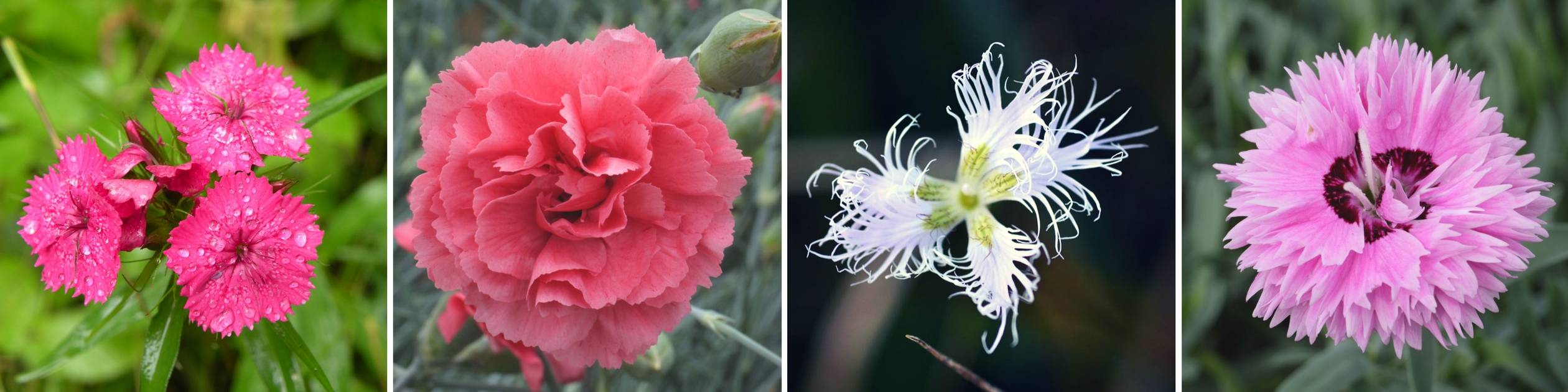
Dianthus Barbatus – D. plumarius – D. superbus – D. ‘Pop Star’
Beneath its precious-flower appearance, the pink combines vigour and frugality. It is a robust, low-maintenance plant. While some are more tender, pinks are generally very hardy, sometimes enduring beyond −15 °C for dwarf varieties. Most are compact and vigorous and grow throughout France, flowering repeatedly from spring until the frosts, indifferent to heavy rain as well as drought.
Pinks flower abundantly when planted in full sun in an open position. Easy to grow, they are undemanding and favour chalky, dry soils but tolerate any poor or neutral, even slightly acidic soils, provided they are well drained. They thrive in stony, sandy soils. They withstand summer drought but dislike humidity, summer and winter. In fertile soil they may become more vigorous.
A staple of naturalistic gardens, the pink is a versatile floriferous plant that fits almost anywhere. It brings colour, texture and lightness to borders, rockeries and mixed borders, and to flowering containers. It also has a place in the vegetable garden’s cut-flower corner. While Dianthus can be grown singly, it is best planted in groups at the edge or centre of a sunny border, paired with grasses or other vigorous perennials. In borders, plant tall pinks en masse to create striking colour scenes with Nepetas, Scabious, Coreopsis, dwarf blanketflowers, Cleomes or ornamental tobaccos. They mingle naturally with the grey‑green foliage of Euphorbias and Artemisias. Their graceful silhouette lightens heavier perennial neighbours, bringing airiness next to large-flowered summer plants such as Dahlias and Echinaceas. Perennial species form a persistent bush with fine grey‑green leaves attractive all year. Low varieties are perfect for raised beds, dry rockeries and well-drained slopes, or between stones of a wall where they make low, floriferous cushions with little fuss. They adapt well to container culture on a sunny terrace or balcony, paired with moss phlox, avens, yarrow, asters, Iberis, aubrieta or rockroses. Choose a passageway or near an entrance so you can fully enjoy the sweet scent of certain varieties.
Main species and varieties
Genus Dianthus includes about 300 species of evergreen perennials, annuals and biennials. This excludes the tens of thousands of horticultural varieties resulting from successive hybridisations. This family comprises tall and dwarf species, offering a wide variety of sizes, shapes and colours. One distinguishes repeat-flowering species from non-repeat-flowering pinks.
- Mignonette pinks or plumarius pinks (Dianthus plumarius): repeat-flowering or not, both are very suitable for containers, rockeries and borders. They are more compact than the florist’s carnation and have more branched stems and large double flowers often very fragrant. They are perennials, evergreen and hardy. The old type offers a short flowering period starting in June and lasting two to three weeks. Modern mignonette pinks often begin in May and continue until September, lasting longer and flowering in two or three successive waves.
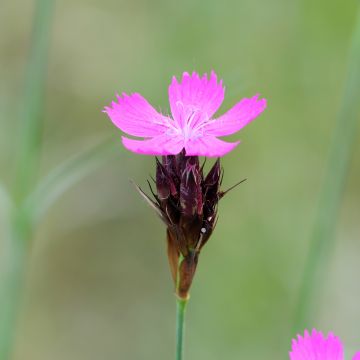
- Carthusian pink (Dianthus carthusianorum): with its long, slender stems it displays a very distinctive habit with linear, evergreen foliage resembling grass. Its simple, toothed flowers appear in rounded, flattened clusters in dark pink to red, sometimes white with a dark calyx.
- Grenoble pink or Pentecost pink (Dianthus gratianopolitanus): originating from a mountain species, it combines robustness and frugality. It is characteristic for its compact, mat-forming habit with semi-evergreen blue-grey foliage. Very floriferous, in May and June the plant is covered with small, simple or double, highly fragrant pink to violet flowers. This pink grows quickly and is particularly resistant to heat and humidity. Mature height does not exceed 20 cm with a spread of 40 cm.
- Dianthus deltoides, ‘maiden pink’ or ‘prostrate pink’: perfect in rockeries and on borders, it forms a dense turf of dark green, sometimes bluish foliage covered with small fragrant flowers with fringed petals in red, white or pink, sometimes with a darker eye.
- Sand pink (Dianthus arenarius): this botanical species forms an unobtrusive cushion about 30 cm high covered with small fringed white, slightly scented flowers on fine green foliage. Very floriferous until September.
Annuals and biennials:
- Sweet William (Dianthus barbatus): short-lived and not very perennial, it is grown as an annual or biennial. Among the tallest, it can reach 70 cm. It forms branched bushes with well-defined leaves bearing dense clusters of small flat, single, sometimes bicoloured flowers with fringed petals in pink, crimson or white, scented with a pale eye. Some new hybrid series such as ‘Jolt’ group cultivars selected for vigorous growth, vivid colours, tolerance of heat and cold and the ability to flower tirelessly from spring until the first frosts.
- Florist’s carnation or wild carnation (Dianthus caryophyllus): also called ‘giroflée’ or ‘Chabaud carnation’, this short-lived perennial cultivated as a biennial is mainly used for cut flowers. It forms clumps of green foliage on which very fragrant double flowers in crimson, salmon, white or red appear in May to June for non-repeat-flowering varieties, and from June until the frosts for repeat-flowering varieties.
- China pink (Dianthus chinensis): a tender, short-lived plant bearing numerous weakly scented dark purple or reddish-purple flowers often blotched or streaked with white, which open continuously from summer through autumn.
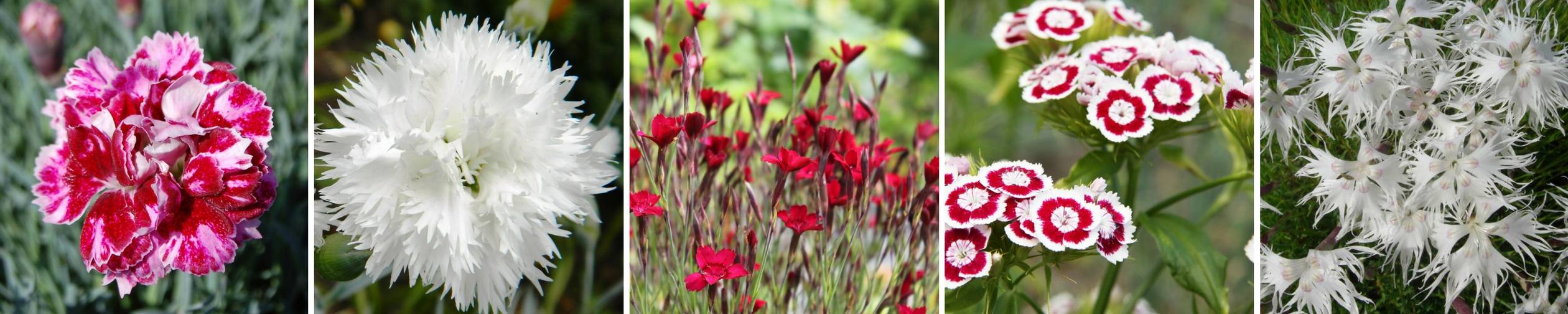
Dianthus gratianopolitanus – D. plumarius – D. deltoides – D. barbatus – D. arenarius
Our favourites
Dianthus plumarius Doris
- Flowering time June to October
- Height at maturity 25 cm
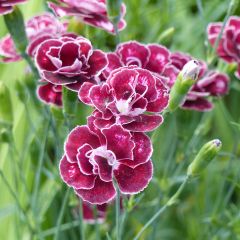
Dianthus allwoodii Romeo
- Flowering time June to October
- Height at maturity 40 cm
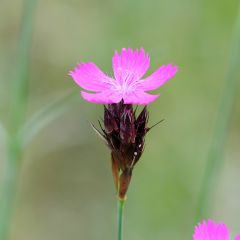
Dianthus carthusianorum
- Flowering time August, September
- Height at maturity 40 cm
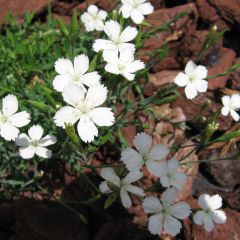
Dianthus deltoides Albiflorus
- Flowering time June to August
- Height at maturity 15 cm
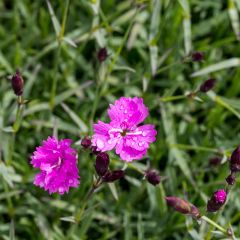
Dianthus gratianopolitanus Badenia
- Flowering time June to November
- Height at maturity 15 cm
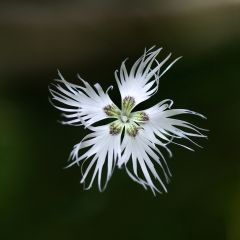
Dianthus arenarius
- Flowering time August to October
- Height at maturity 25 cm
Looking for a highly fragrant pink? Discover our advice sheet : “Pinks: which are the most fragrant”
Discover other Dianthus - Pinks
View all →
Available in 0 sizes
Available in 1 sizes
Available in 2 sizes
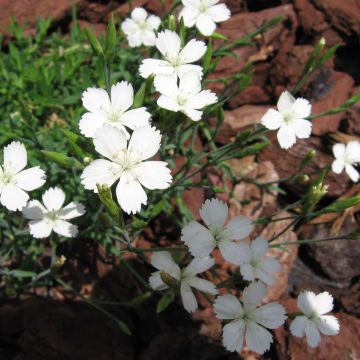
Available in 2 sizes
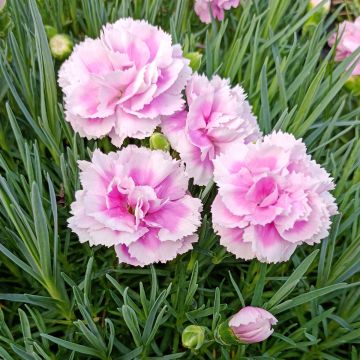
Available in 2 sizes
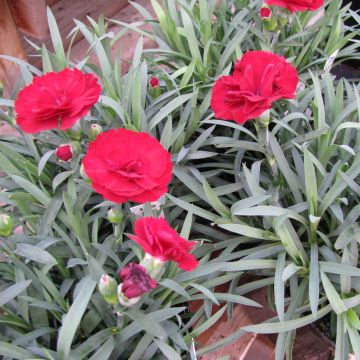
Available in 1 sizes
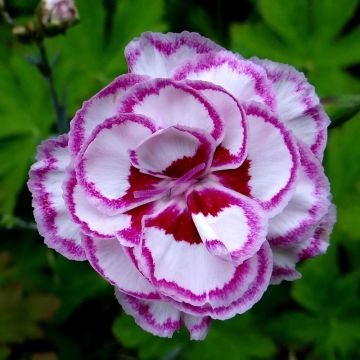
Available in 2 sizes
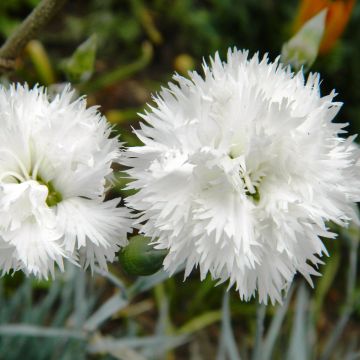
Available in 2 sizes
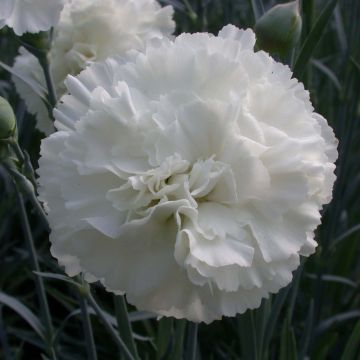
Available in 1 sizes
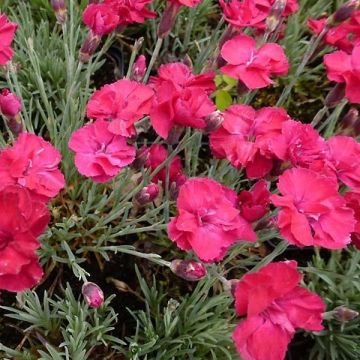
Available in 1 sizes
Planting
When to plant Dianthus?
Dianthus is planted out in spring from March to April or in autumn from September to October, avoiding periods of frost and drought.
Where to plant Dianthus?
Very easy to grow, it thrives almost everywhere in France and even adapts to seaside conditions. With good hardiness (below -15°C), it tolerates frost and copes well with summer drought. It prefers a sunny or very lightly shaded, open position. While it favours calcareous conditions, it tolerates all well-drained soil. It dislikes clay soils that become waterlogged, preferring permeable, stony soil, dry to fresh. In waterlogged or clay soil it is more vulnerable to rust or certain viruses that can be fatal.
This is a versatile plant that thrives in all kinds of bright, warm positions. Dianthus can be grown as a specimen but is best planted in groups at the front or centre of a sunny border, combined with small grasses and other vigorous perennials to add coloured touches: Campanulas, Nepetas, Veronicas, Dwarf asters, Alyssums, Love-in-a-mist, Creeping phlox, Achilleas or even Helianthemums. In the vegetable garden, it also has a place in the area reserved for cut flowers for making bouquets. Low-growing varieties are perfect for raised beds, dry rock gardens, on well-drained banks and between the stones of a wall where they form undemanding flowering cushions. They also adapt very well to pot culture on a terrace or balcony.
How to plant?
Easy to grow, once well established these hardy perennials cause no problems. Secret? Soil must be light, cool during summer and above all well drained (excess water in summer or winter would be fatal).
- Soak pots in water before planting
- Loosen soil, work the ground well
- Dig a hole twice the volume of the pot
- In heavy soil, mix in gravel to improve drainage
- Plant in a mix of potting compost and garden soil, taking care not to bury the basal leaves. Plant slightly raised in wet regions
- Allow 6–7 pots per m²
- Space plants 25 cm apart at planting
- Backfill with soil
- Firm down gently
- Water lightly at first to encourage rooting
Growing a carnation in a pot
- Spread a layer of clay pebbles or gravel in bottom of pot to prevent standing water
- Plant in a well-draining mix of potting compost, garden soil and gravel
- Place in full sun
- Avoid leaving water in saucers: Dianthus dislike having their roots in water
- Apply a balanced fertiliser in spring
Read also
Propagating and sowing carnationsCare and maintenance
Very disease-resistant, once well established, carnations require little care and prove to be undemanding perennials provided soil remains perfectly drained
- Remove flowers as they fade to encourage further blooms. Deadhead older plants more sparingly.
- Florist’s carnations and spray/miniature carnations may require light staking to support the flower stems
- Cut clump back lightly after summer flowering to encourage repeat flowering in September for repeat-flowering varieties
- A light tidy-up or cutting back some dead foliage with shears to ground level at end of summer is enough to maintain a compact habit and ensure flowering the following season.
- Water during prolonged drought; tolerates periods of high heat very well
- Layer or take cuttings to preserve the plant
Multiplication
Dividing clumps is a very delicate operation. We do not recommend it, especially as carnations are easily sown and propagated by cuttings.
By sowing
This perennial is very easy to grow from seed. Seeds germinate within 1 to 3 months. Depending on species, sowing is done at different times of year. Sowing of annual species is done in February–March. Dwarf species are sown from October to March under cold frame; biennial species and perennials are sown in situ in autumn or under cover in March–April.
- Sow in a seed tray on surface of light, moist seed compost
- Do not cover seeds as they need light to germinate
- Keep at 15–20°C in light
- Keep this growing medium moist but not waterlogged; germination usually takes 7 to 30 days.
- Prick out seedlings into pots when seedlings have two or three leaves
- Plant out in May into open ground once root system is sufficiently developed and frosts have passed.
By cuttings
Propagation by cuttings is an easy method to multiply all carnations. Success rate is very good.
- In summer, take a non-flowering stem a few centimetres below a node. Remove leaves from the base.
- Plant two-thirds of the cutting into a pot of light growing medium composed of garden soil, sand and potting compost.
- Keep cuttings regularly moist and under cover, protected from frost
- After about 2 months, pot up cuttings into pots
- Plant out the following spring, in April–May once risk of frost has passed.
Find out more in our advice sheets: “Propagate and sow carnations”; and also read our tutorial: How to propagate carnations?
Associate
Dianthus is a versatile plant that finds a place everywhere. It brings colour to beds, sunny path edges and English-style mixed borders. In the vegetable patch it belongs in the cutting-flower corner. Its slender, airy silhouette helps lighten heavier herbaceous beds.
In borders, plant tall Dianthus en masse to create striking colour scenes with Nepetas, Scabious, tickseed, dwarf blanketflowers, Cleomes or ornamental tobaccos. The silver, evergreen foliage of Dianthus blends naturally with the grey‑green foliage of Euphorbias and Artemisias, and brings lightness alongside large summer-flowering plants such as Dahlias and Echinaceas.
Low varieties are perfect on raised beds, in dry rock gardens, on well-drained banks, or between wall stones where they form undemanding flowering cushions. They adapt very well to growing in pots or troughs, in sun on the terrace or balcony, paired with Creeping Phlox, Avens or Achilleas, with Asters, Iberis, Aubrietas or Helianthemums. Choose a passing spot, near an entrance for example, so you can fully enjoy the sweet fragrance of some varieties.
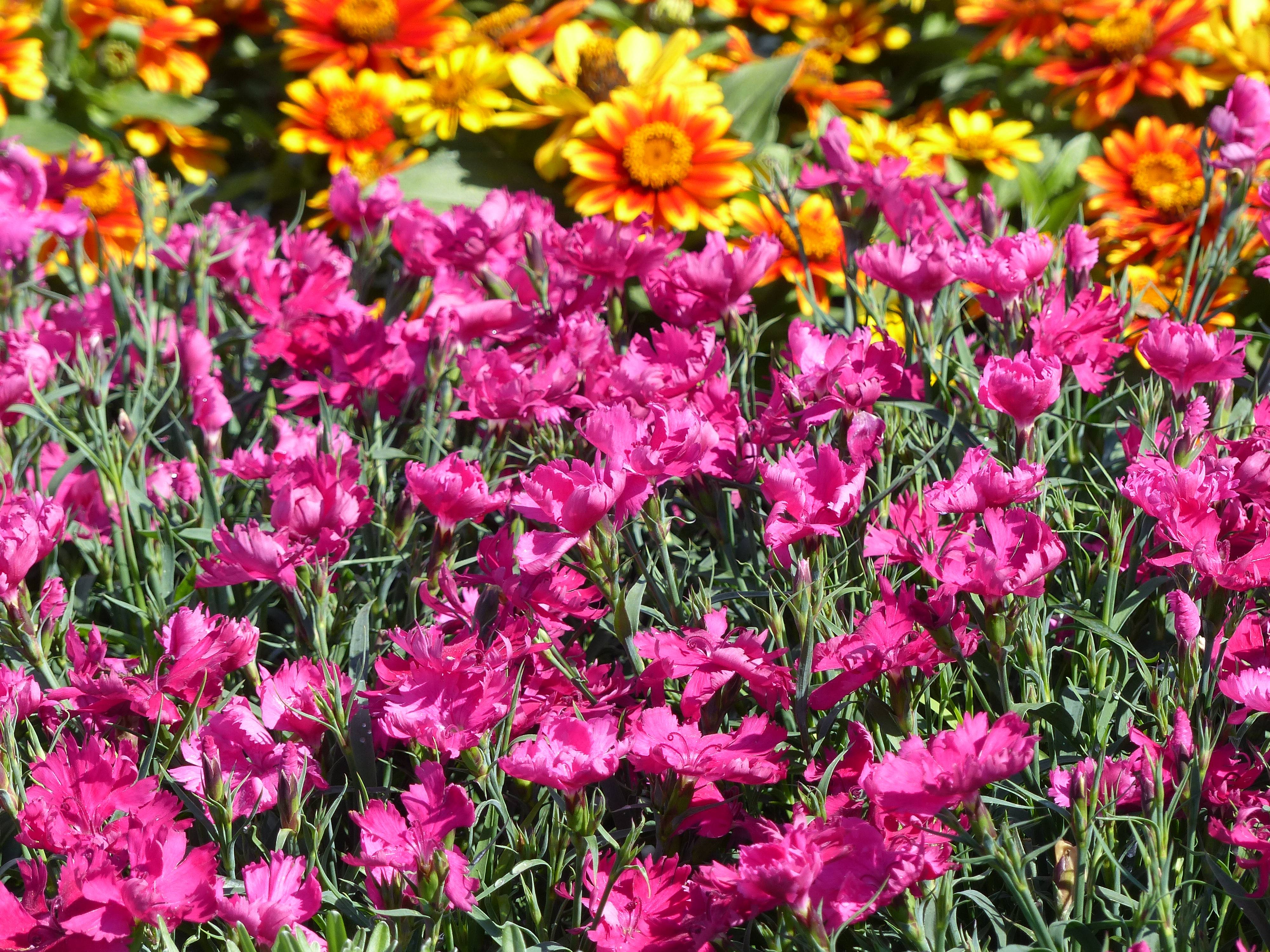
And for more inspiration, discover our advice sheet : “Dianthus – 6 ideas for pairing in the garden”
Useful resources
Discover:
- Our wide range of carnations: includes the best varieties
- Our tutorial: Drying carnations
- Our advice sheet: Growing a carnation in a pot and 6 carnations to grow in pots
- Our advice sheet: How to plant a carnation?
- Our advice sheets: 5 most beautiful pink carnations, 5 most beautiful red carnations, 5 most beautiful white carnations
- Our advice sheet: 7 carnations for a dry rockery
- Our advice sheet: Choosing a carnation
- Our advice sheet: 10 carnations to plant at the edge of flower beds
- Plants used by perfumers
- Also read our advice sheet on the best long-lasting flowers and foliage for your cut flower arrangements
- Subscribe!
- Contents
This form is protected by reCAPTCHA - the Google Privacy Policy and Terms of Service apply.

































Comments