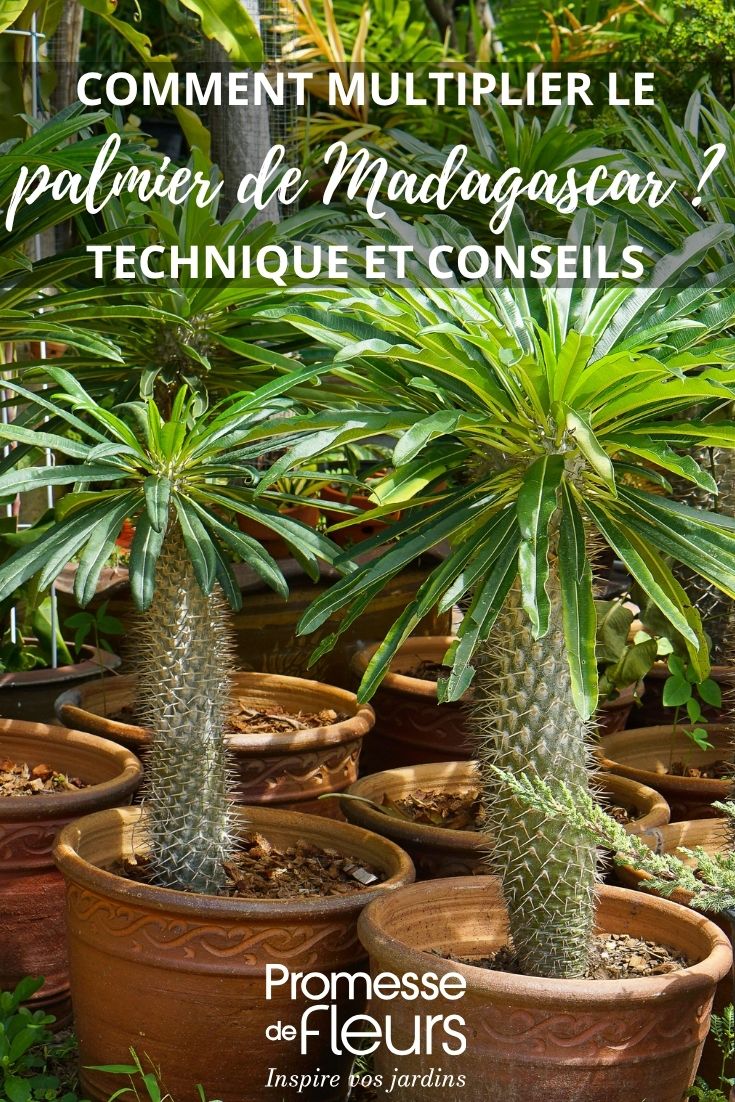
Indoor plant in most of our regions, the Madagascar palm (Pachypodium lamerei) is recognisable by its striking bottle-shaped trunk studded with spines and by its blooms resembling a white oleander. This unusual plant, much loved by gardeners with a taste for the exotic, can be propagated from seed. Here is how to do it in this tutorial.

Why propagate a Pachypodium?
This slow-growing and often expensive tree, which is also frost-tender, is generally propagated to expand a collection without spending a penny, give plants to friends and family, or create a striking group of specimens of varying sizes, which looks very attractive in a winter garden, for example. Growing this beautiful, highly exotic species from seed is also quite an adventure!
Where to source Madagascar palm seeds?
You will most easily find them on a tree that is at least 10 years old. It flowers in summer, then the flowers turn into pods. Harvest them when they yellow and open naturally, split them open and the seeds inside are black and flat. Use them immediately for best germination as fresh seeds germinate in only 3–4 days.
Alternatively, look for seeds on specialist exotic plant sites or reputable seed suppliers, or at plant swaps among succulent and cactus enthusiasts, always checking seed freshness.
When to propagate the Madagascar palm?
Ideal timing depends on chosen method:
- For sowing: in spring (between April and May) or early autumn, when temperatures are mild (ideally 20–25°C).
- For propagation by cuttings or division of offshoots: in spring or summer. These techniques are not covered here as they are riskier with low success rates.

Propagation by seed for Madagascar palm: the most reliable method
Once you have seeds, follow a few key steps carefully:
Equipment
- pots or small plant pots in plastic or terracotta.
- specialist cactus and succulent compost (or a mix of universal compost + sand or perlite).
- sprayer.
- heated mini-greenhouse (optional).
- labels.
Steps
- Collect or buy seeds (beware of old seeds for sowing succulents and cacti: germination rate drops dramatically after 1 year. Test seeds by soaking in water: if they float they are probably non-viable);
- Pre-soak: soak seeds for 24 hours in lukewarm water to speed up germination;
- Prepare substrate: mix cactus compost with perlite or sand for optimal drainage;
- Sow on surface: place seeds on surface without covering (they need light to germinate).
- Moisten lightly with a sprayer to avoid displacing seeds;
- Keep substrate slightly moist by misting, but do not water until after 3 weeks;
- Place under a mini-greenhouse or cover with a large plastic sheet at 20–25°C, in bright but indirect light. This temperature is important to encourage seedling emergence;
- First shoots appear in 3–7 days, though some seeds can take up to 6 months to germinate depending on harvest date and/or seed quality;
- Pot on seedlings as soon as they have developed 2–3 leaves, into individual pots.
What next?
- Harden off seedlings: gradually expose young plants to outdoor air (in partial shade) before placing in direct sun. Two or three hours on first days, then increase gradually. This is beneficial for spring-sown seedlings.
- Repot when roots emerge from the pot or every 2–3 years in spring, into a pot 2–3 cm larger (use same very free-draining substrate).
- Do not water for 10 days after repotting, then resume light watering.
- Feed 1 month after repotting with a specialist cactus fertiliser, once a month during growing season.


































Comments