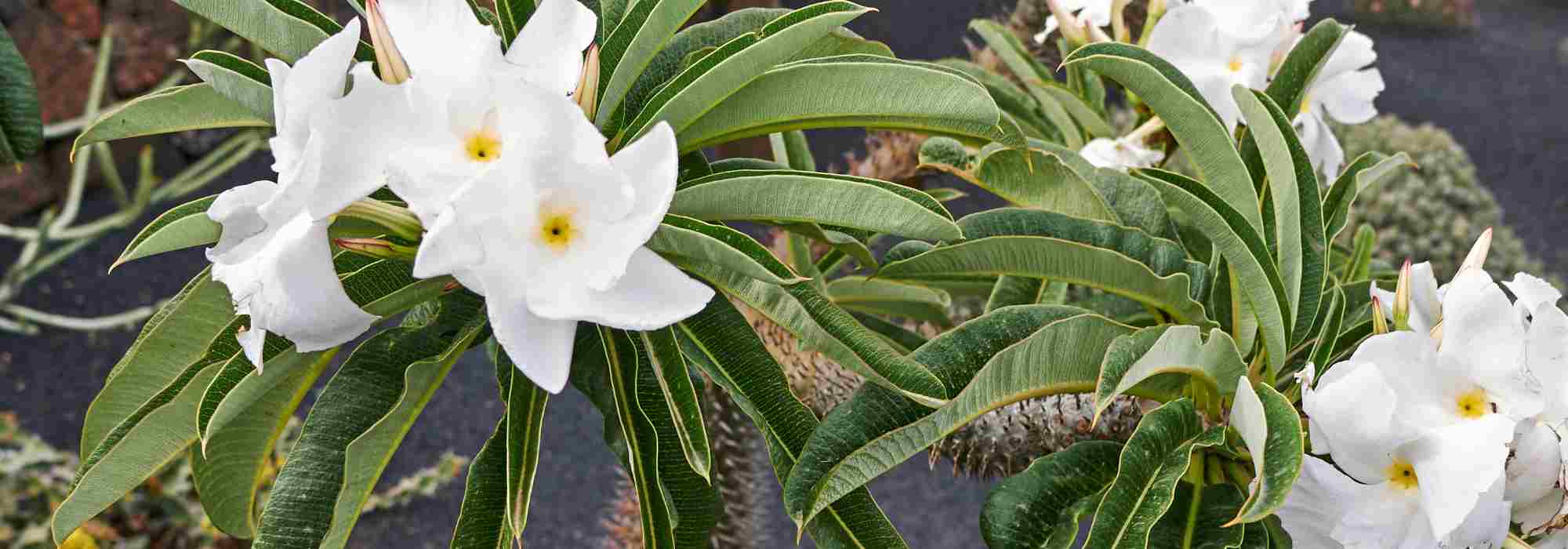
Madagascar palm: to grow and care for
Contents
Essentials of Pachypodium lamerei
- Original indoor succulent, recognisable by its spiny trunk and palm-like appearance
- Easy to care for, it thrives in rooms bathed in light
- Slow growth and upright habit make it an excellent choice for small bright spaces
- Regarding care, Pachypodium lamerei requires little attention
- Perfect for adding a touch of exoticism effortlessly to a living room or conservatory!
A word from our expert
With its miniature-palm silhouette, Pachypodium or Madagascar palm is a striking succulent plant! It is characterised by a thick, silvery, spiny trunk topped by an elegant tuft of long, glossy lanceolate leaves. Suited to pot culture, it fits perfectly indoors, in a bright living room, a conservatory or even a sunlit office.
Among the most popular for indoor cultivation are chiefly Pachypodium lamerei, Pachypodium geayi, more slender with bluish foliage, and Pachypodium saundersii, more compact and ideal for container growing. They all share the same requirements: a very free-draining potting mix, plenty of bright light and a dry atmosphere.
Care of Pachypodium is surprisingly simple for such an exotic plant. It likes warmth, bright light and dislikes excess moisture. Indoors, it needs infrequent watering: allow the potting mix to dry out completely between waterings.
In summer, Pachypodium can be moved outdoors, provided it is acclimatised gradually to avoid sunburn from direct sun. However, bring it back indoors as soon as temperatures fall below 12 °C, as Pachypodium has low hardiness — it does not tolerate cold.
Striking, robust and undemanding, Pachypodium is a houseplant as exotic as it is low-maintenance!
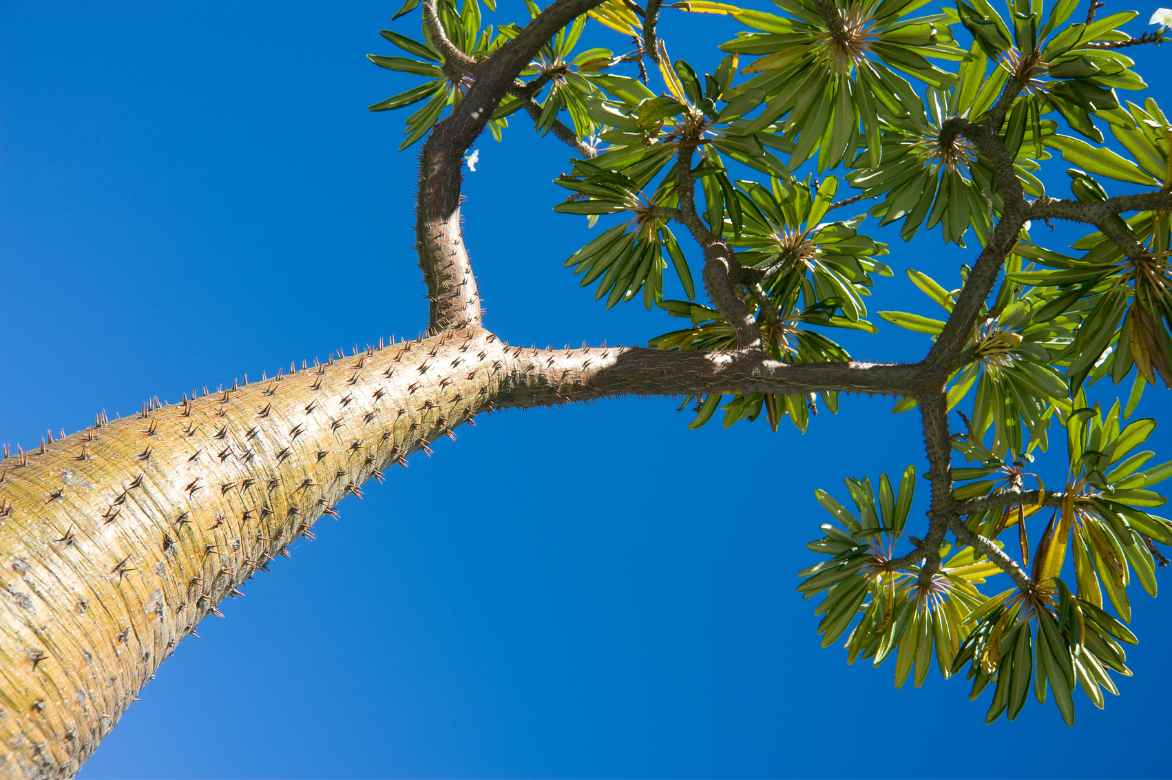
Pachypodium lamerei
Growing requirements for Madagascar palm
| Needs | Recommendation |
| Exposure | Full sun, direct light essential |
| Watering frequency | Moderate in summer, very low in winter |
| Humidity level | Low (30 to 50%) |
| Ideal temperature | 20 to 30°C, do not fall below 10°C |
| Substrate type | Very well-draining, cactus or succulent mix |
| Repotting | Every 2 to 3 years, in spring |
Description of Pachypodium lamerei
Botanical data
- Latin name Pachypodium
- Family Apocynaceae
- Common name Madagascar palm, bottle palm
- Flowering June to September
- Height 1.50 m
- Exposure Bright direct light
- Soil type Well-draining potting mix, cactus mix
- Hardiness >10°C (temperate greenhouse)
Native to arid regions of Madagascar and southern Africa, Pachypodium belongs to family Apocynaceae, as do better-known plants such as oleander (Nerium oleander) and frangipani (Plumeria). Genus name derives from Ancient Greek, meaning “thick foot” (pachy- for “thick”, and -podium for “foot”), referring to swollen, fleshy trunk characteristic of Pachypodium, adapted to store water during drought.
It is sometimes called “bottle palm” or “Madagascar palm”, although it is neither a palm nor closely related to palms. These common names come from its slender silhouette topped by a tuft of leaves, vaguely reminiscent of a palm.
In its natural habitat Pachypodium grows in very dry, often rocky and sun-drenched environments. Its morphology, adapted to extreme conditions, allows survival through long dry spells. This drought-adaptation is precisely why it is appreciated as an indoor plant. Main constraint is cold sensitivity: Pachypodium is frost-tender and cannot withstand sub-zero temperatures. Hardiness is generally around 10°C, which explains indoor cultivation in temperate regions, except in subtropical climates where it can be grown outdoors year-round.
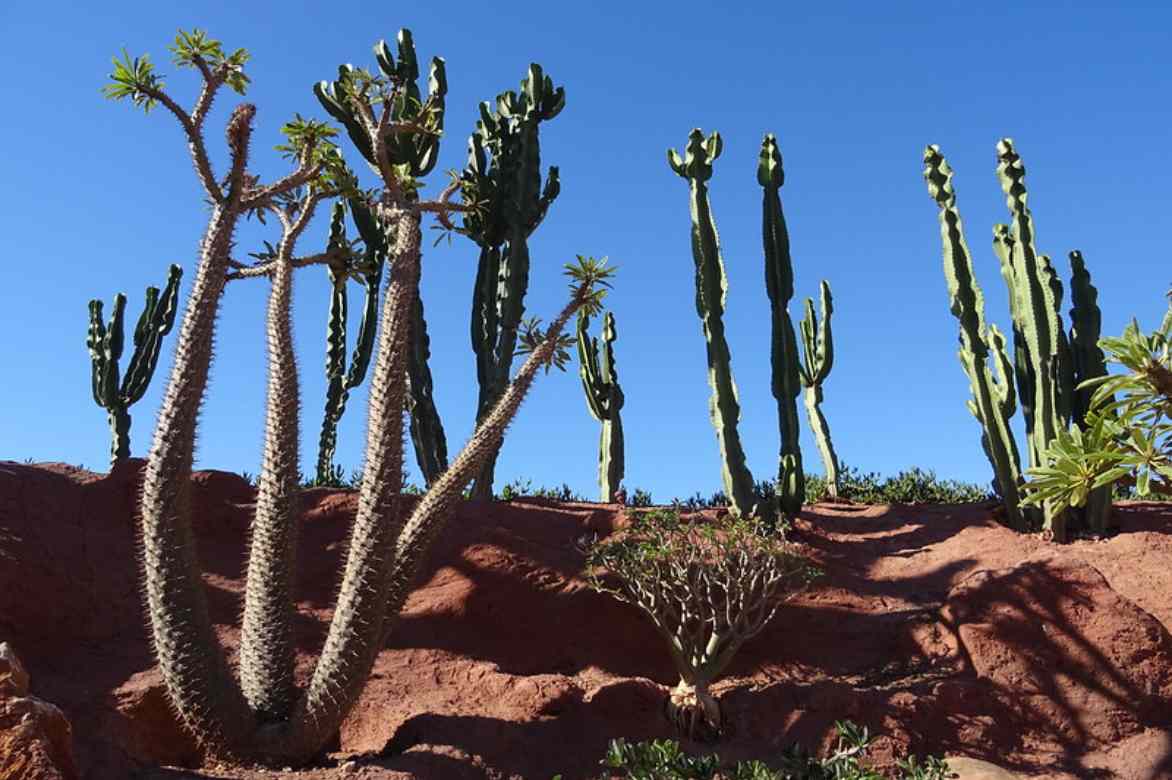
Pachypodium lamerei ©Olive Titus
Genus Pachypodium comprises around thirty recorded species, with several horticultural varieties derived mainly from the most popular species. For indoor cultivation, the following species are favoured :
- Pachypodium lamerei : most widespread, with thorny trunk and crown of elongated leaves.
- Pachypodium geayi : similar to previous species but with bluer foliage and a more slender trunk.
- Pachypodium saundersii : more compact, with a bushy habit, often used for bonsai.
- Pachypodium densiflorum : dwarf Malagasy species, globose habit, very decorative in a pot.
Pachypodium presents as a succulent plant with erect habit, shrubby to arborescent depending on growing conditions. In its natural habitat it can reach up to six metres, but remains much smaller indoors, where growth usually stabilises between 1.2 and 1.8 metres in a suitably sized container.
Architecture is based on single, vertical main axis that functions as apparent trunk. This trunk, although imposing, is not a true woody organ. It is a thickened succulent stem, silvery in colour, whose surface is covered with strong conical thorns, rigid, often arranged in groups of three around former leaf scars. This tissue stores water, an adaptation to arid climates.
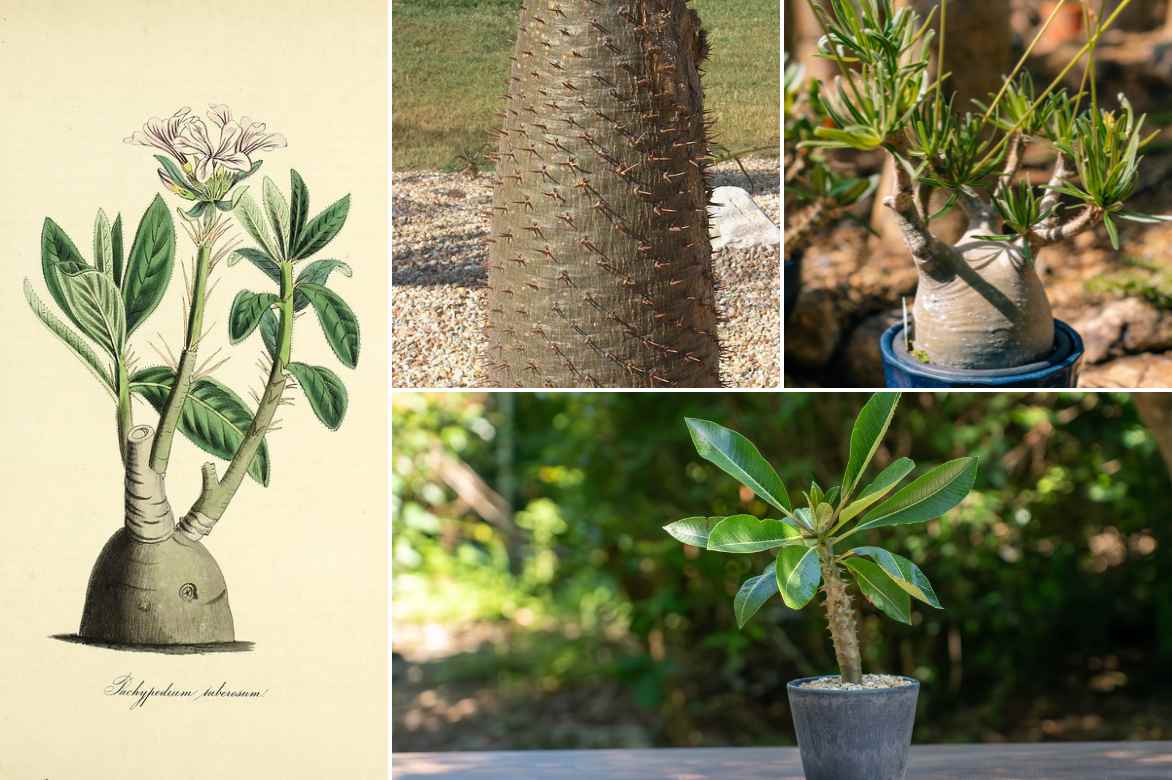
Botanical plate circa 1850 (Pachypodium succulentum), trunk of a Pachypodium lamerei (© The Fun Chronicles), Pachypodium succulentum and bottom right Pachypodium baronii
Leaves of Pachypodium, sometimes deciduous under water stress or during winter dormancy, usually persist provided plant receives good light and appropriate watering. Leaves are grouped in terminal rosettes at stem apex. They are lanceolate to linear, glossy green, sometimes slightly glaucous depending on species. Lamina can reach up to 30 cm on well-developed specimens. Crown-like leaf arrangement emphasises palm-like appearance often mistakenly attributed to this plant. Leaves drop during drought or winter rest, leaving bare stem and accentuating sculptural aspect.
Flowering of Pachypodium is rarely seen indoors, as it requires optimal conditions and considerable physiological maturity, usually reached after around ten years. When flowering does occur, it appears as terminal inflorescences composed of tubular flowers with flared corolla and five petals. Colour ranges from pure white to creamy depending on individual. Slightly scented, these flowers recall those of other Apocynaceae members, such as frangipani. Outdoors or under glass, successful pollination may lead to formation of elongated follicle fruits containing numerous winged seeds.
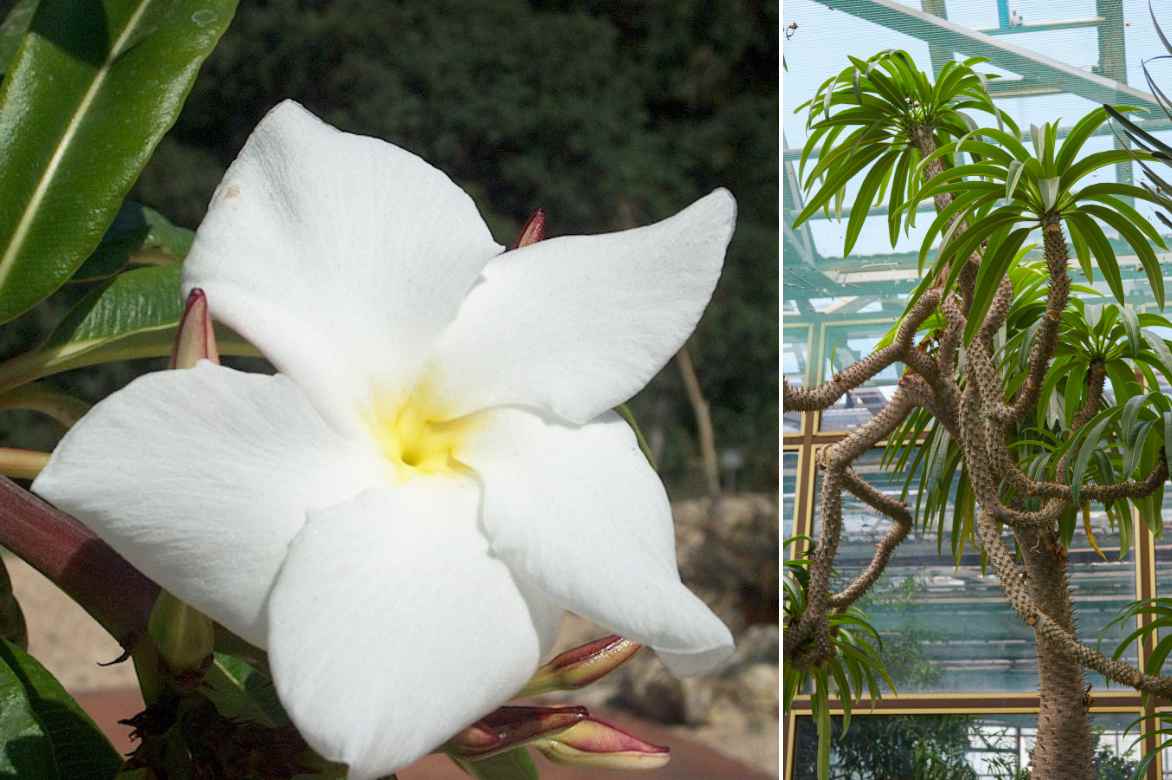
Flowering (© The Fun Chronicles) and habit of Pachypodium lamerei
Pachypodium may produce offshoots, although this is relatively uncommon. These lateral shoots usually emerge at base or lower part of trunk, giving some specimens a bushier habit with age. Finally, sap, milky in consistency, is rich in toxic alkaloids; it can cause skin irritation on contact, so exercise caution when handling, especially around children and pets.
Our favourite varieties
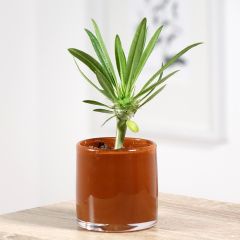
Pachypodium lamerei - Madagascar palm
- Height at maturity 1,50 m
Planting Pachypodium in pots
When to pot?
Pachypodium can be potted at any time of year, provided ambient temperature remains stable and mild, ideally between 18–30 °C. In temperate climates, spring is nevertheless the most favourable period, as it corresponds to resumption of vegetative growth. It is also the right time to place a young plant from a plug plant into its first container.
Which pot to choose for Pachypodium?
For plug plants, Pachypodium should be placed in a small 8–10 cm diameter pot. This container must be pierced in the base to ensure good drainage. Ideal pot is terracotta, a porous material that promotes evaporation of excess moisture, but a plastic pot can be suitable if used with a very free-draining growing medium. Choose a pot slightly wider than the plug, but not too deep, as root system remains relatively shallow.
Where and how to position it?
Pachypodium requires bright light to develop well. Indoors, position it near a south- or west-facing window, avoiding direct sun during hottest hours in summer, especially for young plants. Place pot in a very bright spot with stable temperature, avoiding cold draughts. Ideal humidity is between 30 and 50%, which corresponds to standard atmosphere of a heated interior.
Pachypodium lamerei can be moved outside from May onwards, provided night temperatures exceed 12 °C. Exposure to sun should be introduced gradually to avoid sunburn on foliage. In autumn, bring plant indoors before onset of cool temperatures, as Pachypodium does not tolerate cold: below 10 °C it suffers, and frost would be fatal.
Recommended growing medium
Pachypodium needs a perfectly free-draining growing medium, similar to that used for cacti and succulents. It should be light, mineral and low in organic matter to avoid risk of root rot. Ideal mix:
- 50% coarse sand or pumice/pozzolana
- 30% cactus compost (light and well aerated)
- 20% of perlite or vermiculite to improve drainage.
It is possible to add a thin layer of gravel or clay pebbles to base of pot to ensure optimal drainage.
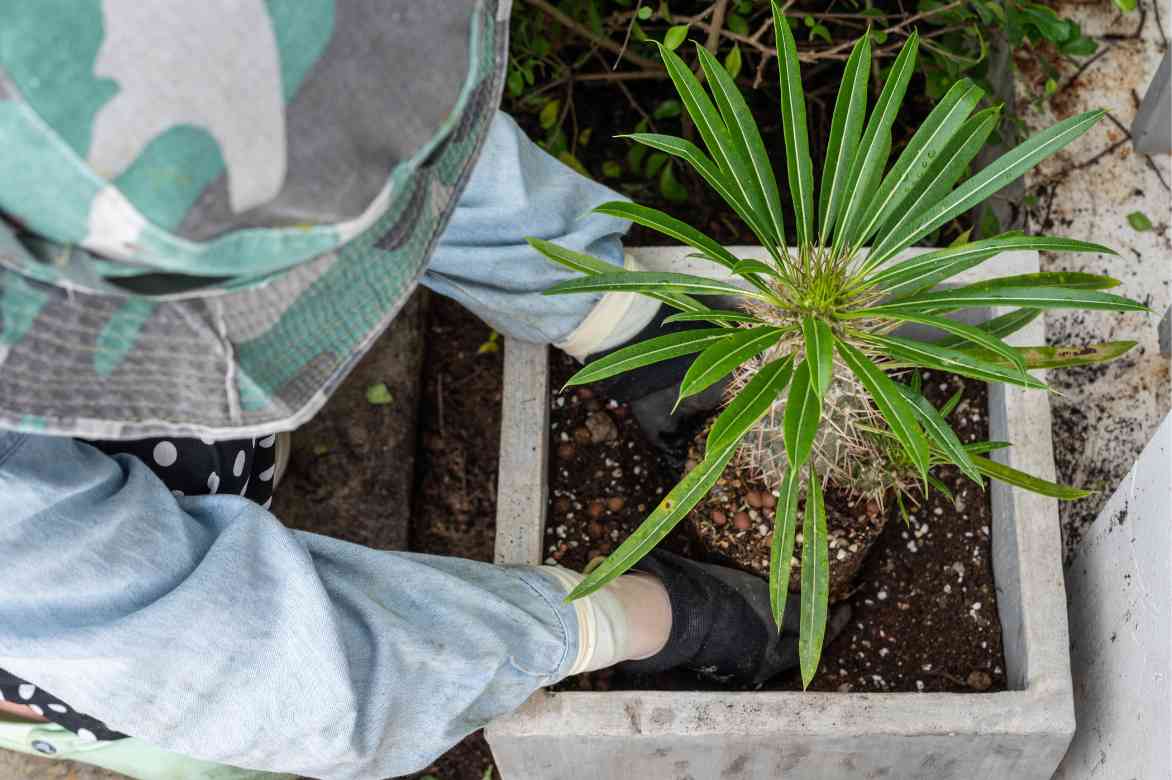
Growing medium should be particularly light
Planting steps for plug plants
- Prepare a small pot with a drainage layer in the base (gravel, clay pebbles).
- Part-fill pot with the growing medium mix, pre-moistened (but not waterlogged).
- Place plug plant gently in centre of pot without burying collar of plant.
- Top up with growing medium around plug, firming lightly without over-compacting.
- Water lightly after potting, then allow growing medium to dry before next watering.
Pachypodium care — quick guide Overview Pachypodium (often called Madagascar palm) are succulent shrubs or small trees prized for swollen trunks, spiny branches and showy flowers. They are drought-tolerant, sun-loving plants that suit warm, bright indoor positions or sheltered outdoor sites in mild climates. Light and position - Provide as much bright light as possible. Full sun is ideal; a south- or west-facing window or greenhouse works well. - Insufficient light causes leggy growth and poor flowering. - Gradually acclimatise plants to stronger sun to avoid leaf scorch. Temperature and humidity - Prefer warm conditions: 18–30°C (65–85°F) in growing season. - Minimum winter temperature around 10°C (50°F); avoid exposure below 5°C (41°F). - Low humidity is acceptable; good air circulation helps prevent fungal issues. Soil and potting - Use a very free-draining, gritty cactus/succulent mix. Add pumice, grit or coarse sand to improve drainage. - The pot should have drainage holes to avoid waterlogging. - Pachypodium appreciate being slightly root-bound; avoid oversized pots. Watering - Water thoroughly in spring and summer, then allow substrate to dry between waterings. - In active growth, water regularly but never leave plant sitting in water. - Reduce watering sharply in autumn and keep minimal in winter dormancy; water only enough to prevent shrivelling. Feeding - Feed with balanced liquid fertiliser diluted to half strength every 4–6 weeks during active growth (spring–summer). - Stop or reduce feeding during autumn and winter when growth slows. Dormancy and seasonal care - Many species have a true dormant period in cooler months; leaves may drop. This is normal. - During dormancy reduce watering and do not feed. - Keep plant in a cool, bright spot for winter rest if possible. Repotting and root care - Repot only when necessary (every 2–4 years), ideally in spring before active growth. - Inspect roots for rot; remove any soft or blackened tissue. - When repotting, maintain neck of trunk slightly above soil level to reduce rot risk. Pruning and training - Pruning is minimal; remove dead or damaged branches with clean tools. - Wear gloves and eye protection — spines are sharp. Propagation - Most pachypodium are propagated from seed; some species can be grown from cuttings but rooting can be slow and risk rot. - Sow seed in warm, well-draining mix and keep moist until germination. Pests and diseases - Watch for mealybugs, scale and spider mites indoors. Treat infestations early with insecticidal soap or systemic insecticide where appropriate. - Overwatering causes root rot and stem softening — main threat in cultivation. Toxicity and safety - Sap can be irritating; avoid contact with eyes and skin. Keep away from children and pets. - Spines present a physical hazard — handle with care. Common mistakes - Overwatering or poor drainage. - Insufficient light. - Keeping plant too cold during winter. Quick-care checklist - Light: full sun to very bright. - Soil: free-draining, gritty. - Water: moderate in summer, minimal in winter. - Temp: 18–30°C in growth, not below 10°C in winter. - Feed: dilute fertiliser in spring–summer. - Propagation: seed preferred. If you tell me which Pachypodium species you have (for example Pachypodium lamerei or Pachypodium variegatum) and whether it’s grown indoors or outdoors, I can give tailored advice.
Watering
Watering must be moderate and carefully controlled. Basic principle is to let substrate dry out completely between waterings. During growth period (spring–summer), watering every two to three weeks may suffice, depending on ambient temperature. In autumn and winter, drastically reduce watering, or stop altogether if plant is dormant. Misting is unnecessary, even discouraged: Pachypodium is adapted to dry atmospheres, with ideal humidity between 30 and 50 %. Excess moisture can cause rot.
Feeding
Light feeding can be considered in spring and summer, about once a month, with a diluted liquid feed for cacti or succulent plants. Never apply fertiliser to dry substrate, and avoid any feeding during autumn and winter when plant is dormant.
Pruning
Pachypodium does not require regular pruning. If a stem becomes deformed or dries out, it can be neatly cut with a well-disinfected tool. Be careful: any wound causes flow of toxic sap. As plant’s natural habit is very structured, limit interventions.
Repotting
Repotting should be carried out every two to three years, in spring, when roots begin to fill the pot. It is essential to use a slightly larger pot, always with drainage holes, and to partially or completely renew the substrate with a suitable well-draining mix (cactus type). Repotting too frequently or into an oversized container can encourage stagnant moisture and weaken the plant.
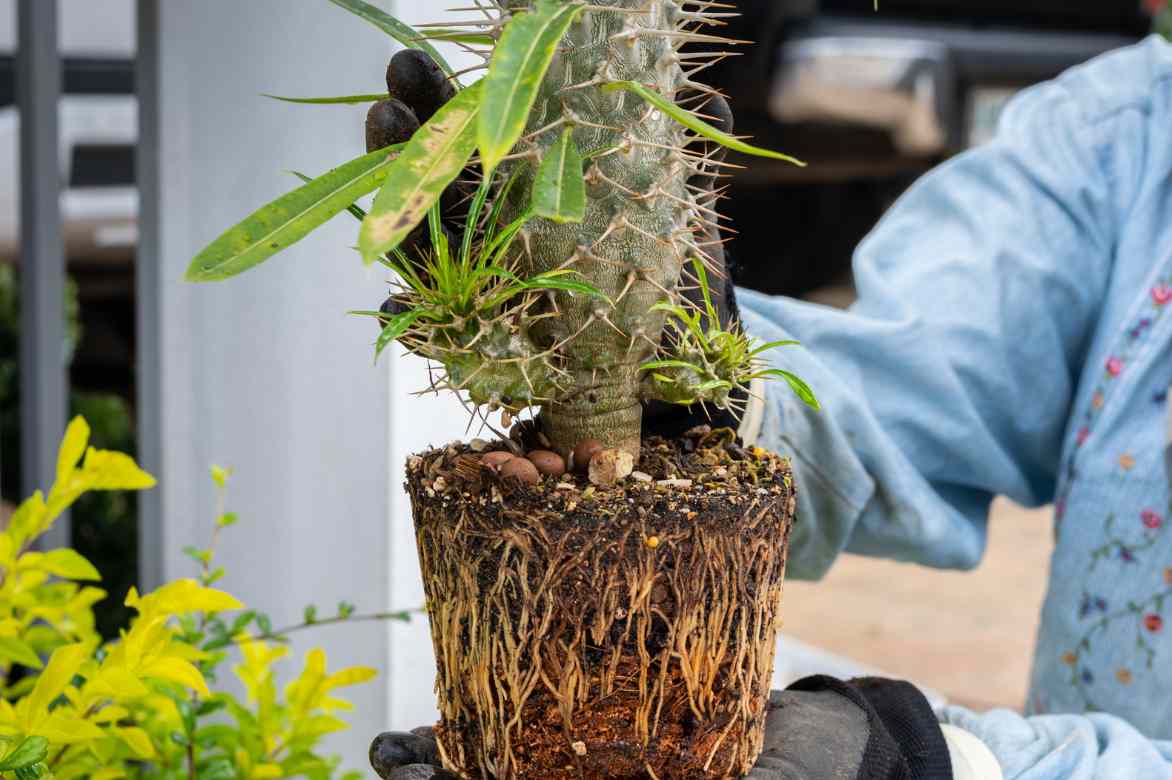
Repot when roots have fully colonised the pot
Precautions
- Sap of Pachypodium is toxic and irritating. It is therefore recommended to wear gloves when handling (repotting, pruning).
- During warm season (May to September), plant can be moved outdoors, provided it is gradually acclimatised to full sun to avoid sunburn. It must be brought back indoors before temperatures fall below 12 °C.
Diseases and pests of Pachypodium lamerei
| Problem | Symptoms | Natural solution |
| Overwatering / rot | Softening of base, brown spot disease, collapse, soft roots | Stop watering, prune affected parts, repot into dry, free‑draining substrate |
| Mealybugs | Small white cottony masses, slowed growth | Wipe with cloth soaked in 70% alcohol, apply black soap |
| Red spider mites | Leaf discolouration, fine webs, dull appearance | Rinse plant, increase ambient humidity, spray with black soap |
Propagate Madagascar palm from offshoot cuttings
Propagation of Pachypodium by cuttings is rarely practised, as the plant does not naturally produce multiple branches that are easy to take. However, when offshoots appear at the base or on the trunk, it is possible to remove one to try a cutting.
How to proceed?
- Use a clean, sharp knife to cut a vigorous offshoot from the base of the plant. The offshoot should measure at least 5–10 cm and be well formed.
- Leave the cutting to dry for several days in the open air in a dry, shady place until a callus forms (essential to prevent rot).
- Plant the cutting in a small pot containing a very free-draining mix (cactus mix based on sand, light potting compost and perlite).
- Wait a few more days before the first light watering, then keep the substrate barely moist.
- Place the Pachypodium cutting in a warm spot (22–28 °C) with bright light but no direct sun.
- During the first weeks, keep the substrate almost dry: excessive moisture is the enemy of rooting. It can sometimes take several weeks, even months, for a root to form. If the cutting remains firm and does not wilt, that is a good sign: be patient.
- As soon as new leaves appear, you can resume very infrequent watering, as you would for a mature plant.
Precautions
- Wear gloves: sap is toxic and irritating.
- Successful establishment is not guaranteed: some cuttings may not develop roots.
- Patience required: rooting can take several weeks, even months.
Gwenaëlle explains in detail the propagation methods for the Madagascar palm in this tutorial.
Companion planting and decoration
With its slender habit, silvered trunk covered in thorns and a crown of glossy leaves, the Pachypodium lamerei brings a distinctive presence in bright interiors. Its silhouette evokes both exoticism and restraint, making it an ideal choice for planting in a sunlit living room, a sunny conservatory or an office. It fits particularly well into contemporary, ethnic or exotic settings.
It can be paired with other plants with similar requirements, such as Adenium obesum (Desert rose), or with cacti such as Mammillaria hahniana. These companions share the same needs for light and drainage while providing a pleasing contrast of form and texture. Together they create a display that is understated, elegant and distinctly graphic.
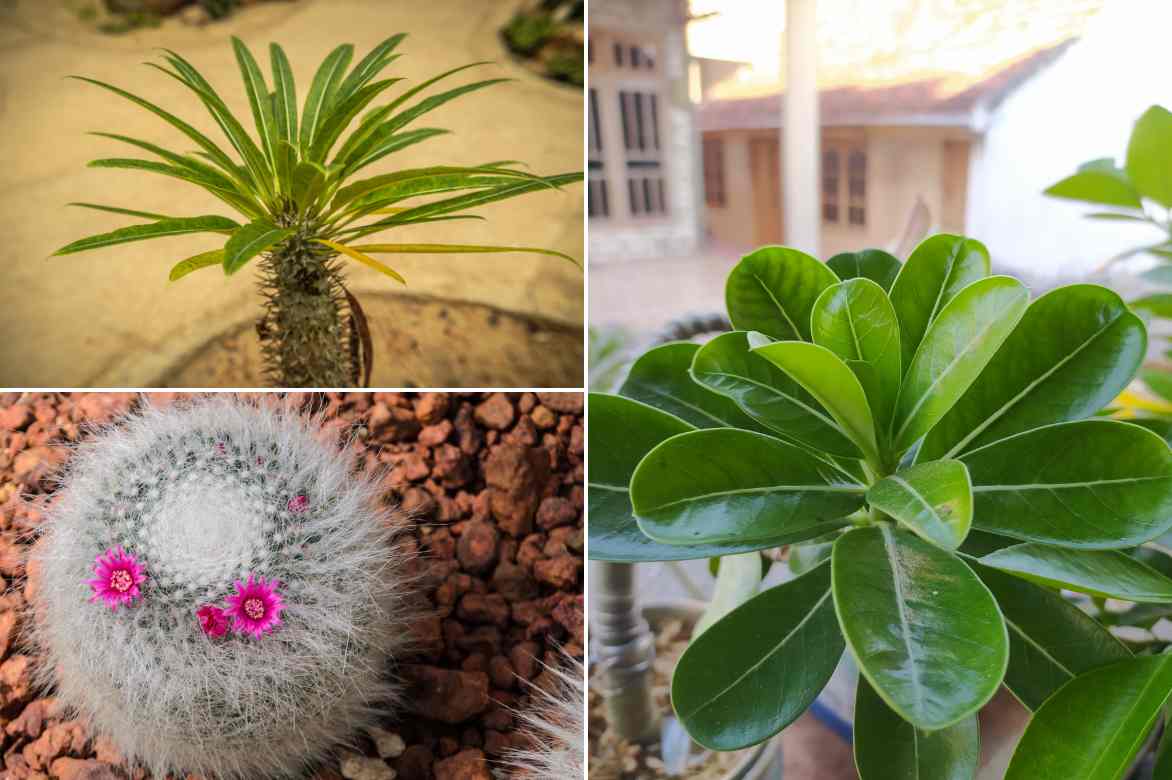
Pachypodium lamerei, Mammillaria hahniana and Adenium obesum
See also
→ Discover our wide range of houseplants.
→ Our decorative leafy houseplants and our flowering houseplants.
→ Our many books on houseplants.
Frequently asked questions
-
How to save a Madagascar palm?
To save a Pachypodium lamerei, place it in bright light, stop watering if soil is damp, check the roots and repot into a dry, well-draining substrate. Cut away soft or blackened parts, and avoid cold (<12 °C).
-
What is the ideal ambient temperature for a Madagascar palm?
Ideal ambient temperature for Pachypodium lamerei is between 18 and 30 °C, with a minimum of 10–12 °C in winter to avoid thermal stress.
- Subscribe!
- Contents
This form is protected by reCAPTCHA - the Google Privacy Policy and Terms of Service apply.

































Comments