Colchicum macrophyllum - Autumn Crocus
Colchicum macrophyllum - Autumn Crocus
Colchicum macrophyllum
Autumn Crocus
Back-to-school special offer!
Get €10 off for every €50 you spend! And get up to €40 off on a single order.
How does it work?
1. Shop your favourites
Add your favourite plants to your basket. For every €50 you spend (excluding delivery charges, store credit and the plastic-free option), you’ll receive a €10 voucher.
€50 spent = €10 voucher
€100 spent = €20 voucher
€150 spent = €30 voucher
€200 spent = €40 voucher
2. Place your order
Once your basket reaches one of the spending thresholds, place your order. You can even choose your delivery date!
3. Receive your voucher
As soon as your order has been shipped, you’ll receive an email containing your personal voucher code and its value.
4. Use it on your next order
Your voucher is valid for 90 days from the date you receive it. It can be used once only, on a new order worth at least the value of the voucher, excluding delivery charges.
Please note: Vouchers can be combined with other offers, but cannot be split or refunded.
Why not try an alternative variety in stock?
View all →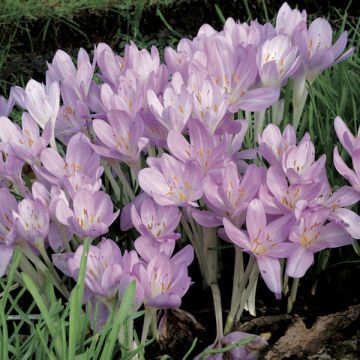
Available in 1 sizes
This plant carries a 6 months recovery warranty
More information
We guarantee the quality of our plants for a full growing cycle, and will replace at our expense any plant that fails to recover under normal climatic and planting conditions.
Would this plant suit my garden?
Set up your Plantfit profile →
Description
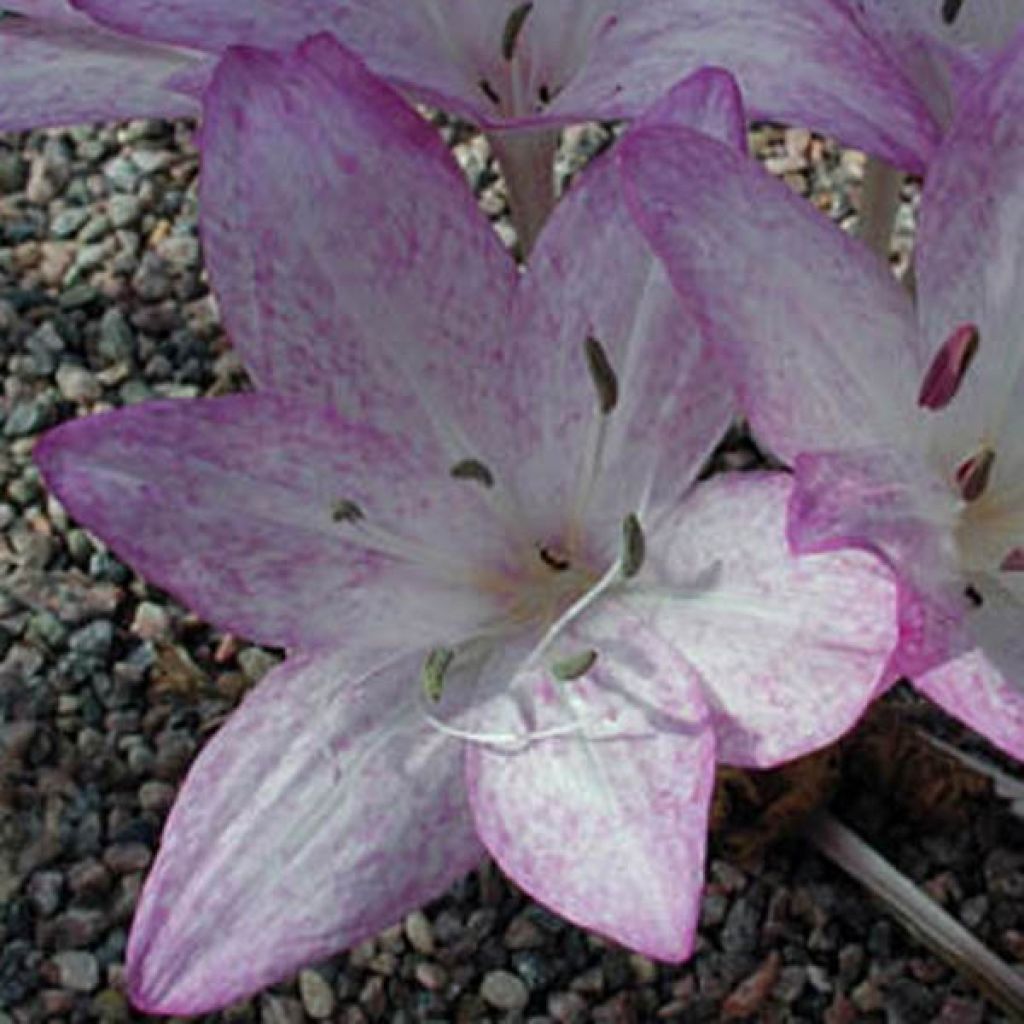
Colchicum macrophyllum, called checkered colchicum or large-leaved colchicum, is a rare species interesting for Mediterranean gardens. Unlike the autumn crocus, which prefers cool meadows in temperate regions, this one comes from the Aegean region, where the summer is dry. Its flowers appear in autumn, directly at ground level, as large pale pink cups heavily marbled and veined with mauve pink. It is suitable for rock gardens, stony slopes, and very well-drained borders.
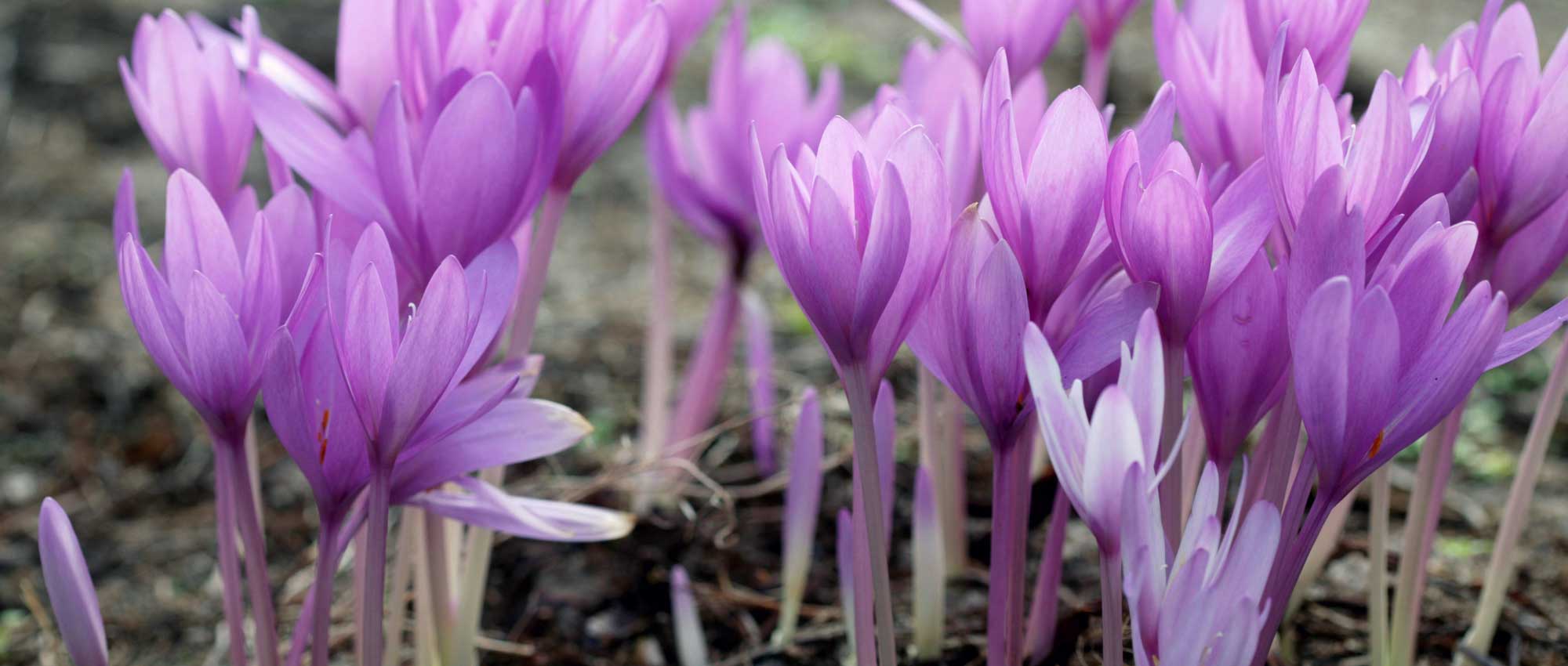
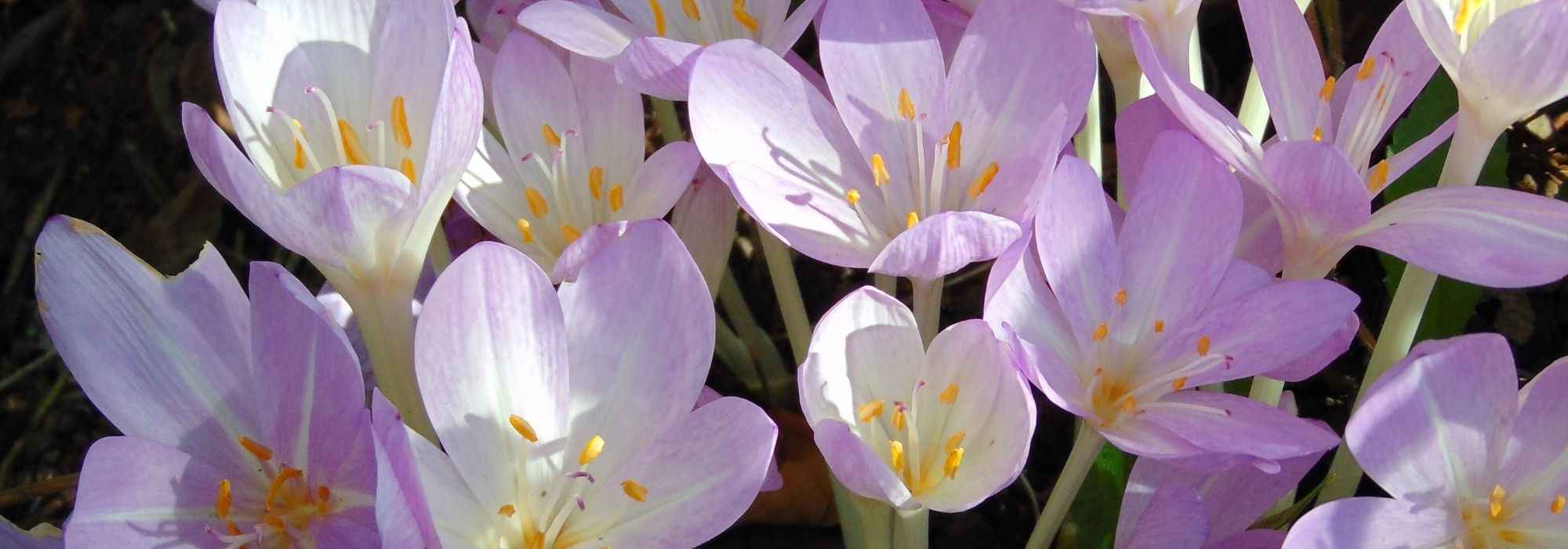
This species belongs to the Colchicaceae family. It is known by several vernacular names, including checkered colchicum, large-leaved colchicum, Cretan colchicum and variegated colchicum. Its main botanical synonym is Colchicum latifolium var. longistylum. It is a perennial cormous plant, a swollen underground organ that stores reserves. Colchicum macrophyllum grows naturally in Greece, Crete, several Aegean islands and in southwestern Turkey. It is found on grassy slopes, in olive groves, scrub and rocky terrain, often at low or medium altitudes. Its cycle is well suited to these Mediterranean environments: flowers appear with the return of autumn rains, leaves develop in spring, then all vegetation disappears before the summer drought. In flower, it reaches 10 to 20 cm in height. Each corm produces one to four flowers, sometimes more on well-established specimens. The corollas measure 6 to 8 cm in diameter. They are white, pale lilac or rosy mauve, adorned with a darker pattern reminiscent of a checkerboard. The six tepals open wide in mild weather. In spring, the plant completely changes appearance: it produces large basal leaves, medium green, lanceolate, more or less plicate, reaching 35 to 40 cm long. This foliage feeds the corm, then yellows naturally before summer. The plant then enters dormancy. The fruits, visible in spring among the leaves, are elongated capsules with three valves. The corms slowly enlarge and multiply; they withstand -15°C at a pinch in well-drained soil.
The name macrophyllum means 'large-leaved', distinguishing this species from many colchicums with more discreet foliage. Like all colchicums, the plant is toxic in all its parts and must not be confused with a crocus or edible saffron.
In the garden, this colchicum is planted in small groups in loose, well-drained, fairly fertile soil that receives autumn and spring rains but dries out in summer. It is well suited to Mediterranean gardens, but can also be grown elsewhere if its needs are met. It can be planted at the base of deciduous shrubs, on a stony slope enriched with compost, or in a rock garden that is not too poor. Allow enough space for its large leaves to spread out. It pairs well with autumn crocuses, hardy cyclamen, Ophiopogon planiscapus ‘Nigrescens’ and groundcover perennials such as Geranium macrorrhizum ‘Spessart’.
Plant habit
Flowering
Foliage
Safety measures
Botanical data
Colchicum
macrophyllum
Colchicaceae
Autumn Crocus
Colchicum latifolium var. longistylum
Southern Europe, West Asia
ingestion
Cette plante est toxique si elle est ingérée volontairement ou involontairement.
Ne la plantez pas là où de jeunes enfants peuvent évoluer, et lavez-vous les mains après l'avoir manipulée.
Pensez à conserver l'étiquette de la plante, à la photographier ou à noter son nom, afin de faciliter le travail des professionnels de santé.
Davantage d'informations sur https://plantes-risque.info
Planting and care
Plant Colchicum macrophyllum preferably in late summer or early autumn, before the flowers emerge. Plant the corms upon receipt, at a depth of about 10 to 15 cm, in well-loosened soil. The soil should be well-drained, deep, and fairly fertile. A stony soil enriched with well-rotted compost suits it very well. In heavy soil, plant on a slight slope, a mound, or in a raised rockery, so that water does not stagnate around the corm in winter. Choose a sunny or lightly shaded position, especially in warm regions. Water after planting if the soil is dry, then let the autumn rains take over. In spring, the foliage must remain in place until it has completely yellowed: it is this that allows the corm to replenish its reserves. Avoid working the soil in that spot in summer, even when the plant has disappeared. In a Mediterranean climate, no summer watering is necessary once the plant is established. The clumps can be divided when they become very dense, during the dormant period.
Planting period
Intended location
Care
Planting & care advice


This item has not been reviewed yet - be the first to leave a review about it.
Recently viewed products
Haven't found what you were looking for?
Hardiness is the lowest winter temperature a plant can endure without suffering serious damage or even dying. However, hardiness is affected by location (a sheltered area, such as a patio), protection (winter cover) and soil type (hardiness is improved by well-drained soil).

The flowering period indicated on our website applies to countries and regions located in USDA zone 8 (France, the United Kingdom, Ireland, the Netherlands, etc.)
It will vary according to where you live:- In zones 9 to 10 (Italy, Spain, Greece, etc.), flowering will occur about 2 to 4 weeks earlier.
- In zones 6 to 7 (Germany, Poland, Slovenia, and lower mountainous regions), flowering will be delayed by 2 to 3 weeks.
- In zone 5 (Central Europe, Scandinavia), blooming will be delayed by 3 to 5 weeks.
In temperate climates, pruning of spring-flowering shrubs (forsythia, spireas, etc.) should be done just after flowering.
Pruning of summer-flowering shrubs (Indian Lilac, Perovskia, etc.) can be done in winter or spring.
In cold regions as well as with frost-sensitive plants, avoid pruning too early when severe frosts may still occur.
The planting period indicated on our website applies to countries and regions located in USDA zone 8 (France, United Kingdom, Ireland, Netherlands).
It will vary according to where you live:
- In Mediterranean zones (Marseille, Madrid, Milan, etc.), autumn and winter are the best planting periods.
- In continental zones (Strasbourg, Munich, Vienna, etc.), delay planting by 2 to 3 weeks in spring and bring it forward by 2 to 4 weeks in autumn.
- In mountainous regions (the Alps, Pyrenees, Carpathians, etc.), it is best to plant in late spring (May-June) or late summer (August-September).
The harvesting period indicated on our website applies to countries and regions in USDA zone 8 (France, England, Ireland, the Netherlands).
In colder areas (Scandinavia, Poland, Austria...) fruit and vegetable harvests are likely to be delayed by 3-4 weeks.
In warmer areas (Italy, Spain, Greece, etc.), harvesting will probably take place earlier, depending on weather conditions.
The sowing periods indicated on our website apply to countries and regions within USDA Zone 8 (France, UK, Ireland, Netherlands).
In colder areas (Scandinavia, Poland, Austria...), delay any outdoor sowing by 3-4 weeks, or sow under glass.
In warmer climes (Italy, Spain, Greece, etc.), bring outdoor sowing forward by a few weeks.
Shipping country and language
Your country of residence may be:
Your country of residence is:
For a better user experience on our website, you can select:
Your shipping country:
-
 Austria
-
 Belgium
-
 Bosnia & Herzegovina
-
 Bulgaria
-
 Croatia
-
 Cyprus
-
 Czechia
-
 Denmark
-
 Estonia
-
 Finland
-
 France
-
 Germany
-
 Greece
-
 Hungary
-
 Iceland
-
 Ireland
-
 Italy
Italy
-
 Latvia
-
 Liechtenstein
-
 Lithuania
-
 Luxembourg
-
 Malta
Malta
-
 Netherlands
-
 Poland
-
 Portugal
-
 Romania
-
 Serbia
-
 Slovakia
-
 Slovenia
-
 Spain
Spain
-
 Sweden
-
 Switzerland
Language:
-
French
-
 English
-
Spanish
-
Italian
-
German
-
Portuguese
-
Dutch
-
Finnish
My Account
Hello
My wish lists
My cart
Log in / Register
Existing customer?
This form is protected by reCAPTCHA - the Google Privacy Policy and Terms of Service apply.
New customer?
Create an account to track your orders, access our customer service and, if you wish, make the most of our upcoming offers.