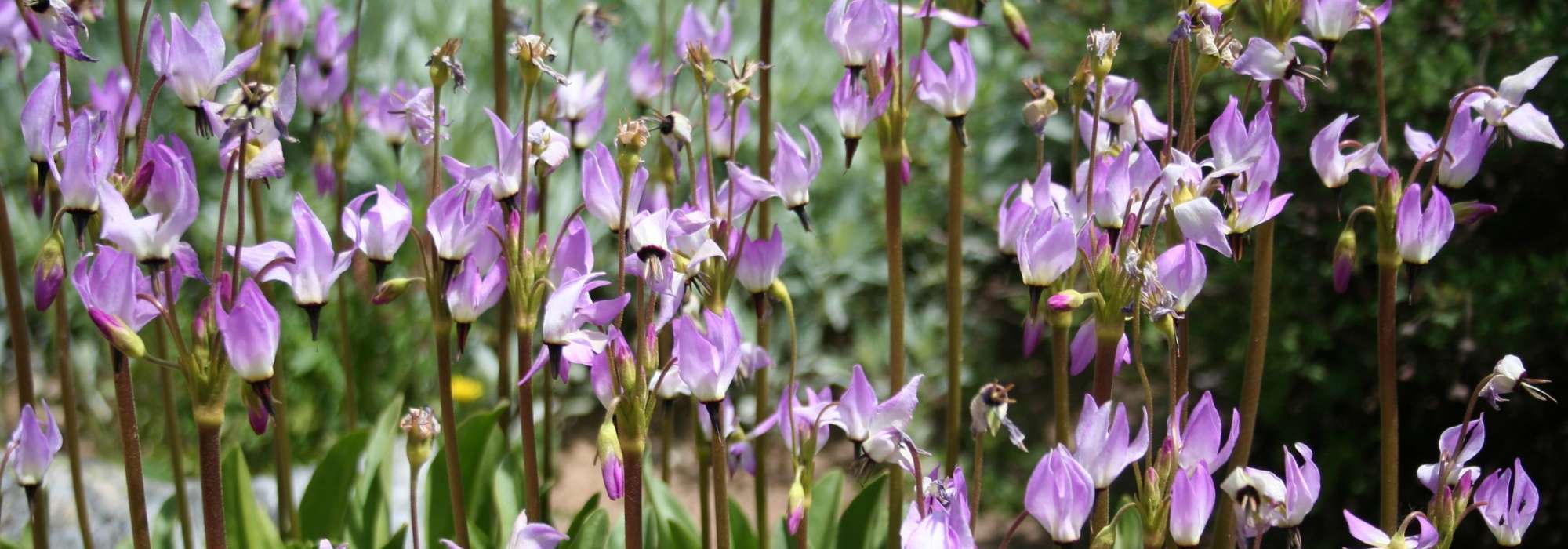
Shooting star, Virginia gyroselle: planting and growing
Contents
Shooting star in a nutshell
- Shooting star is one of the loveliest spring blooms!
- Its delicate reflexed flowers, resembling miniature cyclamens, show charming shades of pink
- This small shade-loving perennial requires acidic soil that is consistently moist yet well-drained
- Very hardy, it is easy to establish in a woodland understorey beneath tree foliage
- It also thrives in cool rockeries, borders or shady beds
A word from our expert
Dodecatheon or Virginia shooting star has one of the most beautiful spring flowerings! Still too little known, this flower of rare beauty, hitherto known mainly to discerning collectors, deserves to feature prominently in every garden, well sheltered under tree foliage.
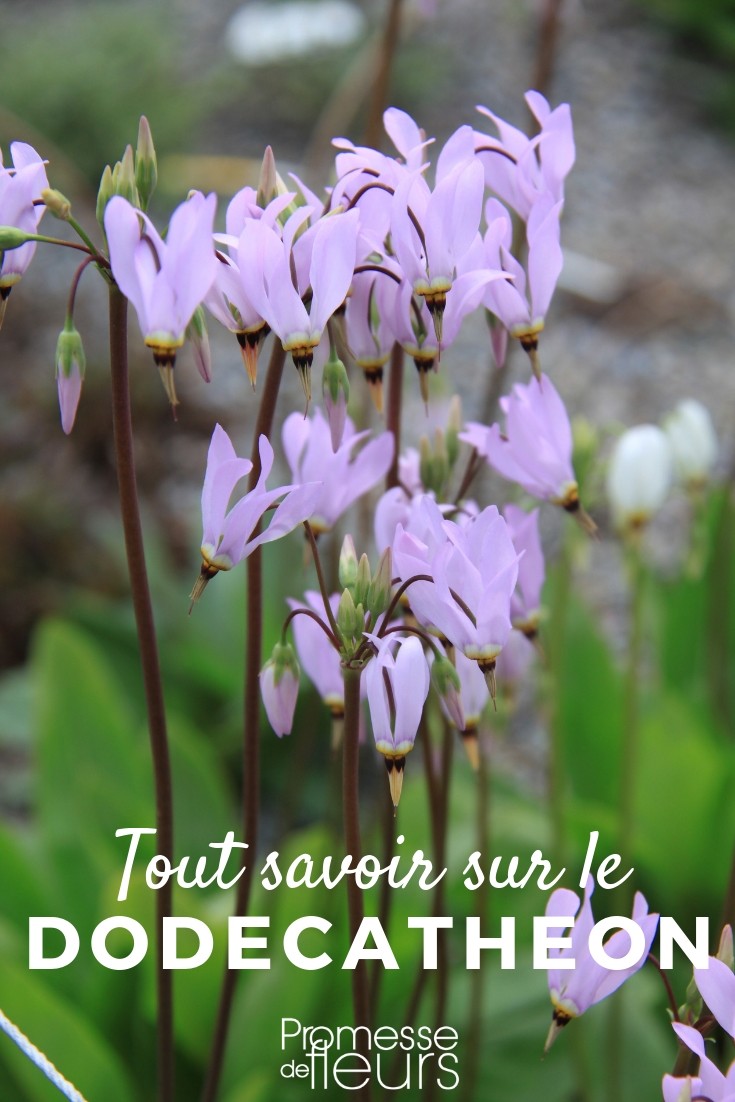
In spring, this small, very elegant perennial displays with infinite grace delicately upturned flowers resembling mini-cyclamens in violet-pink or white.
Dodecatheon meadia or Virginia shooting star and Dodecatheon pulchellum all create slightly sophisticated scenes imbued with freshness.
But do not be fooled by their appearance: beneath that graceful look hides a very hardy perennial plant easy to grow with other fine shade-loving perennials.
This moist shade perennial requires only dappled shade, cool conditions and a rather acidic, cool and well-drained soil to flower generously before quietly going dormant in summer.
Charming and elegant, discover our shooting stars, those little plant jewels to collect; they are perfect for dressing a shaded rockery, the base of trees or a shrub border.
And be inspired to pair them with our spring-flowering perennials!

Description and botany
Botanical data
- Latin name Dodecatheon
- Family Primulaceae
- Common name Gyroselle, Shooting star
- Flowering April to June
- Height 0.15 to 0.40 m
- Exposure partial shade, shade
- Soil type acidic, moist
- Hardiness -15°C
The Dodecatheon, also known as gyroselle, is an herbaceous perennial in family Primulaceae, a cousin of primroses and cyclamens, native to cool woodland, wet meadows and sometimes alpine habitats of North America.
The genus includes 14 species, among which Dodecatheon meadia or Virginia shooting star is the most widespread. It has produced some interesting cultivars such as ‘Queen Victoria’. Only four species are commercially available in our country and Dodecatheon jeffreyi, Dodecatheon hendersonii and Dodecatheon pulchellum are rarely offered for sale.
Slow-growing, gyroselle forms in spring a tuft of upright leaves gathered in a basal rosette. It reaches 10 to 45 cm in height. Leaves oval to lanceolate, spatulate or obovate, 2 to 25 cm long, sometimes irregularly dentate. Glabrous or slightly velvety and fleshy, they recall those of primroses. From light green to dark green, they sometimes flush purple towards the petiole depending on variety. Deciduous foliage regenerates in spring.
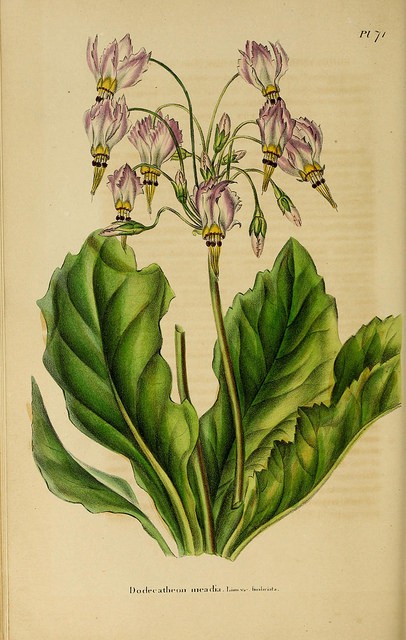
Dodecatheon meadia – botanical illustration
Graceful and exquisitely delicate, gyroselle’s flowering is of rare beauty. From March to June depending on climate, numerous flower stems, slender yet robust, rise well above the foliage, sometimes exceeding 40 cm in height. At the tip of these bare, greenish-tinged stems that are slightly arching, hang gracefully umbels of around fifteen flowers revealing a calyx of 5 fully recurved sepals. Their singular form, with narrow lanceolate petals directed backwards on long stalks, unmistakably evokes mini-cyclamens.
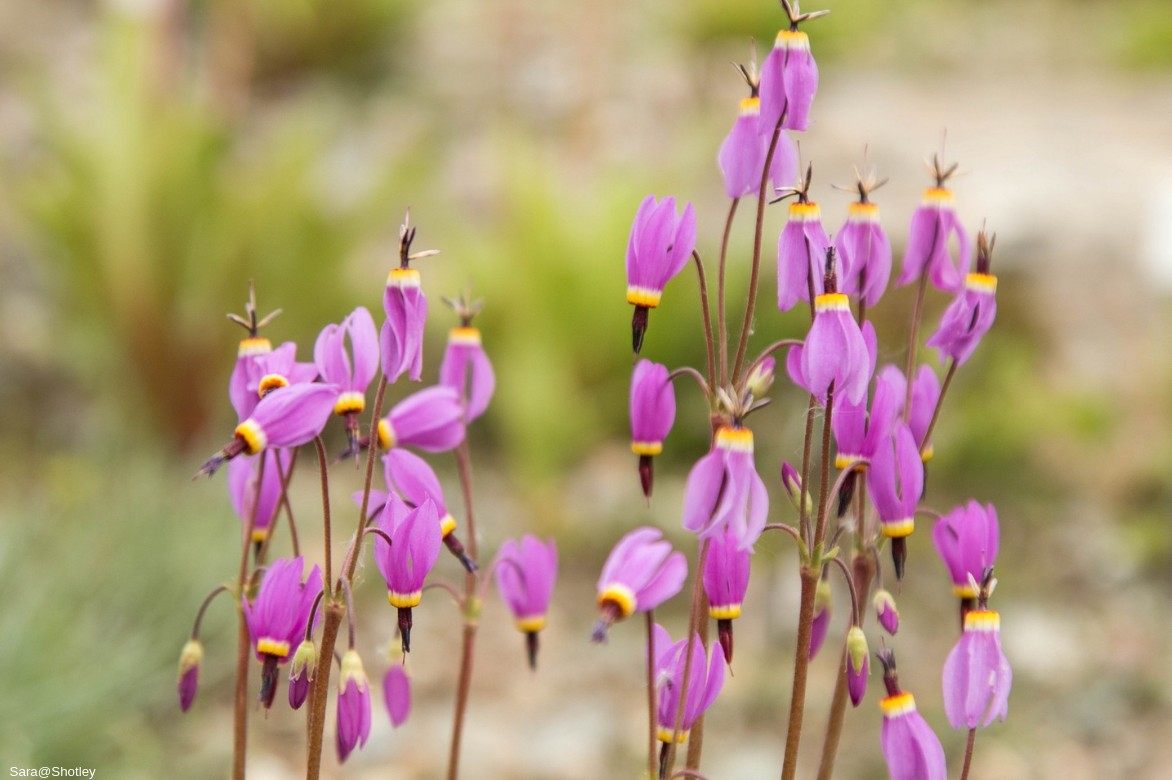
As if suspended in air and turned skywards, they open in swarms of small upside-down bell flowers 1 to 3 cm long in colour ranges from pastel pink, cyclamen pink to raspberry or cherry red, more rarely cream-white; these flowers are slightly white at the base. The flower centre, very conspicuous, reveals a pointed cluster of 5 stamens fused together and projecting, dark reddish-brown or deep violet ringed with golden yellow, orange or white.
Like a celestial ode, this fairy-like flowering seems to honour the twelve gods of Olympus; from Greek “dodeca” meaning “twelve” and “theos” meaning “god”.
As with many spring ephemerals, gyroselle has a very short growing cycle; after flowering it enters dormancy, losing its foliage during summer and disappearing completely.
Very hardy to between -15°C and -25°C, Dodecatheon prefers cool, mountainous climates. This small perennial of damp woodlands requires dappled or partial shade and a humus-rich, acidic soil that stays cool to moist during the growing season and remains well drained.
Read also
Care of perennial plantsMain species and varieties
Dodecatheon meadia or Virginia shooting star is the most widespread species; it occurs in numerous varieties covering all shades of pink, from pale to carmine, including white.
Our favourites
Dodecatheon meadia Queen Victoria
- Flowering time May, June
- Height at maturity 35 cm
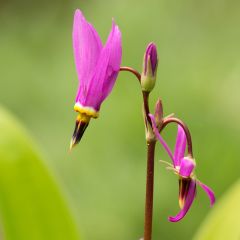
Dodecatheon meadia
- Flowering time May, June
- Height at maturity 30 cm
Discover other Dodecatheon
View all →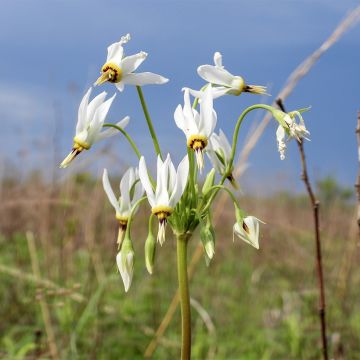
Available in 1 sizes
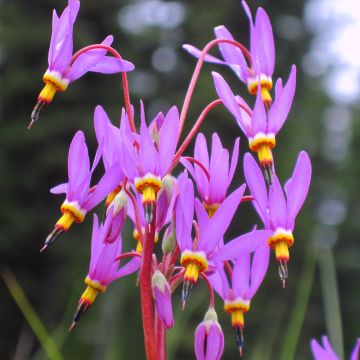
Available in 1 sizes
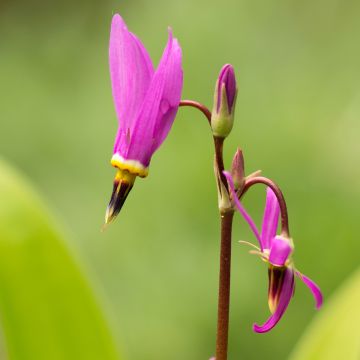
Available in 1 sizes
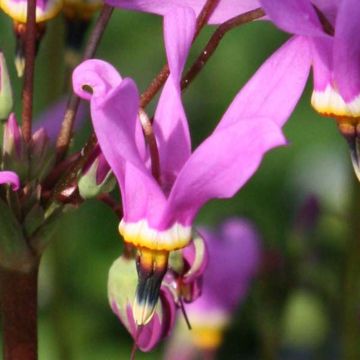
Available in 1 sizes
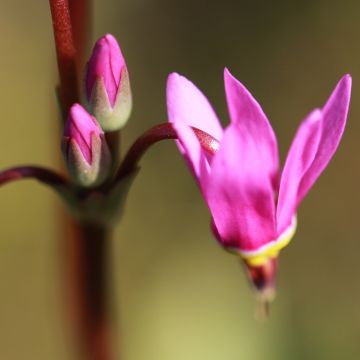
Available in 3 sizes
Planting
Where to plant shooting star or Dodecatheon?
From its montane origins, the shooting star has retained a good hardiness, able to withstand temperatures of -15°C sometimes down to -25°C. It is very comfortable in rather cool climates and in a mountain garden.
Although it tolerates cold well, this small moist-shade plant has some cultural requirements, making it delicate to grow in Mediterranean climate, which is rather too dry. Avoid strong sun exposure and dried-out soils.
This woodland perennial thrives in partial shade or in shaded but bright areas in non-calcareous soil, slightly acidic, rich in humus, remaining always cool, even moist during growth and well drained. It will, however, appreciate slightly drier soil during summer dormancy.
Choose its position carefully because once well established this plant does not tolerate transplanting well.
Plant it at the edge of a border or a cool shady rockery, on the woodland edge or under tree foliage which will protect it from intense sun, where it will form in spring pretty, if ephemeral, clumps that are very floriferous.
Particularly fond of moisture, it will also do well on the edge of a pond.
When to plant shooting star or Dodecatheon?
Planting Dodecatheon is done in early spring in March–April after frosts or from September to November.
How to plant shooting star or Dodecatheon?
Soil must be well drained and rich in organic matter to plant the shooting star. Space plants 30 to 40 cm apart to allow clumps to spread freely and allow 5 to 7 pots per m². As foliage disappears early in summer, to cover bare soil and take over after flowering, consider planting between two shooting star plants some small summer bulbs or other perennials that appreciate cool, moist soils and shaded positions.
- Clean soil thoroughly by removing stones, roots and weeds
- Work soil well, adding a mix of turf and leaf mould
- Dig a hole 2 to 3 times the pot volume
- Lay a draining layer of gravel or coarse sand
- Plant and cover the rootball with the fertile soil mix
- Water copiously to encourage rooting
- Mulch in spring with pine bark to keep soil cool
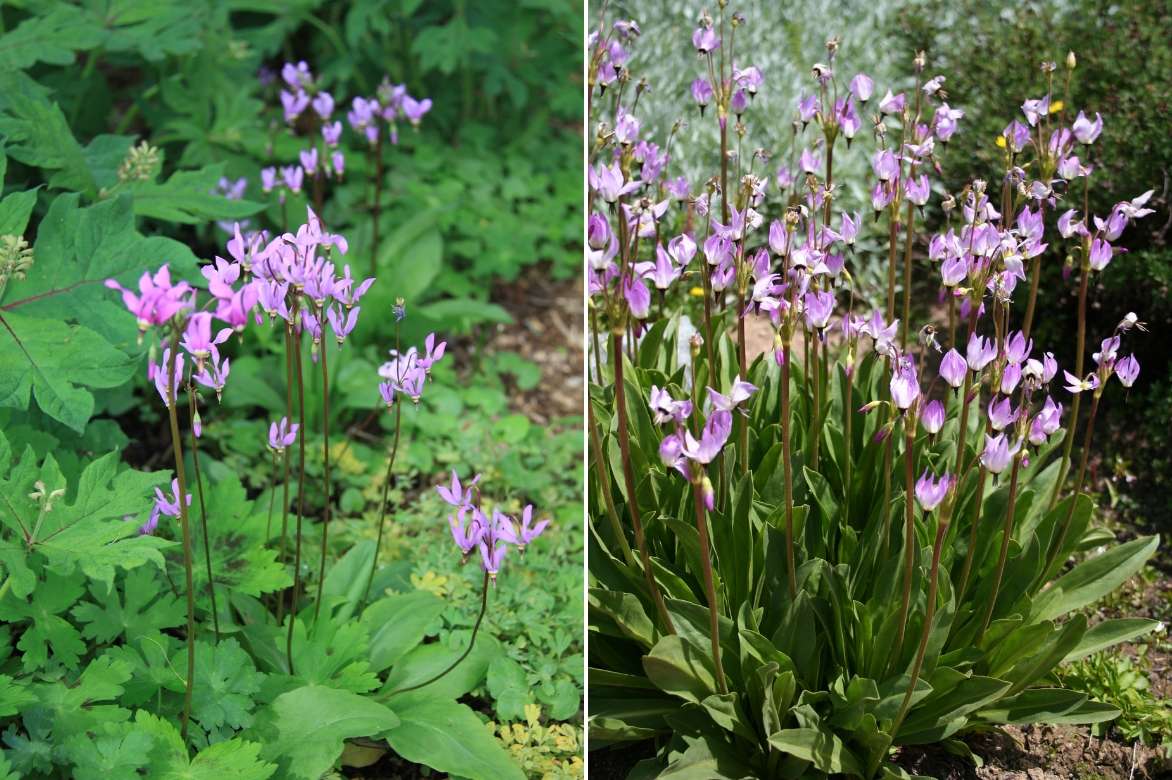
Dodecatheon redolens
Read also
Planting perennials and shrubsCare and maintenance
Once well established, Shooting star requires almost no maintenance and proves to be a trouble-free perennial, able to live for many years without any care, provided the soil remains consistently moist, especially during flowering.
It does not tolerate overly dry soils: if necessary water regularly once or twice a week during the growing period so that the soil stays fresh.
After flowering, the leaves collapse onto the ground, then the deciduous foliage disappears in summer, leaving the plant dormant underground and therefore hard to spot — which is convenient since it requires no watering during that time! That said, we recommend marking its location to avoid damaging it when weeding and to make it easier to control slugs and snails as soon as growth resumes.
Remove any spent flower stems, which look rather unsightly after flowering, and cover the stump with a carpet of dry leaves.
Unaffected by diseases, it has only a few enemies: slugs and snails, which devour young leaves in spring. Follow our advice to keep them away naturally!
Multiplication
If sowing is possible, we recommend instead dividing rosettes in spring on stumps at least three years old, to rejuvenate plant and preserve beautiful flowering.
Divide clumps of Shooting Star
- Using a spade, gently lift the clump to remove an offset bearing a leaf rosette
- Replant immediately in garden in deep, well-worked soil
Pairing shooting star in the garden
The Dodecatheon is the shade-loving perennial essential for bringing colour and freshness to the heart of spring, in a wooded garden, used as a groundcover in cool understorey, beneath deciduous trees or shrubs, or as accents in a moist shaded rockery.
Slender, with pink, more rarely white, flowers, it blooms in all the natural and naturalistic gardenslle, creating fresh scenes in subtle or lively combinations. In a pink or romantic garden pair with hardy fuchsias, Dicentra spectabilis or bleeding heart.
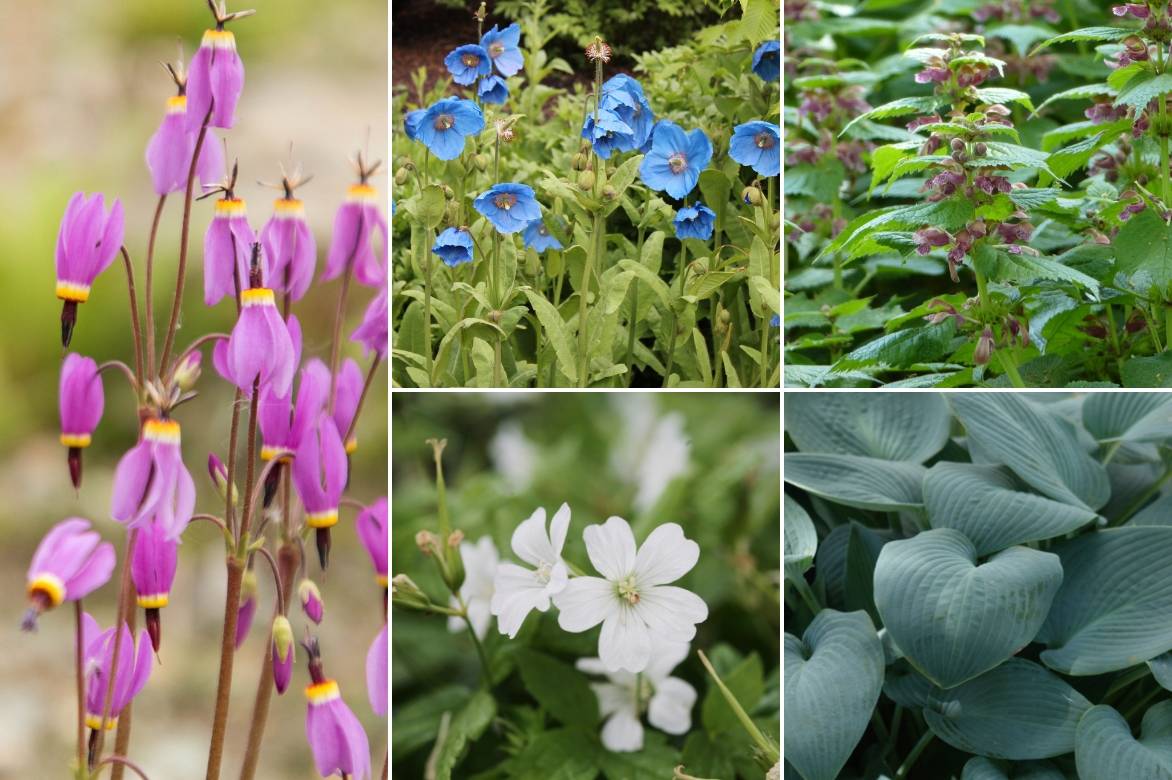
A planting idea for a shaded spot: Dodecatheon meadia, Meconopsis betonicifolia, Lamium orvala, Geranium nodosum ‘Silverwood’, Hosta tardiana ‘Halcyon’ and you can complete with a few clumps of Polypodium vulgare
Makes a wonderful companion to cyclamens, white daffodils, snowdrops, erythronium and other spring bulbs such as early tulips, scillas and muscari, which are also good companions.
Small shade-loving perennials such as primroses or violas create delicate displays with it.
In a shaded rockery, by a water feature, pair with Epimedium, pulmonarias, small ferns, astilbes, hostas and rodgersias.
To cover a slope, it pairs perfectly with Corydalis, creeping bugles or small groundcovers such as Chrysosplenium oppositifolium, which will fill the gap left by the shooting star during summer dormancy.
And get inspiration from our ideas for planting under your trees !
Useful resources
- How to make the most of shade in the garden? Discover our tips on our blog!
- What to plant under your trees?
- Gyroselle brings a touch of pink to the garden! Essential in a romantic garden!
- Perfect for filling a bare understorey, a shaded bank or dressing the base of a tree, fall for our unique collections of shade-loving perennials!
- Subscribe!
- Contents
This form is protected by reCAPTCHA - the Google Privacy Policy and Terms of Service apply.

































Comments