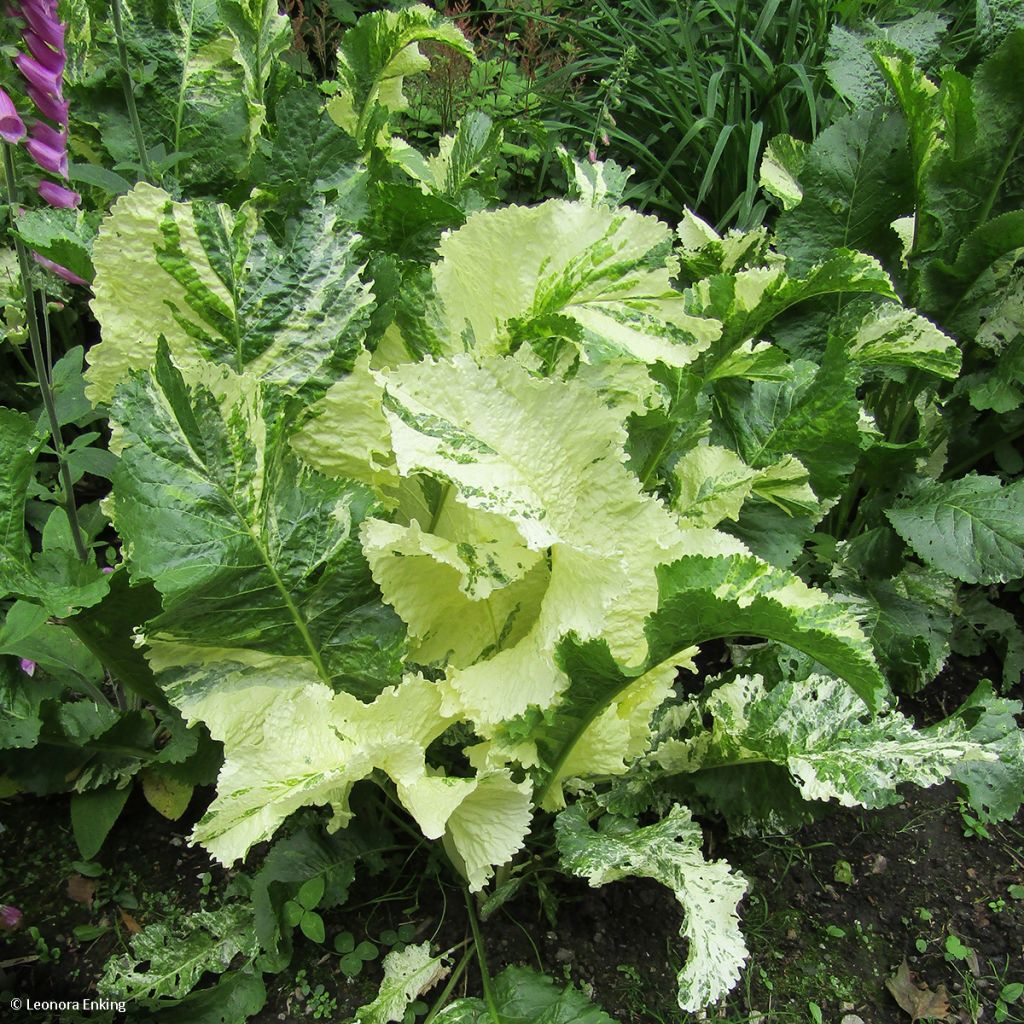
Armoracia rusticana Variegata - Variegated Horseradish
Armoracia rusticana Variegata - Variegated Horseradish
Armoracia rusticana Variegata
Variegated Horseradish
Back-to-school special offer!
Get €10 off for every €50 you spend! And get up to €40 off on a single order.
How does it work?
1. Shop your favourites
Add your favourite plants to your basket. For every €50 you spend (excluding delivery charges, store credit and the plastic-free option), you’ll receive a €10 voucher.
€50 spent = €10 voucher
€100 spent = €20 voucher
€150 spent = €30 voucher
€200 spent = €40 voucher
2. Place your order
Once your basket reaches one of the spending thresholds, place your order. You can even choose your delivery date!
3. Receive your voucher
As soon as your order has been shipped, you’ll receive an email containing your personal voucher code and its value.
4. Use it on your next order
Your voucher is valid for 90 days from the date you receive it. It can be used once only, on a new order worth at least the value of the voucher, excluding delivery charges.
Please note: Vouchers can be combined with other offers, but cannot be split or refunded.
Why not try an alternative variety in stock?
View all →
Available in 0 sizes
Available in 2 sizes
Available in 1 sizes
Available in 1 sizes
Available in 1 sizes

Available in 1 sizes

Available in 1 sizes
Available in 1 sizes

Available in 1 sizes
Available in 1 sizes
This plant carries a 12 months recovery warranty
More information
We guarantee the quality of our plants for a full growing cycle, and will replace at our expense any plant that fails to recover under normal climatic and planting conditions.
Would this plant suit my garden?
Set up your Plantfit profile →
Description
Armoracia rusticana ‘Variegata’ est un raifort panaché rare en culture, une plante potagère particulièrement décorative. Il forme rapidement une grosse touffe de feuilles éclaboussées de crème, lumineuse dès le printemps, et sa racine comestible recèle la saveur piquante du raifort traditionnel. On l’installe au potager d’ornement, dans un massif frais ou dans un grand pot pour mieux canaliser sa vigueur. C’est une plante condimentaire rustique, utile et dotée d'une belle présence au jardin.
De la famille des Brassicacées, à l'instar des radis, cette vivace herbacée est connue sous les noms de raifort, grand raifort ou cranson. Son aire d'origine se situe du sud de l’Ukraine au sud de la Russie d’Europe. La plante est cultivée depuis très longtemps et se rencontre à l'état subspontané près des habitations dans une grande partie de l’Europe. Le raifort vit plusieurs années, entre en repos en hiver puis repart de sa souche charnue au printemps.
'Variegata’ développe un feuillage beaucoup plus décoratif que celui du type : de grandes feuilles basales oblongues, plus ou moins ondulées, épaisses, luisantes, portées par de longs pétioles, aléatoirement maculées de blanc crème. Certaines feuilles ne portent que quelques taches, d’autres sont largement éclaboussées, presque blanches par endroits. La touffe est dressée, ample, et atteint 60 à 90 cm de hauteur pour 45 à 90 cm d’envergure, davantage avec l’âge en terrain profond. En pot, elle sera un peu moins vigoureuse. Sa croissance est rapide en terre riche et fraîche. Sous terre, la plante forme une grosse racine pivotante blanche, charnue, très aromatique, accompagnée de racines latérales capables de produire de nouvelles pousses. En pleine terre, si elle n'est pas récoltée régulièrement, elle finit par coloniser l’espace. La floraison, discrète mais charmante, paraît de mai à juillet selon le climat : de petites fleurs blanches à quatre pétales, groupées en grappes ou panicules lâches au sommet de hautes tiges robustes. Les graines sont viables, mais la multiplication se fait surtout par éclats de racines.
On récolte des racines en automne ou au début du printemps. Les jeunes feuilles peuvent aussi se consommer, crues ou cuites. La racine se consomme râpée, avec un peu de vinaigre, pour accompagner poissons fumés, viandes froides ou sauces. Elle renferme des composés soufrés caractéristiques des Brassicacées et apporte notamment de la vitamine C, même si on la consomme généralement en petite quantité.
Le raifort a été désigné Herb of the Year en 2011 par l’International Herb Association.
Au jardin, ce raifort panaché s'installe au potager d’ornement, en lisière de massif ou dans un grand bac profond, ce qui permet de garder ses racines sous contrôle. En pleine terre, plantez-le dans une terre meuble, riche et fraîche ; vous récolterez une partie des racines après les premières gelées ou au sortir de l’hiver. À mi-ombre, vous pouvez l'associer à l’Astrantia major ‘Sunningdale Variegated’ et au Brunnera macrophylla ‘Jack Frost’. L'oseille sanguine, Rumex sanguineus, constitue une excellente compagne : vigoureuse, elle offre un feuillage décoratif veiné de rouge que l'on apprécie en cuisine pour sa saveur acidulée et sa richesse nutritionnelle.

Flowering
Foliage
Plant habit
Botanical data
Armoracia
rusticana
Variegata
Brassicaceae
Variegated Horseradish
Armoracia lapathifolia, Armoracia sativa, Cochlearia armoracia, Rorippa armoracia
Cultivar or hybrid, Eastern Europe, Russia
Planting and care
Prefers well-drained soils, including limestone, but tolerates clay soil if not waterlogged in winter.
Planting period
Intended location
Care
Planting & care advice
-
-
-
-
-
-
-
-
This item has not been reviewed yet - be the first to leave a review about it.
Recently viewed products
Haven't found what you were looking for?
Hardiness is the lowest winter temperature a plant can endure without suffering serious damage or even dying. However, hardiness is affected by location (a sheltered area, such as a patio), protection (winter cover) and soil type (hardiness is improved by well-drained soil).

The flowering period indicated on our website applies to countries and regions located in USDA zone 8 (France, the United Kingdom, Ireland, the Netherlands, etc.)
It will vary according to where you live:- In zones 9 to 10 (Italy, Spain, Greece, etc.), flowering will occur about 2 to 4 weeks earlier.
- In zones 6 to 7 (Germany, Poland, Slovenia, and lower mountainous regions), flowering will be delayed by 2 to 3 weeks.
- In zone 5 (Central Europe, Scandinavia), blooming will be delayed by 3 to 5 weeks.
In temperate climates, pruning of spring-flowering shrubs (forsythia, spireas, etc.) should be done just after flowering.
Pruning of summer-flowering shrubs (Indian Lilac, Perovskia, etc.) can be done in winter or spring.
In cold regions as well as with frost-sensitive plants, avoid pruning too early when severe frosts may still occur.
The planting period indicated on our website applies to countries and regions located in USDA zone 8 (France, United Kingdom, Ireland, Netherlands).
It will vary according to where you live:
- In Mediterranean zones (Marseille, Madrid, Milan, etc.), autumn and winter are the best planting periods.
- In continental zones (Strasbourg, Munich, Vienna, etc.), delay planting by 2 to 3 weeks in spring and bring it forward by 2 to 4 weeks in autumn.
- In mountainous regions (the Alps, Pyrenees, Carpathians, etc.), it is best to plant in late spring (May-June) or late summer (August-September).
The harvesting period indicated on our website applies to countries and regions in USDA zone 8 (France, England, Ireland, the Netherlands).
In colder areas (Scandinavia, Poland, Austria...) fruit and vegetable harvests are likely to be delayed by 3-4 weeks.
In warmer areas (Italy, Spain, Greece, etc.), harvesting will probably take place earlier, depending on weather conditions.
The sowing periods indicated on our website apply to countries and regions within USDA Zone 8 (France, UK, Ireland, Netherlands).
In colder areas (Scandinavia, Poland, Austria...), delay any outdoor sowing by 3-4 weeks, or sow under glass.
In warmer climes (Italy, Spain, Greece, etc.), bring outdoor sowing forward by a few weeks.
Shipping country and language
Your country of residence may be:
Your country of residence is:
For a better user experience on our website, you can select:
Your shipping country:
-
 Austria
-
 Belgium
-
 Bosnia & Herzegovina
-
 Bulgaria
-
 Croatia
-
 Cyprus
-
 Czechia
-
 Denmark
-
 Estonia
-
 Finland
-
 France
-
 Germany
-
 Greece
-
 Hungary
-
 Iceland
-
 Ireland
-
 Italy
Italy
-
 Latvia
-
 Liechtenstein
-
 Lithuania
-
 Luxembourg
-
 Malta
Malta
-
 Netherlands
-
 Poland
-
 Portugal
-
 Romania
-
 Serbia
-
 Slovakia
-
 Slovenia
-
 Spain
Spain
-
 Sweden
-
 Switzerland
Language:
-
French
-
 English
-
Spanish
-
Italian
-
German
-
Portuguese
-
Dutch
-
Finnish
My Account
Hello
My wish lists
My cart
Log in / Register
Existing customer?
This form is protected by reCAPTCHA - the Google Privacy Policy and Terms of Service apply.
New customer?
Create an account to track your orders, access our customer service and, if you wish, make the most of our upcoming offers.